(Above: Roy Orbison performs “(Oh) Pretty Woman” on “Austin City Limits.”)
By Joel Francis The Daily Record
The musical landscape of television was of a different world when “Austin City Limits” debuted on Public Television 35 years ago. Brief performances on late night talk shows or segments on “Don Kirshner’s Rock Concert” were the only options for fans hoping to catch a glimpse of their favorite act.
Baloons and the capital building, trademarks of the Flaming Lips and Austin City Limits.
The Rock and Roll Hall of Fame celebrates the show that put long-form performances on the air with the new exhibit “Great Music. No Limits. Celebrating 35 Years of Austin City Limits.”
“There were certainly music shows on television before, like Ed Sullivan, ‘Shindig’ or ‘Hullabaloo,’” said Jim Henke, vice president of exhibitions and curatorial affairs for the Rock Hall. “But ‘Austin City Limits’ was the first show where the performers didn’t lip synch and were provided with a platform that extended beyond just a song or two.”
The exhibit includes photographs, setlists, documents and video footage of the show’s greatest moments.
“A big part of the exhibit are the photos from the show. We have 30 or more pictures of artists ranging from B.B. King, Dolly Parton and Elvis Costello to Pearl Jam, R.E.M. and the Dave Matthews Band,” Henke said. “We also have a lot of different documents, including lots of early stuff like the proposal for underwriting the pilot episode and several handwritten memos.”
The memos show the evolution of the show’s title from “River City Country” to “Austin Space” before finally settling on the current title.
The Hag on ACL.
“We also have three setlists from Wilco’s performance where you can see which songs were added and changed before they went on,” Henke said.
“MTV Unplugged,” “Sessions at West 54th Street” and “Soundstage” are but a few of the shows Austin City Limits has inspired during its run. In 2002, the show spun off into the three-day Austin City Limits Music Festival.
“The show started out with Willie Nelson on the first episode then expanded,” Henke said. “If you look at who’s appeared since then it’s been a nice mix of artists.”
Henke pointed out recent episodes with Ben Harper sitting in with Pearl Jam and Mos Def with K’Naan as examples of the show’s continued innovation.
“The producers don’t just book established artists. They’re looking at younger artists as well,” Henke said. “Our video reel has everyone from Ralph Stanley and Bill Monroe to Damian Marley. It’s not just focused on one era or genre. I think this is not only what made the show so innovative, but has given it such longevity.”
(Above: Drivin’ N’ Cryin’ are one of many artists to get some love in a recent Oxford American music writing anthology.)
By Joel Francis
The Daily Record
The Oxford American “Southern Music Issue” is an annual treat, loaded with great writing that unearths wonderful stories on longtime favorites and introduces several new discoveries. Coupled with a CD – in recent years it’s come with two discs – the magazine effectively serves as the ultimate set of liner notes to a killer compilation.
Now in its 11th year, these editions are been rightfully prized; back issues frequently fetch more triple face value online. Fortunately, there is a more affordable way for new readers to access the previously published essays and features.
The Oxford American: Book of Great Music Writing compiles the best articles from the magazine’s first decade. The 420-page book reads like a mixtape, transitioning smoothly from all the usual suspects – blues, country, jazz, rock and bluegrass – and spiking the playlist with pieces on Southern metal, the Sex Pistols and the art of playing.
Several of the best features provide an intimate view of the artist or their environment. Tom Piazza’s account on hanging out backstage at the Grand Ol’ Opry with snubbed bluegrass legend Jimmy Martin is so awkward Ricky Gervais could turn it into a screenplay. Similarly, John Lewis’ weekend at Ike Turner’s house puts the much-savaged abuser in new light, particularly when the host shows up in his pajamas at the end of the day to thank Lewis for coming and hug him goodnight.
A history of jazzman Bob Dorough by Paul Reyes takes us from the obscure keyboard player’s origins touring with Sugar Ray Robinson, recording “Blue Xmas” with a dismissive Mile Davis and ultimately as the force behind Schoolhouse Rocks. The line from “Up a Lazy River” to “Conjunction Junction” was never so clear.
Beth Ann Fennelly’s description of a night at Junior Kimbrough’s juke joint with R.L. Burnside and Cynthia Shearer’s search for understanding in Janis Joplin’s hometown of Port Arthur, Texas both paint a clear picture of the artists’ native perspectives. One can feel the plywood sweat at Junior’s Place and imagine Joplin longing for some niche in town where she felt comfortable and ultimately yearning to get the heck out.
Despite a mention of Wu Tang Clan producer RZA in the introduction, the book eschews hip hop and most new music. A dated piece on R.E.M. circa “Automatic for the People” is the only time when the mainstream and the modern intersect. But while the book doesn’t touch on modern artists, it will certainly send readers scrambling back to dusty old platters, either on vinyl, acetate or plastic, to unearth old favorites, possibly for the first time.
Easier to carry than a stack of magazines, less trouble to hunt down online, the Oxford American: Book of Great Music Writing will be a pleasant voyage for adventurous fans of both good writing and good music.
Big Star’s third album isn’t a happy affair. The record was delayed for four years by their label and issued in various configurations before finally being issued on CD as “Third/Sister Lovers,” nearly 15 years later. More than three decades later, it remains a fascinating mish mash of songs about death, abandonment, sexual paranoia and odd Velvet Underground and Jerry Lee Lewis covers.
Yet – perhaps metaphorically – out of this mess comes “Jesus Christ.” The fourth cut on the album, the song eschews the expected sarcasm and is a straightforward celebration of the Savior’s birth. In two short verses, songwriter and vocalist Alex Chilton paints an image of angles rejoicing that “Jesus Christ was born today.”
“Jesus Christ” is barely over two and a half minutes, but Chilton doesn’t even need that much to get his point across. The track starts with 20 seconds of nonsense before song kicks in, and closes with a saxophone solo from guest Carl Marsh that betrays the band’s Memphis roots. The performance has a deceptively spare arrangement, alternating between raw verses delivered with just Chilton’s guitar and voice and Jody Stephens’ drums. The touches of piano and percussion on the chorus, however, show that the boys have studied Phil Spector’s Wall of Sound. Although he’s barely audible in the mix, producer Jim Dickinson is presumably somewhere in the background, thumping away on bass.
Big Star may not have been big stars – a video for this song couldn’t even be found online – but they were very influential. Power pop acts like Teenage Fanclub, Matthew Sweet and the New Pornographers owe a lot of their sound to Big Star. Paul Westerberg name-checked Big Star’s leader in the Replacements single “Alex Chilton.” Both Teenage Fanclub and Athens, Ga.-based acolytes R.E.M. have recorded memorable versions of “Jesus Christ.”
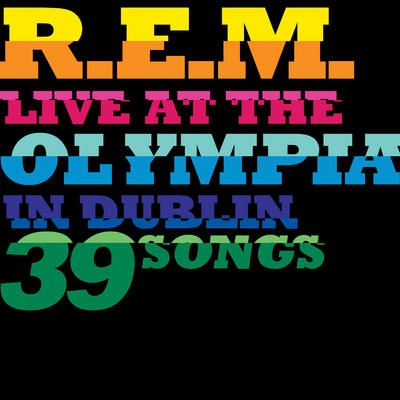
(Above: If you’ve been good, maybe Santa will bring the new R.E.M. album, “Live at the Olympia.”)
By Joel Francis
The holiday season is a notorious dumping ground for greatest hits, repackagings and other musical ephemera. Four established artists, however, transcend the fourth-quarter wasteland. New live albums by Paul McCartney, R.E.M., Tom Waits and Tom Petty are essential additions to any music fan’s library.
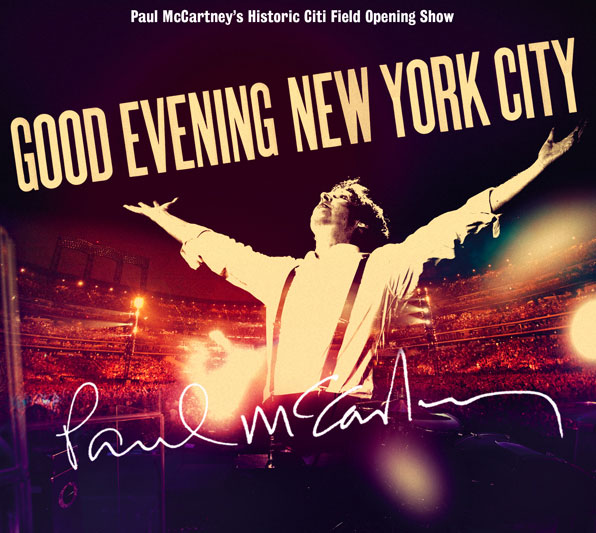
After dropping just one live album in the first half of his solo career, Paul McCartney opened the floodgates over the past two decades. Issuing six live albums since 1990, McCartney has faithfully documented nearly all of his tours and several special performances, but “Good Evening New York City” stands out. The two-CD, one-DVD set documents McCartney’s three-night inaugural performance at the Mets new home Citi Field last summer. Backed by his tight, longstanding quartet, Sir Paul unloads several surprises, like the forgotten “Mrs. Vandebilt,” a tribute to John Lennon with a medley of “A Day in the Life” and “Give Peace a Chance,” and the delightful segue way into Jimi Hendrix’ “Foxy Lady” at the end of “Let Me Roll It.”
Other delights are newer cuts “Only Mama Knows” and “See the Changes,” and the full-band arrangement of “Something” that echoes the performance at the Concert for George. Of course Beatle numbers are plentiful, but the obligatory “Hey Jude” and “Let It Be,” are countered with “Paperback Writer” and “Day Tripper.”
As with all McCartney live albums, the stage banter has been removed, giving the album a bit of a workman-like quality, as the band grinds through the songs with only brief pauses. This editing creates some curious results, such as Billy Joel’s unannounced duet on “I Saw Her Standing There,” or the accidentally buttressing of “Yesterday” and “Helter Skelter” (there was likely an encore break separating the two).
Although there are many places to hear Sir Paul shuffle through the world’s greatest jukebox, few are this energetic or diverse.
When R.E.M. released their last live album, “R.E.M. Live,” only two years ago the band seemed to be running on fumes. Following the disappointing “Beyond the Sun” album with a stop-gap, hits-in-concert set as generic as its title was a naked, holiday cash grab.
A lot has changed since then. Last year’s “Accelerate” brought the trio long-absent acclaim and reinvigorated both the band and its fans. Although “Live at the Olympia” was recorded only four months after “R.E.M. Live” the results couldn’t be more different. While “Live” hit all the obvious marks with little passion, “Olympia” digs deep into the catalog, offering early fan favorites “Driver 8” and obscurities like “Circus Envy.” “Olympia” boasts 17 more songs than “Live” and only two overlapping numbers, so both collections can coexist comfortably.
Fans excited by “Accelerate” will celebrate this 39-track collection. “Live at the Olympia” is the sound of a band being reborn.
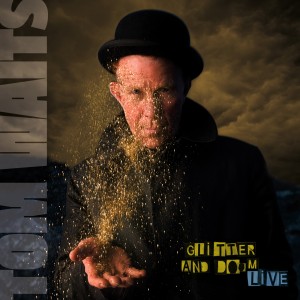
Unlike McCartney and R.E.M., it has been nearly a generation since Tom Waits last issued a live album. “Glitter and Doom Live” does a good job spotlighting Waits’ sonic shifts over the last several years, leaning heavily on tracks from his decade on the Anti- label. Drawn from stops along his 2008 tour of the same name, “Glitter and Doom Live” is more a sampler than a complete performance.
Most of the stage banter has been excised, hilariously, to the second disc. “Tom’s Tales” is a 36-minute montage of Waits’ musings about vultures, jokes about Nazi pasta and adventures on eBay that could stand on its own as one of the year’s best comedy albums.
The songs that made the cut, though, are invigorating. “Orphans” cuts “Lucinda” and “Fanin Street” are more raw while “The Part You Throw Away” is delicate and tender. “Get Behind the Mule” sounds like a voodoo chant at a deep South juke joint, and early cuts like “Singapore” and “I’ll Shoot the Moon” are completely reworked. While hardcore fans may have been happier with a set that recreated Waits’ concert experience, few will be disappointed with the 16 songs delivered.
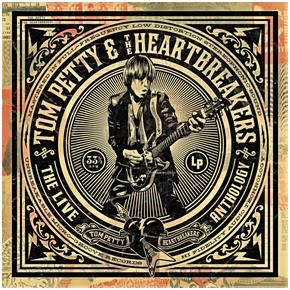
Tom Petty has issued more than a dozen albums during his hit-filled, three-decade career, but until now has only had one live album to his name. “Live Anthology” corrects that problem by offering 50 choice cuts spanning 30 years of gigs. The performances zig zag through the years, but the set flows, creating a dream concert spread across four discs (more if you buy the deluxe edition).
Although all the hits are here, the opening number, “Nightwatchman” shows how deep Petty is willing to delve. More than living up to its name, “Anthology” explores early performances of hits “Even the Losers” right up to full-band arrangements of “Square One” off Petty’s most recent solo album. A sing-along stroll through “A Thing About You” segues seamlessly into Bobby Womack’s soul ballad “I’m In Love.” Later, “Breakdown” slides into a few bars of “Hit the Road, Jack.”
There are no cuts from the Heartbreakers’ mid-‘80s stint as Bob Dylan’s backing band, but honestly, there are enough other incredible moments that they’re not missed. A sublime “Learning to Fly” with Stevie Nicks on backing vocals, an extended “Good to Be King” and unreleased originals like “Melinda” and “Driving Down to Georgia” and covers like “Good Good Loving” and “Goldfinger” (yes, that one) make the set an embarrassment of riches.
This collection not only cements the Heartbreakers’ legend as one of the tightest and most versatile bands of all time, but amplifies their love of rock and roll in all its forms. “Live Anthology” is both more consistent and comprehensive than Petty’s previous box set, the hits/album cuts/rarities collection “Playback.” It is the jewel of Petty’s catalog.


 joelfrancis.com