Review: Carbon/Silicon at the Record Bar

Above: Carbon/Silicon deliver “The News.”

By Joel Francis

Like a lot of bands who play The Record Bar, Carbon/Silicon is trying to promote their first album and make a name. But as the latecomers who were turned away at the door learned, few of those bands have a greater legacy than Mick Jones and Terry James.
The former Clash and Gen-X axemen dashed onstage through a side door, ripped through ten songs from their debut album in about an hour, then hurriedly left, leaving the sold-out throng to revel in what they’d witnessed.

Jones may be a more than a few years removed from his commercial heyday, but he still has plenty of magic left to deliver. He is a bit leaner and more articulate these days, but can still craft a great melody and rip a sizzling solo.

While few in the crowd seemed familiar with the new material, it’s unlikely that anyone left without the catchy chorus of “The News” – “Good morning it’s the news/and all of it is good” – stuck in their head. The chords in “WTF” slashed in a similar progression to “Clash City Rockers” and tore with just as much fury.

James trotted out a left-field cover of “Reason to Believe” for his turn at the mic. A punk cover of a Rod Stewart hit shouldn’t have worked, and nearly didn’t, but the band’s enthusiasm for the tune kept the wheels from falling off.

After cracking several jokes about the empty Conestoga wagon in the southeast corner of the parking lot, Jones prefaced “Really the Blues” with an apology: “When we found out we were playing Kansas City, we knew we had to play the blues. This is our attempt.”

Jones and James have been leading Carbon/Silicon – named for the combination of organic (guitars) and synthetic (computers) used in their songwriting process – for six years now, nearly as long as Jones and Joe Strummer were partners in the Clash. Saturday night’s only nod to their former bands, though, was a tease of “Police On My Back” during the band introductions in the final number.

That was more than enough for the dedicated, though, who christened every guitar solo with a hearty yell and kept the Record Bar illuminated with constant camera flashes and cell phone captures.

The duo were backed by Big Audio Dynamite alum Leo Williams on bass and drummer Domonic Greensmith.

Setlist: The Magic Suitcase/I Loved You/War on Culture/Reason to Believe/Soylent Green/Acton Zulus/The News/Really the Blues/WTF/Why Do Men Fight?
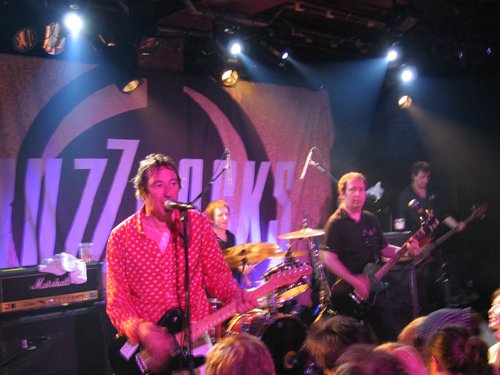
Ever Fallen For The Buzzcocks?


Buzzcocks 2006First-gen Brit punk band is an inspiration to groups that follow.

Kansas City Star

By Joel Francis

It’s hard to keep a band together for 30 years.
It’s even harder to stay relevant for that long. But to achieve both and outlast contemporaries like the Sex Pistols, The Clash and the Damned – the original families of the British punk movement – is a rock ‘n’ roll hat trick.
“It’s strange to think that we’re the last gang in town. Funny how that works,” Steve Diggle, the Buzzcocks’ guitarist and singer. “Our inspiration is still to write good songs, and it’s still possible for us to do that. People – the younger people now, which surprises me a bit – still want to see us and that’s what keeps us going.”
The band’s durability has not gone unnoticed.
“We just got Mojo magazine’s Inspiration Award,” Diggle said. “I’m not big into awards but I think this one sums it up, rather than saying ‘lifetime achievement’ or something.”
Diggle may not be big into awards because, as he later revealed, this was the first one the band has received.
“We’ve never won an award in our life, but this is a good one to have,” Diggle said. “It was hard to accept without freaking out a bit because Elton John was there saying ‘I love the Buzzcocks.’”
John, who was being inducted into Mojo’s Hall of Fame, also said he’s had a ball performing the Buzzcock’s classic “Ever Fallen in Love.”
The Buzzcocks formed in Manchester in 1975. Singer/guitarist Pete Shelley, the other longest-tenured member of the band, met Diggle at a Sex Pistols show and asked him to be the band’s bass player.
“In Britain at that time music was stale all around us. It was all progressive rock bands, but there was no music for our generation,” Diggle said. “We made the most uncommercial music possible, with rough guitars and weird mixes.”
After a series of artistically successfully/commercially dismal singles and albums the band broke up. Foreshadowing the current reunion trend by nearly a generation, the classic Buzzcocks lineup regrouped in 1989.
“It was supposed to be a two-week tour of America, because there was no farewell tour before,” Diggle said, explaining why the band regrouped. “From my point of view, me and Pete were getting on and things were cooking between us.”
Shelley and Diggle permanently returned the Buzzcocks to the music scene in 1990, when bass player and producer Tony Barber and drummer Phil Barker were hired. The quartet has played twice as long as the original incarnation.
“You know on the first day if it’s a good decision” to reunite, Diggle said. “You have to have your head on straight, be realistic and analyze it. Is it as good?
If a band can’t perform as good, if not better, than it did before, there’s no point in getting back together, Diggle said.
Music had changed a lot in the Buzzcocks’ absence. Punk had given way to a new wave on the carts and hardcore in the underground.
“In some ways everyone is a punk rocker now. (Punk) is a long way from what we started,” Diggle said. “These new bands have taken the works of Shakespeare and put on a play. What they’ve done is make it entertainment.”
Far from being bitter, Diggle is happy to headline the Warped Festival and share the bill with so many younger bands.
“I’m not knocking them completely,” Diggle continued, “but they’re a few yards, or maybe 200 miles, away from what we do.”