Springsteen in the waiting room: Drop the needle and pray


“This too shall pass, I’m gonna pray
Right now all I got’s this lonesome day”

By Joel Francis

I didn’t make it to Bruce Springsteen’s concert at the Sprint Center Sunday night. Around the time he was going onstage – about 8:50 – most of my extended family was leaving the hospital. It had been a long day. Grandma started aspirating about noon, and for the third time that week we all descended upon her intensive care room. At 10:30, about the time Bruce was ripping into “Spirit in the Night,” the nurse told us Grandma’s heart was working harder because her oxygen levels were falling. It didn’t look good. The nurse said it was unlikely Grandma would survive the night.

Hard times baby, well they come to tell us all
Sure as the tickin’ of the clock on the wall
Sure as the turnin’ of the night into day
Your smile girl, brings the morni
n’ light to my eyes
Lifts away the blues when I rise
I hope that you’re coming to stay”

Even before he took the stage, Springsteen was my release. My wife and I saw him last March in Omaha, so we didn’t buy tickets when this show was announced. Even so, the possibility of grabbing tickets from a scalper just before showtime was always open. I even bought a pair of earplugs to the hospital with me, just in case. I pulled them out of my pocket every so often and wondered “Where would the band eat dinner?” Knowing this was the final concert of the tour I imagined how long they’d play. “Hey,” I’d say to no one in particular, “what song are they going to open with?” or, later, “What song do you think they are playing right now?”

“A dream of life comes to me
Like a catfish dancin’ on the end of the line”

Helen Kelley was born in Minneapolis in 1920. The sixth of seven children, she met my grandpa at church. After Grandpa returned from World War II they moved to Manhattan, Kan. where he attended Kansas State on the G.I. Bill. After earning his doctor of veterinary medicine the couple and their young daughter, my mother, relocated to Independence, Mo., where he opened a pet hospital on 23rd Street.

My favorite memories of Grandma take place in the children’s clothing store she opened next door to Grandpa’s pet hospital. Ostensibly hired to help with inventory, she grew to appreciate the Beatles, B.B. King and Ray Charles CDs I brought along. We would talk for hours, solving all the world’s problems before taking the obligatory break for “Oprah.”

“I got a picture of you in my locket
I keep it close to my heart
A light shining in my breast
Leading me through the dark
Seven days, seven candles
In my window light your way
Your favorite record’s on the turntable
I drop the needle and pray”

On the trips back and forth from the hospital in the week leading up to Grandma’s death Springsteen was my passenger. The titles alone were testimonies: “Reason to Believe,” “Counting on a Miracle,” “Land of Hope and Dreams,” “Waitin’ on a Sunny Day,” “The Promised Land,” “Lift Me Up,” “Lonesome Day.”

We finally left the hospital Sunday night after Grandma’s condition had plateaued and we had collected promises of a phone call if anything changed. As we sailed up U.S. 71 I rolled down the windows and gave the speakers a workout. “Rosalita,” “Backstreets” and “Thunder Road” from the 1975 Hammersmith Odeon concert. When we arrived at the house around midnight, the E Street Band was finally leaving the Sprint Center stage after a three-hour marathon set.

“May your strength give us strength
May your faith give us faith
May your hope give us hope
May your love give us love”

Grandma died shortly after 8 p.m. Monday. Her family huddled around the hospital bed and sang the old hymns she loved so much. I doubt she heard them, but if she did, one of the last sounds Grandma would have heard was “Jacob’s Ladder.” This 19th century hymn has its origins in the slave churches, but was popularized by Paul Robeson in the 1920s and Pete Seeger in the 1950s. Springsteen recorded it on his “Seeger Sessions” album. Another of Grandma’s favorite hymns came from those same sessions.

I got into Springsteen too late to share him with Grandma, but I think she would have enjoyed him. If not, she would see how happy his songs made me and gamely smile along. As I made my final trip home from the hospital, I knew Grandma was enjoying the Boss’ performance of “How Can I Keep From Singing.”

“My life flows on in endless song
Above earth’s lamentation…
No storm can shake my inmost calm
While to that rock I’m clinging.
Since love is lord of Heaven and earth
How can I keep from singing?”

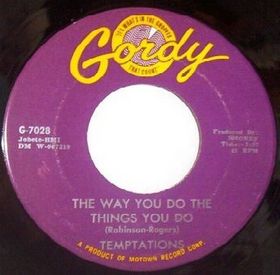
The Temptations – “The Way You Do The Things You Do”

The Temptations – “The Way You Do The Things You Do,” Pop #11
Several Motown songwriters had tried to write a hit for The Temptations before Smokey Robinson teamed with fellow Miracle Bobby Rogers to pen this gem.
Sung by high tenor Eddie Kendricks, the lyrics are equal parts pick-up lines and nursery rhyme. Few could rhyme “candle” with “handle” and “money” with “honey” without sounding trite and cliched, but somehow Robinson and Kendricks pulled it off.
Whatever worked in the song then, still holds up today. UB40 released a reggae-tinged cover 35 years after the Temptations and bettered the original by five spots (No. 6) on the charts. Radio Disney performer Jordan Pruitt — who wasn’t even born when UB40’s version was released — is scheduled to include a version on her second album later this year. — By Joel Francis

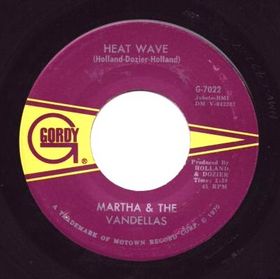
Martha and the Vandellas – “(Love is Like A) Heat Wave”

Martha and the Vandellas – “(Love is Like A) Heat Wave,” Pop #4, R&B #1

When the mercury starts pushing past the century mark my first inclinations are to shave my head and hibernate near the air conditioning. If actual heat waves were more like this song, I’d be dancing in the streets.

Holland-Dozier-Holland wrote it and Martha Reeves sang the heck out of it, but the real credit should go to the Funk Brothers, Motown’s stable of uber-talented, under-recognized musicians. The drums open the song with the buoyancy of an oceanic wave, while a swiftly strummed guitar tells your feet when to move. Add a spritely horn section and peppy piano and you’ve got a hit before Reeves nails the first note.
With so many upbeat elements it’s easy to miss the pain in the lyrics. “Whenever he calls my name/Sounds so soft sweet and plain/Right then, right there/I feel this burning pain/This high blood pressure’s got a hold on me/I said this ain’t the way love’s supposed to be/It’s like a heatwave burning in my heart/I can’t keep from crying/Tearing me apart.” Divorced from the melody and arrangement and the words have the same longing and pain as Bruce Springsteen’s “I’m On Fire.” But together bad love and frustration never felt so good.
Berry Gordy tried to replicate his success by lending the number to the Supremes in 1967. A year earlier The Who covered it a for their second album, but neither version measured up. How could it? Stick “Heat Wave” in your summer cookout playlist alongside Sly and the Family Stone’s “Hot Fun in the Summertime” and any number of Beach Boys tunes and you’ve got a recipe for success. — By Joel Francis

Stax vs. Motown (part one)

With the recent passings of Jerry Wexler and Isaac Hayes and The Daily Record’s ongoing walk through the Hitsville U.S.A. box set, I thought this would be a good time to examine the histories of the twin titans of soul music, Stax and Motown. Joining me in this conversation is Brad, friend of the blog and the man who puts the “B” in “R&B.” This is part one of three in the series.

Joel Francis: To me, Motown and Stax are two sides of the same coin. Like most people born after the baby boom, I first heard Motown and Stax records on the oldies station. I didn’t know much about the artists, but I could tell that certain songs sounded similar and stood apart. It wasn’t until college that I could differentiate the Temptations from the Four Tops. Around the same time, I learned that the Booker T and the MGs were the backing band for most of the Stax singles I loved. Brad, as a fellow soul music fan, tell me about how you were introduced to Stax and Motown and why Stax holds ultimate appeal for you.

Brad S.: In my hometown, we had the Top 40 station, the country station, the “background music” station, the “farm report” station and static. So it took a little bit of work to discover soul music beyond the omnipresent James Brown “I Got You (I Feel Good).” But being a child of the 80’s, a few factors put soul on my radar:

(1) Some soul classics came along with the oldies music that came out of a Hollywood retro trend – “Dirty Dancing,” “The Big Chill,” “Peggy Sue Got Married,” “Back to the Future,” etc.

(2) The baffling cultural mini-phenomenon of the California Raisins advertising campaign.

(3) Being a Hall & Oates fan, who followed their popular “Big Bam Boom” album with “Live at the Apollo with David Ruffin and Eddie Kendrick.”

(4) Discovering the Blues Brothers movie.

This last factor was the most significant. That musical stew of blues,R&B and soul – featuring Stax alums Steve Cropper and Donald “Duck” Dunn – really drew me in. The music was a blend of classic and re-recorded numbers that enabled it to sit alongside of contemporary rock without feeling diminished in comparison. It also had a gritty edginess that I felt the Motown stuff lacked. I perceived Stax to be the “rock” to Motown’s “pop.” Motown’s impeccable production sometimes felt “overproduced” to my sensibilities – like all the edges had been sanded down. It felt like it was trying to appeal to the “white” audience, and in that it was successful. But my personal preferences lie elsewhere.

I tend to oversimplify in the following way: Motown is sweet and smooth; Marvin Gaye is Motown’s archetypical vocalist. Stax is raw and gritty; Otis Redding is its archetypical vocalist. Beyond its oversimplification, I’m curious if you – being better-read on the matter – think my musical shorthand is accurate or not.

JF: Oh man, “The Blues Brothers.” What a cultural discovery that was. I think I first saw that movie my freshman year of high school. Like you, I knew several of the songs from oldies radio, but seeing them performed added a completely new dimension to the song.

Being a few years younger than you, I really got into the California Raisins. I saved up my allowance to buy their cassette, which featured “You Can’t Hurry Love” and a couple other Motown songs. I didn’t learn until recently that Buddy Miles, the great drummer in Jimi Hendrix’ Band of Gypsys, was the voice of the Raisins.

The prevalence of Motown on the oldies station – my mom’s favorite station – and the grit of the Blues Brothers drove me away from Motown for a while. The sweet strings just couldn’t match the punchy horns. That lasted until I went off-dial and discovered the Motown songs untouched by our microscopic oldies radio playlist. Songs from the late ’60s and early ’70s by Stevie Wonder, Marvin Gaye and the Temptations. That drove me right back in.

Continue on to part two.

Isaac Hayes: Forever a Soul Man

By Joel Francis

When Isaac Hayes played at the Voodoo Lounge last October, I jumped at the opportunity. Well, that’s not exactly true. My wife, who had been seduced by my Ultimate Isaac Hayes collection, was elated at the prospect and convinced me to buy tickets. I figured this might be our last chance to see him perform in Kansas City, but I didn’t think he’d be dead less than a year later. While the show was solid, Hayes looked shaky. Regardless of his health, or the reason for his frailty, it was still a treat to hear “Walk On By,” “Theme From Shaft” and “I Stand Accused” performed by many of the same men who recorded them over a generation ago.

More than even Booker T and MGs, Hayes was the backbone of Stax Records. In the ‘60s, Hayes and David Porter were the label’s go-to songwriter team, turning out hits like “Soul Man,” “Hold On, I’m Comin'” and “B-A-B-Y” for artists like Sam and Dave, Carla Thomas and Johnnie Taylor. After the near-simultaneous loss of Otis Redding in a plane crash and the label’s back catalog in a bad distribution contract with Atlantic Records, Hayes became the label’s biggest star.

Stax may have expected more sharp, pop hits when Hayes finally started producing his own albums, but he went the opposite way, transforming unlikely covers into epic slabs of funk and soul. With a deep voice, second only to Barry White as the definitive baby-making crooner, Hayes took left-field selections like Bread’s “Baby I’m-A Want You” to a black audience.

The songs may have not been Hayes originals, but the arrangements were. Burt Bacharach’s “Walk on By” ran past 12 minutes with a stirring string arrangement in its first half and stinging guitar and organ interplay in the second half. Running times of more than 10 minutes had become a Hayes trademark. The seminal “Hot Buttered Soul” album had just four tracks and clocked in at 45:05.

Even though edited versions were released for radio play, these sweeping performances could not be contained on a 45 and, for the first time, urban audiences started buying albums over singles. And not only were they buying albums, but many of Hayes’ releases were double-LP sets.

In the early 1970s, Hayes was the Soul Man. Adorned in gold chains, he was Black Moses. Standing alongside labelmates the Staple Singers, he headlined the 1972 Wattstax Concert, performing in front of a crowd of 100,000 fans. A few months after Wattstax, Hayes received the best song Oscar for “Theme From Shaft.” He was at the pinnacle of his artistry.

His success continued, but by 1975 he was a shadow of his artistic and commercial success. Although Hayes continued making albums at his regular pace, disco and bankruptcy hurt his music career. By the ‘80s, Hayes put music on the back burner so he could focus on acting. He popped up on “The Rockford Files,” “The A-Team” and “Miami Vice” and had supporting roles in Mel Brooks’ “Robin Hood: Men In Tights” and “Escape from New York.”

In 1988 he helped the pre-“In Living Color” Wayans brothers lampoon the blaxploitation genre he helped define, as Hammer in “I’m Gonna Git You Sucka.” Hammer meets an untimely and hilarious demise when, after gearing up with an obscene amount of guns, ammo and grenades, he trips and falls on a stray bullet and is consumed by his own arsenal.

Today, Hayes is best known from “Shaft” and his role as Chef on “South Park,” but thanks to sampling, his radio presence hasn’t diminished. Jay-Z’s debut album, “Reasonable Doubt,” could still have been a classic without “Can I Live.” However, it is telling that this song, supported by a sample of Hayes’ arrangement of “The Look of Love,” is the only number from this album that Jay-Z regularly performs.

A proud legacy? You’re damn right.

Review: Jill Scott at Starlight

By Joel Francis
The Kansas City Star

As her 11-piece band vamped, Jill Scott casually walked onstage Thursday night at Starlight, a notebook tucked under her arm, like she was a guest on a talk show. The crowd greeted her like she was Oprah.

It was an appropriate introduction for a show that was equal parts Apollo Theater and confessional conversation. The two-hour setlist leaned heavily on Scott’s most recent album, “The Real Thing,” which documents the end of Scott’s 12-year relationship with ex-husband Lyzel Williams.

For someone delivering the 21st century edition of “Here My Dear,” Scott was surprisingly exuberant. The album’s title song is built on an arena rock guitar riff and ‘80s drum sound, and was so important to Scott that she repeated the second verse a capella after the song was over and brought the full band back in for a reprise.

For songs from her first album, most of which were written about her love for Williams, Scott relied on the audience to carry her.  She introduced “A Long Walk” as a tribute to Roy Ayers before a sing-along erupted so forcefully that Scott relinquished the mic and let the crowd take over. It was a pattern repeated on much of her earlier material.

Scott is less a soul diva than a poet with pipes. Her spoken-word background shone when she would break a song down to discuss its themes. Scott is so comfortable talking with the audience that the moments chatting about relationships, sandals and women in music videos felt like friends dropping by for a living room chat.

She paused during “All I” to lament radio’s definition of old school – anything recorded between 1998 and 2004 – and showcase her backup singers with a medley of true old school classics: the Isley Brothers’ “Between the Sheets,” Teena Marie’s “Portuguese Love” and Prince’s “Do Me Baby.” Scott later started the encore set with “Gimme,” her version of old school, complete with a Kool and the Gang bassline and “sock it to ya” backing vocals.

Starlight was far from full – screens were placed across the back section of seats – and while the heavily female crowd was attentive, there were plenty of side conversations happening. Scott may have been Queen Bee for the night, but she still had to share time with other friends.

Scott’s singing is more Ella than Aretha. “He Loves Me (Lyzel in E Flat)” – a surprising selection given the subject matter – opened with a piano solo and a near-operatic delivery. The show should have ended there. Scott introduced her band, left the stage and the house lights came on. But as people were filing toward the exits, she returned to deliver “And I Heard,” a new number she had to get off her chest. Less a song than a poem set to melody, Scott had the audience singing like a gospel choir as her band quietly shuffled offstage again. It was an ending that affirmed the endurance of love, despite the pain it might bring.

Opening act Bilal took the stage at 7:30 sharp for a solid half-hour set that saw a lot of people still finding their seats. The high point was the keyboard/conga interplay topped with Bilal’s scat vocals that blurred the lines between jazz and soul and led into “Sometimes.” Bilal dedicated his song “Soul Sister” to the late record producer J. Dilla. 

Setlist:

The Rightness, Let It Be, The Real Thing, A Long Walk, Epiphany, Insomnia, Only You, Whenever You’re Around, Slowly Surely, Is It The Way, Do You Remember Me, How It Make You Feel, All I/Old School Medley, Come See Me, Imagination, Crown Royal (Encore:) Gimme, It’s Love, Golden, Hate On Me, He Loves Me (Encore 2:) And I Heard (new song)

Review: Cracker get on this (again) at Crossroads


Above: “The Man In Me,” honors the little Lebowski in all of us.

By Joel Francis
The Kansas City Star

Crossroads KC at Grinders plan last summer to harvest e-mail addresses in exchange for a free ticket to see Cracker went so well they decided to do it again. The pitch may have been déjà vu, but the shows were as different as night and day.

Cracker played a strong, satisfying set last summer, but the boys were on fire for the repeat performance Friday night. Opening number “One Fine Day” sounded like a lost Tom Petty track and stretched past the seven-minute mark as guitarist Johnny Hickman peeled off solo after solo. The performance was too good to end, so band leader David Lowery let go until it reached its natural conclusion.

That set the tone for the rest of the night: There was no letting up. The hilarious country send-up “Mr. Wrong” led into the epic travelogue “Euro-trash Girl,” which was framed with some Willie Nelson-style jazz guitar; the straight country of “Lonesome Johnny Blues” solidified the band’s Grand Ole Opry cred.

As the final notes of the wonderfully self-depreciative “Happy Birthday To Me” were still lingering, Lowery introduced the next number as “approximately the same song” and launched into “Take the Skinheads Bowling.” Although the song – Lowry’s most popular number from his pre-Cracker days in Camper Van Beethoven – was also in last summer’s set list, it was still a pleasant surprise.

If Lowery is the band’s heart then Hickman is its not-so-secret weapon. His guitar solos, high harmony backing vocals and turns as band leader stole the show. Case in point: Hickman’s surprising and outstanding cover of Bob Dylan’s “The Man In Me.”

Although the energy flagged a bit with the slow tempo of “Loser” and a reading of “Everybody Gets One For Free” that went on a bit too long, the night ended strong with crowd pleaser “Low.” Hickman again stepped behind the mic for the encore, “Another Song About the Rain.” The song from Cracker’s debut was the perfect capper to the evening: a slow builder that smoldered, then burned and showcased a smoking band.

First Friday and shows at the Sprint Center and River Market made for a competitive evening, which may explain why Crossroads KC was only about a quarter full. The 90-minute set may have been lighter on the hits than last summer’s show, but the faithful had had no room for complaint. Here’s looking to next August.

Setlist:

One Fine Day, Gimme One More Chance, The Riverside, Mr. Wrong, Euro-trash Girl, Lonesome Johnny Blues (Johnny Hickman – lead vocals), Teen Angst (What the World Needs Now), 100 Flower Power Maximum, How Can I Live Without You, The Man In Me (Bob Dylan cover, Johnny Hickman – lead vocals), Happy Birthday To Me, Take the Skinheads Bowling (Camper Van Beethoven cover), Loser, Everybody Gets One For Free, Low, Encore: Another Song About the Rain (Johnny Hickman – lead vocals)

Stevie Wonder – “Fingertips (Part Two)”

Stevie Wonder – “Fingertips (Part Two),” Pop #1, R&B #1

Little Stevie Wonder’s first single joins Pink Floyd’s “Another Brick in the Wall (Part Two)” as the only “part twos” to hit No. 1 on the U.S. chart. Another notable “part two” is Gary Glitter’s “Rock and Roll (Part Two),” which was a No. 7 U.S. hit.

Not only did Wonder not write this song, he didn’t even need the whole number to sell his charisma and talent. “Fingertips (Part Two)” is less a song than a vamp that Wonder builds up with his harmonica playing and joyous singing. Even if there aren’t any real lyrics, it’s impossible not to smile and sing along.

It took Wonder nearly two years to land on the charts with this song and nearly as long to find a follow-up hit, 1965’s “Uptight (Everything Is Alright).” The complete 6-minute performance of “Fingertips” opens Wonder’s 1963 live album, “Recorded Live, The 12 Year Old Genuis.” — By Joel Francis

Marvin Gaye – “Pride and Joy”

Marvin Gaye – “Pride and Joy,” Pop #10, R&B #2

The bouncy piano that opens and propels this track may be pure Chicago blues and Gaye’s singing more jazz than soul, but the backing vocals are pure Motown.

Supported by Martha and the Vandellas, Gaye reunited with Norman Whitfield and Mickey Stevenson for this jaunty ode to label boss Barry Gordy’s sister, Anna. This songwriting trio may have misfired on “Beechwood 4-5789,” but everything works here. Not only was the song Gaye’s first Top 10 hit, but Anna Gordy went on to marry Gaye. — By Joel Francis

What Bob Dylan Means To Me (part 2)

(Above: the video for “Most of the Time” off the “Oh Mercy” album.)

The second installment in this series comes from McKay Stangler, public relations writer for the University of Kansas Medical Center. For more of McKay’s writing, check out his great blog.

I wish I had a great Dylan story.

I wish I could say that some foggy memory lay buried in the deep recesses of memory, a brief excerpt from the halcyon days of youth in which I first discovered Robert Zimmerman. A day when I heard those first notes of “Sara” or “Oh Sister” and was set on an irreversible path toward musical enlightenment.

I wish the 15-year-old me had pulled a dust-covered copy of Blonde on Blonde from a bookshelf in my parents’ basement and become instantly captivated with its sounds. Or perhaps that some tune hummed by the corner vagabond would have remained lodged in my mind’s musical echo chamber, quickly crowding out the assorted noise of the mid-90s, pushing into oblivion the Collective Souls and Blink 182s of the time.

Alas, the truth is much more boring. Although my parents did have Blonde on Blonde, I was first exposed to Dylan through the local oldies radio station. This fixture of the family autos and our kitchen was where I first heard the (overplayed) classics such as “Like a Rolling Stone” and “Knockin’ on Heaven’s Door.” I liked them but mostly because they became family sing-alongs by the second verse. Hell, I had the same feelings for “Hang on, Sloopy” and “Daydream Believer” – still do, in fact.

My Dylan knowledge expanded exponentially in college, when I lived for two years with an avowed Dylan-ophile. Tom collected bootlegs and basement tapes with a fervent fixation bordering on obsession – and it was great. He exposed me to the Dylan pop culture often forgets, the wandering, brooding, haunted man who produced some of his best work when the industry was busy forgetting his genius. I heard enough to know I wanted to hear more.

In August 2001, I saw Dylan live for the first time, at the Missouri State Fair in Sedalia with my roommate and another college friend. It was a forgettable venue: we sat in the grandstand of the racetrack while much of the man’s sound was lost in the open summer air. Much of our attention was immediately seized, though, by the charming rural couple seated behind us. They were from Smithville, Mo., and were named, somewhat improbably, Jim and Jane Smith. They’d had a few beers already – the only option at the concert was the gargantuan 24 oz. cup – and said they’d buy us a beer if we correctly predicted what Dylan’s opening song would be.

We thought we were golden. After all, we had my roommate Tom, the Dylan savant! He went with “Roving Gambler,” which had been the opening song at a few recent concerts he had attended. Tom was wrong, but thanks to Jim’s video poker windfall we were clutching beers anyway. Despite being underage, Jim was happy to buy us a round. And then another. And then another. And then about five more.

The end of the concert found us a drunken and boisterous crew, with us promising to visit the munificent couple in Smithville. Dylan’s spotlight had been improbably stolen by the generous, corruptive strangers. Our groups diverged in the main concourse when Jim insisted on throwing money at sideshows. The three of us wandered around for a bit but eventually set a course for the parking lot.

Then we saw Jane. She was wandering alone, drunk and confused. When we asked about her mate, she told us he was lost. L-O-S-T gone. Our offers to help find him were mixed with poorly suppressed laughter at the inanity of the situation. We had Jim paged over the Fair loudspeaker, then flagged down a Missouri Highway Patrol golf cart to help look.

And this was how our night ended. The three of us plus a deeply intoxicated Jane Smith, riding around the Fair with Officer Friendly, finally locating Jim behind a row of public toilets. He was passed out cold, but upon rousing was mighty glad to see Jane and, oddly, us. We rode with them back to their campsite. The magnitude of the night’s misadventures was too much for three drunken students to comprehend.

And this, I suppose, is what Dylan means to me: memories of friendship. Hearing his songs makes me think of college, of sitting around with Tom, futilely trying to stump him with Dylan trivia. Of meeting a couple who would change the course of our night and give us a story to tell for the rest of our lives. Of insisting that the friendly officer take his picture with the five of us, right before Jim passed out again, all of us grinning broadly around the golf cart amid the sparkling bonfires of the campsites. Of listening to Oh Mercy on the way home, none of us speaking a word about the evening until we pulled into a late-night eatery. Of the three of us laughing hysterically, even months or years later, as we recounted the tale for friends.
 
Huh. Maybe I do have a great Dylan story.