Iggy Pop – “Preliminaires”

IggyPop-02-big

By Joel Francis

Purists of all stripes can relax: Iggy Pop’s much ballyhooed 15 studio album, “Preliminaires,” is not the jazz album Pop talked up before its release.

That said, the album’s lone foray into the genre is actually one of its best songs. Borrowing enough of Louis Armstrong’s New Orleans hot jazz sound and arrangements to earn Satchmo a partial songwriting credit, “I Want to Go to the Beach” is surprising triumph that should throw a nice curveball into dinner party playlists.

The rest of “Preliminaries,” however, is more French café than bebop bistro. Pop opens and closes the album with two spoken word pieces in French and provides two versions of “She’s the Business” – both with and without French narration – that are straight from the Serge Gainsbourg model.

Other tracks find Pop channeling late-period Leonard Cohen for “I Want to Go to the Beach,” dropping in some acoustic Delta blues for “He’s Dead/She’s Alive” and delivering another spoken word piece about how dogs are the ultimate companion based on the Michel Houellebecq novel “The Possibility of an Island.” On the gentle yet foreboding “Spanish Coast,” Pop croons in a deep baritone on what could be a lost Marianne Faithful song. There’s also a cover of Antonio Carlos Jobim’s “How Insensative.”

Try as he might, Pop can’t repress his rock side for the entire album. “Nice To Be Dead” is a solid rocker that is one of the album’s best tracks and very much what one would expect from Pop. The electronic “Party Time” is to cocktail parties what “Night Clubbing” was to nights on the town.

While “Preliminaires” is a departure, it doesn’t arrive out of the blue. Pop first dabbled in jazz on a 1990 duet with Debbie Harry on Cole Porter’s “Well, Did You Evah!” He also did an entire album of jazz-tinged spoken word pieces. And although that album, “Avenue B,” was a disaster, “Preliminaires” succeeds in large part because Pop delivers each track with authority and authenticity.

While Pop’s genre hopping could be a bizarre recipe for disaster, he turns this into a strength, weaving the diverse threads together for a cohesive listen.  The resulting variance in mood and texture is another element that keeps “Preliminaires” from being as stilted and dreary as “Avenue B.” “Preliminaires” greatest strength, though, might simply be that Pop knows when to quit. Most songs hover between two and three minutes and the 12-track affair is over in a brief 36 minutes.

“Preliminaries” will not bump “Lust for Life” or “The Passenger” off the pedestal atop Pop’s catalog and likely won’t even stand as a major entry in his canon, but curious fans interested in what the Wild One can do when stripped of his raw power should find something to like.

Arguments over 78s still resonate in iPod world

(Above: Guy Lombardo urges listeners to “Get Out Those Old Records” in this ode to the 78.)

By Joel Francis
The Daily Record

Gallons of cyber-ink have been spilled over the wailing and gnashing of teeth that has accompanied the transition from CDs to iPods.

While I love the convenience of my iPod and cannot be more than a few yards from it without suffering from withdrawal, I also miss the anticipation of new-release Tuesdays that the old paradigm brought.

It is comforting to know, however, that ours is not the first generation of music fans to suffer format growing pains. While reading Gary Marmorstein’s “The Label,” an exhaustive history of Columbia Records, I stumbled on a passage about the poet Philip Larkin, who was furious that long-playing records were starting to replace his beloved 78s.

“When the long-playing record was introduced,” Larkin is quoted as saying in the book, “I was suspicious of it: it seemed a package deal, forcing you to buy bad tracks along with good at an unwanted price.”

Larkin’s displeasure with record labels trying to foist bad tracks on consumers by bundling them with good ones was chillingly prescient. The argument he made in the late ’40s was echoed nearly 50 years later when the labels abolished the single and hiked album prices.

Other mid-century music consumers were upset that the new 22-minute side made listening a passive experience. According to their reasoning, since you didn’t have to get up and change sides every five minutes, the music would just fade into the background.

While classical fans rejoiced that an entire movement could be contained on a single side, jazz fans were less enthusiastic. Many fans, Larkin included, felt that the time limit on a 78 was the optimal span for a group to have its say and leave before overstaying its welcome.

As Marmorstein writes: “Larkin associated the halcyon days of his youth with winding the gramophone and listening to 78s by Louis Armstrong. To Larkin, a single shellacked side was a gem, not these vinyl platters that played interminably.”

Unfortunately for Larkin, the LP not only caught on but was the dominant format for 40 years, when the CD took over. Although Columbia unveiled the LP in 1948, strange parallels still resonate today. The more things change ….

Bird lives! (and so will jazz)

(Above: Mos Def is a rapper, but his song “Umi Says” has a very jazzy feel.)

By Joel Francis
The Daily Record

The New York Times jazz and pop critic Ben Ratliff participated in a very enlightening Q and A with readers yesterday. It seems Kansas City jazz fans, like our friend at Plastic Sax, aren’t the only ones obsessed about the state of the genre.

Several people asked Ratliff why jazz didn’t have a bigger audience, what the media’s responsibility is to promote jazz to a larger audience, if there is a stigma against jazz in mainstream culture and, most bluntly, whether jazz was dead.

Similarly, several readers were concerned about the legacy of today’s jazz artists. They asked which contemporary artists have the best potential to join the pantheon of innovators like Miles and Duke, and whether the current crop of players are pioneers or regurgitators. One bold reader actually called out the elephant likely hiding behind many of these questions. “Pretty much all jazz sounds the same today,” he said.

It seems that just as baseball fans can’t wait to compare Albert Pujols to Stan Musial, jazzheads love debating the merits of John Medeski to Jimmy Smith or Joshua Redman to Sonny Rollins. They (we) are forever insecure that our moment in the sun won’t measure up to the established legacy. They are right. Just as no contemporary president will be as lauded as the Founding Fathers, and no slugging outfield can surpass Babe Ruth’s mythology, there is no way that the abilities of Jaco Pastorius or Christian McBride can exceed the monumental achievements of Charlie Mingus and Ray Brown.

But that doesn’t mean they can’t all be enjoyed. Trumpeter Roy Hargrove hasn’t redefined the instrument the way Louis Armstrong did in the Hot Five and Hot Seven, but I think his playing on D’Angelo’s “Voodoo” and Common’s “Like Water For Chocolate” is inventive and unique. There is no comparison between the works, because they can’t be compared. They exist in different worlds. And questions about “is it jazz” are as silly and insignificant as whether or not poker or Nascar are sports. It doesn’t matter.

One of the elements I enjoy most about jazz is watching how it absorbed in reinterpreted in new contexts. One can hear the free jazz influence of John Coltrane and Pharaoh Sanders in both the Stooges and the Soft Machine, but what they did with it was drastically different.

Ironically, “fans” might be the only ones worrying or arguing about these issues. Just as Hargrove had no problem working with Common and D’Angelo, I’m sure Ron Carter didn’t hesitate before recording with A Tribe Called Quest and Black Star. Artists make art, not distinctions.

To these ears, pieces like “Water” from the Roots’ album “Phrenology” or Mos Def’s “Modern Marvel” from “The New Danger” embody the spirit of jazz as much as anything Rudy Van Gelder recorded for Impulse or Blue Note.

Just as folk music survived the birth of the electric guitar (and Bob Dylan plugging in), and Sacred Harp has peacefully coexisted with gospel, jazz will survive. It will not be preserved in amber, but it is too indelible to be erased from American culture.

Although Ratliff’s answers were thoughtful and informative, he failed to pass along one key piece of advice to the Chicken Littles so worried about the future of their art: Pick up a horn and do it yourself.

The Music of James Bond: Part One – The Classic Years

(Above: Johnny Cash’s alternate version of “Thunderball.”)

By Joel Francis

After nearly 50 years of slugging spies and bedding beauties, the premier of a James Bond movie has become an cultural event. The opening credit sequences of these films are events among themselves. Even though some of the biggest names in rock have performed a Bond theme song, the producers have always treated the number as a throwback to the Broadway and pop numbers of the 1950s.

When Bond made his big screen debut in 1962’s “Dr. No,” Ray Charles’ “I Can’t Stop Loving You,” variants of “The Twist” and the Four Seasons topped the Billboard charts. The theme song for “Dr. No” was a bizarre calypso arrangement of “Three Blind Mice.” Thankfully, the nursery rhyme is preceded by Monty Norman’s immortal James Bond theme. Norman’s theme was reinterpreted in every Bond film thereafter. It’s still exciting to hear the surf guitar race into the explosion of horns. The song is over-the-top, suspenseful and dangerous, but the swinging drums winkingly confide in the viewer that everything is in good fun.

Bond was back the following year with “From Russia With Love.” This time, producers hired Broadway songsmith Lionel Bart, best known for his work on “Oliver!,” to write an original theme song. Bart’s lyrics, coupled with soundtrack composer John Barry’s music, are the embodiment of the bachelor pad/Playboy image. Singer Matt Monro made his name performing in the nightclubs, caberets and lounges Bond would have haunted offscreen. Their lounge music is the embodiment of the bachelor pad/Playboy image that reeks of wood paneling, shag carpeting, hi-fi stereos and rotating beds. In other words, it’s straight out of Bond’s world.

Three-time Bond songstress Shirley Bassey made her debut with “Goldfinger.” Although the film hit screens during the year of Beatlemania, there is no hint of rock and roll in the title song written by the musical theater team of Leslie Bricusse and Anthony Newley. Barry’s bombastic horns are matched only by Bassey’s brassy delivery. “Goldfinger” is not only one of the most memorable Bond songs of all time, but it’s also the first memorable Bond song.

Barry and Bricusse didn’t stray far from the template when they approached Tom Jones to sing “Thunderball.” Jones puts his pelvis in the delivery, but the arrangement is essentially “Goldfinger”-redux. While they may have been working with a formula, it’s a strong one – “Thunderball” works nearly as well as “Goldfinger.”

An alternate “Thunderball” song was given to Johnny Cash to perform, but rejeced by the film’s producers. It seems even at the peak of his pills phase, Cash was more man than Bond could handle.

Rock and roll finally appeared in the serpentine guitar lick that opens Nancy Sinatra’s performance of “You Only Live Twice.” Even with the guitar, Sinatra’s sexy vocals rest on a pillow of strings accentuated by a harp. The number was Barry and Bricusse’s third consecutive teaming, and constructed from fragments of 25 separate takes. Bassey must have felt left out, because she covered the song in 2007, following in the footsteps of Coldplay, Bjork and Robbie Williams (who sampled the original for “Millennium”).

 “On Her Majesty’s Secret Service” is a misfit in the Bond cannon, musically and theatrically. The title sequence is a throwback to the orchestral opening of “Dr. No.” Barry’s instrumental theme is notable for its deep Moog synthesizer notes, chugging rock bass and the soaring trombone melody, later taken over on trumpet. Barry, who scored every Bond film to this point, composed a great alternate to Norman’s original Bond theme. During the mid-’90s electronic craze, the Propellerheads created a 10-minute remix of the song.

Barry teamed with Burt Bacharach’s lyricist Hal David to write the film’s love theme, “All The Time in the World.” Saturated by fingerpicked guitar and a saccharine string section, the song couldn’t be further from jazz, despite the vocals of Louis Armstrong. Satchmo is in full-on “What A Wonderful World” mode. Lesser singers would buckle under the weight of the arrangement, but Armstrong is able to emote the lyrics perfectly, even if someone else is playing the trumpet solo.

As the calendar flipped to the 1970s, Bassey was given her second stint on a Bond theme. “Diamonds Are Forever” is the sexiest Bond theme since Sinatra’s. Barry’s arrangement is full of the soft strings and horn punctuations that viewers had come to expect, but he tosses in an unexpected splash of funk at the halfway point. The wah wah guitar and subtle nod to Isaac Hayes’ Oscar-winning “Theme from Shaft” could be what drew Kanye West to the song when he sampled it for his 2005 hit “Diamonds of the Sierra Leone.”

Keep reading:

The Music of James Bond: Part Two – The Seventies

The Music of James Bond: Part Three – The ’80s and Beyond

Jazz Sets Make Great (Late) Stocking Stuffers

By Joel Francis
The Kansas City Star’s Back To Rockville blog

Two excellent jazz collections slipped into the bins quietly during the holiday rush last year.

“If You Got To Ask, You Ain’t Got It,” is three comprehensive discs of pure fun from Fats Waller. The set is comprised of 66 cuts from 1926 to 1943 than find the jolly, indomitable pianist in solo, quintet and big band settings. The included 100-page book contains an excellent biography that puts the songs into context, and a history of Fats’ various recording groups and sidemen.

But the true feast is the music, and what a feast it is. One disc focuses on Fats’ work out of the Tin Pan Alley songbook and includes his joyful interpretations of “Dinah,” “Two Sleepy People” and “‘Tain’t Nobody’s Business.” These songs have been, and continue to be, performed as a rite of passage for jazz musicians, and with good reason. It’s a fair bet, though, that no one has infused such glee and humor into their readings. One or two verses from any of these songs are guaranteed to chase the blues away and bring a smile to the listeners’ face.

The second disc finds Fats in instrumental, and often solo, mode and was the most revelatory to me. Fats’ organ work on “St. Louis Blues” blurs the lines between classical and jazz, and gospel chording obvious on several other songs point to the path Ray Charles would later take. In fact, one could easily look at this set as one of the many birth places of soul music.

Many of Fats’ most recognizable tunes – “Honeysuckle Rose,” “All That Meat and No Potatoes” and “Ain’t Misbehavin’” – can be found on the disc titled “Fats Waller Sings and Plays Fats Waller.” At 22 tracks, the disc just dips its toe in the water of Fats’ songwriting (the accompanying book says he wrote more than 400 songs), but like everything else here it’s all top-shelf.

To the uninitiated – which I’ll confess included me – “If You Got To Ask” is a great entry point to the world of Fats Waller. Longtime fans will no doubt enjoy having a great cross-section of the man’s works in one place.

Most of my familiarity with Fats’ came from Louis Armstrong’s 1955 tribute album “Satch Plays Fats.” Two songs from that album are found on Time Life’s “The Wonderful World of Louis Armstrong” collection. Armstrong has been collected and compiled literally hundreds of times, but what sets this entry apart is its DVD.

With performances spanning four decades, it is a true delight to see Satchmo perform hits like “When the Saints Go Marching In,” “Sleepy Time Down South” and “Mack the Knife.” Those songs are all present alongside 37 other well-known tracks like “What A Wonderful World,” “Blueberry Hill” and “Do You Know What It Means to Miss New Orleans?” on the two CDs that round out the set. There’s nothing from the Hot Five or Hot Seven ensembles here, but it’s just as well: true Satchmo fans will need at least one disc devoted exclusively to this period. The rest of his career, and material from the Verve, Decca, Columbia and RCA labels are all here, though.

If you’ve already got a decent, multi-disc Armstrong collection, it may not be worth your money to pick this one up, but fans looking for that first Armstrong purchase would do well to steer toward this collection if only for the DVD.

Perhaps the most attractive aspect of both these collections, aside from the music, is the price. Both may be found online for about $30, and while it may be too late to request them as stocking stuffers, there’s nothing wrong with treating yourself.

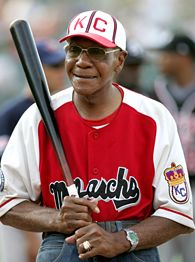
Buck O’Neil: Sweet times, sweet sounds at 18th and Vine

Buck O'Neil

Sweet times, sweet sounds at 18th and Vine
An Interview With Buck O’Neil

By Joel Francis

(Note: This 1998 interview was published in 2001 by The Independence Examiner newspaper.)

Q: I’d like to talk about the jazz scene in Kansas City, be cause you talked a little bit about that in your book, and I think that’s an exciting aspect of our town that people may not hear about as much, especially when they think of you. What was Kansas City like in the 1930s and ’40s?

A: Outstanding. See, Kansas City was a wide-open town and all the restaurants would have live music hotels would have live music, bars live music, and so it became easy to get a gig here. So musicians flocked here and played. Kansas City was a town that closed up at 1 o’clock (a.m.), at least the legitimate places. And so the musicians would flock to this area (18th and Vine) and we had a place called the Subway.

All the musicians would come after they got through working and, oh, they would jam all night, have jam sessions, yeah. You wouldn’t be surprised to see Basie there, or Joe Taylor, Georgia Thomas and musicians from all over the country. You would see them down there at this thing jammin’, just having a good time they were having a good time. Or Charlie Parker would drop in, or a blues singer maybe Big Joe Turner, somebody would drop in. All of these things were happening here, just a couple blocks from here; (it was) very alive.

Q: You were obviously a big part of the baseball scene. Why were baseball and jazz so closely linked together?

A: We played the same circuit, man. We’d go to Chicago to play. We’d be playin’ on the South Side and they would visit our ball games and we would go to the jazz joints. It was the same thing, not only there, also in New York City. We would play ball in the afternoon, say Sunday afternoon in New York City, Sunday night go down to Sugar Ray’s, the Apollo we were catchin’ all the acts there or the Baby Grand. All of this live music, it was just jazz. They were playin’ jazz all over. We did this at all of the places we would play. At matinee shows all of the theaters had bands. In Harlem, like I said, we would go to the matinee and maybe we would catch Cab Calloway, see? And we would go from there to Washington, D.C., and the Howard Theater. Maybe Ma Mabley was there and we would catch her, or Duke Ellington, or Fletcher Henderson. Everyplace that we went to play, the jazz people went, too. This was during the days of segregation, so we probably stayed at the same places, and we got to know them and they knew us.

Q: How would you describe the Kansas City style of jazz?

A: Exciting. Different. It was different that New Orleans. And right out of Kansas City, we come up with Charlie Parker, blowin’ notes nobody’d heard before. This is a brand new thing! These were the kind of things you could hear at that Subway. Here come a new dude, come in blowin’ something you hadn’t heard before a different note. Where did this come from? Where did this sound come from? It was a brand new sound.

And the good thing about it was that the musician was telling a story and it was his story to tell. They were playing the same song, but when it was his turn to come up and blow, it was different. And you could see the other musicians listening and coming in, you know. This drummer’s going to change the beat now. He’s got to change that. You could hear it if you’re listening; you could hear the change. This guy’s playin’ “Ain’t Misbehavin'” a little different than the other guy did. He’s puttin’ a little something of him in there. You could listen to a new story. The guy would blow notes, you knew who it was without seeing him, you know what I mean? You knew it was Armstrong. You didn’t have to be in there. You knew it was Ben Webster. You knew all these things. A little jazz. So many things were happening all over the country.

Q: Like what?

A: The music was live and the whole country (was) changing. A top musician would go to, maybe, Paris and when he came back from Paris, this was his style, but he had picked up something else. Or he might go to Egypt Cairo, or something like that. And here was a guy doing something on the bongos that was just different than they were doing in Harlem. You added a little something to what you were doing. You would take a little of this, a little of that.

And the jazz singers (did this with their) different phrasing styles. Like, nobody phrased like Billie Holiday. She could just open her mouth and hey, that’s Billie. You knew because nobody did it like Billie. You could hear the different phrasing and all of it was so clean, so clear.

This is the only thing I have against a lot of the things they play now. It’s hard to understand, because a lot of the words, the way they’re sayin’ them, I don’t get. But they were so clear. Like the tones they were playin’. The tones were so clear, you could hear it, you knew it; you weren’t confused. I like rap. I like to hear rap if the guy is distinct and I can understand what he’s saying. But if he jumbles it all together where I can’t understand it, it ain’t good. This is why music then, anyone who sang it, (sang) a clear note. You could understand it. You like to know what they’re doing and where they’re going from there. They will lead you around through this thing if you listen. Music is a great medium.

Q: What role did Tom Pendergast and his political machine play in the development of jazz in Kansas City?

A: It provided a place for them to play it was a job. It was in that era they had the speakeasy they had everything goin’ on and you had to provide entertainment with it.

Q: So did Pendergast turn a blind eye to it?

A: No. If there was a blind eye, it may have been the government turning a blind eye to Pendergast. There wasn’t anything illegal about jazz, but the things Pendergast was doing could have been illegal.

Q: Did any of Pendergast’s illegal activities help the jazz scene grow?

A: It just may have, because you know you’ve got to entertain the people you’re selling whiskey to, or the people going to gamble. Right now, we’ve got the boats, and gambling is legal. Whereas it wasn’t legal during that day and you had to entertain people. This was good entertainment.

Q: If speakeasies were illegal, how did people know where to go to hear the music?

A: Pendergast was running the city. When you say illegal, if I am the boss of the city and I am running the city this way, it wouldn’t be illegal. What would have been against the law was this: If you were running a club and instead of closing at 1 o’clock, you stayed open ’till 3 o’clock. If you stayed open at 3, you were doing the same things at 3 you were doing at 10, but the law was you had to close at this time. And the places would close, the musicians would come down here and go into that Subway and play and jam. And somebody down there would be doing something illegal, because somebody would be selling some whiskey. A lot of these things were happening before prohibition.

Q: So did Prohibition help the jazz scene?

A: Yeah, sure. Actually it opened it up all over the country. Wherein you had to go just to certain spots before, now you’re (playing) in Manhattan, you’re playing in Times Square. You’re playing now all over the country, even going to universities to play. Before you were playing in speakeasies, but now you’re playing in clubs.

Q: What were some of the hot jazz clubs in Kansas City at that time?

A: The Milton was strictly jazz. They had so many different clubs in Kansas City and … music was everywhere. During that time, just like a band comes to the Starlight and plays now, every weekend it was some band at the Municipal Audi torium. That doesn’t just mean Count Basie or something like that, but Benny Goodman would play; everybody would come. I’ve seen so many wonderful bands down there.

Q: What are some of your favorite bands you’ve seen play there?

A: I like Duke. To really jump I like Lionel Hampton. I was a very good friend of Count Basie; I like Basie. I like Goodman. The Jazz Philharmonic that was the top musicians put together and they traveled all over the country. Oh man, you talk about some music! You’d hear these great artists play. I like Armstrong. They had a girl band called the Sweethearts of Rhythm; they could play. First of all you were going because it was a girl band and you wanted to see them, but they could play.

There was another one called Tiny Davis. She blew that trumpet Louis Armstrong-style; she could play. Bob Burnside played the sax he could play the bell off of that horn! It was the era of the Mills Brothers. They were one of the first singing groups, the Platters and a whole lot of others came behind them.

Q: I couldn’t go too far in this interview without mentioning Satchel Paige.

A: He was an outstanding athlete.

Q: What did Satchel think of the jazz scene?

A: He loved it. He used to play the ukulele. He would play on the bus and we would sing along. Satchel Paige, yeah, we had a lot of fun.

Q: Did Satchel go with you to all the concerts at Municipal?

A: Yes, yes he would go. We all would go as a team. They (jazz musicians) would come out to the ball game in the afternoon and at night we would go down to the jazz concert. That was a couple of musts. If you lived in Kansas City, it was a must on Sunday afternoon to go to the Monarchs and see baseball, and it was a must after that to go to the Municipal Auditorium and hear these bands.

Q: Did they ever bring any of the Monarchs onstage and introduce them as celebrities?

A: Actually they would introduce the teams, because if we were playing the Chicago American Giants here, they would be going too. All of us would be there.

Q: Did both teams sit together?

A: Sometimes.

Q: What did your managers think about the jazz scene?

A: They were there. What do you mean “what did they think,” they were with us! (Laughs).

Q: Did they impose any rules about drinking and things like that?

A: You knew that yourself. You knew you couldn’t drink too much. We were there, but we didn’t drink that much. Everybody drank a little maybe, but you didn’t drink that much because you knew you had to play ball the next day.

Q: I’d like to name off some jazz performers and have you tell me some memories about them. A lot of these we have mentioned already. Let’s start with Bennie Moten.

A: Bennie Moten, that was early. That’s when I first met Count. Count was playin’ with Bennie Moten. A good musician.

Q: Lionel Hampton.

A: I made him first base coach for the Monarchs. It was just for a show. They were playing here that night and I put him in a uniform. His wife said that he kept that uniform and had it on an easel he kept in one room. He would tell everybody about that uniform.

Q: Count Basie.

A: Basie was a Yankee fan, and I’m a Dodger fan, see. And we would bet every year on the Yankees and Dodgers. You know he beat me most of the time, but we had a lot of fun.

Q: Duke Ellington.

A: Duke was sophisticated and clean. Clean music. Like with Lio nel, you wanted to dance, Duke you wanted to listen.

Q: Charlie Parker.

A: Oh, now you got a new step. You could start dancin’ a different way because you got a different beat. Charlie, he used to blow here at that Subway. He’d drop in as a kid, blowin’ that horn, making those new sounds.

Q: How did his death at such a young age affect you?

A: It wasn’t too much of a shock because of the way he was going. You knew the things happening to him, so it wasn’t a shock.

Q: Louis Armstrong.

A: That was music you could listen to, and you could laugh with Louie because Louie had a kind of a laughing horn, you know. When he blew that horn you’d laugh about the different notes he’d play. The thing about it is, you know that handkerchief he had to cover up so nobody was coppin’ those things. Quite a fella. Baseball nut too; he liked baseball.

Q: What was Satchmo’s favorite team?

A: It would be, more or less, the Black Yankees.

Q: What do you think caused the decline in the jazz scene in Kansas City?

A: It’s coming back now, and that’s all over the country. Different listeners are coming and they’re looking for new sounds. This is our last progress in anything and it’s something new, something different.

Q: What does jazz mean to you?

A: It has afforded me a lot of pleasure. I listen to it now and I like all music. There’s something about music. With television, I have to look, but I can do anything I want to do and listen to music. Every once and awhile somebody’s going to hit a note or something and I’m going to stop and listen to what they’re playing. Music can put me to sleep at night or it can wake me up. It’s a soothing thing, but it can be very exciting too.