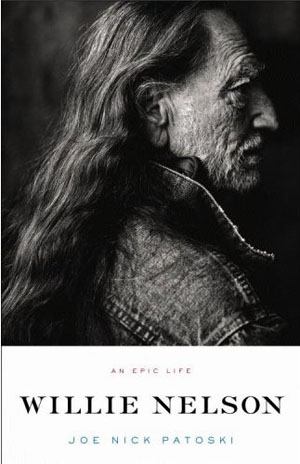
“Willie Nelson: An Epic Life” by Joe Nick Patoski

willie2By Joel Francis

“Epic” is the key word in the title of Joe Nick Patoski’s 567-page biography on Willie Nelson. Drawn from dozens of interviews and scores of oral histories, books and articles, Patoski paints a comprehensive picture of his fellow Texan.

If Patoski skimps on Nelson’s childhood – less than 50 pages are devoted to his years as a minor – he makes up for it by piling chapter on top of chapter about Nelson’s early family life, struggles as a disc jockey and songwriter for hire and, finally, as a nascent country performer. Patoski also devotes an entire chapter on IRS struggles and puts in strong perspective how such horrible accounting could have transpired.

But while Patoski’s journalism skills and research is impeccable, he spends too much of his time telling and not enough showing. For example, there piles of anecdotes about Nelson’s generosity and his inability to say no. He sticks around for hours after concerts to sign autographs, and lavishly gifts his friends and family. When a credit card company asked him to put his face on their card, he said yes without thinking of the consequences. Manager Mark Rothbaum has to explain the implications.

“Well think about it: A third of all credit cards go into receivership, so a third of your fans will go bankrupt, and they will have to look at your picture on that card,” Rothbaum tells Nelson. “Every time they see your picture they will think, That prick is making money off of me.”

Nelson asked Rothbaum to get him out of the deal, but the reader is never given understanding of what compels Nelson to be so affable.

The person who shines best is Nelson’s longtime drummer Paul English. English doesn’t appear until a third of the way through, where he initially surfaces as a pimp who drills and robs pinball machines and operates backroom card games. When Nelson’s drummer failed to show up for a radio session, English is recruited. Even though he had never played drums before, but the experience went well enough English accepted Nelson’s invitation to walk away from the lucrative prostitution business and join the band on the road.

English’s skills with a gun and knife were handing in prying a reticent promoter away from the band’s money and bailing Nelson’s smart mouth out of fight. English was never shy about displaying the pistol he always carried, which was usually all it took to calm any disagreements. English’s black market background also came in handy procuring marijuana for the band.

Patoski’s meticulous exploration sheds light on Nelson’s long walk to fame, where record labels and producers try in vain to pigeonhole the artist, and Nelson’s inability to fit into their boxes, even when he gamely goes along. Later, as Nelson’s fame and wealth grows, he builds a studio on his Texas estate. Patoski conveys a laid-back atmosphere where music flows as freely as beer and songs are recorded as effortlessly as lighting a roach. That Nelson practically lived in his studio explains the prolificacy of his catalog (he released two albums in 2008), and the easygoing environment explains how his financial problems reached the boiling point.

The vision of Nelson unearthed in the book refuses to be worried about anything except his music, even when doing so compromised his family and friends. His nature reminds me of a line from the film “Walk the Line.” When Johnny Cash tells June Carter on the back of the tour bus that everything will work itself out, she replies “No, John. People work them out for you, and you think they work themselves out.”

That Nelson’s music has attracted rednecks and hipsters alike is less mystifying after this thorough examination of the man. The songs are merely an extension of the personality: Nelson is willing to meet anyone anywhere for a good time. The access Nelson provided for this thick tome can rest proudly alongside his albums as a testament to the man’s generosity.

The Music of James Bond: Part One – The Classic Years

(Above: Johnny Cash’s alternate version of “Thunderball.”)

By Joel Francis

After nearly 50 years of slugging spies and bedding beauties, the premier of a James Bond movie has become an cultural event. The opening credit sequences of these films are events among themselves. Even though some of the biggest names in rock have performed a Bond theme song, the producers have always treated the number as a throwback to the Broadway and pop numbers of the 1950s.

When Bond made his big screen debut in 1962’s “Dr. No,” Ray Charles’ “I Can’t Stop Loving You,” variants of “The Twist” and the Four Seasons topped the Billboard charts. The theme song for “Dr. No” was a bizarre calypso arrangement of “Three Blind Mice.” Thankfully, the nursery rhyme is preceded by Monty Norman’s immortal James Bond theme. Norman’s theme was reinterpreted in every Bond film thereafter. It’s still exciting to hear the surf guitar race into the explosion of horns. The song is over-the-top, suspenseful and dangerous, but the swinging drums winkingly confide in the viewer that everything is in good fun.

Bond was back the following year with “From Russia With Love.” This time, producers hired Broadway songsmith Lionel Bart, best known for his work on “Oliver!,” to write an original theme song. Bart’s lyrics, coupled with soundtrack composer John Barry’s music, are the embodiment of the bachelor pad/Playboy image. Singer Matt Monro made his name performing in the nightclubs, caberets and lounges Bond would have haunted offscreen. Their lounge music is the embodiment of the bachelor pad/Playboy image that reeks of wood paneling, shag carpeting, hi-fi stereos and rotating beds. In other words, it’s straight out of Bond’s world.

Three-time Bond songstress Shirley Bassey made her debut with “Goldfinger.” Although the film hit screens during the year of Beatlemania, there is no hint of rock and roll in the title song written by the musical theater team of Leslie Bricusse and Anthony Newley. Barry’s bombastic horns are matched only by Bassey’s brassy delivery. “Goldfinger” is not only one of the most memorable Bond songs of all time, but it’s also the first memorable Bond song.

Barry and Bricusse didn’t stray far from the template when they approached Tom Jones to sing “Thunderball.” Jones puts his pelvis in the delivery, but the arrangement is essentially “Goldfinger”-redux. While they may have been working with a formula, it’s a strong one – “Thunderball” works nearly as well as “Goldfinger.”

An alternate “Thunderball” song was given to Johnny Cash to perform, but rejeced by the film’s producers. It seems even at the peak of his pills phase, Cash was more man than Bond could handle.

Rock and roll finally appeared in the serpentine guitar lick that opens Nancy Sinatra’s performance of “You Only Live Twice.” Even with the guitar, Sinatra’s sexy vocals rest on a pillow of strings accentuated by a harp. The number was Barry and Bricusse’s third consecutive teaming, and constructed from fragments of 25 separate takes. Bassey must have felt left out, because she covered the song in 2007, following in the footsteps of Coldplay, Bjork and Robbie Williams (who sampled the original for “Millennium”).

 “On Her Majesty’s Secret Service” is a misfit in the Bond cannon, musically and theatrically. The title sequence is a throwback to the orchestral opening of “Dr. No.” Barry’s instrumental theme is notable for its deep Moog synthesizer notes, chugging rock bass and the soaring trombone melody, later taken over on trumpet. Barry, who scored every Bond film to this point, composed a great alternate to Norman’s original Bond theme. During the mid-’90s electronic craze, the Propellerheads created a 10-minute remix of the song.

Barry teamed with Burt Bacharach’s lyricist Hal David to write the film’s love theme, “All The Time in the World.” Saturated by fingerpicked guitar and a saccharine string section, the song couldn’t be further from jazz, despite the vocals of Louis Armstrong. Satchmo is in full-on “What A Wonderful World” mode. Lesser singers would buckle under the weight of the arrangement, but Armstrong is able to emote the lyrics perfectly, even if someone else is playing the trumpet solo.

As the calendar flipped to the 1970s, Bassey was given her second stint on a Bond theme. “Diamonds Are Forever” is the sexiest Bond theme since Sinatra’s. Barry’s arrangement is full of the soft strings and horn punctuations that viewers had come to expect, but he tosses in an unexpected splash of funk at the halfway point. The wah wah guitar and subtle nod to Isaac Hayes’ Oscar-winning “Theme from Shaft” could be what drew Kanye West to the song when he sampled it for his 2005 hit “Diamonds of the Sierra Leone.”

Keep reading:

The Music of James Bond: Part Two – The Seventies

The Music of James Bond: Part Three – The ’80s and Beyond