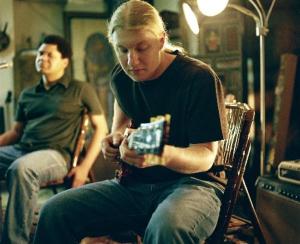
The Derek Trucks Band makes old-school rock new

derek_trucks_band

By Joel Francis
The Kansas City Star

Guitarist Derek Trucks was 12 years old when Bob Dylan asked him onstage during a show to play “Highway 61 Revisited.”

For Trucks, it was just another gig. The look on his dad’s face, however, told a different story.

“I knew who Dylan was because my dad was a massive fan, but it didn’t hit me then like it would have now or even 10 years ago,” Trucks said. “But even though I didn’t realize the significance, I could see it in my dad’s eyes that this was life-changing.”

Trucks and his father were both right. Playing with Dylan was just another encounter for the prodigy who would go on to play with Buddy Guy, Carlos Santana, Eric Clapton and numerous others. But it also opened the door to other possibilities.

Trucks, who turns 30 in June, now helms his own eponymous group (performing Friday at Harrah’s Voodoo Lounge) and also plays in the Allman Brothers Band. He returned Dylan’s favor with his supercharged blues cover of Dylan’s “Down in the Flood,” which opens his sixth and newest studio album, “Already Free.”

“I try to pick covers with some connection to the band,” Trucks said. “Part of that is Dylan is such a good songwriter with a great amount of tunes, but on top of that I figured after Katrina and the flooding in Iowa, the title and the lyrics were just a great metaphor for all that.”

Trucks didn’t go into the studio planning on cutting a record. Finding himself with downtime at his Jacksonville, Fla., home – atypical for a man who averages 300 shows a year – and a recently completed home studio called Swamp Raga Studio, Trucks and his band decided to lay down some tracks just to see how the room felt.

“The first day we wrote and ” Trucks said. “The next thing we recorded (the song) ‘Already Free,’ knew there were a dozen, then two dozen songs. We started calling people from (wife and blues guitarist) Susan (Tedeschi)’s band, Doyle (Bramhall II), Warren Haynes, Oteil Burbridge, to come in.”

The resulting release has a laid-back yet focused organic vibe that inhabits the best of the Allman Brothers’ Capricorn albums.

“It’s the most natural record I’ve done,” Trucks said. “It was very comfortable recording, and I think you can feel it. We captured tunes hours after they were written. There’s a freshness that comes across when songs are captured so quickly.”

Unsurprisingly, Trucks wanted to translate that urgency to the road as quickly as possible. The Derek Trucks Band tour kicked off last week.

For someone who has seemingly played with everyone, Trucks had the opportunity to encounter another legend and influence last year.

When you record two John Coltrane numbers on your debut album, and the opportunity to play with Coltrane’s longtime pianist McCoy Tyner arises, you don’t say no.

Still, Trucks was intimidated. Especially when he walked into the studio and saw bass player Ron Carter and drummer Jack DeJohnette.

“Those guys are legends in their own right, but McCoy is on his own level,” Trucks said. “He was such a sweet guy. He really made it feel comfortable.”

Trucks entered the studio with a list of four songs he hoped to play with the trio, but as the last guitarist on the session, some of his choices had already been recorded.

“My first choice of song was ‘Contemplations,’ but (jazz guitarist Bill) Frisell had already recorded it,” Trucks said.

The two-day session yielded collaborations with Trucks, Frisell, Bela Fleck, Marc Ribot and John Scofield. Trucks was the only “rock” guitarist invited, but he works well on his two featured cuts, “Slapback Blues” and “Greensleeves.” Trucks’ presence in the company of such eclectic legends is unsurprising given the range of covers his band performs – everything from Pakistani qawwali singer Nusrat Fateh Ali Khan to Delta bluesman Son House – and the diversity of the band playing them, which contains a four-decade age span.

Trucks said his innate musical curiosity has not only expanded his palate but has also given him a level of comfort playing with nearly anyone.

“It started at such a young age. I was always around musicians, so I’d try to pick their brains and see what influenced their music,” Trucks said. “A huge part of being able to stay on the road and on top of the game is to keep finding inspiration. You keep finding different things that turn you on, things that tweak different parts of the brain. In the long run you’re a better musician for it.”

Trucks hopes that same level of comfort and curiosity extends to his home Swamp Raga Studio.

“I’ve spent a lot of time with Willie (Nelson) in Maui, and anywhere he is has a clubhouse vibe. I can see that communal feeling. Wherever you are with him – on his bus, in his home – he makes sure everybody is absolutely comfortable,” Trucks said. “That’s kind of what it’s (Swamp Raga) starting to turn into in the month and a half we’ve gotten into it.”

Swamp Raga is not only musician-friendly but environmentally friendly as well.

“The beauty of building from scratch is that you can think about stuff ahead of time,” Trucks said. “When I figured the electric bill would be double, not only was that a financial hit, but psychologically I started feeling guilty because of all the energy we’d be using. We went out of our way to be conscious of that. We made it a point to do everything as efficiently as possible.”

To that end, Trucks and Tedeschi installed 26 solar panels on the studio and their home. And in the months when the family is out on tour, the local utility company pays them for the energy their panels generate.

“Sometimes our bill comes in right around zero,” Trucks said. “By doing the right thing it actually works out better in the end.”

Despite such 21st century enterprises, Trucks believes his band and his music are a throwback to a time where wooden instruments were hand-crafted and stepping onstage meant being ready to cut some heads.

“When you get on stage, you have to bring it,” Trucks said. “I get a sense from new music that the idea is to outsmart your audience or be so ultra-hip you can pull one over on them.

“With a band like ours, we try to represent a more honest music. We’re musicians representing our craft first and then trying to connect with people.”

Five Jazz Legends Still Adding to Their Legacies

(Above: The Dave Brubeck Quartet “Take Five” at the Ottawa Jazz Festival.)

By Joel Francis

In a belated post-script to The Daily Record’s series on 15 jazz greats to emerge in the past 20 years, we look at five artists who are still significantly contributing to their legendary status. Although their reputations were cemented generations ago, it would be criminal to overlook their most recent works.

Roy Haynes

At the 2005 Newport Jazz Festival, Chick Corea, Pat Metheny, Christian McBride, Joshua Redman and several others all paid tribute to drummer Roy Haynes on the occasion of his 80th birthday. These musicians honored Haynes not only for his resume, which includes stints with Lester Young, Bud Powell, Thelonious Monk and Sarah Vaughan, but because he has allowed the younger artists to grow and learn under his guidance. Haynes has released six albums this decade, starting with “The Roy Haynes Trio,” which recaps his career through new performances, “Birds of a Feather,” a tribute to his former bandleader Charlie Parker, and the strong live set “Whereas.”

Dave Brubeck

One of the most important – and popular – jazz pianists of the post-War era, Dave Brubeck landed on the cover of Time magazine and became a legend with his groundbreaking, yet accessible, work with saxophonist Paul Desmond. Although the 16 years Brubeck and Desmond played together in the Dave Brubeck Quartet form the crux of his catalog, Brubeck has built an impressive resume in the 40-plus years since.

Brubeck’s current quartet, consisting of drummer Randy Jones, bass player Michael Moore and saxophonist/flautist Bobby Militello, may be the best ensemble he’s worked with since his mid-’70s pairing with Gerry Mulligan. Unlike many of his contemporaries, there has never been a Brubeck comeback; there are no lulls or low periods in his catalog. Brubeck has continued to write, record and perform regularly well past his 88th birthday. Of the nearly dozen albums Brubeck has released this decade, three stand out. “The Crossing” kicked off the 21st century with nine strong, new selections, including an ode to longtime drummer “Randy Jones,” Militello’s delightful solo on “Day After Day” and the title song, Brubeck’s interpretation of a chugging ocean liner. Brubeck blends old and new songs on “London Flat, London Sharp,” and the his quartet sizzles on the live album “Park Avenue South,” which mixes standards and favorites with more recent material.

Wayne Shorter

After two years of auditioning other horn players, Wayne Shorter’s saxophone turned out to be the piece missing in Miles Davis second great quintet. An alumni of Art Blakey’s Jazz Messengers, Shorter not only filled the spot vacated by John Coltrane, but contributed many key songs to the group’s repertoire. As if that weren’t enough, he was simultaneously cutting magnificent solo albums on Blue Note. Shorter followed his bandleader’s path into fusion, but took a more pop approach in Weather Report, the group he co-founded with keyboardist Joe Zawinul, another Davis alum. Shorter floundered in the days after Weather Report’s demise in the mid-’80s, but his three most recent albums are among the most inspired of his career. After a 12-year absence from recording, Shorter returned with “Footprints Live,” which documents his reinvigorated 2001 tour. He fronted an acoustic band for the first time in over a generation on “Algeria,” which paired Rollins and his “Footprints” rhythm section with Brad Mehldau for several selections. Shorter’s hot streak continued with his most recent album “Beyond the Sound Barrier” and his inspired playing on Herbie Hancock’s Grammy-winning “River: The Joni Sessions.”

McCoy Tyner

More people have probably heard McCoy Tyner than know who he is. The backbone and counterfoil in John Coltrane’s masterful quartet for six years, Tyner’s piano has graced well-known recordings like “My Favorite Things” and “A Love Supreme.” Tyner also put out several stellar albums under his own name on Blue Note and Impulse in the 1960s. No less active today, Tyner collaborated with Bobby Hutcherson for the live album “Land of Giants” and played tenor Joe Lovano and the awesome rhythm section of Christian McBride and Jeff “Tain” Watts for 2007’s  self-titled release. Tyner’s latest album, “Guitars,” was recorded over a two-day span that paired Tyner, Ron Carter and Jack DeJohnette with several of six-string luminaries, including John Scofield, Bill Frisell, Marc Ribot, Bela Fleck and Derek Trucks. Uninformed fans should stay away from 2004’s “Illuminations,” however. A dream pairing on paper of Tyner, McBride, Terence Blanchard, Lewis Nash and Gary Bartz, the performances are ruined by a glossy production that smothers the quintet’s interplay and is suitable only for shopping for a sweater at Nordstrom with your mom.

Sonny Rollins

Sonny Rollins’ legacy includes recordings with Charlie Parker, Miles Davis, Thelonious Monk, Dizzy Gillespie, Max Roach, Bud Powell and Clifford Brown – and that’s just in his first decade of playing. In the half-century since then, Rollins (along with contemporary John Coltrane) established himself as the preeminent post-Bird saxophonist. Although the pace of Rollins’ releases has slowed considerably, what he has put out have only added to his reputation. Recorded in Boston just four days after the Sept. 11 attacks in New York City, “Without A Song” is an emotional listen finding Rollins channeling his conflicted emotions through long solos. “This Is What I Do” continues Rollin’s penchant for transforming b-quality songs into must-listen melodies with the Bing Crosby standard “Sweet Leilani.” Rollins’ most recently release, “Road Songs, Vol. 1” mines the archives for several cherry-picked performances that prove that the passion on “Without A Song” was no fluke.

Keep Reading: 15 Jazz Legends to Emerge in the Last 20 Years

Part One

Part Two

Part Three

15 jazz greats to emerge in the last 20 years (part three)

(Above: Savion Glover does his thing with plenty o’ swing.)

By Joel Francis
The Daily Record

Continuing The Daily Record’s look at the state of jazz today, here is the final of three installments shedding light on 15 jazz greats to emerge in the last 20 years. Note that these musicians are not necessarily the 15 greatest jazz artists to arrive since 1990. A brief listen to any of them, though, should more than persuade the most ardent purist that jazz is alive and well.

Eldar Djangirov

Eldar Djangirov is the continuation of the great line of pianists to emerge from Kansas City, Mo. that stretches back to Count Basie and Jay McShann. The three have more than an adopted hometown in common, though. Although none were born in Kansas City, all experienced significant musical growth while living there. Unlike Basie and McShann, though, Eldar’s formation started before puberty. He performed at a Russian jazz festival at age 5 and at age 12 became the youngest guest ever on Marian McPartlan’s Piano Jazz radio show. Though his latest album is straight-up smooth jazz, Eldar’s earlier work has a breadth that recalls everyone from Ahmad Jamal to Art Tatum. Albums to start with: Eldar, Live at the Blue Note

Christian McBride

Bass player Christian McBride was mentored and hailed by no less an authority than Ray Brown before starting off on his own. McBride works comfortably in the traditional vein on his early albums like “Fingerpainting,” the excellent tribute to Herbie Hancock performed in a bass/guitar/trumpet setting. He gets more funky and touches on fusion with his three-disc live set recorded at Tonic and studio albums “Sci-Fi” and “Vertical Vision.” In 2003, McBride collaborated with hip hop drummer Ahmir “?uestlove” Thompson of the Roots and keyboardist Uri Caine for a spectacular collaboration known as the Philadelphia Experiment. McBride has also worked extensively with Sting and Pat Metheny. Albums to start with: Fingerpainting, The Philadelphia Experiment.

Joshua Redman

Expectations have been high for Joshua Redman since winning the Thelonious Monk International Jazz Saxophone Competition in 1991. While Redman hasn’t fulfilled those unrealistic expectations by taking his instrument to the heights achieved by Sonny Rollins and John Coltrane, he has built a strong career on his own terms. Redman’s early quintets helped launch the careers of Christian McBride and Brad Mehldau and his work as musical director of the San Francisco Jazz Collective paired him with legends like Bobby Hutcherson and new artists like Miguel Zenon. Redman’s catalog is adventurous enough to include covers of Eric Clapton’s “Tears in Heaven” with guitarist Pat Metheny and funky experiments that recall Eddie Harris. Albums to start with: Spirit of the Moment, Back East.

Savion Glover

Jazz tap may have died with the golden age of big-budget Hollywood musicals, but Savion Glover is trying his best to bring it back. He has appeared in televised concerts with Wynton Marsalis’ Jazz at the Lincoln Center Orchestra, collaborated with poet Reg E. Gaines and saxophone player Matana Roberts for the John Coltrane-inspired improve “If Trane Was Here,” appeared in Spike Lee’s “Bamboozled” and was a cast member of “Sesame Street.” Glover hasn’t recorded any albums, but his live performances are a potent reminder that jazz isn’t the exclusive province of those with a horn or a voice.

Bad Plus

Combining rock and jazz is nothing new, but the piano/drums/bass trio Bad Plus have done it in an acoustic setting that resembles Medeski, Martin and Wood more than Weather Report. Their early albums were filled with original material that split the difference between Oscar Peterson and Ben Folds, tempered by occasional arrangements of Pixies and Black Sabbath classics. Unfortunately, recent releases have steered sharply away from new compositions and saturated the increasing covers with more irony. While the concept of their newest album – all covers with a female vocalist – makes one wary, their early material should not be overlooked. Albums to start with: Give, Suspicious Activity.

Keep Reading 15 Jazz Greats to Emerge in the Last 20 Years

Part One

Part Two

Five Legends Still Adding to Their Legacies

15 jazz greats to emerge in the last 20 years (part two)

(Above: The Kora Jazz Trio in concert.)

By Joel Francis

Continuing The Daily Record’s look at the state of jazz today, here is the second of three installments shedding light on 15 jazz greats to emerge in the last 20 years. Note that these musicians are not necessarily the 15 greatest jazz artists to arrive since 1990. A brief listen to any of them, though, should more than persuade the most ardent purist that jazz is alive and well.

Ravi Coltrane

Not only has Ravi Coltrane followed in his famous father’s footsteps as a musician, but he’s established himself with his dad’s instrument. The child of John and Alice Coltrane (Ravi was two when his dad died), Ravi cut his teeth with McCoy Tyner and Elvin Jones before finally stepping out on his own. In little over 10 years, he’s build a strong catalog that would sound just as sweet under a different surname. Coltrane is currently on the road in a new septet celebrating 70 years of Blue Note Records. Albums to start with: Mad 6, In Flux.

Kora Jazz Trio

Comprised of pianist Abdoulaye Diabaté (who is not related to kora master Toumani Diabate), griot percussionist Moussa Sissokho and kora player Djeli Moussa Diawara, this trio deftly blends their African heritage with American jazz. Throughout their three albums, they have tackled songs by Charlie Parker, Thelonious Monk and the Buena Vista Social Club and delivered over a dozen dazzling originals. Imagine McCoy Tyner getting lost in an African marketplace and you’re getting close. Albums to start with: Part II, Part III

Diana Krall

Pianist and singer Diana Krall grew up surrounded by her dad’s extensive collection of Fats Waller albums, but ended up with a style and sound closer to that of Ralph Sharon, Tony Bennett’s longtime arranger and accompanist. Although Krall’s music is certainly not aggressive or pushing any boundaries, dismissing her music as smooth jazz for dinner parties would be a mistake. Her performances of Irving Berlin, Cole Porter and Jimmy McHugh have a freshness, energy and vitality lacking in other “supper club” performers. Krall’s most recent album, “The Girl in the Other Room,” leans heavily on original material written with her husband, Elvis Costello. Albums to start with: Love Scenes, The Girl in the Other Room

Medeski, Martin and Wood

Decades of touring have made the bass/keyboard/drums trio of Medeski, Martin and Wood one of today’s tightest ensembles. Their experimental, groove-based sound is broad enough to be equally at home at both Newport and Bonnaroo without changing a thing. Early pieces like “Hermeto’s Daydream” sound like Dave Brubeck run through “A Clockwork Orange,” while newer material features hip hop artists like DJ Logic, and guitarists Marc Ribot and John Scofield. Albums to start with: Notes from the Underground, Combustication.

Jason Moran

Pianist Jason Moran only has 10 years of recording under his belt, but he’s covered a lot of territory in that time. His albums contain interpretations of Prokofiev and Afrika Bambaataa interspersed with original compositions and spoken-word pieces. In addition to releasing seven albums under his own name, Moran has worked and recorded with Andrew Hill, Cassandra Wilson, Christian McBride, Don Byron, Ravi Coltrane and dozens more. Only 34 years old, Moran is just getting started. Albums to start with: Modernistic, Same Mother

Keep Reading: 15 Jazz Greats to Emerge in the Last 20 Years

Part One

Part Three

Five Legends Still Adding to Their Legacies

Bird lives! (and so will jazz)

(Above: Mos Def is a rapper, but his song “Umi Says” has a very jazzy feel.)

By Joel Francis
The Daily Record

The New York Times jazz and pop critic Ben Ratliff participated in a very enlightening Q and A with readers yesterday. It seems Kansas City jazz fans, like our friend at Plastic Sax, aren’t the only ones obsessed about the state of the genre.

Several people asked Ratliff why jazz didn’t have a bigger audience, what the media’s responsibility is to promote jazz to a larger audience, if there is a stigma against jazz in mainstream culture and, most bluntly, whether jazz was dead.

Similarly, several readers were concerned about the legacy of today’s jazz artists. They asked which contemporary artists have the best potential to join the pantheon of innovators like Miles and Duke, and whether the current crop of players are pioneers or regurgitators. One bold reader actually called out the elephant likely hiding behind many of these questions. “Pretty much all jazz sounds the same today,” he said.

It seems that just as baseball fans can’t wait to compare Albert Pujols to Stan Musial, jazzheads love debating the merits of John Medeski to Jimmy Smith or Joshua Redman to Sonny Rollins. They (we) are forever insecure that our moment in the sun won’t measure up to the established legacy. They are right. Just as no contemporary president will be as lauded as the Founding Fathers, and no slugging outfield can surpass Babe Ruth’s mythology, there is no way that the abilities of Jaco Pastorius or Christian McBride can exceed the monumental achievements of Charlie Mingus and Ray Brown.

But that doesn’t mean they can’t all be enjoyed. Trumpeter Roy Hargrove hasn’t redefined the instrument the way Louis Armstrong did in the Hot Five and Hot Seven, but I think his playing on D’Angelo’s “Voodoo” and Common’s “Like Water For Chocolate” is inventive and unique. There is no comparison between the works, because they can’t be compared. They exist in different worlds. And questions about “is it jazz” are as silly and insignificant as whether or not poker or Nascar are sports. It doesn’t matter.

One of the elements I enjoy most about jazz is watching how it absorbed in reinterpreted in new contexts. One can hear the free jazz influence of John Coltrane and Pharaoh Sanders in both the Stooges and the Soft Machine, but what they did with it was drastically different.

Ironically, “fans” might be the only ones worrying or arguing about these issues. Just as Hargrove had no problem working with Common and D’Angelo, I’m sure Ron Carter didn’t hesitate before recording with A Tribe Called Quest and Black Star. Artists make art, not distinctions.

To these ears, pieces like “Water” from the Roots’ album “Phrenology” or Mos Def’s “Modern Marvel” from “The New Danger” embody the spirit of jazz as much as anything Rudy Van Gelder recorded for Impulse or Blue Note.

Just as folk music survived the birth of the electric guitar (and Bob Dylan plugging in), and Sacred Harp has peacefully coexisted with gospel, jazz will survive. It will not be preserved in amber, but it is too indelible to be erased from American culture.

Although Ratliff’s answers were thoughtful and informative, he failed to pass along one key piece of advice to the Chicken Littles so worried about the future of their art: Pick up a horn and do it yourself.

Remembering Ron Asheton of The Stooges

(Above: The Stooges do “1969” in 2007.)

By Joel Francis
The Daily Record

When Ron Asheton started playing electric guitar in the mid-’60s, there were no signs pointing the way he wanted to go. The Beatles were just starting to experiment with feedback and backwards instrumentation on their albums; Pink Floyd was buried in the London underground and Andy Warhol had yet to champion the Velvet Underground (not that many were paying attention anyhow).

The closest things to the sounds in his head were Pete Townshend’s guitar riff on The Who’s “My Generation,” the surf guitar instrumentals of Dick Dale and the dirty blues of the Rolling Stones and the Yardbirds.

By the time Asheton, his brother Scott, and their longtime friend Dave Alexander hooked up with fellow Ann Arbor, Mich. musician Jim Osterberg there were a few more road signs. Home state natives the MC5 had kicked out their jams, and the free jazz freak-outs of John Coltrane and Pharaoh Sanders were regularly released on the Impulse label. But there still weren’t many fellow travelers on the Asheton brothers’ weird road during the Summer of Love. Osterberg, who would soon call himself Iggy Pop, was one hitchhiker they had to pick up.

Four years later, it was mostly over. In retrospect, it’s amazing the band lasted that long. The Stooges two albums, released in 1969 and 1970, were rawer than razor burn, more violent than the 1968 Democratic Convention and as combustible as the Hindenburg. When it was over, Asheton’s guitar work pointed the way that nearly every guitarist since has followed, or at lease acknowledged.

It’s difficult to imagine the furious stomp of the White Stripes and the six-string perversions of Sonic Youth and Dinosaur Jr without the expanded palette Asheton created. The Sex Pistols and the Damned both covered “No Fun” in concert. Heck, the blueprint of the grunge movement was mostly hijacked from the Stooges’ designs.

Of course David Bowie prodded the Stooges to reconvene in 1973 for “Raw Power,” but it wasn’t the same. Iggy’s name was out front and Asheton was confined to the bass guitar by Ig’s new best bud, James Williamson. There was even a piano player! Asheton’s rightful place on lead guitar was restored when the Stooges reunited a generation later for a couple guest shots on Iggy’s solo album, an R.L. Burnside tribute and, finally, an album of their own, but by then they were no longer leaders.

Ron Asheton’s name rarely comes up in “Guitar God” discussions. The music he made nearly 40 years ago remains difficult to assimilate by mainstream tastes. And like his long-overdue adulation, it took people a while to figure out he was gone. Six days after dying from a heart attack, Asheton’s body was discovered in his Ann Arbor apartment.

There was no obituary in the New York Times and little mention on the 24-hour news channels, but somewhere in heaven a white cloud is tarnished with soot and Asheton’s scary noise is driving the harp-plucking cherubs out of their minds. Which is as it should be.

Classic Christmas Carol: “Greensleeves”

(Above: Paul Desmond and the Modern Jazz Quartet put their spin on “Greensleeves.”)

By Joel Francis

The melody for “Greensleeves” dates to 16th century England. It is been rumored that King Henry VIII for his lover Anne Boyeln – the subject of the recent “The Other Boyeln Girl” novel and film. According to historians, however, the best case scenario is that ol’ Hank just stuck his words on an existing melody.

Double entendres were common in the love songs of the Renaissance. At the time, the color “green” was a charged term. It implied the color that a woman’s clothes would turn if she made love outside. Lady Greensleeves, the subject of the song, was said to be a prostitute, or at least a promiscuous woman.

As with the words, no one knows who wrote the melody. It was likely developed by English minstrels and troubadours as they traveled the countryside. The tune was first published in a 1580 broadside entitled “A New Northern Dittye of the Lady Greene Sleeves.” Four years later, it turned in A Handful of Pleasant Delights as “A New Courtly Sonnet of the Lady Green Sleeves.”

Nearly 300 years later, Englishman William Dix penned new lyrics to the familiar, lilting melody. At age 29, Dix was confined to several months of bed-rest after a nasty bout with a near-fatal illness. Manager of maritime insurance company by day, Dix used the opportunity to write several hymns. The new words became “What Child Is This?” and draw on the nativity story from the Gospel of Luke.

It’s hard to believe such a cherished song grew from such bawdy beginnings. Over the last 60 years, it has been performed by everyone from singers Odetta and Olivia Newton-John to rockers Jethro Tull and Jeff Beck. John Coltrane made it a jazz standard and organist Garth Hudson of The Band played it over the closing credits of Martin Scorsese’s film “The Last Waltz.”