(Above: “True Love Ways” is The Daily Record’s favorite Buddy Holly song.)
By Joel Francis The Daily Record
Fifty years ago this week, the plane carrying Buddy Holly, Ritchie Valens and the Big Bopper crashed in an Iowa cornfield, claiming its passengers and 22-year-old pilot Roger Peterson.
The event became known as “The Day the Music Died,” but the fact people were still talking about it 12 years later when Don McLean memorialized the moment with the song “American Pie” proves that music indeed survived.
The rock landscape had changed a lot between 1959 and 1971. The pioneers of the rock and roll were having hard time. Chuck Berry had bounced from Chess to Mercury and back and was seven years removed from his most recent Top 40 hit (although the No. 1 “My Ding-A-Ling” was right around the corner). Carl Perkins was performing as a sideman in Johnny Cash’s band and Little Richard, Bo Diddley, Fats Domino and Bill Haley dismissed as washed up. Only Elvis Presley and Jerry Lee Lewis retained a whiff of their ’50s fervor, but it took a televised “comeback” special and a genre hop to country and western for them to manage the trick.
That Holly was not only remembered, but celebrated in the aftermath of Woodstock and Altamont, in an era where rock’s excesses were just starting to steamroll, was not pure nostalgia.
Far from killing rock and roll, Holly planted the seeds that allowed it to flourish. Holly was one of the first artists to recognize the recording studio as creative environment, by experimenting with double-tracking and overdubs. He was the first songwriter to pilfer the Bo Diddley beat for “Not Fade Away.” He was the first rock and roll star to play a Fender Stratocaster, the guitar of choice for Eric Clapton, Jeff Beck, Jimi Hendrix, Stevie Ray Vaughan and countless others.
Although the Beatles often receive credit for being the first group to write their own material and put strings on a rock album, the truth is, Holly did both nearly a decade before them. It’s not a big leap from Holly’s “Raining In My Heart” to McCartney’s “Yesterday.”
But the most amazing of Holly’s feats is that he did it all by 22, an age at which Bob Dylan was just emerging from his Woody Guthrie fixation, Brian Wilson was begging out of tours because of stage fright and Neil Diamond was still trapped in the Brill Building.
Few mourn other ’50s rock casualties, like Eddie Cochran, who died a scant 14 months later, but Holly’s influence continues to be felt today. It’s in Elvis Costello’s spectacles, Weezer’s Top 5 1994 hit, and the myriad of bands – ranging from the Rolling Stones to the White Stripes to the cover band in the bar around the corner – who regularly drop “Not Fade Away” into their sets.
(Above: Mos Def is a rapper, but his song “Umi Says” has a very jazzy feel.)
By Joel Francis The Daily Record
The New York Times jazz and pop critic Ben Ratliff participated in a very enlightening Q and A with readers yesterday. It seems Kansas City jazz fans, like our friend at Plastic Sax, aren’t the only ones obsessed about the state of the genre.
Several people asked Ratliff why jazz didn’t have a bigger audience, what the media’s responsibility is to promote jazz to a larger audience, if there is a stigma against jazz in mainstream culture and, most bluntly, whether jazz was dead.
Similarly, several readers were concerned about the legacy of today’s jazz artists. They asked which contemporary artists have the best potential to join the pantheon of innovators like Miles and Duke, and whether the current crop of players are pioneers or regurgitators. One bold reader actually called out the elephant likely hiding behind many of these questions. “Pretty much all jazz sounds the same today,” he said.
It seems that just as baseball fans can’t wait to compare Albert Pujols to Stan Musial, jazzheads love debating the merits of John Medeski to Jimmy Smith or Joshua Redman to Sonny Rollins. They (we) are forever insecure that our moment in the sun won’t measure up to the established legacy. They are right. Just as no contemporary president will be as lauded as the Founding Fathers, and no slugging outfield can surpass Babe Ruth’s mythology, there is no way that the abilities of Jaco Pastorius or Christian McBride can exceed the monumental achievements of Charlie Mingus and Ray Brown.
But that doesn’t mean they can’t all be enjoyed. Trumpeter Roy Hargrove hasn’t redefined the instrument the way Louis Armstrong did in the Hot Five and Hot Seven, but I think his playing on D’Angelo’s “Voodoo” and Common’s “Like Water For Chocolate” is inventive and unique. There is no comparison between the works, because they can’t be compared. They exist in different worlds. And questions about “is it jazz” are as silly and insignificant as whether or not poker or Nascar are sports. It doesn’t matter.
One of the elements I enjoy most about jazz is watching how it absorbed in reinterpreted in new contexts. One can hear the free jazz influence of John Coltrane and Pharaoh Sanders in both the Stooges and the Soft Machine, but what they did with it was drastically different.
Ironically, “fans” might be the only ones worrying or arguing about these issues. Just as Hargrove had no problem working with Common and D’Angelo, I’m sure Ron Carter didn’t hesitate before recording with A Tribe Called Quest and Black Star. Artists make art, not distinctions.
To these ears, pieces like “Water” from the Roots’ album “Phrenology” or Mos Def’s “Modern Marvel” from “The New Danger” embody the spirit of jazz as much as anything Rudy Van Gelder recorded for Impulse or Blue Note.
Just as folk music survived the birth of the electric guitar (and Bob Dylan plugging in), and Sacred Harp has peacefully coexisted with gospel, jazz will survive. It will not be preserved in amber, but it is too indelible to be erased from American culture.
Although Ratliff’s answers were thoughtful and informative, he failed to pass along one key piece of advice to the Chicken Littles so worried about the future of their art: Pick up a horn and do it yourself.
(Above: “Dreaming Of You” is one of many stand-out tracks on “Tell Tale Signs.”)
By Joel Francis
If there’s one detail to take away from “Tell Tale Signs,” the eighth installment in Bob Dylan’s Bootleg Series, its that “Mississippi” is as vital to his late-career renaissance as “Like A Rolling Stone” was to his electric rebirth.
The song opens both discs of the set (a third version appears on the bourgeoisie-only $130 “deluxe edition”). We first hear it as beautiful, slow folk ballad that features one of Dylan’s best vocal performances. Play this version for people who say Dylan can’t sing. It next appears as a more wirey, blues-influence tune that bears more of producer Daniel Lanois’ fingerprints.
Anyone who heard Sheryl Crow’s cover of “Mississippi” – she cut it for her “Globe Sessions” album before Dylan included it on “Love and Theft” – knows the song’s durability. It’s interesting to see Dylan add and shave layers before settling on a version suitable for release.
“Tell Tale Signs” is mainly a collection of shading and texture. With a few exceptions, hardcore Dylan fans will be familiar with all its 27 songs. What is surprising is the new contexts Dylan continually places them in.
“Most of the Time” is a gorgeous mood piece on “Oh Mercy,” but the alternate version replaces Lanois’ sheen with an acoustic guitar and places Dylan’s regret and pain at center stage. This motif is repeated across the set. Lanois produced two albums with Dylan and it’s telling that a majority of the cuts on this set draw from those sessions. Although their collaborations were critically acclaimed, Dylan and Lanois often struggled over differences in vision. These alternate versions are closer to the sound and feel that Dylan achieved alone on his ‘00s albums and could be seen as refutations of Lanois’ input.
There are only a handful of unheard songs, but what’s here is worth hearing. Lesser artists could build a career with the material Dylan discards. It’s unclear why the evocative “Dreaming of You” was left off “Time Out Of Mind,” but it is one of the brightest gems in this collection. There are two other “Time” discards – the gospel-flavored “Marching to the City” and the longing tale of lost love “Red River Shore.” “Can’t Escape You” is a sideways love song recorded in 2005, while the traditional “32-20 Blues” is an acoustic folk song from the “World Gone Wrong Sessions.”
The live cuts sprinkled throughout aren’t as illuminating, but still worthwhile. “High Water (For Charley Patton)” is angrier onstage, while an acoustic “Cocaine Blues” is a reminder of the amazing chemistry Dylan had with longtime touring guitarist Larry Campbell.
The inclusion of three previously released soundtrack songs is a bit puzzling. We’re given the superb “Cross the Green Mountain” from “Gods and Generals” and the haunting “Huck’s Tune” from “Lucky You,” but where is the Oscar-winning “Things Have Changed” from the “Wonder Boys” soundtrack? (A live version does appear on the $100 bonus disc.) Dylan’s swinging version of “Red Cadillac and Black Moustache” cut about the same time as “Love and Theft” for a Sun Records tribute would have been nice to have.
But these are minor quibbles. While this set doesn’t tell the faithful anything they don’t already know, that doesn’t mean they’re not worth hearing again in a different light.
(Above: the video for “Most of the Time” off the “Oh Mercy” album.)
The second installment in this series comes from McKay Stangler, public relations writer for the University of Kansas Medical Center. For more of McKay’s writing, check out his great blog.
I wish I had a great Dylan story.
I wish I could say that some foggy memory lay buried in the deep recesses of memory, a brief excerpt from the halcyon days of youth in which I first discovered Robert Zimmerman. A day when I heard those first notes of “Sara” or “Oh Sister” and was set on an irreversible path toward musical enlightenment.
I wish the 15-year-old me had pulled a dust-covered copy of Blonde on Blonde from a bookshelf in my parents’ basement and become instantly captivated with its sounds. Or perhaps that some tune hummed by the corner vagabond would have remained lodged in my mind’s musical echo chamber, quickly crowding out the assorted noise of the mid-90s, pushing into oblivion the Collective Souls and Blink 182s of the time.
Alas, the truth is much more boring. Although my parents did have Blonde on Blonde, I was first exposed to Dylan through the local oldies radio station. This fixture of the family autos and our kitchen was where I first heard the (overplayed) classics such as “Like a Rolling Stone” and “Knockin’ on Heaven’s Door.” I liked them but mostly because they became family sing-alongs by the second verse. Hell, I had the same feelings for “Hang on, Sloopy” and “Daydream Believer” – still do, in fact.
My Dylan knowledge expanded exponentially in college, when I lived for two years with an avowed Dylan-ophile. Tom collected bootlegs and basement tapes with a fervent fixation bordering on obsession – and it was great. He exposed me to the Dylan pop culture often forgets, the wandering, brooding, haunted man who produced some of his best work when the industry was busy forgetting his genius. I heard enough to know I wanted to hear more.
In August 2001, I saw Dylan live for the first time, at the Missouri State Fair in Sedalia with my roommate and another college friend. It was a forgettable venue: we sat in the grandstand of the racetrack while much of the man’s sound was lost in the open summer air. Much of our attention was immediately seized, though, by the charming rural couple seated behind us. They were from Smithville, Mo., and were named, somewhat improbably, Jim and Jane Smith. They’d had a few beers already – the only option at the concert was the gargantuan 24 oz. cup – and said they’d buy us a beer if we correctly predicted what Dylan’s opening song would be.
We thought we were golden. After all, we had my roommate Tom, the Dylan savant! He went with “Roving Gambler,” which had been the opening song at a few recent concerts he had attended. Tom was wrong, but thanks to Jim’s video poker windfall we were clutching beers anyway. Despite being underage, Jim was happy to buy us a round. And then another. And then another. And then about five more.
The end of the concert found us a drunken and boisterous crew, with us promising to visit the munificent couple in Smithville. Dylan’s spotlight had been improbably stolen by the generous, corruptive strangers. Our groups diverged in the main concourse when Jim insisted on throwing money at sideshows. The three of us wandered around for a bit but eventually set a course for the parking lot.
Then we saw Jane. She was wandering alone, drunk and confused. When we asked about her mate, she told us he was lost. L-O-S-T gone. Our offers to help find him were mixed with poorly suppressed laughter at the inanity of the situation. We had Jim paged over the Fair loudspeaker, then flagged down a Missouri Highway Patrol golf cart to help look.
And this was how our night ended. The three of us plus a deeply intoxicated Jane Smith, riding around the Fair with Officer Friendly, finally locating Jim behind a row of public toilets. He was passed out cold, but upon rousing was mighty glad to see Jane and, oddly, us. We rode with them back to their campsite. The magnitude of the night’s misadventures was too much for three drunken students to comprehend.
And this, I suppose, is what Dylan means to me: memories of friendship. Hearing his songs makes me think of college, of sitting around with Tom, futilely trying to stump him with Dylan trivia. Of meeting a couple who would change the course of our night and give us a story to tell for the rest of our lives. Of insisting that the friendly officer take his picture with the five of us, right before Jim passed out again, all of us grinning broadly around the golf cart amid the sparkling bonfires of the campsites. Of listening to Oh Mercy on the way home, none of us speaking a word about the evening until we pulled into a late-night eatery. Of the three of us laughing hysterically, even months or years later, as we recounted the tale for friends.
(Above: “Rainy Day Women #12 and 35” from Woodstock ’94.)
This is the first installment of what will hopefully be an ongoing feature. I asked a lot of my friends to write about their introduction or experiences with Bob Dylan’s music. The goal is to show that Dylan belongs to the ages, not just the Baby Boomers, but the effect is a series of testimonies.
Brad S., a recent transplant to Los Angeles, kicks off the series.
Dylan’s one of those guys like Elvis Costello, Tom Waits, and Nick Cave: old songwriting warhorses that mostly fly under the radar of popular culture but are revered by nearly everyone who is into music. These musicians have been creating for so long, their bodies of work so varied, yet their number of “hits” are so slight, that each new listener is likely to come away with a completely different set of songs that they deem best. I think I first got hip to Dylan after really getting into the Beatles. Learning that they were contemporaries and that Dylan had an influence on them made me think “Okay, clearly he’s worth checking out.” So I picked up a cassette of “Blonde on Blonde” and … Hated it. Except for “Rainy Day Women,” a sentiment that any high school boy can get behind. But the rest of it was so different than the ‘60’s pop that I was just getting into. My musical appreciation still had some developing to do. And I did keep the cassette, maybe anticipating this. And by the time I was a sophomore in college and got a CD player (that is so weird to actually type out), I got Dylan’s Greatest Hits 1 and 2 and I would gradually immerse myself more and more into his music. Weirdly enough, the element that most people hate about Dylan is one of my favorite elements: his voice. Given that I’m also a Tom Waits fan, I clearly have a tolerance for voices that aren’t “pretty.” I think these gravelly/nasally/whatever voices underscore a rootsy, naturalistic, non-refined, unpretentious core with which their subject matter often explores.
Above: The Flaming Lips “Race for the Prize” at Wakarusa 2008.
By Joel Francis
The Kansas City Star
Arrested Development – Friday afternoon, Revival Tent
The sound of Arrested Development warming up was funky enough to send a crowd scrambling to the Revival Tent and its ankle-deep mud, but the group had trouble keeping them there.
The group’s Afrocentric rap harks back to De La Soul’s daisy age and capped a three-act run of hip hop in the Revival Tent, including Blackalicous and Del tha Funky Homosapien. Their low-key approach had difficulty translating to the half-populated tent, but part of the problem could have been the 15-plus years since the band last hit the area.
Flanked by two vocalists and backed by a guitarist, DJ and rhythm section, MC Speech warmed the crowd up on a couple newer numbers before heating the crowd up with “Fishin’ 4 Religion” and a spirited gospel arrangement of “Tennessee.”
Fans who weathered the bass solo were treated to a karaoke romp through “Billie Jean” and a full-band cover of “Redemption Song.”
Although the set’s energy lagged at times, the greatest hits still sounded, well, great. “Mr. Wendall” is still as fun and timely as it was nearly 20 years ago. The closing one-two of “Mama’s Always Onstage” and “People Everyday” had a sea of smiling faces hoping it wouldn’t be another half-generation until the next show.
Flaming Lips – Friday night, Sun Down Stage
The Flaming Lips performed nearly the same show at their Wakarusa debut two years ago. Damn if it didn’t work just as well the second time.
Flanked by a horde of Teletubbies, the band took the stage as front man Wayne Coyne rolled over the crowd in a giant hamster ball. “Race for the Prize” kicked off the night as confetti, streamers and smoke snowed over the crowd.
It would be easy to get lost in the spectacle of a Flaming Lips concert and forget about the band onstage if the music wasn’t so good. “The Yeah Yeah Yeah Song” rocked so hard that Coyne himself called it “glorious.” The group funneled their anger and passion for a better America after the November elections into a devastating version of “The W.A.N.D.” that was prefaced by an anti-war airing of “Taps.”
The quartet also got some help from their fans. Coyne encouraged the crowd to get naked during their cover of “The Song Remains the Same” and a half dozen women jumped onstage and took him up on the offer. Spontaneous fireworks from the back of the lawn punctuated the trippy “Pompeii am Gotterdamerung” and heightened the atmosphere of “Vein of Stars.”
The night ended with “Do You Realize.” A million pieces of yellow and orange confetti falling from the sky created a nice cinematic moment that made the song sound even more majestic than usual.
Set List: Race for the Prize/Free Radicals/The Song Remains the Same/Fight Test/Mountain Side/Vein of Stars/Yoshimi Battles the Pink Robots (pt. 1)/Pompeii am Gotterdamerung/The Yeah Yeah Yeah Song/Taps->The WAND/She Don’t Use Jelly/(encore:) Do You Realize
“Christmas On Mars” – Friday night, the Flaming Lips tent
The chance to catch a band-hosted screening of the Flaming Lips’ seven-years-in-the-making movie “Christmas on Mars” overpowered the need for sleep for many Wakarusa campers.
Shortly after the Lips’ spectacular set on the Sun Down Stage, 200 fans lucky enough to snag a free ticket earlier in the evening were ushered into the band’s large “Eat Your Own Spaceship” tent. Inside, it felt a lot like summer camp. Everyone sat on long wooded benches and roadies handed out popcorn.
After a short personal introduction from lead Lip Wayne Coyne and a longer recorded interview, the film finally started around 1 a.m.
The movie follows the descent of paranoia and psychosis on a crew of astronauts in their Martian space station on Christmas Eve. Multi-instrumentalist Steven Drozd plays the main astronaut while Coyne portrays an emerald-hued, antennae-sporting Martian who swallows an asteroid, is detained by the space crew and then forced into the role of Santa Claus.
The results are pretty much what you’d expect from a group with no acting or screenwriting background, paying for their production as they go. Fans started sneaking out almost as soon as the rock-show volume movie started. When I finally succumbed an hour into the movie a herd of fans were seated on the ground outside the tent for the next showing. Live and learn.
Ozomatli – Saturday afternoon, Sun Down Stage
Listening to Ozomatli is like flipping through a National Geographic. The L.A.-based band deftly mixes traditional South American music with African rhythms, hip hop, rock and a splash of Indian raga.
Opening with consecutive songs in Spanish could be an obstacle for some bands, but Ozomatli’s groove needs no translation. Although a moderate crowd had gathered on the lawn in anticipation of the set, each song saw more arms raised as the multitude grew.
The septet kept the energy high for all of its 90-minute set, from the Indian-influenced improvisation on “Believe” to the straight hip hop of “City of Angels” and vibrant African rhythms of “Como Ves.”
Ozomatli is not only proficient with different styles of music, but its members all play more than one instrument. This broadens their palate even further. The clarinet solo introducing gave “Cumbia de los Muertos” a Yiddish flavor, while the horns on “Magnolia Soul” added a New Orleans feel.
The appearance of Tre Hardson, aka Slimkid3 of the Pharcyde, who has been touring with the band since last winter, was an unexpected treat. He led the band through a great cover of “Passing Me By” that drew big cheers from the crowd.
Porter Batiste Stolze – Saturday afternoon, Sun Up Stage
Porter Batiste Stolze was more than 30 minutes into their set when Ozomatli wrapped up. I entered just in time to hear the band roll into a faithful cover of “Like A Rolling Stone” with a sidestepping backbeat that definitely gave the drummer some.
In front of me a father and son stood with their arms on each other’s shoulders, belting out every word with absolute delight. Proud mom looked on, her face radiant.
The Dylan cover gave way to the booty-shaking, Bo Diddley beat of “Not Fade Away,” which, in turn, fed into “Little Liza Jane.” No matter how many gnarled honky tonk guitar licks Brian Stolze threw at his band mates, George Porter, Jr.’s bass kept things funky while drummer Russell Batiste, Jr. shuffled the beat like a Vegas card dealer.
The New Orleans-based trio honed their chops together as in-demand session musicians, and worked Art Neville as three-fourths the Funky Meters until 2005. PBS’ three-part harmonies and musical sensibilities sounds like The Band filtered through Kool and the Gang and given a late-night run on Bourbon Street. They touched on nearly every style of American music in the half hour I heard, and could groove on them all.
Jennie Arnau – Sunday morning, Sun Up Stage
From a distance, Jennie Arnau sounds a lot like Kathleen Edwards. Both have mournful country vocals supported by muscular rock hooks. Up close, however, Arnau’s alt-country sound is less plaintive than Edwards and owes as much to Fleetwood Mac as it does to Emmylou Harris.
Backed by a four-piece band, the blonde South Carolinian performed four songs from her latest album, “Mt. Pleasant,” and one song from each of her last three.
While Arnau’s “Float On” is not a Modest Mouse cover, its buoyant melody should please fans of Edwards, Neko Case and Caitlin Cary. Set closer “You’re Not Alone” is the type of song that Sheryl Crow should be doing. It ended the show on a strong note.
While late morning, closing day festival gigs are never coveted, the two dozen folks who showed up for Arnau’s set seemed genuinely appreciative of the music and pleased by the 45 minute performance that held nothing back. Hopefully Arnau will be invited back at a better time slot and in front of the bigger audience she deserves.
Ivan Neville’s Dumpstaphunk – Sunday afternoon, Sun Down Stage
Dumpstaphunk know how to ride a groove and aren’t afraid to hop on at a moment’s notice with several hundred hip-shaking hitchhikers in tow.
Opening with the aptly titled instrumental “Stinky,” the band quickly drew a dancing crowd to the lawn in front of the stage. By the time their hour-long set reached its midpoint the congregation had easily doubled.
With staccato riffs from his Hammond organ, Ivan Neville led the quintet through songs like “Shake It Off” and “Ugly Truth” that sounded like a streamlined, less bizarre P-Funk.
While vocal responsibilities shifted, they were always soulful. Between songs, Tony Hall would sometimes abandon fellow guitarist and Ivan’s cousin Ian Neville, and drop one string and several octaves to add another bass guitar and even more bottom to the sound.
Dumpstaphunk aired their views on the handling of their native New Orleans in “Meanwhile.” Easily the most fun Hurricane Katrina protest song to date, the band’s philosophy was summarized with the chorus “might as well have a good time/it might be the last time.”
Although, many of its members have worked with Ivan Neville’s father Aaron and the Neville Brothers, Dumpstaphunk is firmly rooted on The Meters side of the family tree.
Game Theory – The Roots
The Boxing Mirror – Alejandro Escovedo
The Obliterati – Mission of Burma
St. Elsewhere – Gnarls Barkley
Fox Brings the Confessor – Neko Case
Fishscales – Ghostface Killah
Return to Cookie Mountian – TV on the Radio
In the Pines – In the Pines
Begin to Hope – Regina Spektor
Modern Times – Bob Dylan
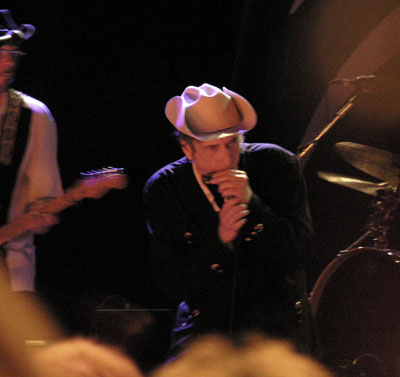
Twenty-plus years after eschewing his “Christian phase,” Bob Dylan assumed the mantle of Old Testament prophet at his joint concert with Willie Nelson at the T-Bones minor league baseball park in Kansas City, Kan.
Dylan cried out warnings of the apocalypse with a voice burdened by so much wisdom and sorrow it frequently broke and scraped under its own weight. There was no alternative but to drench it in echo: This is the way Moses’ voice must have sounded booming down from the mountains, falling like a harsh rain on the sinners’ ears. Then again, if Moses were accompanied by Larry Campbell on steel pedal the way Dylan was, the idolaters likely would have started casting a new statue. Like Isaiah foretelling the destruction of the temple, Dylan’s echo-laden, sparse and mournful arrangement of “All Along the Watchtower,” driven by Campbell’s pedal steel, warns that the future isn’t as bright as many concert-goers would like to believe.
In this new arrangement, the joker and the thief watch in relative safety. From their vantage-point, the riders are no longer approaching, but inside the city walls, raping, ransacking and causing unimaginable destruction. Campbell’s playing suggests that the wind has been howling for some time now._“Look at it,” the thief says in dismay, not wanting to believe his eyes. “We tried to warn them, but no one wanted to listen. Now they’re paying the price.”
A tear trickles down the joker’s cheek as he sees more riders on the horizon. He has lied to the thief, and he knows it: There is no kind of way outta here. The only exit from this horrific scenario is to end the song and turn on the house lights, which is exactly what Dylan does, but only after another of Campbell’s solos. The crowd cheers rapturously, never knowing how close they came to oblivion._But then again, seldom are the prophets’ words heeded in time.


 joelfrancis.com