Kim Weston – “Take Me In Your Arms (Rock Me A Little While)”

kim-weston

Kim Weston – “Take Me In Your Arms (Rock Me A Little While),” Pop #50, R&B #4

By Joel Francis

Kim Weston is best remembered as Marvin Gaye’s duet partner on “It Takes Two,” but she did manage to score a few chart hits on her own. (Like seemingly every Motown hit of 1965) “Take Me In Your Arms” was written by the Holland-Dozier-Holland team. It was Weston’s most successful solo effort.

Weston faced the same obstacle that confronted every female Motown singer post-1964: She wasn’t Diana Ross. While label founder Berry Gordy was busy obsessing over Ross and the Supremes, Weston’s husband, longtime Motown A&R man Mickey Stevenson, was pouring the same energy into his wife. Unfortunately, the Motown machinery didn’t quite know what to do with her. Weston’s body wasn’t built for the dresses Gordy had designed for his female stars and Gordy’s sisters, who also worked at the label, grew resentful of all the time Stevenson spent grooming his wife. Aside from her tenure as Gaye’s duet partner, Weston was always a second-tier vocalist for the label.

After writing epic, sweeping arrangements for the Four Tops, the score for this number is pretty straightforward. There are no strings or horns. In fact, the entire song rests in the strength of the Funk Brothers rhythm section. “Rock Me” is the operative phrase from the title. The tambourine and drums pushed in the listeners face while equally strong guitar and piano work buried in the mix. Weston’s powerful singing drives everything home. If you’re feet aren’t moving 10 seconds into this number call the doctor, there’s something wrong.

The song was back on the R&B charts just two years later courtesy of the Isley Brothers. A different set of brothers, the Doobie Brothers rode the song to No. 11 on the pop chart in 1975. Blood, Sweat and Tears also covered the song on their 1971 album “BS&T 4.”

Martha and the Vandellas – “Love (Makes Me Do Foolish Things)”

882867

Martha and the Vandellas – “Love (Makes Me Do Foolish Things),” Pop #70, R&B #22

By Joel Francis

Martha and the Vandellas didn’t do many ballads. Their best-known songs – “Heat Wave,” “Jimmy Mack” and “Nowhere to Run” – are all relentlessly upbeat. Despite the drastic change in tempo, the three songs above share at least one similarity with “Love (Makes Me Do Foolish Things)”: They were all written by Holland-Dozier-Holland.

The HDH team really came into its own in 1965, the year “Love” was released. Rare was the week that one or more of their songs wasn’t found near the top of the charts. This number, however, was a rare misstep for the team.

Martha Reeves turns in a fine vocal performance, but the song never really ignites. The number never peaks. Once Reeves’ voice enters, everything just kind of sits there until the fade-out. Although the trio wrote captivating arrangements for “It’s the Same Old Song” and “I Hear a Symphony,” the arrangement here isn’t anything to write home about. The drums are prominent in the mix, but aren’t really saying anything. Likewise, one gets the impression the strings were just added to make the mix more full. Finally, the lyrics are solid, but don’t expose anything not given away in the title.

“Love (Makes Me Do Foolish Things)” never ignited with other artists, either. Berry Gordy tried to farm the song off to a couple other Motown artists, most notably the Supremes. The results of Kim Weston’s adventures with the tune languished in the Motown vaults until the historical reissues of 2005.

That said, it is never wise to write off a Holland-Dozier-Holland number, especially from this era. In the right hands, the song could be a surprising hit today.

Four Tops – “It’s the Same Old Song”

341862
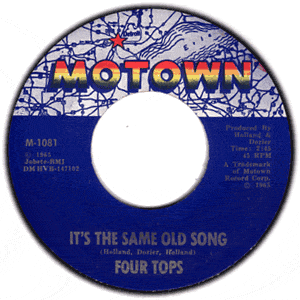
Four Tops – “It’s the Same Old Song,” Pop #5, R&B #2

By Joel Francis

There’s a good reason why “It’s the Same Old Song” sounds so much like the Four Tops’ previous hit, “I Can’t Help Myself:” both songs are built on the same chords, only in reverse order.

When “I Can’t Help Myself” hit No. 1 in June, 1965, the Tops’ old label, Columbia, tried to cash in by re-releasing a five-year-old Tops single. An upset Berry Gordy countered that Motown needed to quash that single with one of their own – in just 24 hours.

At 3 p.m. Holland-Dozier-Holland sat down to write. Just two hours later, the Tops had finished recording the number and the tune was ready to mix. By 3 p.m. the next day, 1,500 copies of “It’s the Same Old Song” had been pressed and sent to DJs across the country. The icing on this astounding feat of production came in the coming weeks, as the song eventually rose to No. 5 on the charts.

Like “I Can’t Help Myself,” the song is propelled by Funk Brother Jack Ashford’s vibe’s and Richard “Pistol” Allen’s drumming. The bubbly string arrangement also echoes “I Can’t Help Myself.” Unsurprisingly, the end result is a second helping of a joyous melody masking a melancholy lyric. If it ain’t broke….

In the late ’70s two groups proved it was anything but “The Same Old Song” with two very different covers. KC and the Sunshine Band turned in a disco version and Delroy Wilson gave a reggae reading. Neither translation made the charts.

Four Tops – “I Can’t Help Myself (Sugar Pie Honey Bunch)”

sugar-pie-honey-bunch
Four Tops – “I Can’t Help Myself (Sugar Pie Honey Bunch),” Pop #1, R&B #1

By Joel Francis

The piano riff that kicks off this tune is instantly and universally recognizable – and with good reason. Depsite the apologetic lyrics, Levi Stubbs’ magnificent vocals are a ray of sunshine. He might be singing that he’s “weaker than a man should be,” but Stubbs is clearly having more fun than he should for a man in his predicament.

The string arrangement echoes the upbeat, impulsive melody – pay attention to the delightful vibraphone line – while Funk Brother Richard “Pistol” Allen’s offbeat drumming keep the feet moving. Stubbs’ vocals sound like the direct descendent of Kansas City, Mo. jazzman Big Joe Turner’s “shout” singing style. If they couldn’t bring his lover back, then the saxophone interlude should have sealed the deal.

Holland-Dozier-Holland’s song capped five straight No. 1 hits with the Supremes. Although the trio penned the Tops’ early hits like “Baby I Need Your Loving,” Berry Gordy thought they had lost their touch and passed the Tops to Mickey Stevenson and Ivy Jo Hunter’s pen for “Ask the Lonely.” After the success of “I Can’t Help Myself,” Holland-Dozier-Holland were given nearly exclusive rights to the Tops’ singles for the next three years.

In the summer of 1965, this song fought for the No. 1 spot with The Byrd’s “Mr. Tambourine Man” and “I Can’t Get No (Satisfaction)” by the Rolling Stones. What a summer that must have been.

Brenda Holloway – “When I’m Gone”

bholloway
Brenda Holloway – “When I’m Gone,” Pop # 25, R&B #12

By Joel Francis

Brenda Holloway isn’t the biggest name in soul music, but she was on top of the world when this song hit 1965. She opened for the Beatles on their U.S. tour that year, and performed at the legendary Shea Stadium show.

The story behind “When I’m Gone” is more interesting than the song itself. Originally slated to be Mary Well’s follow-up to “My Guy,” the song was given to Holloway when Wells spurned Motown for 20th Century Fox Records. Despite being an alto to Well’s soprano, Berry Gordy thought Holloway was best-suited to put lead vocals to Well’s backing track.

“When I’m Gone” wasn’t as big a hit as “Every Little Bit Hurts,” but Holloway kept making singles for the next three years. Shortly after recording the original version of “You’ve Made Me So Very Happy” (later a huge hit for Blood Sweat and Tears), Holloway retired from the music business. Deeply religious, Holloway was disillusioned with Motown and conflicted about the lifestyle expected of a young star. Although she was just 22, Holloway had been making records for 6 years. After a 12-year absence, she returned with gospel album in 1980 and a pop album in 1999.

Four Tops – “Ask the Lonely”

4t
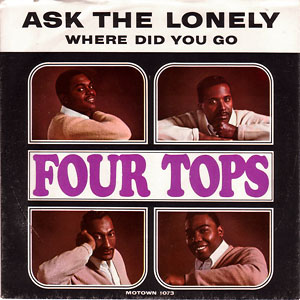
Four Tops – “Ask the Lonely,” Pop #24, R&B #9

The name on the label says “Four Tops” but this is really a Levi Stubbs record. Stubbs was never one of Motown’s marquee vocalists, and the injustice of that act is amplified by his three-minute tour-de-force singing here. Mickey Stevenson and Ivy Hunter’s song and production is more mature than the typical Motown single. Stubbs’ classic soul voice is imbedded with the “hurting pain” he’s imploring his friend to avoid. The female backing vocals sound silly when they introduce the song, but blend well with the arrangement. The other three Tops are all but absent, but they’re not missed thanks to Stubbs’ heart-wrenching performance.

“Ask the Lonely” is stuck in the Tops’ limbo land. It wasn’t a big hit, but it was too good to be a footnote. The song is still performed at Four Tops concerts today – sans Stubbs’ vocals, of course – but unlike other Motown hits, it never made an impact on the covers circuit. Which is probably just as good. — by Joel Francis

The Supremes – “Baby Love,” “Come See About Me”


The Supremes – “Baby Love,” Pop #1, R&B #1
The Supremes – “Come See About Me,” Pop #1, R&B #3

By Joel Francis

(Note: Since the producers of the “Hitsville U.S.A.” box set programmed these tracks back-to-back, we’ll tackle them in one entry.)

For most people, the Supremes are Motown. Label founder Berry Gordy certainly didn’t hesitate to promote and encourage their singles, seemingly above all other releases. Gordy had been looking high and low to find a female face for his label. Early contender Mary Wells defected, and for some reason Martha Reeves and the Vandellas and Gladys Knight and the Pips didn’t fit his image. The answer was right under his nose the whole time.

Supreme Florence Ballard grew up in Detroit with future Temptations Paul Williams and Eddie Hendricks, who were performing as the Primes. Their management wanted a female group, so Ballard formed the Primettes with best friend Mary Wilson, who recruited schoolmate Diana Ross.

In 1960, Ross pestered her old neighbor Smokey Robinson for an audition at Motown. He thought the girls were too green, but snagged their guitarist to join the Miracles. Undaunted, the trio stopped by the Hitsville studio every day after school and bugged Gordy for a spot on his label. The persistence paid off and in 1961 The Supremes released their first Motown single.

The Supremes were hardly the overnight success history has made them out to be. Their first eight singles, released over three years) did absolutely nothing on the charts. In 1964 they were turned over to the Holland-Dozier-Holland machine and their fortunes improved.

“Baby Love” was the Supreme’s second No. 1 hit with HDH. Any listeners that Ross’ opening coo didn’t seduce were captured by the catchy chorus that opens the song. The Funk Brothers shuffle underneath the lyrics imitates the footsteps, but are they walking away or coming back? The sexy saxophone accompaniment seems imply a lover’s return, but Ross is so insistent throughout it’s impossible to be sure.

“Come See About Me” continued the Supreme’s No. 1 success. Yet another HDH song and production, the repeated musical and lyrical theme – a spurned Ross singing over a shuffling Funk Brothers track – the assembly-line criticism holds up in this case. Why did such lovely ladies do to be treated so badly and ignored by the men in their lives?

Both songs have risen to the top of the oldies pantheon, and performed by dozens of artists. As with most of his major hits, Gordy passed both numbers around his stable of singers. For my money, the definitive version of “Come See About Me” is Jr. Walker’s 1967 cover.

Velvelettes – “Needle in a Haystack”

Velvelettes – “Needle in a Haystack,” Pop #45

The real action in “Needle in a Haystack” is happening away from the microphones and behind the glass. This song was the first single the late Norman Whitfield’s produced for Motown. Whitfield got his start at the label as a songwriter, co-writing Marvin Gaye’s hit “Pride and Joy,” but he made his name as a pioneering producer on the edge of the psychedelic soul movement.

In keeping with Berry Gordy’s assembly line mentality, the song sounds very much like the other Motown productions of the time. None of the experimental flourishes that mark Whitfield’s groundbreaking time with The Temptations are present. The promise of sounds to come, however, makes the song historically worth hearing.

History aside, there’s little that makes “Needle in a Haystack” stand out. The single was the Velvelettes’ second single for Motown and first charting effort. Although they had a follow-up hit, the Velvelettes, like Carolyn Crawford, are a footnote in Motown’s great history. – by Joel Francis

Mary Wells – “My Guy”

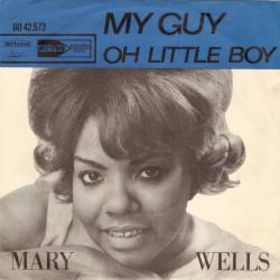
Mary Wells – “My Guy,” Pop #1

Before Gladys Knight, Martha Reeves and certainly Diana Ross, Mary Wells was Motown’s first female (super)star. Landing a No. 1 single in the heart of Beatlemania was no small feat. Arguably none of the Motown’s female stars have had bigger or more recognizable hits than “My Guy.” The Beatles themselves were so enraptured with Wells that they called her their favorite American singer.

Unfortunately, the Smokey Robinson-penned “My Guy,” was also Well’s swan song. Just a few months after “My Guy” was released, and while it was still very much ruling the charts, Wells exercised the termination clause in her Motown contract. Only 21 years old, she signed with 20th Century Fox with dreams of higher royalty rates and movie stardom. Leaving Motown also meant leaving Robinson, who penned and produced many of her greatest songs. Wells landed only one hit on the Top 40 pop charts after leaving Motown. She spent the rest of the decade bouncing to Atco, then Jubilee Records and finally Reprise Records.

Motown founder Berry Gordy was quick to groom a replacement for Wells – Diana Ross.

While the back story is interesting, none of it matters when listening to the actual song. The giddy, lightness in Wells’ delivery and the Funk Brothers bouncy accompaniment make “My Guy” stand up to the most narrow oldies playlists and misguided covers. Check the breathy semi-stutter Wells uses to sing “there’s not a man today who can take me away from my guy” in the outro. Pure delight. — by Joel Francis

Stax vs. Motown (part two)

The second of three installments in my conversation about the golden era of Stax and Motown with soul music fan and Stax afficiando Brad. Don’t forget to check out part one.

Brad S.: I have to admit, when I think of Motown, I almost only associate it with the ‘64-‘65 period. Although I know, to cite one example, one of my old favorites, “Reflections” incorporates just enough psychedelica to distinguish it from what I consider Motown to sound like.

So what are some of those Motown songs that brought you back in?

Joel Francis: For a label so reliant upon singles, it was the albums that drew me back into Motown. “What’s Going On” made me realize there was more to Marvin Gaye than “It Takes Two.” Stevie Wonder’s “Talking Book” and “Songs in the Key of Life” and The Temptation’s “Cloud Nine.”
These albums showed more depth, emotion and creativity than the monotonous parade of mid-60s oldies radio staples would have you believe. Motown may have made its name with its assembly line parade of hits in the first half of the ’60s when it set the agenda, but its output gets more interesting to me in the second half of the decade as it responds to the Beatles, psychedelica, the civil rights movement, etc. That’s when the artists and songwriters really started to grow.

Getting back to Stax I don’t think it ever really recovered from the death of Otis Redding. The near-simultaneous loss of its biggest star in a plane crash and back catalog to Atlantic records was the beginning of the end. I know they regrouped and had massive success with Isaac Hayes, the Staple Singers and Wattstax, but the Stax I enjoy most – Otis, Sam and Dave, Rufus Thomas, Booker T and the MGs, sessions with Wilson Pickett, Solomon Burke, Aretha – was never entirely recaptured.

BS: I hear you with the post-Otis era of Stax, but that also begs this question: What were the true prime lifespans of these labels? I’m not talking about the point at which they continued only in name. The other question that comes to mind is how much of the label’s success is because of a fortunate luck of the draw with artists or is it because of the efforts of record owner or signature producer? Or to put it another way, is there an equivalent to (Motown founder and visionary) Berry Gordy on the Stax side?

JF: For me, Motown loses its luster when it relocated to Los Angeles. There are two reasons for this decline. The first factor is the rise of disco, which practically killed soul music until the neo-soul rebirth of the late-’80s. Second, Berry Gordy’s ambition to branch out into movies and television scattered the label’s focus and brought “mission creep” into his boardroom.

Stax golden years for me are its time with Atlantic when the late Jerry Wexler was helping run the studio. With the exception of Isaac Hayes and the Staple Singers (who were signed later), no one performed as well after the split as they did before. That said, it’s important to remember Stax two big ’70s non-soul successes bluesman Albert King and power pop rock combo Big Star. Many of today’s indie rock bands owe a huge debt to Alex Chilton and Chris Bell’s fantastic Big Star.

If there was a Berry Gordy figure at Stax, I would say it was Wexler in the early days and Al Bell in the later period. Not only was Wexler involved with much of Stax material, but he was also the person responsible for bringing other Atlantic artists, like Wilson Pickett, Aretha Franklin and Solomon Burke, to record at Stax.

After Wexler left, Bell assumed more production duties and became Stax co-owner. Bell patterned his business model off of Gordy. Bell was the person responsible for getting Stax into the soundtrack business (think “Shaft”) and movie business (think “Wattstax”). Ironically, after Stax bankruptcy and demise, Bell worked with Gordy at Motown in the ’80s.

To answer your question, though, I’d say both Motown and Stax’ success came because they were great at identifying talent – be it the songwriting teams of Holland-Dozier-Holland or Hayes-Porter or the raw talents of Mary Wells and Carla Thomas – and had a great business plan for delivering that talent out to the masses. Success breeds success and once those initial singles broke the charts, other artists wanted in.

Continue to part three.