A conversation with Elijah Wald

(Above: Although forgotten by both jazz and pop historians today, bandleader Paul Whiteman was a major figure in early 20th century music. A central figure in Elijah Wald’s latest book, “How the Beatles Destroyed Rock and Roll,” here is the trailer for Whiteman’s 1930 film “King of Jazz.”)

By Joel Francis
The Daily Record

Author Elijah Wald has dedicated his past two books to stripping away the legend and mythology surrounding two of music’s most iconic figures, and placing them in the context of their times. In “Escaping the Delta,” Wald demonstrates how Robert Johnson was very much a product of his time, and how his deification was established. Wald’s latest book expands that motif, and bears the inflammatory title “How the Beatles Destroyed Rock and Roll.”

Wald recently took the time to speak with The Daily Record about some of the themes in his new book and, of course, how the Beatles changed rock and roll.

In the book you talk about how “everything old becomes new again,” and use the Twist to illustrate your point. What are some of the other examples of cyclical trends you discovered?

To be fair, I don’t say everything old can always be recycled. When something new comes along, we tend to look back and find things that seem similar to us. But I think that may be less a recognition of real cycles than a way of making the present seem less strange.

Clearly, things come back, but when they do come back they are different. I’m not sure things are cyclical. It may just be they way we get comfortable with them. When the Twist came around, the way the entertainment industry handled it was to talk with Irene Castle and say “This is like what was happening in 1914, isn’t it?”

Why do you call “Rhapsody in Blue” the “Sgt. Pepper’s” of the ‘20s?

This is really the germ of the whole book. I was reading how people in the people in the 1920s wrote about “Rhapsody in Blue” and noticed how similar it was to what was said about “Sgt. Pepper’s” in the 1960s.

(In the 1920s) everyone was saying how until now jazz was a lot of noise and music for rowdies and kids, but now this had turned it into a mature art form. This is exactly what happened with “Sgt. Pepper’s.” Leonard Bernstein said he was excited about it and Lennon and McCartney were compared to Schubert. Just as “Rhapsody in Blue” created a respectable thing that could still be called “jazz,” “Sgt. Pepper’s” created something respectable that was still considered rock.


Who was Paul Whiteman and what was his impact on music? Why has he largely been forgotten today?

I spend a whole chapter in the book on this, but in a nutshell, Paul Whiteman was the most popular bandleader of the 1920s. He was the man who transformed the perception of jazz from noisy, small groups into large orchestras who played not only fun dance music, but also at Carnegie Hall.

I think Whiteman is largely forgotten because he didn’t swing by and large and was resolutely white. We have understood the history of jazz to largely be a history of African-American music. Whiteman tried, for better or worse, to separate jazz from that heritage.

In many ways, the 1940s parallel today, in that there is fear new technology will usurp the traditional way artists got paid. Then it was a fear of jukeboxes and radio’s reliance on pre-recorded music and today, of course, the dominant issue is digital piracy. What are some of the similarities and differences you’ve observed between these two decades?

The huge difference is that all the things we talked about in the ‘40s did involve musicians getting paid, just different musicians. It was R&B and country musicians getting paid instead of big bands. A lot of people previously neglected became huge stars.

What’s happening now is really dangerous, in terms of musicians continuing to be able to make a living. It is exciting, in terms of everyone being able to make their music available to millions of listeners, but it is getting harder and harder to make a living in music. It’s more like a lottery – win and become a star or lose and go on to something else.

There are skills you develop as a professional musician that we’re seeing less and less of because people don’t perform as much. Everyone in my book went through an apprenticeship playing seven nights a week for four or five hours a night. Those opportunities no longer exist. There’s no way to build those kinds of skills today.

Explain the difference between hot and sweet combos. Why have the hot survived while the sweet are dismissed?

A lot of people will say this is a false dichotomy. Everyone played some sweet and some hot, but the best way to explain the difference to people of my generation is to go back to the British Invasion. In the U.S., we thought of both the Beatles and the Rolling Stones as belonging to the same genre. In England, however, the Beatles were called pop and the Rolling Stones were called R&B, and it’s easy to understand why.

The way we look at it today, hot bands played for boys who were into music as fans and listeners, while sweet bands were for sappy girls. That’s not the way I would phrase it, but it’s not necessarily wrong. Women have always been the determining pop buyers, because they like to dance, but men have always been the main critics. In any case, in the 1930s the two extremes were Guy Lombardo on the sweet end and Count Basie as hot, but most bands were in the middle.

One reason the hot bands live on is because by and large the only people listening today are jazz fans and they always liked the hot bands better. There’s also the racial component I mentioned earlier. I don’t disagree that what is exciting in American music was largely taken from African-American music—I would argue that it’s more complicated than that, because they are always interchanging, but as a listener I am certainly more excited by Basie than by Lombardo. As a historian, though, I am interested in both, and well aware that in their era Lombardo was far more popular.

What is the connection between swing and rock and roll?

It was the hot dance music, youthful, noisy dance music. We think of these worlds as separate, but a lot of the same musicians crossed over. The first house band for Alan Freed’s rock party was the Count Basie Orchestra. Bill Haley and the Comets all did their apprenticeships playing swing. Musically, there was a lot of overlap.

How did the success of the Beatles and other late-‘60s rock bands segregate the music industry? What are the lasting effects of that segregation?

Two things happened at once. One, the Beatles arrived when the industry was moving very heavily toward black music. The myth is the Beatles rescued us from Frankie Avalon, but they really rescued us from Motown and girl groups. If you look at the charts, black groups had so completely taken over, they actually stopped having separate charts.

The Beatles and British Invasion bands were exciting, but their rhythm sections were old fashioned. In a world of Motown and James Brown they played archaic styles. Black kids were not much interested in the British bands, because they weren’t as much fun to dance to—and it was not just black kids, but everyone who was dancing to Motown, which included a lot of white kids, especially white girls.

At the same time, the discotheque craze was hitting, so people didn’t have to have live bands. The lasting effect of that is that you no longer had to have one band who could play every style of music. Before you couldn’t have a band play only black or white music, because people wanted to dance to and hear the full range of current hits. In the ‘60s, though, you could have one band only play one kind of music, because when you wanted to hear a different kind you could just change the record.

In the epilogue you discuss how rock and dance music gradually began playing to divergent audiences. Do you think they will intersect again?

Today we don’t have bands that have to play anything, period. It’s a sad reality that if you listen to hit records – or even records that aren’t hits, by little-known, local performers – the number of records where the group on the album plays regularly is vanishingly small. The number of hits that can be recreated without recordings is virtually none.

Don’t get me wrong; hip hop couldn’t exist in a world where you had to play everything live and I think hip hop is exciting. Overall, however, the world of live music is becoming extinct. There are certainly plenty of people for whom live music is important, and I’m sure there always will be, but they are increasingly a minority.

Keep reading:

Review – “How the Beatles Destroyed Rock and Roll”

Talking King Records with author Jon Hartley Fox

Review – “King of the Queen City”

Talking Motown with author Bill Dahl

Key King Artists

The True Story of Cadillac Records

Talking King Records with Jon Hartley Fox

(Above: Blues guitarist Freddie King was one of several King artists to get pinched when James Brown’s career started taking off.)

By Joel Francis
The Daily Record

Jon Fox Hartley is the author of the book “King of the Queen City” about King Records in Cincinnati. From 1943 to 1968, King was the home of James Brown, Freddie King, Grandpa Jones and countless other musicians. While other independent labels of the time concentrated on one type of music, King founder Syd Nathan wanted to produce “music for the little man” in all genres.

Fox , a native of Dayton, Ohio who now lives in California, recently took the time to speak with The Daily Record over the phone.

In the book, you make the case for several forgotten artists, such as Henry Glover, Wynonie Harris, Roy Brown and the Dominoes. These pioneers made important contributions to music, but have been ignored by the Rock and Roll Hall of Fame. Why do you think they have been overlooked and haven’t received the recognition they deserve?

I think the first reason is that they’re all dead and have been for several years. Because of that, there’s no one to go to award shows and remind people they haven’t been elected. Also, because of the haphazard status of King reissues, records on King weren’t as available and presented as well as those on other labels. Finally, while all of these artists had pop success, they weren’t pop artist with large audiences. They were niche artists.

I would think that Wynonie Harris has a pretty good shot at getting in (the Rock and Roll Hall of Fame). Henry Glover’s daughter has talked to me about putting together some kind of campaign to get Henry into the Rock and Roll Hall of Fame in Country Music Hall of Fame.

Jon Hartley Fox

In the book you also make the case for “Good Rockin’ Tonight” as the first rock and roll song. Why do you believe “Good Rockin’” that title over “Rocket 88”? How does acknowledging “Good Rockin’,” which was recorded in 1948, change our perspective of the landscape of early rock and roll?

It’s funny, because I made this argument in the book but hadn’t thought I’d have to explain or defend it. Right before the book came out, my wife says “You know you’re going to have to talk about that.” And she was right, because everyone has asked.

It’s a backwards process. You start with a song acknowledged as rock and roll, like “Rocket 88.” Then you break down the attributes that make it rock as opposed to jump blues or country. There’s a certain beat, a certain attitude and the subject matter of the lyrics aimed at kids. There’s also the aggressive, hyper-charged vocals.  Once you have those attributes of what makes a song rock and roll, you can apply them to other songs and see if they measure up.

For me, “Good Rockin’ Tonight” makes a strong case. It was the first post-war song to use “rockin’” in the sense of having a good time. “We’re going to party tonight.” It was also one of the first songs to be bought and listened to by white teenagers. The trend crested in the ‘50s, but as early as late ‘40s, white kids were buying these songs and listening to them on the radio.

If you take “Good Rockin’ Tonight” as the first rock and roll song over something by Bill Haley and the Comets or Elvis Presley or Jackie Brenston, it changes our understanding that rock and roll was something brand new that popped on the scene fully formed. It coincides with the evolution of a lot of things reflected in the music people in the upper South and Midwest heard on radio stations out of Memphis and Nashville. You’d hear country, gospel, jump blues, R&B and country boogie on those stations. Then you realize everything that went into rock and roll wasn’t a market creation so much as young people coming of age hearing the music of the ‘40s and synthesizing them.

Describe King founder Syd Nathan. What kind of a person was he? How did he live? How did his personality compare to other independent label owners of the time like, say, Leonard Chess or Berry Gordy?

When I talked to people about Syd Nathan, the word that invariably came up was “character,” as in He was a real character. He was kind of like someone out of a short story. He was tight with a penny, but generous sometimes. He was ahead of the race line culturally and politically, but could tell the crudest racist joke. He was a fun guy but abusive and could push people to the brink of mayhem.

A lot of people got mad at Syd Nathan, but few stayed mad at him. He was gregarious and loved to be surrounded by people. He was the guy holding court in the corner booth at the bar.

In talking to people who worked for and knew Syd Nathan, everyone respected him. Everyone had Syd stories. It is rare to find anybody who will badmouth Syd Nathan these days. I think that’s partly out of nostalgia, but I also think on a day-to-day basis he was probably a real good guy.

There are several stories about Syd’s anger, but I think he used those temper tantrums in the studio to get results out of people. He was trying to get the artist fired up. If he thought there was a spark missing from the performance, he would pick a fight to get the artist fired up. I think these fights were calculated, because Syd never held a grudge and no one stayed mad.

Compared to Leonard Chess or Berry Gordy, Syd Nathan was certainly more expansive musically than either man. He didn’t want to limit himself to one style of music; he wanted to try it all.

I really don’t know this for sure, but I think Syd was probably a little more progressive on race matters than Leonard Chess. I often thought of this while researching the book. At King, Henry Glover would write songs, play on sessions and produce. He was a highly valued vice president of the company. At Chess, Willie Dixon filled many of the same roles, but his day job was as a janitor at Chess.

I had long heard a rumor that during World War II Nathan had 30 or 40 Japanese-Americans working for him. I thought that was unusual because on the West Coast these people were being sent to internment camps.

Well I asked somebody who knew Syd at a book signing. He told me Syd was working with a religious political action group trying to relocate people about to be interred. Syd accepted about 30 to 40 families. They were American citizens, but if they’d stayed at home they would have been locked up. Syd moved them all to Cincinnati where they lived in an apartment complex on the bus line so they could come in to King and work each day.

Most labels find one niche and exploit it. Why do you think King was so successful in so many varied genres?

I think they were successful because they wanted to be and weren’t afraid to try. Syd realized he could make more money if he didn’t specialize in one kind of music, but did a lot of different things. Before the days of record stores, only two or three shops in a town would sell records back in the corner. They’d sell what they got from wherever. Syd saw that specializing was leaving money on the table so if they wanted gospel, he had gospel records for them. Same thing for blues, country, R&B, whatever.

Syd also realized that the song sold the record more than the style or performer. If he thought a song was good, he’d record it in several different styles. Once in a while he was right, and the same song was a hit on the country and R&B charts by different performers.

Once the major labels smelled money and figured out what King and other independent labels were doing they would swoop in and take it away. Syd knew the more diverse he could make King the more control he would have and the more success was guaranteed.

One often hears of a hit record ruining a company, like the Beatles and Vee-Jay. How was King able to sustain the massive popularity of James Brown? Did Brown’s success come at the price of other artists on the label?

To answer the last part first, yeah, Brown sometimes hurt other artists. Freddie King was very vocal about why he left King. One of his reasons was that all the promotional muscle and ad money went to James Brown. There were certainly others who felt his success came at their expense.

King built a huge infrastructure in the ‘40s and ‘50s. They had their own pressing plant and printing facilities to make covers; the studio was in house. The infrastructure took a certain amount of volume to make it profitable.

Right about the time they got it perfected in the mid-‘50s, business started to fall off. But just as the market started to decrease, along comes James Brown. Here was an infrastructure dedicated to James Brown, because frankly there weren’t many other artists left.

Had James’ success hit at a busier time, he might have swamped them. Other labels might not have been able to keep up with demand or gotten paid. That wasn’t a factor at King because they controlled their pressing. If they needed 100,000 James Brown records shipped out, they could get it done. They didn’t have to stand in line like other labels did.

In one of the last chapters you discuss the difficulties King supporters have faced in trying to get the label complex the landmark recognition it deserves. Other than the unveiling of a plaque in 2008, why has King yet to be recognized by the city of Cincinnati?

Again, I think this is in part because the principals are all dead or moved away a long time ago. There’s no real physical presence. The ice house complex (the former King building) is an ugly building in an industrial facility in a funky part of town. With the label’s move to Nashville in the ‘70s, there’s nothing to memorialize. About the only thing to do is put something on the building, and now they’ve got that done.

People have been trying for years to get something done with the old facility. A group at Xavier University in Cincinnati is the latest to try. They want to build a King museum with a recording studio and training facility for youth. We’ll see how this goes. It seems something like this gets proposed every 10 years.

The important thing about King is the spirit of it and I don’t know how to memorialize that. King was never about the facility, it was the spirit and idea of making records.

Keep reading:

Review – “King of the Queen City”
Talking Motown with Bill Dahl

Key King Artists

The True Story of Cadillac Records

George Harrison – “Ding Dong, Ding Dong”

(Above: The original 1974 promotional film for “Ding Dong, Ding Dong.”)

By Joel Francis

It seems hard to believe in wake of the deification of St. John and the myth building of Sir Paul, but George Harrison was far and away the most successful of the solo Beatles after the implosion of the group.

The “Silent Beatle” racked up three No. 1 hits, a blockbuster triple-album, lured the reclusive Bob Dylan to appear at his all-star charity concert alongside Eric Clapton and fellow Beatle Ringo Starr, scored big with the subsequent Concert for Bangladesh soundtrack album.

Harrison rang in 1975 with “Ding Dong, Ding Dong,” the second single from his third solo album and the opening cut on its second side. A gentle kiss-off to his former band and bright look ahead, Harrison’s laid-back, hopeful approach – “ring out the old, ring in the new; ring out the false, ring in the true” – supported his optimistic spirituality.

The catchy number is pretty simple, essentially four choruses and a bridge bolstered by a short, two-stanza verse. The arrangement hangs on Harrison’s slide guitar riff and is punctuated by a horn section. The galloping drums recall Phil Spector’s production on the previous two Harrison albums.

The presence of keyboard player Gary Wright, bassist Klaus Voorman and Starr suggest the basic track may have been laid down during 1973’s “Living in the Material World” sessions. The three musicians aren’t credited anywhere else on the “Dark Horse” album. Guitarists Ronnie Woods, Mick Jones, in pre-Foreigner guise, and Albert Lee also appear in Harrison’s Wall of Sound.

While the song’s roots stretch back, the vocals are unmistakably new. Harrison developed laryngitis while recording the album, and because of a pending U.S. tour – the first-ever American tour by a Beatle since the group’s final show in 1966 – he could not wait for his throat to heal. The resulting vocals were raspy and strained and Harrison’s voice was completely shot when the tour kicked off.

“Ding Dong, Ding Dong” was Harrison’s lowest-charting single to date, but it still cracked the Top 40. For some reason, Harrison didn’t perform it during the North American tour. The trek was one of the first major arena tours, and performers will still figuring out how to translate the nuances of their songwriting to large sports domes. Critics savaged Harrison’s hoarse voice and bombastic band arrangements and silenced Harrison’s ambition as a live act.

The failure of Harrison’s 1974 U.S. Tour ended his reign as Top Beatle. The following year McCartney launched a massively successful tour immortalized on the “Wings Over America” LP and Lennon grabbed headlines with his Lost Weekend escapades.

Harrison returned to his familiar post, turning out reliable, if largely unchallenging, albums and guesting on songs with friends. Once again, he was the most celebrated second fiddle in pop music. “Ring out the old, ring in the new” indeed.

Stuff your stocking with these live collections

(Above: If you’ve been good, maybe Santa will bring the new R.E.M. album, “Live at the Olympia.”)

By Joel Francis

The holiday season is a notorious dumping ground for greatest hits, repackagings and other musical ephemera. Four established artists, however, transcend the fourth-quarter wasteland. New live albums by Paul McCartney, R.E.M., Tom Waits and Tom Petty are essential additions to any music fan’s library.

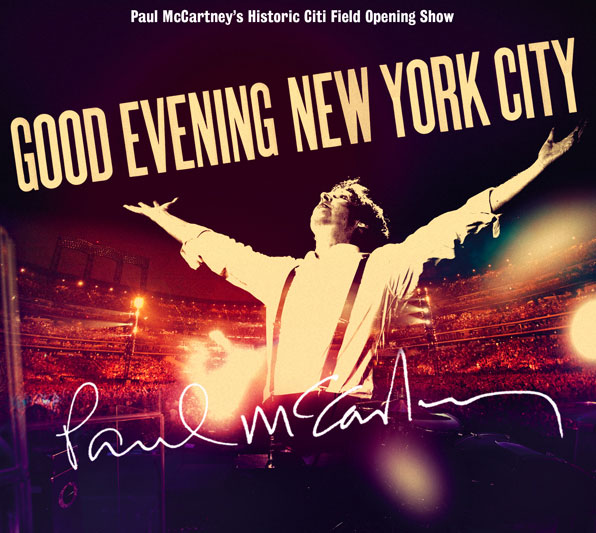
After dropping just one live album in the first half of his solo career, Paul McCartney opened the floodgates over the past two decades. Issuing six live albums since 1990, McCartney has faithfully documented nearly all of his tours and several special performances, but “Good Evening New York City” stands out. The two-CD, one-DVD set documents McCartney’s three-night inaugural performance at the Mets new home Citi Field last summer. Backed by his tight, longstanding quartet, Sir Paul unloads several surprises, like the forgotten “Mrs. Vandebilt,” a tribute to John Lennon with a medley of “A Day in the Life” and “Give Peace a Chance,” and the delightful segue way into Jimi Hendrix’ “Foxy Lady” at the end of “Let Me Roll It.”

Other delights are newer cuts “Only Mama Knows” and “See the Changes,” and the full-band arrangement of “Something” that echoes the performance at the Concert for George. Of course Beatle numbers are plentiful, but the obligatory “Hey Jude” and “Let It Be,” are countered with “Paperback Writer” and “Day Tripper.”

As with all McCartney live albums, the stage banter has been removed, giving the album a bit of a workman-like quality, as the band grinds through the songs with only brief pauses. This editing creates some curious results, such as Billy Joel’s unannounced duet on “I Saw Her Standing There,” or the accidentally buttressing of “Yesterday” and “Helter Skelter” (there was likely an encore break separating the two).

Although there are many places to hear Sir Paul shuffle through the world’s greatest jukebox, few are this energetic or diverse.

When R.E.M. released their last live album, “R.E.M. Live,” only two years ago the band seemed to be running on fumes. Following the disappointing “Beyond the Sun” album with a stop-gap, hits-in-concert set as generic as its title was a naked, holiday cash grab.

A lot has changed since then. Last year’s “Accelerate” brought the trio long-absent acclaim and reinvigorated both the band and its fans. Although “Live at the Olympia” was recorded only four months after “R.E.M. Live” the results couldn’t be more different. While “Live” hit all the obvious marks with little passion, “Olympia” digs deep into the catalog, offering early fan favorites “Driver 8” and obscurities like “Circus Envy.” “Olympia” boasts 17 more songs than “Live” and only two overlapping numbers, so both collections can coexist comfortably.

Fans excited by “Accelerate” will celebrate this 39-track collection. “Live at the Olympia” is the sound of a band being reborn.

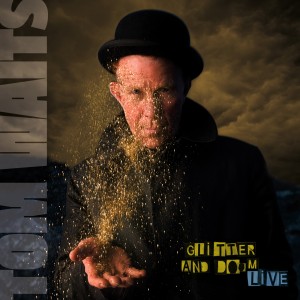
Unlike McCartney and R.E.M., it has been nearly a generation since Tom Waits last issued a live album. “Glitter and Doom Live” does a good job spotlighting Waits’ sonic shifts over the last several years, leaning heavily on tracks from his decade on the Anti- label. Drawn from stops along his 2008 tour of the same name, “Glitter and Doom Live” is more a sampler than a complete performance.

Most of the stage banter has been excised, hilariously, to the second disc. “Tom’s Tales” is a 36-minute montage of Waits’ musings about vultures, jokes about Nazi pasta and adventures on eBay that could stand on its own as one of the year’s best comedy albums.

The songs that made the cut, though, are invigorating. “Orphans” cuts “Lucinda” and “Fanin Street” are more raw while “The Part You Throw Away” is delicate and tender. “Get Behind the Mule” sounds like a voodoo chant at a deep South juke joint, and early cuts like “Singapore” and “I’ll Shoot the Moon” are completely reworked. While hardcore fans may have been happier with a set that recreated Waits’ concert experience, few will be disappointed with the 16 songs delivered.

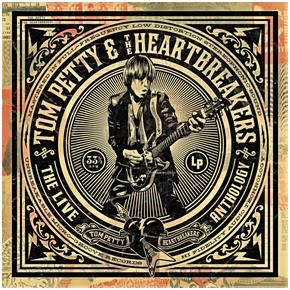
Tom Petty has issued more than a dozen albums during his hit-filled, three-decade career, but until now has only had one live album to his name. “Live Anthology” corrects that problem by offering 50 choice cuts spanning 30 years of gigs. The performances zig zag through the years, but the set flows, creating a dream concert spread across four discs (more if you buy the deluxe edition).

Although all the hits are here, the opening number, “Nightwatchman” shows how deep Petty is willing to delve. More than living up to its name, “Anthology” explores early performances of hits “Even the Losers” right up to full-band arrangements of “Square One” off Petty’s most recent solo album. A sing-along stroll through “A Thing About You” segues seamlessly into Bobby Womack’s soul ballad “I’m In Love.” Later, “Breakdown” slides into a few bars of “Hit the Road, Jack.”

There are no cuts from the Heartbreakers’ mid-‘80s stint as Bob Dylan’s backing band, but honestly, there are enough other incredible moments that they’re not missed. A sublime “Learning to Fly” with Stevie Nicks on backing vocals, an extended “Good to Be King” and unreleased originals like “Melinda” and “Driving Down to Georgia” and covers like “Good Good Loving” and “Goldfinger” (yes, that one) make the set an embarrassment of riches.

This collection not only cements the Heartbreakers’ legend as one of the tightest and most versatile bands of all time, but amplifies their love of rock and roll in all its forms. “Live Anthology” is both more consistent and comprehensive than Petty’s previous box set, the hits/album cuts/rarities collection “Playback.” It is the jewel of Petty’s catalog.

Bruce Springsteen rocks the Hall (part one)

(Above: Bruce Springsteen isn’t even close to being the biggest legend onstage in this historic performance of “I Saw Her Standing There” from 1987.)

By Joel Francis
The Daily Record

“Rock Hall Live,” an exquisite nine DVD box set of performances and speeches from the past 25 years of Rock and Roll Hall of Fame induction ceremonies is a treasure trove for all music fans, but it should especially attractive to Bruce Springsteen fans. Springsteen appears on all but two of the discs in more than a dozen performances and nearly as many speeches. As the unofficial MC of the collection, Springsteen makes more appearances than anyone else.

The Daily Record previously reviewed “Rock Hall Live.” On Monday and Friday of this week it will examine every Springsteen performance on the collection. Although these performances are scattered throughout the box set, we will look at them in chronological order. On Wednesday, The Daily Record will review Springsteen’s concert at the Sprint Center in Kansas City, Mo. (NOTE: Tuesday’s concert was cancelled because of the death of Springsteen’s cousin and road manager. On Wednesday The Daily Record will discuss Stevie Wonder’s 1968 hit “For Once in My Life.”)

1987 – “(Oh) Pretty Woman” (with Roy Orbison)

The footage from these early inductions – 1987 heralded the Hall’s second class of members – is shaky and the audio is questionable at best. Surrounded by Bo Diddley, Smokey Robinson, B.B. King, Carl Perkins and scores of other music legends, and awestruck Springsteen pays tribute to the man he immortalized in the lyrics to “Thunder Road.” Springsteen is so excited he forgets the song in a couple places, but his joy at being able to celebrate with Roy Orbison is infectious. Two years later, Orbison was gone and Springsteen paid him another tribute by performing “Crying” at that year’s ceremony.

1988 – “I Saw Her Standing There” (with Mick Jagger and the Rock Hall Jam Band)

It takes the cameraman a few moments to find the vocalist amongst the throng of performers onstage, but the camera finally lands on Billy Joel, belting out the first verse from the peanut gallery. Mick Jagger takes the second verse with an assist from George Harrison. Somewhere onstage, Ringo Starr is one of several happy drummers, making the occasion the closest thing to a Beatles reunion to happen until the Anthology project. (Paul McCartney was feuding with Harrison and Starr at the time and opted not to attend.) After a guitar solo from Jeff Beck, Springsteen finally gets the mic for the third verse. Despite forgetting a few of the words, he exuberantly finishes the number with Jagger.

1988 – “(I Can’t Get No) Satisfaction” (with Mick Jagger and the Rock Hall Jam Band)

In his 2004 speech inducting Jackson Browne to the Rock Hall, Springsteen says he wishes he’d written “Satisfaction.” Sixteen years earlier, Springsteen realized part of his dream by performing the number with half of its authors. Surrounded by John Fogerty, Bob Dylan, Harrison, Beach Boy Mike Love, Jeff Lynne, Tina Turner, Ben E. King and keytar-rocking band leader Paul Schaffer, Springsteen trades lines with Jagger on the chorus. Sporting a gray suit and bolo tie and backed by E Street drummer Max Weinberg somewhere in the swarm, Springsteen is little more than a vocal prop in this chaotic number.

1993 – “Green River,” “Born on the Bayou,” “Who’ll Stop the Rain” (all with John Fogerty and Robbie Robertson)

Springsteen plays rhythm guitar and adds backing vocals to this trio of Creedence Clearwater Revival classics. Still upset at his former CCR band mates, John Fogerty refuses to perform with Doug Clifford and Stu Cook. The tension between the three is evident during the acceptance speech, but it completely dissolves once Fogerty straps on his guitar and steps behind the mic. The songs don’t really need three guitarists, but Springsteen is elated to be performing with yet another idol and happy to let Robbie Robertson and Fogerty do all the heavy lifting. There is also rehearsal footage of Springsteen, Fogerty, Robertson and bass player Don Was playing around with different arrangements. Robertson is clearly in charge of the ensemble and again Springsteen seems content to observe. Springsteen does jump into action, however, to work out the harmony vocal line with Fogerty and to successfully lobby for the inclusion of “Green River.”

1994 – “Come Together” (with Axl Rose)

This is a bad idea on paper and it’s even worse onstage. Springsteen looks stiff, sharply strumming a black Stratocaster that matches his tuxedo. A few paces away, Axl Rose more relaxed wearing jeans and flannel as he bobs and weaves like a snake hearing some inaudible flute. This isn’t a duet so much as two performers doing the same song in a shared space. Rose’s voice is fine in its own context, but it’s rarely complementary. His performance here is so grating it makes one long for Aerosmith’s version (shudder). Springsteen seems relieved when the song finally ends.

Keep reading:

Springsteen Rocks the Hall (part 2)

Review: Boss is Bigger than Big 12 Tourney (2008)

Bruce Springsteen and Tom Morello – “The Ghost of Tom Joad”

Review: Springsteen’s “Dream” Needs More Work

Springsteen in the Waiting Room: Drop the Needle and Pray

New DVD Set Celebrates Rock Hall Performances

More Bruce Springsteen in The Daily Record

New DVD Box Set Celebrates Rock Hall Performances

rock hall dvds

By Joel Francis

When the Rolling Stones were inducted into the Rock and Roll Hall of Fame in 1989, a tuxedo-clad Mick Jagger famously announced “Tonight we’re all on our best behavior — and we’re being rewarded for 25 years of bad behavior.”

That irony is on full display throughout eight of the DVDs in a new collection of induction ceremony performances released by Time Life and the Rock Hall this month. (A ninth disc features highlights from the 1995 Concert for the Rock and Roll Hall of Fame held in Cleveland.) Despite white tablecloth banquet tables and austere surroundings, great music frequently prevails.

The “Rock Hall Live” discs each run between 75 and 90 minutes and have a loose theme of soul, punk or ‘50s pioneers and the performances span the first ceremony in 1986 to this year’s Metallica induction. The performances tend to fall in two camps.

The early ceremonies were all-star celebrations of the inductees’ songbooks shot with on a couple video camera. Through fly-on-the-wall footage we see Jerry Lee Lewis and Chuck Berry swap verses on “Roll Over Beethoven” and Little Richard rejoice through “I Can’t Turn You Loose” as Jagger, Bob Dylan, members of the Beatles, Beach Boys and other rock royalty stand shoulder to shoulder, holding mics and strumming instruments. It’s fun to play spot the artist during these early presentations. Sometimes the results are shocking, as when Stevie Ray Vaughan appears – playing a Les Paul, no less – during “Beethoven.”

As the ceremonies grew in stature, the performances were better preserved and choreographed. The past 15 years of inductions play like one massive VH1 special, makes sense as these events have been a spring broadcast staple on that channel for better than a decade. Although the production is smoother, the spontaneity is retained when Jimmy Page casually strolls onstage to join Jeff Beck on “Beck’s Bolero” and Queen jam with the Foo Fighters on “Tie Your Mother Down.”

With are more than 100 performances across the nine discs, some unevenness is expected. Some this is because of the health of the performers. These discs capture some of the final appearances by The Band’s Rick Danko, Ruth Brown, Lynyrd Skynyrd’s Billy Powell and Johnny Cash. Brown and Powell are fine, but Danko and Cash labor through their sets. Sometimes the pairings misfire, as on Bruce Springsteen and Axl Rose’s duet through “Come Together.”

These missteps are minimized by the tight pacing of each disc, which moves from artist to artist like a well-paced soundtrack, with occasional snippets of introduction and induction speeches. (Complete version of selected speeches are available as bonus features.)  Despite the loose themes, each disc boasts a variety of guitar heroes, singer/songwriters, tributes and hits.

The best moments come when the performers reach beyond the formal atmosphere, like when Patti Smith spits onstage, or two kids bum rush the stage to help Green Day commemorate the Ramones. There is an impressive display of solos from guitar heroes Beck, Page, Eric Clapton, Buddy Guy, B.B. King, Joe Perry, Carlos Santana, Peter Green, and Kirk Hammett, but the greatest six-string moment is Prince’s searing tribute to George Harrison on “While My Guitar Gently Weeps.” Anchored by Tom Petty, Jeff Lynne and Harrison’s son Dhani, the immaculately tailored Prince soars on an jaw-dropping solo that is long on both melody and style.

Each disc contains about a several bonus features, which highlight backstage moments like watching Steven Tyler and Joe Perry induct Led Zeppelin from the wings of the stage with the band (and Willie Nelson!). It’s fun to watch Robbie Robertson, Bruce Springsteen and John Fogerty work out “Green River” and to eavesdrop on Hammett and Perry talk about guitars, but one viewing is probably enough.

One downside to this set is the packaging and sequencing. Each disc is housed in its own separate, full-sized case. This takes up a lot of shelf space. It would have been nice if they all came bundled in one compact, cardboard and plastic unit like seasons of TV shows.

The greater inconvenience is the sequencing. Cream’s three-song reunion from 1993 is spread across three discs. Ditto for the Doors’ 1993 set with Pearl Jam’s Eddie Vedder (three songs over three discs) and Bruce Springsteen’s E Street revival from 1999 (four songs on four discs). Culling the best moments is understandable, but it would have been great to get the multi-song sets in one place. It is also puzzling that less than two hours of the six-hour Concert for the Rock and Roll Hall of Fame are included.

Oversights aside, any of these discs stand alone as a fun romp through rock history and celebration of its greatest songs and players across most genres and eras. At $120, this set isn’t cheap, but it’s a heck of a lot more affordable – and easier to come by – than the ticket that gets you a plate at one of those sterile, banquet tables. You don’t have to dress up, either.

(Full disclosure: The Daily Record received a complimentary review copy of “Rock Hall Live.”)

Keep Reading:

Rock Hall Celebrates 50 Years of Motown

Rock Hall Celebrates the 40th Anniversary of Woodstock

George Kalinsky: Painting with Light (Rock Hall photo exhibit)

Bruce Springsteen Rocks the Hall (part one)

Bruce Springsteen Rocks the Hall (part two)

Beatles’ cash grab redefines “Money for Nothing”

(Above: Generations later, Paul’s message still rings out: “You Never Give Me Your Money.”)

By Joel Francis
The Daily Record

Hold tight to your pocketbooks; 9/9/9, the inverted day of the Beast draws neigh.

As any Beatle fan will tell you, Aug. 9 is not only the day Beatles edition of Rock Band lands in stores, but when the remastered Beatles albums will finally be released. On CD, that is, not to iTunes.

That information has been second only to anything related to Michael Jackson or Jack White in the online news hemisphere. The buried story, however, is that the Beatles trail only KISS in their devotion to part fans from their money.

Earlier this week, Paul and Ringo teased the public with their “Box of Vision,” an LP-sized storage container-cum-book for the upcoming remasters. The $90 artifact contains full-size replicas of all the original LP artwork, spiffy new sleeves to house the disc and a “Catalography” guidebook. Inventing new words doesn’t make this a better value.

Basically what you get with this set is a guidebook of discography information readily accessed online, blow-ups of all the artwork that will accompany the CDs and a mega-expensive flip-book. To top off the insult, the flip-book contains slots not only for the traditional catalog (i.e. “Please Please Me” through “Let It Be”) but posthumous releases like “Live at the BBC,” “Love,” and the “Anthology” series. That’s fine, but why are there spaces designated for the red and blue albums and “1” collection? That material is already presented throughout the rest of the catalog.

It’s easy to be cynical and say this move is designed to rankle completes and make them buy redundant collections. It’s easy because even a quick glance at the Beatles online store will jade the most intensely optimistic fans.

When the 40th anniversary of the White Album hit last summer, the Beatles did not release the long hoped-for remastered edition. They offered a $530 white pen. Last year also marked the 40th anniversary of the “Yellow Submarine” film, which one could commemorate with a $200 9-inch figurine or a $65 Yellow Submarine “musical globe with Nowhere Man base.” (I wonder who decided they could get more for a Nowhere Man base over a Blue Meanie base.) Oh, and don’t forget to get a jump start on the 45th anniversary of “Help” buy grabbing the $121 deluxe edition DVD with a reproduction of the script and 60-page book with rarely seen photos.

Official band stores are rarely a bargain, but asking $33 for “Live at the BBC,” $30 for the red and blue albums and $35 for the “Anthology” entries is insulting, especially since all these items may be found on Amazon for about $10 (some are significantly cheaper). You can find a used version of the “Help” deluxe edition for $25 there, too.

The Beatles have a big and diverse enough fan base that more than a few of their admirers can afford to spend extravagantly. But shouldn’t they be getting more bang for their buck than $1,000 album cover lithograph collection?  (I wonder if there’s a connection between these prints and what appears in the Box of Vision.) Is a Beatles edition of Monopoly or Trivial Pursuit really worth double the price ($40)?

Instead of wasting fans’ time and money with worthless trinkets, the band giving the fans what they want. The remastered CDs would have meant something if they appeared six or seven years ago when the upgraded Bob Dylan and Rolling Stones catalogs were introduced. And instead of hoarding the non-album and alternate cuts until the Past Masters and Anthology releases, they could have been sprinkled on the intended albums, creating a sense of context.

Ironically, by trying to dictate the conversation and sell overpriced novelties, Paul and Ringo have inadvertently left piles of cash on the table. Unable to find legitimate remasters, the “purple chick” bootlegs appeared. Unable to legally download the catalog, torrents and illegal MP3s proliferated the Web.

If Paul and Ringo really wanted to create a stir and control the game, they would mine the Apple vaults and create something as innovative, comprehensive and entertaining as Neil Young’s “Archives” box set. Instead, the pair end up looking as backwards and out-of-touch as all the bands that tried to keep up them back in the ‘60s.

The Four Tops – “Reach Out (I’ll Be There)”

Four-tops-reach-out-1966

The Four Tops – “Reach Out (I’ll Be There),” Pop # 1, R&B # 1

By Joel Francis

The dramatic introduction to “Reach Out (I’ll Be There)” owes more than a little to Phil Spector’s Wall of Sound and was Motown’s most cinematic chart-topper to date. While the flute gets the signature melody, check out James Jamerson’s uber-melodic bassline bubbling underneath the bevy of instruments. Paul McCartney gets a lot of (deserved) credit for his inventive basslines, but Jamerson’s brilliant countermelody here rivals anything McCartney came up with the Beatles – OK, maybe not “I Feel Fine” – and should permanently insert Jamerson into the ‘60s bass legends conversation.

The song was written by the white-hot trio of Holland-Dozier-Holland – there were actually other Hitsville employees at the time, although one wouldn’t know it by looking at the Billboard charts – but Norman Whitfield supplied the galloping percussion. Propelled by HDH’s rich arrangement, “Reach Out” starts strong and continues to build through the verse, dropping off and resting slightly before the Tops casually fall into the chorus. Lyrics could almost become superfluous with a melody this strong, but lead singer Levi Stubbs’ words of commitment and devotion are equally compelling.

Although the song became the Tops signature number, Stubbs initially felt his voice was too rough for the song and tried to recuse himself. Fortunately, HDH prevailed on Stubbs to give it a try. Stubbs promptly delivered one of the great vocals in the Motown catalog. Critics who pick on “overproduced” songs like this as examples of the slick Motown sound need to pay more attention to Stubbs’ vocals. His signing is as gritty and soulful as anything in the Stax cannon. Marvin Gaye and Smokey Robinson may sound a little stilted in singing in front of Stax’ incredible house band Booker T and the MGs. It’s not hard to imagine Stubbs being more than up to the task. Unfortunately such cross-pollination never occurred, but with the advent of ProTools and continued merger of major record labels, maybe the Motown and Stax catalog will end up under the same corporate umbrella and someone will give us a recreated session.

Stubbs’ soulful signing on “Reach Out” inspired a lot of people – unfortunately it inspired a lot of the wrong people. While the ability to sing soul music is not racial, a whole lotta white dudes certainly tried to make the case. Elton John, Michael Bolton and Michael McDonald all failed on this number. More successful were Diana Ross, who took her cover into the Top 40 in 1971, and Gloria Gaynor, who did a disco version just four years later.

Traveling Wilburys – “Inside Out”

(Above: The Traveling Wilburys turn “Inside Out.”)

By Joel Francis
The Daily Record

Their meeting was almost too serendipitous. Fresh off the success of “Cloud 9,” George Harrison and producer Jeff Lynne decided to record a b-side with Roy Orbison. When the entourage reached Tom Petty’s house to retrieve Harrison’s guitar, Petty insisted on accompanying the trio to their destination: Bob Dylan’s studio. Dylan was home, of course, and the quintet became the greatest supergroup ever: the Traveling Wilburys.

When the group reconvened two years later in 1990, a lot of the magic was gone. Orbison had died and the remaining members no longer had the element of surprise on their side. Indeed, expectations were set so high not even the century’s greatest songwriter, a former Beatle and a pair of hit-making disciples of both could live up to the standard.

Much of the Wilburys’ sequel, “Volume 3,” sounds forced and lacks the laidback organic vibe that made the first album such a delight. But they got it right in a couple places and “Inside Out” is a lost gem of the era.

Both the second song on “Volume 3” and second single released from the album, “Inside Out” is a transparent look at the Wilburys’ songwriting process and joy that manages to be greater than the sum of its considerable parts.

After opening with a chord progression that sounds like something off Petty’s then-recent “Full Moon Fever” album, Dylan delivers a verse that almost makes “Wiggle Wiggle” look like “Desolation Row.” But the lyrics aren’t that important. The song’s charm lies in the way Dylan’s verse slides into Lynne’s slick multi-tracked bridge that prefaces Petty’s catchy chorus. Oh, and just for good measure Harrison contributes a middle eight that rivals anything his ex-Beatle bandmates ever wrote.  All the ingredients are wrapped in Lynne’s signature production and over in three and a half minutes.

Like a jewelry store exhibit, everything is on open display yet just out of reach. “She’s My Baby” may have been the biggest single and “Wilbury Twist” the most memorable song, but nearly 20 years later, “Inside Out” still sparkles the brightest.

George Kalinsky: Painting with Light

ejjl1
(Above: Elton John and John Lennon at Madison Square Garden, 1974.
All photos by George Kalinsky, courtesy of www.georgekalinsky.com.)

By Joel Francis

In his 34 years as Madison Square Garden’s official photographer, George Kalinsky has forgotten more games, concerts and events than many people could see in several lifetimes.

Kalinsky, who estimates he has shot more than 8,000 events, can be forgiven for having no memory of Bob Marley’s next-to-last performances in 1978, because what he remembers more than makes up for any lapses.

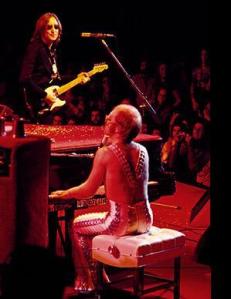
“November 28, 1974. Don’t ask me how I remember that, but I do,” Kalinsky said with a laugh. “Elton John was playing the Garden, and he surprised everyone by having John Lennon join him onstage. Those three songs they did together turned out to be the last time John Lennon performed before he was shot. The moment I captured won’t be there again.”

Several of Kalinsky’s favorite moments are on display for a current exhibit at the Rock and Roll Hall of Fame in Cleveland. “Live From Madison Square Garden: From the Lens of George Kalinsky” opened May 1 in the Ahmet M. Ertegun Main Exhibit Hall and will run through January 2010.

“I’ve always tried to paint with light,” Kolinsky said. “Shooting against a plain black background is not the most creative, but it’s what you usually see. These performers spend millions on lighting and effects. I always try to capture that as part of the atmosphere of the performance.”

fullscreen-capture-562009-34913-pmbmp1

The atmosphere for the Rolling Stones’ Garden concert in 1969 was a frenzy. The show was one of the first arena rock concerts and the pandemonium was captured and released on the Stones’ great live album “Get Your Ya Ya’s Out.”

“That was the first time I saw a buzz, a reaction like that in the audience. Everyone wanted to be onstage and the crowd started gradually pushing forward,” Kalinsky said. “I went under the stage and went on in the back and got some amazing shots.”

Getting the audience’s reaction to the band was the key to recording the moment, Kalinsky said.

“I think a huge part of the story is the people and how they react,” he said. “There may not be too many pictures in this exhibit of the crowd, but I always try to include them. Every audience is different, just as a circus is different from a track meet and hockey is from basketball. The audience is a reflection of the performance.”

The crowd at a 1974 Bob Dylan performance played a key role in a shot Kalinsky called one of the top two or three photos he’s taken.

“Dylan is Dylan, the hair, the body language, all of it connecting and seeing the audience reach out to him is beautiful and telling,” Kalinsky said. “With him, the words are so important; when I look at Dylan I try to capture the aura of the man.

“I want to get a little closer to see what his face looks like,” Kalinsky continued, “and how it shows the years, not in terms of getting older, but the years of performing with the audience and how that bond grows stronger and stronger.”

fullscreen-capture-562009-35709-pmbmpDylan played a key role in George Harrison’s 1971 Concert for Bangladesh at the Garden. Shooting both of those shows not only taught Kalinsky that music was the true universal language, but showed him how far the Garden’s stage extended.
“I was in a cab recently and the driver was from Bangladesh,” Kalinsky said. “He couldn’t have been more than 35 or 40 years old, but he said in the hearts of his family and friends in Bangladesh they would never forget Madison Square Garden. They weren’t there (at the Concert for Bangladesh), but they’d never forget because that’s where people learned to help his country and family.”

Events at the Garden, Kalinsky said, “become part of our culture and part of our world. It wasn’t long ago we had 9/11 and that concert. Even if you weren’t there, you were there because everybody in the world tuned in to the Concert for New York City.”

What stands out in Kalinsky’s mind from that show isn’t the defining performances from Paul McCartney, the Who and artists with ties to the Big Apple like Jay-Z and Bon Jovi, but a moment backstage with Billy Crystal before he was about to go on.

“I asked him how does he project his talent when the audience is in tears and police and firefighters are holding up pictures (of their missing loved ones)?” Kolinsky said. “He said the hardest thing to do was be funny in the face of an audience who had lost so much.”

Although Kalinsky’s relationships and reputation allowed him backstage that day, he acknowledged access has been almost completely shut down from the early days when he would take pictures of Elvis Presley in the dressing room before his first Garden concert or Sly Stone’s groomsmen getting ready before Stone’s onstage wedding in 1974.

And just as backstage has become more restrictive, the window for taking performance photos has been confined to the first three songs. That doesn’t bother Kalinsky, though, because digital technology and automatic lighting systems within the camera let him do as much with those three songs as he could in an entire show in the days of film.

“However, in terms of taking pictures it always comes down to the eye and the moment,” Kalinsky said. “You have to recognize the moment and snap the picture. This is the most important aspect, whether you are shooting a concert, sporting event or portrait setting. It’s what I’m always looking for.”

Kalinsky’s duties have also given him a window on the 1994 Stanley Cup Finals, Knicks games, scores of the world’s top athletes and personalities. This diverse shooting background has provided enough photos to fill eight books and exhibits from the Museum of Modern Art to the baseball and basketball halls of fame.

“The Garden stage, whether it’s Muhammad Ali, the Pope or LeBron James, brings out the best in every performer,” Kalinsky said. “Every day I walk into the Garden I say what a privilege it is to be part of this arena and the best stage in the whole world.”

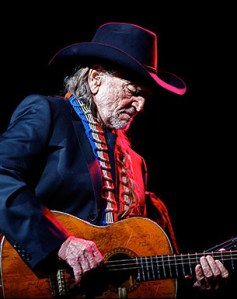
(Below: A recent portrait of the Red-Headed Stranger.)

fullscreen-capture-562009-40105-pmbmp

Keep Reading:

Rock Hall Celebrates 50 Years of Motown

Rock Hall Celebrates the 40th Anniversary of Woodstock

Bruce Springsteen Rocks the Hall (part one)

Bruce Springsteen Rocks the Hall (part two)