Social Distancing Spins – Day 53

By Joel Francis

Insurgence DC – Broken in the Theater of the Absurd (2019) Insurgence DC formed in the late ‘80s, but Broken in the Theater of the Absurd is just their third album, arriving 19 years after their previous release. The Washington D.C.-based punk trio has plenty to say about the corruption and incompetence they see around their hometown. Reading the lyrics printed across the back of the album, one could be forgiven for thinking she was looking at a Billy Bragg broadside. What keeps songs like “Poison Profits” and “Third Party Opinions” from being op-ed pity parties is a well-seasoned band that plays well off each other and knows how vary textures and arrangements to keep the music fresh. The aggressive songs are tempered by flourishes of avant noise (think Sonic Youth), post-punk moodiness and the gleeful ska of “Pick Pocket Pirates.” Fans of the Dischord label and anyone P.O.ed by the current political landscape will find a lot to like in the Theater of the Absurd.

Miles Davis – In a Silent Way (1969) I shudder to think how Miles Davis would have responded to the age of Twitter. Davis has been dead for nearly 30 years and audiences are still trying to catch up to what he was doing. The period when In a Silent Way came out demonstrates Davis’ restlessness and ambition. Just a year earlier, Davis disbanded his second quintet, one of the most incredible ensembles in music history. Three members of that quintet appear on In a Silent Way, but are used in completely different ways and surrounded by a host of other musicians. I’m having trouble coming up with a contemporary corollary for the sounds here. The last couple Davis quintet albums hinted at this direction, but In a Silent Way’s music still sounds surprising and fresh more than half a century later.

Neither rock, nor jazz (and not fusion), the closest touchstone to the music on In a Silent Way might be a psychedelic, improvised version of Brian Eno and Robert Fripp tried to accomplish both together and on their own in the mid 1970s. In fact, John McLaughlin’s electric guitar that opens the second side on “In a Silent Way/It’s About that Time” sounds like what Daniel Lanois would play with Eno in the 1980s. Davis had long moved on by that point, of course. He jerked even more heads by releasing Bitches Brew, another masterpiece, the following year. The vast expanse of the universe is barely enough to contain all of Davis’ ideas. I’m glad he never had to face myopic imbeciles limited to 280 characters.

Alex Chilton – Songs from Robin Hood Lane (compilation) What is it about the Great American Songbook of the 1930s to ‘50s that compels repeated interpretations? Late in his recording career Alex Chilton drew from this well for two solid albums. The output bears absolutely no resemblance to the power pop that Chilton created with Big Star or the blue-eyed soul he brought to the Box Tops. While no one would confuse him with Grant Green, the albums do reveal Chilton has decent jazz guitar chops. Chilton’s phrasing and vocal delivery also depict him as someone completely at home in this style of music. The title of this collection holds the key to Chilton’s comfort with these jazz standards. Robin Hood Lane was the name of the suburban Memphis street where Chilton grew up hearing his mom play these classic songs endlessly. Come to this collection not expecting “September Gurls” or “Cry Like a Baby,” but with an open mind to hear another facet from a criminally neglected (by mainstream society and himself) artist.

Eddie Hazel – Game, Dames and Guitar Thangs (1977) Parliament-Funkadelic guitarist Eddie Hazel left his stamp on many P-Funk classics (dig “Maggot Brain” as Exhibit A) but this was the only solo album released in his lifetime. Solo is a relative term here. Bassman Bootsy Collins co-wrote three of the songs here and keyboard legend Bernie Worrell is credited on two. Those two, plus the Brides of Funkenstein and a host of other P-Funk players all appear, but the album really does belong to Hazel. He transforms “California Dreamin’” into a slow jam and turns the Beatles “I Want You (She’s So Heavy)” into an acid-drenched guitar workout. The original songs fit well into the P-Funk songbook, but Hazel’s playing is remains prominent throughout. Although Hazel continued to sporadically appear on P-Funk releases after this album dropped, he was never as prominent as before. Thankfully back in print, Game is essential not only for P-Funk fans, but anyone who wondered what Jimi Hendrix or Ernie Isley might have sounded like fronting a funk band.

Tom Petty and the Heartbreakers – Hard Promises (1981) Nearly 40 years ago, when Hard Promises came out, MCA records wanted to hike the price to $9.98. Today, you can down the album on iTunes for $9.99. Inflation, huh? Petty and the boys refused to be the reason their label nicked fans an extra buck and Hard Promises eventually came out at the standard price of $8.98. Regardless of how much you paid, the music here is worth the investment. The songwriting on Hard Promises is every bit as good as Damn the Torpedoes, the band’s previous album, but doesn’t suffer from the same overexposure. The album starts with the classic “The Waiting” before leading into “A Woman in Love (It’s Not Me),” the album’s second single. The remaining eight songs are all album cuts, but still beloved to hardcore Petty fans. Stevie Nicks duets on the gorgeous “Insider,” the Heartbreakers roar on “A Thing About You” and the album ends with another delicate ballad, “You Can Still Change Your Mind.” In between we get the slinky “Nightwatchman” and “The Criminal Mind,” which opens with a slide guitar part that sounds like a country version of the riff from “Mary Jane’s Last Dance.”

Heartbreakers bass player Ron Blair left after this album and didn’t return until 20 years later. Of the four original-lineup Heartbreakers albums, Hard Promises is easily my favorite. Heck, it might be my favorite Petty album pre-Full Moon Fever. Either way, all American rock fans need this album.

The Roots – Game Theory (2006) The Philadelphia natives that comprise The Roots are often labelled the best band in hip hop, an unsubtle jab at other groups that don’t play traditional instruments. Twenty-seven years after their debut album, I think it’s past time to drop the sobriquet and call them what they are: One of the best bands ever. Full stop. After striving (and compromising) for mainstream success on their previous album, The Roots went all-in on a darker, stripped down sound for Game Theory. Even though they weren’t aiming for the charts, I find myself humming the hooks in these songs for days afterward. Named after a mathematical model for decision making, Game Theory stares at big-picture topics like police brutality, drug addiction, poverty and dishonest media outlets. MC Black Thought’s isn’t afraid to drop heavy lyrics, but his delivery swings enough that you wind up tapping your foot as you nod your head. “Clock With No Hands” isn’t just a thought-provoking (no pun intended) look at addiction, but features a beautiful original (read: non-sampled) melody. In fact, one of the few samples on the album comes when Thom Yorke’s voice floats in and out of “Atonement.”

I saw The Roots perform with a full horn section on back-to-back nights of the Game Theory tour and they are among the best shows I’ve ever seen. Not in hip hop, but among everyone. Full stop.

Various Artists – Lows in the Mid-Sixties: Vol. 54: Kosmic City Part 2 (compilation) Between 1967 and 1973, Cavern Studios in eastern Kansas City, Mo., were a hotbed of recording activity. Local groups could venture into the subterranean limestone cave where the studio was located and, for the right amount of money, walk out with a record. The best of the rock sides were compiled on Numero’s exquisite collection Local Customs: Cavern Sounds, shown back on Day 12. Lows in the Mid-Sixties is a companion to that release, rounding up 14 covers of well-known hits by bands you’ve never heard. It is solid garage rock with a touch of psychedelia sprinkled across for good measure. One of my favorites is Dearly Beloved’s version of Bob Dylan’s “It’s All Over Now Baby Blue.” Dearly Beloved have clearly studied Van Morrison and Them’s cover, but removed the shimmering signature guitar line (later sampled by Beck on “Jack Ass”). The music here is far from essential and I’m not sure how interesting it might be to an audience beyond KC’s metropolitan area, but it proves the local music scene was humming around the Age of Aquarius.

Social Distancing Spins – Day 52

By Joel Francis

Missouri’s governor announced concerts can resume starting today. I want live music back as much as the next fan, but I hope public health is quite a bit stronger before I’m standing shoulder-to-shoulder in a sweaty club again. Until that day arrives, I’ll be back in the stacks.

Art Blakey’s Jazz Messengers – A Night in Tunisia (1957) Several years ago, I was record shopping with my sister in New York City. We both saw a copy of this album at the same time. Being a good sibling, I let her grab it. The moment we got home and placed it on the turntable, I realized I had made a mistake. Fortunately, I ran across another copy fairly quickly. Like many 20th century jazz artists, Art Blakey was so prolific and excellent, deciding what to listen to in his vast catalog can feel a lot like throwing a dart. The nearly 13-minute version of Dizzy Gillespie’s classic title song starts with a thunderous drum solo from Blakey before settling into the familiar melody. Jackie McLean’s alto sax spars with Johnny Griffin’s tenor saxophone throughout the album, creating a great tension and dynamic. This twin-reed lineup was a rarity in Blakey’s Messengers, which usually stuck to the classic quintet format. Later, the group tackle’s Sonny Rollins’ “Evans” and the Blakey and McLean co-write “Couldn’t It Be You?” This is a gem where every number flies past, leaving a smile burned onto my face and me wondering where three-quarters of an hour went so quickly.

Wilco – Live at the Troubadour, L.A. (1996)
Sleater-Kinney – Live in Paris (2017)
By the time Wilco officially released Live at the Troubadour, L.A. on Record Store Day a few years ago, the version of the band on the album was a distant memory. While many of the songs performed on this album remain in the band’s setlists today, the pedal steel guitar and alt-country mindset that propels the archival show are vestiges of the last century. The 90-minute set leans heavily on the then-new Being There album. Songs from the band’s debut and a few Uncle Tupelo covers round out the rest of the evening. Wilco was still finding their sound at the time, as illustrated by two divergent, back-to-back versions of “Passenger Side.” The first attempt sounds like a lost early Replacements song. The second rendition is slower than the album version and plays up the country elements.

Live in Paris was recorded on Sleater-Kinney’s immensely successful reunion tour just a few years ago, but already seems just as dated the Troubadour performance. S-K drummer and not-so-secret-weapon Janet Weiss left the band in 2019 after recording their most recent, synth-heavy album. It remains to be seen how the older material will be interpreted through this sleeker, slinkier lens (and with a new drummer). Regardless, Live in Paris is a triumphant encapsulation of S-K’s triumphant return.

I’m crossing my fingers I’ll get to witness both Wilco and Sleater-Kinney later this summer. The two bands announced a joint, co-headlining tour last winter, just before the pandemic crystalized our world in amber. With tickets in hand, I hope the public health is sufficiently strong enough to keep this tour a reality.

In the Pines – self-titled (2006) This six-piece Americana band from Kansas City was a true gem in its time. I remember going to the album release concert at the old RecordBar and everyone in the room being both entranced by the music and elated it was finally available to play at home and share with friends. Taking their name from the old folk tune, In the Pine’s music is moody and foreboding. The violin laced through all melodies adds a mournful Gothic element to the arrangements. Sadly, the group fizzled away when half the members moved out of town. About five years ago, the group reconvened for a reunion show – with new songs to boot – but then fell silent again. As recently as March of this year, there was talk of a second album underway. My fingers are crossed that the pandemic doesn’t prevent this from happening.

While we’re on the topic of Kansas City folk bands from the early days of this century, I want to shout-out Oriole Post. They only released one album and never pressed it to vinyl, but their hopeful, energetic music was always inspiring. Sadly, they were another band with a ton of promise that faded away before capitalizing on their potential.

Idles – Joy as an Act of Resistance (2018) Tucked near the end of the British punk group’s second album is a cover of Solomon Burke’s 1961 hit “Cry to Me.” Idles replace the New Orleans shuffle of the original with a post-punk drone and own the cover so convincingly it feels like one of their own. The choice is a nice encapsulation of Idles as a whole. They sneer like the Sex Pistols, but have the soul (and politics) of The Clash. One of the catchiest songs on the album, “Danny Nedelko,” champions immigration by telling the story of the Heavy Lungs’ – another British punk band – lead singer. Most bands sing about love, but singer Joe Talbot espouses true brotherly love and is utterly unafraid to wear his heart on his sleeve. Even more rare than an earnest punk cover of an old R&B tune is honest, heartfelt embrace of emotion, free of irony and other filters. The Idles aren’t afraid to go there, either. “June,” is a devastatingly moving song about the loss of Talbot’s baby daughter.

I saw Idles almost one year ago with Fontaines D.C. and it was one of the best punk shows of the year. In the time since, Idles have released a live album captured on that same tour. Few acts are able to simultaneously channel such intensity and vulnerability as Idles. I can’t wait to see what they bring us next.

Social Distancing Spins – Day 48

By Joel Francis

Bill Haley and his Comets – Bill Haley’s Greatest Hits (compilation) I hope the flower child on the cover of this album is enjoying Haley’s early rock and roll hits. At just 11 songs, this collection seems a bit skimpy at first glance. Thankfully, it contains all of Haley’s major hits: “Rock Around the Clock,” “Shake, Rattle and Roll” and “See You Later, Alligator.” The other eight tracks are a mixed bag. “The Saints Rock and Roll” is a rocked-up version of “When the Saints Go Marching In.” A cover of Louis Jordan’s “Choo Choo Ch’boogie” is fun, if inessential. The songwriters of “Skinny Minnie” and “Razzle-Dazzle” put all their energy into coming up with a rhyming title and forgot to write a decent song to go with it. Then there’s “Thirteen Women (and the Only Man in Town),” a bizarre fantasy about being the only man to survive the apocalypse and finding himself with a baker’s dozen willing women. It may be the best non-hit on the album. After all is said and done, 11 songs seems about right.

Janelle Monae – Dirty Computer (2018) The third album from Kansas City, Kan., native Janelle Monae is a triumph. She pays tribute to her late mentor Prince, while also capturing and commenting on the political landscape. To a president who boasts about grabbing women, Monae bluntly warns “if you try to grab my pussy cat, this pussy grab you back” (on “Juice”). To the war hawks, Monae threatens “we’ll put water in your guns/we’ll do it all for funs” (on “Screwed”). The music is as carefree and fun as the lyrics are serious. The hit Prince tribute “Make Me Feel” provides a break from the politics and is a definite highlight, but the album closer “American” plays like another tribute to the Purple One. Against an arrangement that sounds lifted from Around the World in the Day, Monae describes the vision of America she is fighting for. If a dance party happens to break out en route, well, that’s part of the plan, too.

Ramones – self-titled (1976) One, two, three, four and away we go into a new landscape of rock and roll. Part surf, part rockabilly, part girl group pop and all fun. The 14 songs on the Queens-based punk band’s debut album rocket past in less than a half an hour, barely pausing to catch their breath. Many of the Ramones’ best songs can be found here – “Blitzkrieg Bop,” “Beat on the Brat,” “Judy is a Punk,” “53rd and 3rd” – and what isn’t appears on their next three albums. These songs are so imbedded into our lives today it’s hard to imagine the furor they generated when first unleashed on an unsuspecting world. We’re all the better for it, from the grizzled punkers who gobbed and pogoed to this music back in the day, to the tweener girls who rock Ramones t-shirts. God bless the Ramones.

Talib Kweli and DJ Hi-Tek – Reflection Eternal: Train of Thought (2000) Talib Kweli’s debut with Most Def as Black Star is so well-regarded that fans are still clamoring for a sequel more than 20 years later. Train of Thought established Kweli as a serious thinker and talent on his own. The spirit of the album is best encapsulated by the African proverb Kweli quotes on “Africa Dream”: “If you can talk you can sing/If you walk you can dance.” Working with a pastiche of neo soul, jazz and African rhythms, DJ Hi-Tek keeps the listener’s feet busy. Kweli works just as hard on the cranium, celebrating his ancestry, praising women, critiquing hip hop, contemplating love and so much more. Train of Thought never gets too heavy, though, thanks to Kweli’s deft lyrical flow and Hi-Tek’s soundscapes. This album was my go-to quite a while after it came out. I hadn’t listened to it for a while before today, but was instantly reminded of why I loved it so much. A classic.

Social Distancing Spins – Day 47

By Joel Francis

Stay strong and stay safe, my friends.

Johnny Cash – American IV: The Man Comes Around (2002) The final Johnny Cash album released in Johnny Cash’s lifetime is appropriately fixated on mortality. Then again, Cash has been singing about death since he shot a man in Reno to watch him die. The album works more often than it doesn’t. The title song is one of my favorite Cash compositions, funneling the Book of Revelations through a strummy Martin guitar. Similarly, Cash turns Depeche Mode’s “Personal Jesus” into a gospel song. He adds a layer of guilt and gravitas to Sting’s “I Hung My Head” that is absent from the original recording. Best of all, Cash infuses a lifetime of pain and addiction into “Hurt,” completely claiming the song from Nine Inch Nails. Most of the rest ranges from fine to worse. “Tear-Stained Letter” is too jaunty and “Desperado” and “Danny Boy” are unnecessary. Cash isn’t adding anything to those well-worn tunes. Even worse, are covers of “Bridge Over Troubled Water” (with Fiona Apple) and “In My Life.” Surprisingly, Cash seems lost on these songs, unsure of what to do with them. The high points more than make up for the milquetoast material – there is usually a little filler on Cash albums, but the result is the least consistent of the American releases to that point.

David Lee Roth – Eat ‘Em and Smile (1986) Diamond Dave is looking to settle scores with his solo debut. He brought in hotshot guitarist Steve Vai and bass player Billy Sheehan to generate one of the highest notes-per-second rock albums in an era that celebrated six-string excess. For better or worse, Roth can’t help being anything other than himself so even this grudge match was delivered with a broad wink and jazz hands. The key word in the album’s title is SMILE. All the songs push the fun factor to 11, but surprisingly nothing feels forced. Of course it’s all junk food, but like getting the extra butter on movie theater popcorn, sometimes you just can’t help it.

Four Tops – Second Album (1965) More often than not, especially in the 1960s, Motown albums were collections of hit singles padded with other recordings. The result was often uneven, but the album tracks on Second Album are pretty great in their own regard. No one can argue with the three Top 10 hits on the first side: “I Can’t Help Myself (Sugar Pie, Honey Bunch),” “It’s the Same Old Song” and “Something About You.” The second side doesn’t contain any hit singles but doesn’t suffer from it. “Darling, I Hum Our Song” has a great Levi Stubbs vocal performance (really, he’s great on everything here) in a Jackie Wilson-styled song from the period when Berry Gordy was writing hits for Wilson. “Since You’ve Been Gone” first appeared as the b-side of “Standing in the Shadows of Love.” The energy from Four Tops and the Funk Brothers on this track make me think it could have been a hit on its own. Back on the first side, “IS There Anything I Can Do” is one of the few songs on the album not to come from the pen of Brian Holland, Lamont Dozier and Eddie Holland. Written by Smokey Robinson and fellow Miracles Ronald White and Pete Moore, it’s not hard to imagine the Miracles performing this song. Surprisingly, as far as I know they never did. Come for the hits on Second Album but stay for the album tracks that illustrate just how special the Four Tops were.

The Damned – The Best of the Damned (compilation) It seems there are almost as many best-of collections for the Damned as there has been lineups. I picked this up at a garage sale because it has many of my favorite songs from their first three albums, back when they were more punk than goth. At some point I might expand my Damned album collection to include those early releases in their entirety, but until then this is a great overview of a tough band.

The Stooges – Fun House (1970) The hype sticker on my album proclaims “Iggy and the boys find their troglodyte groove.” I wholeheartedly agree with this sentiment. The music on Fun House connects on a primal level, like howling at the moon. In a strange way, it connects with me in the same way as Howlin Wolf or John Lee Hooker – straight in the gut, without any pretense. Like it is hitting the lowest rung of Maslow’s hierarchy of needs (food, shelter, etc.) In other words, the exact opposite of a pompous album review that references Maslow’s hierarchy of needs. The song “TV Eye” came from a phrase that Stooges rhythm section Scott and Ron Asheton’s sister used about men leering at her. It forces me to exceed the speed limit every time it comes on in the car. “Down in the Sleep” came to Iggy Pop in the middle of the night. He got out of bed trying to play the power chord he heard in his head, waking his wife in the process. Unlike Ziggy, Iggy didn’t play guitar. Perhaps he never found that chord.

After the opening assault, Fun House changes up a bit but remains just as gripping. Steven Mackay’s saxophone squonks across the second side like the group has just discovered fire for the first time.

This album needs to be played regularly to make sure you are still alive.

The Shins – Wincing the Night Away (2007) The third album from the Albuquerque indie rock quartet was their first release after Natalie Portman proclaimed them life-changing in the film Garden State. There was a lot riding on this release, but frontman and songwriter James Mercer wasn’t afraid to stretch the band’s sound. He sprinkles synthesizers and funk basslines among the familiar chiming guitars and la-la-la melodies. As a result, Wincing the Night Away isn’t as strong as the two Shins albums before it, but it is still very enjoyable.

Willie Nelson – Teatro (1998) Willie Nelson seems game to try just about anything. Reggae album? Sure. Duet with Kid Rock? Why not? Still, the decision to record in an old movie theater with producer Daniel Lanois was a solid nod. Nelson revisits several of his lesser-known songs from the 1960s with harmonica player Mickey Raphael and the marvelous Emmylou Harris on backing vocals. Many of the arrangements are Spanish or Mexican in spirit and give a vibe like we are lost in a marathon of Ennio Morricone films south of the border. Nelson, the other musicians and the songs thrive in this atmosphere, making this a distinctly unique album in Nelson’s vast catalog and also one of his best.

Peter Gabriel – Us (1992) It took Peter Gabriel six years to release a follow-up to his massively successful album So. That’s almost light speed, considering he’s only given us one other album of original material since then. But what an album Us is. Gabriel throws everything from bagpipes to a Russian folk group in the should-have-been-single “Come Talk to Me.” Other songs are just as overstuffed and immaculately excellent. The horn-driven “Kiss the Frog” ranks as one of the greatest extended sexual metaphors of all time. “Blood of Eden” and “Secret World” are passionately romantic. The only dud is “Steam,” aka Son of “Sledgehammer.” There is a lot to unravel in Us, but Gabriel gave his fans plenty of time to process all of it.

Social Distancing Spins – Day 46

By Joel Francis

The weather is nice and cabin fever is real. Stay safe and keep the faith.

Brian Wilson – Reimagines Gershwin (2010) The opening minute of this album is an absolute dream. Layers of harmony vocals music fans have enjoyed for more than half a century cascade into the melody of the iconic “Rhapsody in Blue.” The rest of the album isn’t quite as exquisite, but maintains the same premise: Two intimately familiar musical styles melting into something new. Wilson’s versions of “Summertime,” “They Can’t Take That Away From Me” or “I Got Rhythm” won’t make anyone forget about the legion of stellar interpretations that have come from Miles Davis, Ella Fitzgerald or Willie Nelson, to name but a few. But they do show how Gershwin’s pen was subconsciously at work in Pet Sounds, “Cabinessence” and “Surf’s Up.”

Rhett Miller – The Interpreter: Live at Largo (2011) In April, 2008, a few days after the University of Kansas Jayhawks won the men’s national basketball championship, my wife and I were in Los Angeles for vacation. I had heard about the club Largo over the years and was hoping to see their unofficial artist in residence, Jon Brion. The multi-instrumentalist wasn’t performing the when we were going to be there, so we happily grabbed tickets for Rhett Miller’s show instead. The Old 97s frontman was in a great mood, telling stories and playing some of his favorite songs by other people (and previewing material from the upcoming 97s album, Blame It On Gravity). About halfway through the set, Jon Brion took a seat behind the piano and the two banged out tunes like a pair of long-lost brothers. That night – and the following one, where Brion wasn’t present but Pixies guitarist Joey Santiago was – comprise the selections here on The Interpreter. Because I was there, it is impossible for me to grade this album objectively. It always takes me back to that night and makes me wish the full performance would be released on Nuggs or something similar. Your mileage may vary, but if you enjoy Miller’s voice and the songwriting of David Bowie, Elvis Costello, Ray Davies, Jeff Tweedy, Tom Petty and Bob Dylan, you are definitely in the right place.

King Curtis – Live at Fillmore West (1971)
Aretha Franklin – Live at Fillmore West (1971)
Both of these landmark live albums are taken from the same run of shows at the historic San Francisco venue, where King Curtis and his Kingpins were backing the Queen of Soul. Franklin’s album has more contemporary rock covers than her better-known soul material. After marching through Stephen Stills’ “Love the One You’re With,” Simon and Garfunkel’s “Bridge Over Troubled Water” and the Beatles’ “Eleanor Rigby,” Franklin manages to make Bread’s “Make It With You” engaging. Franklin starts cooking on the second side. After the slow blues “Dr. Feelgood,” Franklin and her incredible band – including Billy Preston on organ and the Memphis Horns – tear through “Spirit in the Dark.” As the song winds down after about five minutes, Ray Charles comes out and they do it all over again for another nine minutes.

Although less well-known, Curtis’ Fillmore album is just as incredible. Setting the table with “Memphis Soul Stew,” Curtis blasts through the Moody Blues’ “A Whiter Shade of Pale” and destroys Led Zeppelin’s “Whole Lotta Love.” The second side is just as good, with readings of “Signed, Sealed, Delivered I’m Yours” and “Ode to Billie Joe.” Unfortunately, this album also served as Curtis’ swan song. He was fatally stabbed outside his New York City apartment a week after it’s release.

In 2005, Rhino released a limited-edition collection of all three Fillmore shows in their entirety. Finally, fans could hear the music as it was presented each night, with Curtis opening the show, then Franklin coming out. This four-disc box set is definitely worth seeking out.

Jay-Z – American Gangster (2007) Sean Carter rolled into his alleged retirement – Did anyone really believe he was done? – on a hot streak. I confess to wondering if he could rise to the occasion on his inevitable comeback. And he didn’t – until American Gangster. Inspired by the Denzel Washington movie, Jay-Z played to his strengths and crafted 15 songs that revisit his oft-celebrated days as a drug dealer and Washington’s portrayal of black drug lord Frank Lucas. Though the album feels a couple songs too long to my ears, there isn’t a bad cut on the record. The long-awaited track with Nas lives up to the anticipation. American Gangster isn’t as good as The Blueprint or The Black Album, but it’s not far behind them either.

Two quick anecdotes before we move on. For a long time the downtown location of The Peanut hosted Hip Hop and Hot Wings on Sunday nights. (The Peanut has some of the best wings in Kansas City.) The fun usually started late and lasted later, which made for a rough Monday so I never got to attend as often as I wanted. About a month after American Gangster came out, around Christmas time, one of the DJs dropped the needle on “Roc Boys (And the Winner Is)” and the entire room exploded like a grenade had gone off. Strangers were high-fiving and everyone was signing along and dancing. “Roc Boys” got bonus local points for featuring Kansas City Chiefs running back Larry Johnson in the video.

Alright, the second story. On the same vacation in Los Angeles that I discussed in the Rhett Miller entry, my wife and I had tickets to see Jay-Z and Mary J. Blige at the Hollywood Bowl. Despite leaving hours early, we got there just in time to hear the opening song (all the traffic was between the exit and the parking lot). Jay-Z was touring in support of American Gangster and it was incredible to hear those songs in person, with a huge band backing him up. MJB was a solid bonus for the evening.

William Onyeabor – Who Is William Onyeabor? (compilation) Even though this collection spans three LPs and 13 tracks, by the end we are nowhere closer to knowing the answer about William Onyeabor than when we started. According to internet reports, the Nigerian producer self-released eight albums between 1977 and 1985, which were quickly bootlegged. It is not hard to see why so many people would want this music. It’s primitive electronics – clunky drum machines and Casio keyboards – married to Afro-beat rhythms, with a little P-Funk stirred into the sauce for good measure. Who is William Onyeabor? Well for the 75 minutes of this album he’s a fillpin’ musical savant. That’s who.

Various Artists – Red Hot + Riot (2002) The Red Hot charity albums have generally been pretty good, but this one, honoring Afro beat legend Fela Kuti, stands above the rest. For one, it features some of the top socially conscious/backpack rappers of the time: Blackalicious, Talib Kweli, Common and Dead Prez. Plus a mix of great soul singers, including D’Angelo, Macy Gray, Me’Shell Ndegeocello, Kelis and Sade. Finally, a sprinkling of jazz legends (Archie Shepp, Roy Hargrove), African musicians, Kuti’s son Femi Kuti and bluesman Taj Mahal. If this roll call doesn’t pique your interest, trust me, the result is even more impressive. Rap, jazz, blues, soul and gospel all flow into a river leading back to Mother Africa. Can you dig it?

Social Distancing Spins – Day 45

By Joel Francis

Since this is day 45 of the social distancing spins project, I thought it was only fitting we celebrate by spinning, what else, 45s. Here are 10 from my collection.

Penny and the Quarters – You and Me/You Are Giving Me Some Other Love (2011) “You and Me” was neatly tucked near the end of the Numero soul compilation Eccentric Soul: The Prix Label. The scant liner notes provide more questions than answers. Then Ryan Gosling heard this great soul love song and used it in his 2010 movie Blue Valentine. The film developed a devoted following – it’s quite good – and peoples started wondering about the love theme that brought the main characters together. Numero turned on the bat-signal, hoping to learn more about the mysterious Penny – and deliver some royalties. Finally, the mystery was solved. Penny was none other than Nannie Sharpe of Columbus, Ohio. She performed the song with her brothers in a studio in 1969, not knowing if they were actually being recorded. The tune itself sounds like it could have come from the golden age of doo wop, or at least Sam Cooke’s pen. The b-side, “You Are Giving Me Some Love,” is cut from the same cloth and features a lengthy spoken-word introduction. The lo-fi quality of both recordings only adds to the charm. Lost jewels like this are what makes the Numero Group so essential. I dare you to listen to this and not smile.

Mission of Burma – Innermost/And Here It Comes (2009) These are two non-album tracks recorded at the same time as their third reunion album (and fifth overall) The Sound the Speed and the Light. The album is the weakest release of their reunion relative to the rest of their catalog, which is to say it is still very good. I don’t know the record well enough to tell you if “Innermost” and “And Here It Comes” were unfairly excluded, but they aren’t a departure from the band’s arty, cerebral, intense punk. Of the two tracks, I prefer “And Here It Comes” for the guitar solo and sonic experimentation in the middle.

Brandon Phillips and the Condition – People Talk/Angel Say No (2019) Brandon Phillips is a staple of the Kansas City, Mo., music scene. He started off in the Gadjits with his brothers, before the three of them started the Architects, an incredible punk band. Now the Phillips brothers are back with Brandon out front in the Condition, a sonic tribute to early Elvis Costello and Joe Jackson. The pair of tunes here are so good it’s almost a cruel tease. I desperately want a full-length album to enjoy alongside Look Sharp! and Punch the Clock. Like the Phillips’ brothers other musical endeavors, the Condition have hooks and energy for miles, I hope they stick around long enough to give us more.

Ben Folds – Mister Peepers/A Million Years or So (2018) Piano man Ben Folds wrote this song about then-assistant attorney general Rod Rosenstein as part of a storytelling project for The Washington Post Magazine. I don’t think Folds has written another political song (please let me know in the comments if he has), but this track is a winner on several levels. First off, the lyrics, painting Rosenstein as a nerd getting picked on by the GOP jocks in the House of Representatives is perfect analogy. Folds also nails the hypocrisy baked-in to the bullying we’ve normalized from D.C. The lyric is worth quoting in full:

“You boys are Christians right? What would Jesus do? Would he bury crimes and carry water like a stooge? Or smear a family man in case he tells the truth/About the boss/Yeah what would Jesus do?”

Finally, the banjo and fiddle accompaniment is superb. I don’t think Folds has worked in this mode before either and I love the bluegrass tinge it provides. If we’re lucky, there might be a few more songs in this direction on Folds’ next album. Or he could cover Dr. Dre and Snoop Dogg again. Could go either way.

The b-side is a Roger Miller cover that Folds turns into a tear-jerking love ballad.

Jawbox – Motorist/Jackpot Plus! (1992) The single version of “Motorist” is quite a bit different from the album version that appeared on For Your Own Special Sweetheart a couple years later. The single version opens with a drum machine and the verses rest on the bassline and drums, until the guitar kicks in and takes the song over the top on the chorus. The album version opens with the chorus, then drops back to the first verse. The version here is a more raw performance and my favorite of the two readings. The b-side, “Jackpot Plus!” is another song that also appears on For Your Own Special Sweetheart. This time the arrangement and emotion are pretty similar. The biggest difference is J. Robbins’ vocals have a filter on the album version. I love this kind of no-frills, visceral punk.

The Beatles – Baby It’s You/I’ll Follow the Sun/Devil in her Heart/Boys (1994) I believe this was my first vinyl purchase. I don’t know if the turntable at home was even working at the time I bought this, I just knew I was happy to buy a new Beatles single just like my parents (could) have at my age. “Baby It’s You” was pulled from the Live at the BBC compilation. The other three songs are also BBC recordings, two of which were included on the 2013 collection On Air: Live at the BBC, Volume Two. These early sessions are great because they remind you just how amazing the Beatles were as live performers. Before they were turning the recording studio inside-out, they were a heck of a live band. John Lennon’s tender vocals on “Baby It’s You” made it a stand-out cut on the first BBC anthology. The other songs aren’t as essential, but it’s always fun to hear the Fab Four let it all hang out on “Boys.”

Alice Cooper – Clones (We’re All)/Model Citizen (1980) “Clones” doesn’t sound anything like Alice Cooper’s anthems “School’s Out” or “Eighteen,” but then again at the time this was recorded Cooper didn’t sound much like himself, either. He dabbled in 1950s noir on Lace and Whiskey and got ultra-personal on From the Inside. It’s clear Cooper didn’t know what to do at the time, so he hooked up with Cars and Queen producer Roy Thomas Baker and swapped the guitars for synthesizers. I haven’t listened to the album Cooper and Baker made together, but “Clones” has everything I love about those early Cars singles – handclaps! great keyboard hooks! sharp rhythm guitars! – and early ‘80s new wave in general. “Model Citizen” is closer to Cooper’s expected sound but Baker’s production tricks can’t completely hide the inane lyrics that aren’t nearly as clever as they think.

James Brown – The Payback Part One/Part Two (1973) My all-time favorite James Brown jam. The only bad things I can say about “The Payback” is that I get annoyed by having to flip the single over halfway through the song and that I’m always disappointed it doesn’t go on for twice as long. This song has been sampled a million times, but no one has been able to improve on the original. An angry Brown put the godfather in his Godfather of Soul nickname with this tale of revenge. Brown lays out how he’s been wronged and what he’s going to do about it over some funky chicken-scratch guitar. The horns punch like fists and Brown’s emphatic screams punctuate the anger and boasting with a sharp blast of frustration and impatience. You can see Brown pacing his corner of the boxing ring, psyching himself up and waiting for the bell to ring as this song builds. By the time it’s over, I’m ready hit the streets and find some trouble myself. Maybe it’s for the best this song isn’t longer, before I get caught in something I can’t handle.

The Clash – Bankrobber/Rockers Galore ….UK Tour (1980) Between releasing a two-LP masterpiece and it’s three-record follow-up, the Clash managed to released this gem, which never appeared on any of their albums. Joe strummer rides a terrific reggae groove talking about income inequality disguised as the story of his dad, a bank robber who never hurt anyone and just “loved to steal your money.” Think of it as Woody Guthrie’s “Pretty Boy Floyd” by way of King Tubby and Kingston, Jamaica. Reggae producer Mikey Dread added great dub effects to “Bankrobber.” On the b-side, Dread takes over, taking the mic for some toasting over an even more dubbed-out version of the “Bankrobber” track. When Clash guitarist Mick Jones joined Joe Strummer onstage for the first time in decades at a benefit show for striking firefighters, the two jammed on this song for nearly 10 minutes.

The Jimi Hendrix Experience – Can You Please Crawl Out Your Window/The Burning of the Midnight Lamp (1998) If memory serves, this was a promotional give-away that came with the Hendrix Live at the BBC double-disc set. After the success of the Beatles BBC collection, all the heritage bands got in on the act. “Can You Please Crawl Out Your Window” is a song that never appeared on any of the Experience albums, a Hendrix cover of an obscure Bob Dylan song that was only released as a single. Got that? Hendrix covering Dylan has historically been a good thing and this version is a solid addition to the Hendrix catalog, even if it isn’t as incendiary as “Watchtower.” The BBC version of “The Burning of the Midnight Lamp” shows how proficient Hendrix was at transforming his psychedelic studio creations into compelling live performances. Pairing this song with the Dylan cover shows how much an influence the Hibbing, Minn., folk singer had on Hendrix’ lyric-writing. He drops a lot of little details into “Lamp” that sometimes get lost among the guitar heroics.

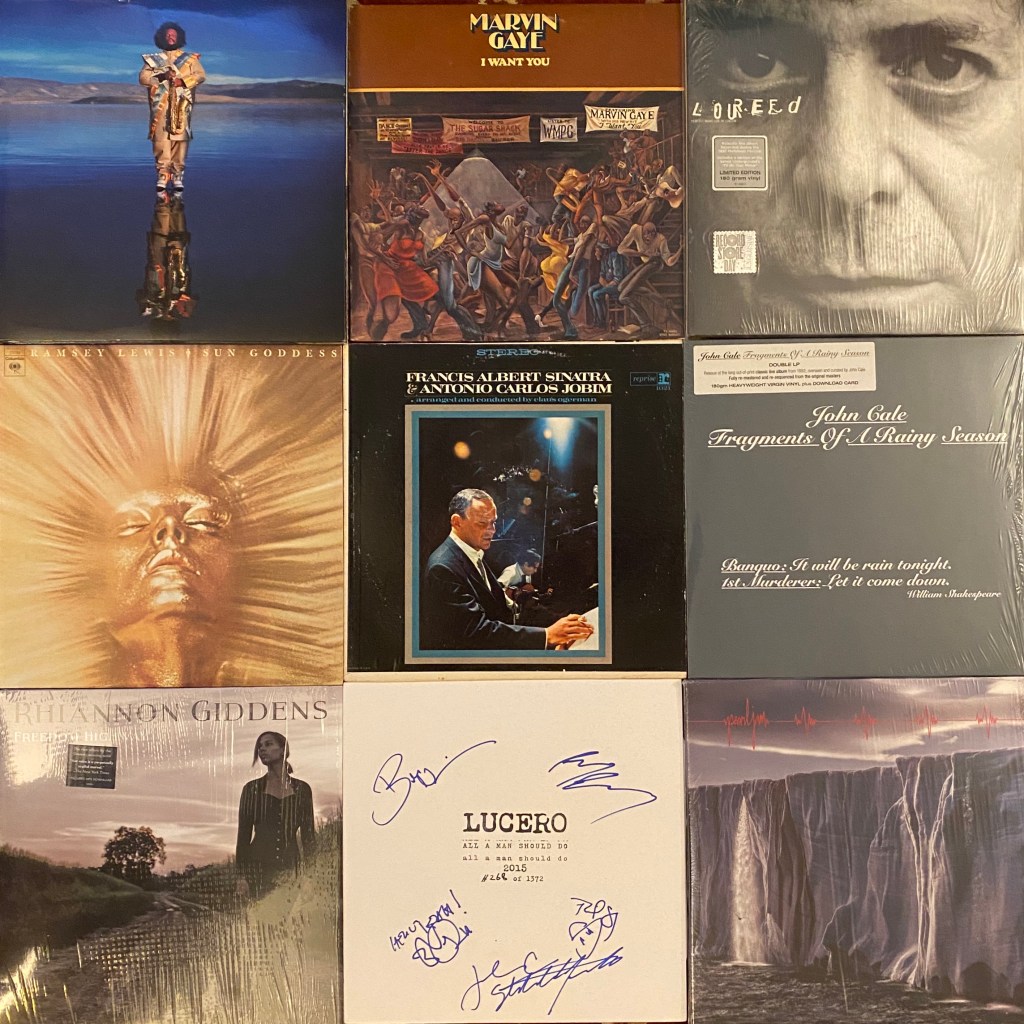
Social Distancing Spins – Days 42-44

No write-ups for these. I’m taking the day off. Sorry.

Rhiannon Giddens – Freedom Highway (2017)

Ramsey Lewis – Sun Goddess (1974)

Kamasi Washington – Heaven and Earth (2018)

Pearl Jam – Gigaton (2020)

Lou Reed – Perfect Night: Live in London (1998)

John Cale – Fragments of a Rainy Season (1992)

Marvin Gaye – I Want You (1976)

Lucero – All a Man Should Do (2015)

Frank Sinatra and Antonio Carlos Jobim – Francis Albert Sinatra and Antonio Carlos Jobin (1967)

Social Distancing Spins – Day 41

Sonny Rollins – The Freedom Suite (1958) The Civil Rights movement and bebop came of age together in the 1940s and ‘50s. It makes just as much sense for the jazz artists of that time to make music about the blatant racial inequality happening in America at the time as did for Chuck D, KRS-One and Mos Def to do it in their times. The hard-hitting title song lasts nearly 20 minutes and takes up the entire first side. In it Rollins displays his talent for twisting, flipping and turning a theme inside-out, only without any of the humor he usually infuses into his playing. Rollins is dead serious here and his point is driven home by Max Roach’s sympathetic and dynamic drumming. The second side is devoted to softer material, including a stellar reading of The Music Man’s “’Till There Was You” (also covered by the Beatles). Rollins’ pacing in the production of this album is just as impeccable as in his playing. He knows when to clench a fist and when to extend a hand.

Raffi – Singable Songs for the Very Young (1976) This was a favorite album from my childhood and my son now enjoys it. I wrote extensively about Raffi and his then-unknown producer some time ago. 

Les Vikings de la Guadeloupe – Enko on ti Tou: 1966-2016 (compilation) I don’t know anything about this band or this music except that I love it. Internet research tells me this is “one of the most important French Antillean band from the ‘60s and ‘70s.” This practically goes without saying. In all my acquaintances with other French Antillean bands from the ‘60s and ‘70s, Les Vikings de la Guadeloupe definitely rest on the top of that pile. The internet also tells me their music is “a unique mix of Biguine, funk, Latin, compass and early Zouk.” Don’t confuse Les Vikings de la Guadeloupe with a late Zouk band. They are strictly early Zouk. Look, here is all you need to know about this fantastic collection. Ready? You know how there aren’t many airplanes in the sky right now, because we can’t really leave our houses except to go to the grocery store? And you know how we all can’t wait for this to end and safely return to exploring our world? If you put this record on and close your eyes, you can take an easy vacation in your mind down to the Caribbean. No frequent flyer miles required.

Bob Dylan – Under the Red Sky (1990)
Joni Mitchell – Chalk Mark in a Rain Storm (1988)
Paul McCartney – Egypt Station (2018) Most longtime artists who hang around long enough reach a crossroads at a certain point in their careers. Do they want to continue pushing to be on the vanguard, or will they regroup and continue to create from their strengths? Typically, the audience figures this out an album or two before the artist. A common attempt to hang on the precipice of the cutting edge a little longer is to rope in several high-profile guests.

This is the place Bob Dylan and Joni Mitchell found themselves in the late ‘80s. Mitchell enlisted Tom Petty and Billy Idol to assist on “Dancin’ Clown,” with a result that is as head-scratching as it appears on paper. Other duets were more successful. Peter Gabriel steps into “My Secret Place” and makes it sound like a So b-side. Willie Nelson and Don Henley trade vocals with Mitchell on “Cool Water” and “Snakes and Ladders,” respectively. The best duet on the album, though, comes between Mitchell and saxophone legend Wayne Shorter on “A Bird that Whistles (Corrina, Corrina).”

The hype sticker on my copy of Under the Red Sky boasts special appearances by David Crosby, George Harrison, Bruce Hornsby, Elton John, Al Kooper, Slash, Jimmie and Stevie Ray Vaughan, Don Was and more, with each musician’s name in all caps. For all that star power it’s remarkable that only a few guests manage to differentiate themselves from standard studio pros. The other problem with Under the Red Sky is that some of the songs are embarrassing. It doesn’t matter which special guest plays the solo on “Wiggle Wiggle,” the ghost of Jimi Hendrix couldn’t save a tune with the lyrics “wiggle to the right, wiggle to the rear/wiggle ‘til you wiggle right out of here.” Dylan is still Dylan though, and he gives us the great “Born in Time” to counterbalance “Wiggle Wiggle.” But that’s the problem: the album is a wash.

Neither Chalk Mark or Red Sky are bad albums, per se. It’s that not only do the results fail to add major works to each artists’ considerable songbooks, they seem to be trying awfully hard to achieve this mediocrity. To be fair, half-baked Dylan and Mitchell are still better than the majority of songwriters, and there are some keepers hidden in both albums. But Chalk Mark and Red Sky are also the final contemporary-sounding albums each made before retreating to acoustic guitars and the style of music that made both of them icons and haven’t come close to anything close to modern again.

Paul McCartney has managed to avoid this trap for the most part. There was a time in the mid-to-late ‘90s after the Beatles Anthology came out that it looked like he was going down the heritage path, but he still believes he can land on top of the charts again. On McCartney’s most recent album, Egypt Station, he brought in producers Greg Kurstin, who has worked with Sia, Beck, Pink and Zayn Malik of One Direction, among others, and Ryan Tedder, who has worked with Beyonce, One Direction, Selena Gomez, Ed Sheeran and many more. Clearly McCartney was thinking about the zeitgeist when he selected these producers. And while the single “Fuh You” was obviously written for Top 40 appeal, it’s also not half as awkward as “Wiggle Wiggle” or “Dancin’ Clown.” Egypt Station won’t make anyone forget about Band on the Run, but it also feels a lot less forced that Under the Red Sky and Chalk Marks in a Rain Storm.

Obviously, Dylan and Mitchell went on to release some great albums after they embraced heritage status. I don’t know that McCartney has made an album as good as Love and Theft this century, but he also hasn’t resorted to a hits-with-strings live album or three consecutive standards album. (McCartney did one, 2012’s Kisses on the Bottom, and moved on.) That has to count for something.

Mavis Staples – Livin’ on a High Note (2016) Mavis Staples is a treasure. Her soulful voice never fails to put me at ease. For her 10th solo album, Staples is assisted by some of the top indie music songwriters today. Justin Vernon, Benjamin Booker, Valerie June, Aloe Blacc and Neko Case all contribute songs. Case’s work is rarely performed by other singers, so it is intriguing to hear Staples’ voice interpret Case’s unique phrasing. Vernon and M. Ward’s “Dedicated” is another standout track. I love the way Staples delivers the lyric “if it’s us against the world/Well I would bet on us” with so much hope and assurance. Livin’ on a High Note ends on a high note with “MLK Song,” a gospel folk song that incorporates one of Martin Luther King, Jr.’s speeches for the lyrics. Staples knew King well and marched with him several times in the 1960s. Again, her singing is full of hope and optimism, not sadness or loss. Livin’ on a High Note is a feel-good album for any time, but it seems especially needed right now.

Social Distancing Spins – Day 40

By Joel Francis

If you wondered how long Noah and his family were aboard the ark while the hard rain fell continuously, we’ve reached that point. Forty days (and nights). I don’t see any doves in the sky.

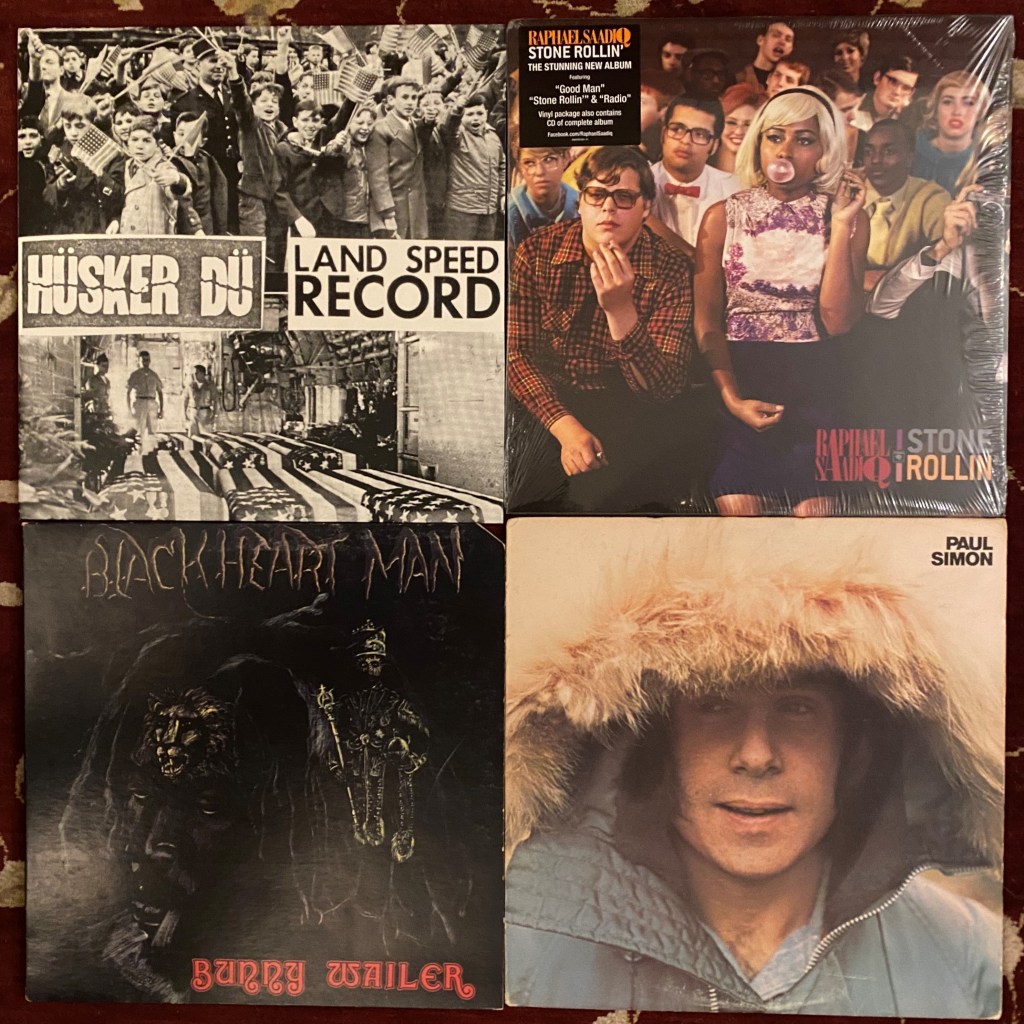
Paul Simon – self-titled (1972) Paul Simon’s solo debut (for all intents and purposes) arrived two years after the landmark Bridge Over Troubled Water. It’s a very different album from Bridge, but it is also established Simon as an artist who could operate completely independently of Art Garfunkel. If you’ve heard the album think about it for a moment. Where would you put Garfunkel? He certainly doesn’t fit on the big singles, “Mother and Child Reunion” and “Me and Julio Down by the Schoolyard.” Maybe on “Duncan” but not really anywhere else. Meanwhile, Simon’s dabbling in reggae, folk, blues, gospel, even hot jazz on the wonderful instrumental “Hobo’s Blues” with Stephane Grappelli. Simon would quickly eclipse this excellent album with his two subsequent releases, but really the blueprints for everything he would do next, even Graceland, can be found here.

Husker Du – Alternate Land Speed Record (1982) When the producers of the excellent Husker Du box set Savage Young Du were denied use of any material the hardcore punk trio recorded for SST, they did the next best thing and compiled an alternate version of the band’s debut live album Land Speed Record. Nearly the same songs, same order, same venue, different performances. I haven’t compared the two versions but I don’t find anything lacking on the numbers offered here. The 13 songs (there were 17 on the original edition) blast past like you are on the business end of a leaf blower. The second side features the In a Free Land single and a bevy of b-sides. Individually, each song rips and kicks like a chainsaw about to throw a part. Together, they flow like a violent sea of free jazz or an industrial raga. Either way, you won’t need to curl your hair or brush your teeth by the time it’s over.

Raphael Saadiq – Stone Rollin’ (2011) The mastermind behind Tony! Toni! Tone! came up in a big way on his third solo album, the Motown-inspired The Way I See It. Stone Rollin’ was his follow up release and if anything it builds on and improves the sound established before. Opening number “Heart Attack” sounds like a lost Sly and the Family Stone track, while Ray Charles was definitely in the house on “Day Dreams.” Another stand-out track, “Go To Hell,” opens with a big organ and tympani straight out of the ‘70s. And in a delightful twist the song is about someone trying to avoid the eternal fires, not send an enemy there. Hidden near the end, “Good Man” is the best album. Taura Stinson sings a hooky chorus that would work well on a hip hop track a la Mary J. Blige. Instead, Saadiq keeps it old school and paints a story of a blue collar man doing everything and still falling short, especially in love. The lush orchestration and horns add another layer of drama to the story. Stone Rollin’ is a stone classic that fans of the revival sound coming from Daptone and Colemine should definitely check out. Everyone else should hear it as well.

Bunny Wailer – Blackheart Man (1976) The third Wailers-related album to come out in 1976. Although all albums touch on each of these areas, the shorthand is that Bob Marley’s Rastaman Vibration is the political album, Peter Tosh’s Legalize It the playful one. Blackheart Man is definitely the most spiritual of the three releases. The title song opens the album and warns against going near the devil and how Jah will one day defeat the Blackheart Man. The album ends with a lengthy – and excellent – version of the classic gospel song “This Train.” Between these bookends, Wailer addresses reparations on “Dreamland,” draws a vivid portrait of poverty and imprisonment in “Fighting Against Conviction” and offers another warning about the end times on “Amagideon.” Blackheart Man is easily lesser-known of the three releases I’ve discussed over the past three days, but it is every bit the equal of the other two. It is a must-own for all reggae fans.