Social Distancing Spins, Day 7

By Joel Francis

The exploration of my record collection continues.

10,000 Maniacs – In My Tribe (1987) Here’s the moment where everything came together for the Maniacs, and for my money is their finest album. Our Time in Eden sold more copies and had bigger singles but none of that success would have been possible without the creative breakthroughs on In My Tribe. There’s not a bad song on the album. Opener “What’s the Matter Here” so effortless and graceful it takes a few dozen listens to figure out Natale Merchant is singing about child abuse. It’s the perfect balance of poignance without being preachy. R.E.M.’s Michael Stipe pops up to provide countermelody vocals on “A Campfire Song.” I believe this is the first time Stipe and Merchant duet on record. Their voices complement each other so well I’ve always longed for a full duets album. Jerome Augustyniak’s percussion arrangement on a cover of Cat Steven’s “Peace Train” gives the song a fresh spin while staying true to the hopeful spirit of the original. The album ends with “Verdi Cries,” an achingly nostalgic look back at a European holiday and the anonymous tourist who played “Aida” every day from his room. Merchant’s wordless chorus and the string arrangement by David Campbell (Beck’s dad) end this perfect album on the perfect note.

The Beach Boys – Ten Years of Harmony (compilation) Contrary to popular perception, the Beach Boys made a tremendous amount of great music after Pet Sounds. Consistent with popular perception, the Beach Boys created several boatloads of embarrassing drek during that same era. Ten Years of Harmony collects the highlights from the 1970s. Not everything here is gold. “It’s a Beautiful Day” is a forced, mawkish attempt of a song that used to roll effortlessly out of the group during their heyday. Despite this misstep, there are enough stellar moments across the two platters to make this an essential addition to any Beach Boys collection. Think of it as a bookend to the stellar Endless Summer compilation. Bonus points to the producers for not tacking on any live versions of their early hits.

Teisco – Musiche de Teisco (compilation) A clerk in a record shop in Seattle recommended this album, so I added it to my pile. Hopefully by now I established that if the price is low and the cover intriguing, I will absolutely take a chance on an album. This is a collection of Italian electronic music recorded between 1975 and 1980. Imagine Pink Floyd as a Krautrock band and you’re pretty close. I have no idea why the covers depicts a person playing guitar when most of the music here is keyboard-based.

The Rolling Stones – Sticky Fingers (1971) I went whole-hog when I discovered the Rolling Stones, evangelizing the band as if they were some obscure group. In the midst of this fervor, my family gathered at my grandparents. We were all watching some movie on television when a commercial came on advertising a Stones hit collection. I was mortified to see the song “Bitch” roll across the screen amongst other hits like “Jumpin’ Jack Flash” and “Honky Tonk Women.” My fear was that some familial authority would connect my newfound love of the band with the distaste of “Bitch” and place the Stones off limit. It seemed like “Bitch” scrolled across the screen three times as often as any other song title. Thankfully, the crisis existed only in my mind and no one said a word.

This anniversary edition of Stick Fingers features two versions of “Bitch.” The one we all know and love is on the first record, while an extended version graces the bonus disc. An extra two minutes of horns grooving over that great Keith Richards guitar riff ain’t a band thing at all. The bonus disc also includes a version of “Brown Sugar” with Eric Clapton on slide guitar. The horns are removed from the track to give Slowhand’s snoozy playing more prominence and Mick Jagger’s racist lyrics are pushed up in the mix. Yes, the zipper on the cover works.

TV on the Radio – Return to Cookie Mountain (2006) The last time TV on the Radio performed in Kansas City was almost five years ago to the day. The first time I saw them, in support of this, their third album, was also in March. They always play intense compact sets, around 75 to 80 minutes in length. Return to Cookie Mountain, the album and the tour, were what cemented my TVOTR fandom. Opener “I Was a Lover” sounds like a chopped and screwed version of a My Bloody Valentine track with haunting falsetto vocals over the top. “Wolf Like Me,” a straight-up rock song about turning into a werewolf, sounds like something destined for a budget Halloween album but never fails to get my blood pumping. Having David Bowie sing on “Provence” was the ultimate seal of approval at the time. Now it sounds more like providence.

Steve Earle – Train a Comin’ (1994) Country singer Steve Earle emerged from incarceration with little going for him. After an existence as a songwriter for hire, Earle shot up his chance at mainstream country success with the Nashville machine behind him. An unassuming, acoustic album, Train a Comin’ opens the second chapter of Earle’s career, spurning the muscle of Music Row for a less lucrative but uncompromised existence as a six-string troubadour and songwriter extraordinaire. He’s been releasing an album about every 18 months ever since (and stopping through town almost as frequently).

R.E.M. – Fables of the Reconstruction (1985) R.E.M.’s third album is an outlier in their catalog. It doesn’t have the jangle or mystique of Murmur and Reckoning, doesn’t punch as hard as Lifes (sic) Rich Pageant and doesn’t have the commercial breakthroughs like Document. But being the odd duck isn’t a bad thing. The album doesn’t pull me in until the second song, “Maps and Legends,” which is followed by “Driver 8,” the big single. The second side is even better, opening with “Can’t Get There from Here” (with punchy horns foreshadowing “Finest Worksong” on Document). Peter Buck’s great guitar line is pushed to the front of the mix on “Green Grow the Rushes,” intentionally burying Michael Stipe’s vocals in the back. “Kohoutek” is a great performance and the acoustic “Wendel Gee” closes things off. Stipe’s lyrics are as inscrutable as ever, so I can’t really tell you what any of these songs are about, but they sound great going by.

Social Distancing Spins, Day 6

By Joel Francis

The coronavirus quarantine has given me plenty of time to explore and write about my record collection.

The Records – self-titled (1979) When you name yourself something as basic as “The Records” you are telegraphing your lack of ambition (ditto for the current rock act The Record Company). I mean, one song released as a stand-alone single at the time was called “Rock and Roll Love Letter.” But being obvious doesn’t make The Records any less fun to play. The combination of chiming guitars straight out of the Byrds’ playbook and sweet harmony vocals on “Starry Eyes” practically laid the foundation for Matthew Sweet’s career. “Girls That Don’t Exist” thumps like a Cars track and “Girl” echoes of Cheap Trick. Again, none of these are bad things. Worse acts have gotten by on a lot less and the sum of these reductive parts is nothing short of a lost power-pop gem.

I have to take a moment to call out “Teenarama.” All the infectious melody in the world – and this cut has a lot of it – can’t mask predatory lyrics like “I wanted a change of style/to be with a juvenile” and “I thought that a younger girl/could show me the world.” Gross. I realize that grown men singing about young girls goes back further than Chuck Berry singing about someone at least half his age on “Sweet Little Sixteen” but that doesn’t make it any less despicable. Stop, now.

Ike and Tina Turner – Workin’ Together (1971) Legitimate question: When did everyone find out that Ike Turner was an abuser? Was it the film What’s Love Got to Do With It, Tina Turner’s autobiography or did everyone kind of know before then? I ask because I couldn’t help but dwell on the Turners’ tumultuous relationship during the Ike Turner-penned song “You Can Have It.” In the song, Tina Turner talks about working up the courage to walk away from a man who was no good. Project much, Ike?

Although this is a catalog-entry album, it plays like a greatest hits collection. The iconic versions of “Proud Mary,” “Get Back” and “Ooh Poo Pah Doo” (with a classical piano intro) are all here, as is the DJ classic “Funkier than a Mosquita’s Tweeter.” Throw in the fine title track and a cover of “Let It Be” and this has just about everything you’d want from soul’s dysfunctional couple.

Mudcrutch – 2 (2016) It is fitting that Tom Petty’s final recording is a reunion with his old band from Gainesville, Fla., and not the Heartbreakers. It is also fitting that guitarist Mike Campbell and keyboard player Benmont Tench are the backbone of both bands. Petty’s name was always out front, but Campbell and Tench (along with deceased bass player Howie Epstein) were the heart of the Heartbreakers. Everyone in Mudcrutch get the chance to sing an original song and Petty retools “Trailer,” a lost ‘80s Heartbreakers classic. This is the sound of musical friends enjoying each other’s company with no pretense other than to have a good time. “Beautiful Blue” belongs in every Petty playlist. There are worse things to have on one’s headstone than “I Forgive It All,” another Petty standout.

Tamaryn – Tender New Signs (2012) I had never heard of the New Zealand-born singer Tamaryn when I walked into the old RecordBar location to see the Raveonettes at the Middle of the Map festival. Performing immediately prior to the headliners, Tamaryn’s lush set of dream pop almost stole the night. Tender New Signs is very much in line what I heard that night. Tamaryn’s latest releases have moved in a more pop direction. They’re not bad, but the layered shoegaze approach here and on her second album, The Waves, are what I keep coming back to.

Prince and the Revolution – Parade (1986) I purchased this album on my way home from work the day Prince died. Surprisingly, the record store still had a handful of Prince titles in stock. I had all the others, so Parade was the winner. I can’t remember what I did first after arriving home, take off my jacket or put this on the turntable.

I never saw Under the Cherry Moon, the Prince film this album is supposed to accompany. I can tell you that I adore the hit single “Kiss” and that it may be my least favorite song on the album. There’s a reason why “Mountains” was a concert mainstay, but for even more fun check out the 10-minute version on the 12-inch single. More contemplative songs like “Under the Cherry Moon,” “Do You Lie” and the instrumental “Venus de Milo” weigh heavily in what would be come D’Angelo’s signature sound a decade later. There’s a reason why D’Angelo’s chose to pay tribute to Prince with this album’s closer “Sometimes it Snows in April.” That songs never fails to make the room dusty.

Mission of Burma – Signals, Calls and Marches (1981) Mission of Burma have always been on the artier side of the punk spectrum, but that doesn’t mean they aren’t brutally loud and abrasive. This debut EP cleans up their sound considerably but it will still pin you up against the back wall if you aren’t watching out. The reissue I own adds the group’s debut single “Academy Fight Song,” it’s b-side and a pair of unreleased songs on a second LP. I only wish the record label had either put all the material on one album (there is certainly enough room) or pressed the bonus content on smaller platter. There is a lot of unused wax on this essential yet brief release.

The Conquerors – Wyld Time (2016) This Kansas City band generated a lot of good press when Wyld Time, their debut album came out. I was so enamored with their British Invasion throwback sound that after hearing them at an in-store performance, I immediately scurried over to the racks and bought the album. Sadly, it appears the wyld times are over for the Conquerors. Their social media hasn’t been updated since 2017. This disappointing development shouldn’t stop any revivalists from enjoying the Conquerors only offering.

Joe Strummer – US North (1986)

Joe Strummer – Forbidden City (1993) This pair of 12-inch singles deliver some gems from the Joe Strummer archives. I have no idea why it took more than 30 years for Strummer’s collaboration with his former Clash bandmate Mick Jones to see daylight. “U.S. North” dovetails nicely with the pair’s work on the Big Audio Dynamite album No. 10, Upping St. and would have been a highlight on anything either artist released around that time. “Forbidden City” ended up on a Strummer’s first album with the Mescaleros in 1999. This demo version has a saxophone that gives it the same sound and feel as the Pigs With Wings soundtrack Strummer did in the early ‘90s. The demo is nice enough, but I don’t know it’s good enough to warrant a stand-alone release. I’d have preferred it if they included it on a proper collection, with more unreleased material. I guess I wasn’t disappointed enough not to buy it, though. There’s one born every minute, eh?

Social Distancing Spins, Day 5

By Joel Francis

In observance of St. Patrick’s Day, here are some of my finest albums with Irish ties.

The Pogues – If I Should Fall From Grace with God (1988) The only thing wrong with this album is that the title song is too short. The extended 12-inch version on the Pogues box set solves this problem. Mentioning the highlights is like reading the track listing, but I’ll narrow it down to the absolute best. “Fairytale of New York” is my absolute favorite Christmas song and is just as powerful in August as it is in December. Hearing Kirsty MacColl and Shane MacGowan trade stanzas in the final verse always crushes me. This song’s all-time status was cemented in my soul when Bill Murray slurred his way through it with David Johansen and Jenny Lewis in his Christmas special.

There may be no finer tribute to the hope and heartbreak of the 19th century immigrants who traveled to the United States to start a new life than “Thousands are Sailing.” And that’s just side one. We’d better move on or I’ll be here all day.

Stiff Little Fingers – Greatest Hits Live in London (2017) The glory days of this Belfast-born punk band were long over when this live set came out. Although most of the material here pulls from the groups mighty four-album run in the late ‘70s and early ‘80s the fire on this inflammable material has dimmed. I really bought this album because it was marked down on a Black Friday sale and signed by the current musicians. As it’s the only SLF I currently own, it will be what I spin when I need to hear “Tin Soldiers” or “Suspect Device.” Oh, one more thing: “Alternative Ulster” makes a great alarm song on your phone. It’s hard not to want to kick the day’s butt after hearing that first thing.

Thin Lizzy – Jailbreak (1976) Yeah, this is the album with “The Boys are Back in Town,” the only song that classic rock radio deigns to circulate, but this is a solid slab of rock from start to finish. “Jailbreak” blows out the speakers like a lost AC/DC song. “Cowboy Song” starts off like a campfire ballad before Phil Lynott’s storytelling takes over and the guitars plug in. Can we talk about Lynott’s lyrics for a moment? “Emerald” reads like a preview to a great lost epic poem. The story in “Romeo and the Lonely Girl” is just as majestic as Mark Knopfler’s masterpiece “Romeo and Juliet.” All with those dual guitars that can sting like a scorpion out of nowhere. Thin Lizzy gets nowhere near the respect they deserve.

The Chieftains – 3 (1971)

Van Morrison and the Chieftains – Irish Heartbeat (1988) If you blindfolded me and played me any one of the Chieftains first half-dozen albums, I’m fairly confident I couldn’t tell them apart. The traditional Irish troupe expanded their sound when they started adding guest artists and gimmicks in the ‘90s. (The Chieftains play movie themes! The Chieftains go to Nashville!) There are many moments to savor on those albums, but I like the unvarnished simplicity of the jigs and reels on their initial run.

Ironically, it was the success of Irish Heartbeat that paved the way for these cross-genre exercises. I don’t begrudge the Chieftains for trying to reach a broader audience but to my ears they’ve never found a better partner than fellow Irishman Van Morrison. For proof, take a look at the group’s star-studded release Long Black Veil from 1995. Everyone from Sting to the Stones shows up, but Morrison steals the album with his own “Have I Told You Lately.” Irish Heartbeat brings out a playful side of Morrison rarely heard, particularly on “I’ll Tell Me Ma” and “Marie’s Wedding.” Hoist a pint and turn it up.

Dropkick Murphys – The Meanest of Times (2007) Irish by way of Boston, the Dropkick Murphys combine the traditional feel of the Chieftains with Thin Lizzy’s hard rock and Stiff Little Finger’s punk attitude. When I played this album in the morning my son announced that he didn’t like it and left the room. That evening he was captivated by the Murphys’ live performance online. I tried to tell him they were the same band from earlier, but he didn’t believe me. I guess some things need to be seen to be believed. (By the way, streaming this concert was a brilliant idea and really seems to be taking off while all of us are stuck at home. According to the counter in the corner, 128,000 people were watching live. That’s a far bigger crowd than they ever could have hoped to reach by playing a St. Patrick’s Day show in Beantown.)

Flogging Molly – Within a Mile of Home (2004) It’s hard to imagine a Dropkick Murphys fan not liking Flogging Molly as well. Molly are slightly less hardcore than the Murphys on record but both acts generate a considerable mosh pit in concert. I found Within a Mile of Home at a ridiculously cheap price on CD shortly after its release. Seeing Lucinda Williams was featured on one track, I picked it up. A couple years later, I found Whiskey on a Sunday, the follow-up EP/DVD under the same circumstances. Watching those live performances convinced me I absolutely had to see this band in concert. While Within a Mile from Home is the only Molly vinyl I own, I’ve seen them a handful of times in person and never been disappointed.

U2 – Boy (1980) If it is possible to think about this divisive Irish quartet without the hype, bombasity and preening it has accumulated over the years, then Boy is it. With the exception of opening track “I Will Follow,” the rest of the album has been excluded from setlists and compilations (although some songs have gradually crept back onstage). The menacing “An Cat Dubh” almost sounds like an anthemic early Cure outtake (with glockenspiel!) that slides into The Edge’s wonderful guitar textures of “Into the Heart.” (Along with Bono’s earnest vocals. U2 were never not-earnest.) There aren’t many hints of The Joshua Tree or Achtung Baby here, yet all the essential elements of those albums are present. Sometimes spending time with the boy is more revelatory than hanging out with the man.

Social Distancing Spins, Day 4

By Joel Francis

Each day during the quarantine I’m going deep into my record collection and writing about what I pull out.

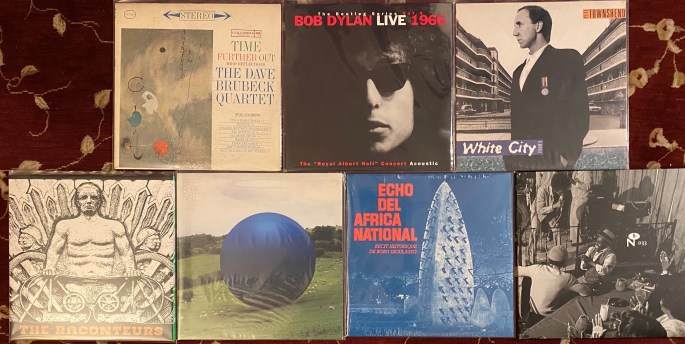
Dave Brubeck Quartet – Time Further Out (1961) Dave Brubeck’s groundbreaking 1959 release Time Out was so successful a sequel was inevitable. The point of these albums isn’t the complexity of each composition’s time signature. It’s how much fun the group seems to be having as they effortlessly skate through rhythms that would make prog rock bands break out in sweat. Take “Unsquare Dance” for example. On the face it seems simple enough – just handclaps and snare drum with Brubeck intermittently tickling the keyboard. The result is catchy and edgy enough to appear in “Baby Driver,” a mixtape masquerading as a heist film released a mere 56 years after the song was recorded.

Bob Dylan – Live 1966: Acoustic Set (1998) The first time I saw Bob Dylan in concert, in the late ‘90s, a friend asked me if he played acoustic or electric. The answer, of course, was both, but the aftermath of that plugged in Newport set warranted the question nearly half a century later. This archival release was recorded about a year after the firestorm at the folk festival. The seven songs that comprise this acoustic set are immaculate. Of course the songs are amazing, but what stands out to me is Dylan’s harmonica playing and the way he teases phrases and moments. This set makes a strong case that Dylan may be an even better performer onstage alone, without a net. Knowing that the arrangements will soon get turned up amplifies the solo performances even more.

Pete Townshend – White City (1985) After the death of drummer Keith Moon, Pete Townshend is often accused of holding back his best work for solo projects and delivering second-rate material for The Who. I disagree. “Face Dances” has just as many strong moments as “Who Are You,” Moon’s final album. By the time the band got to “It’s Hard” no one’s heart seemed to be in it. Besides, it is very difficult to imagine Roger Daltrey singing anything on this album beyond the bombastic (and excellent) opener “Give Blood.” I don’t see where John Entwistle’s bass would add anything, either.

There’s supposed to be a story in here somewhere. I once watched Townshend’s 60-minute film version of White City so long ago it was on videotape. The narrative wasn’t any more apparent after that experience, although it was nice to hear different and extended versions of the material. Don’t overthink this, just appreciate it.

Raconteurs – Live at Cain’s Ballroom (2020) I saw the Raconteur’s performance in Kansas City that immediately followed the shows in Tulsa, Okla. that form this album. It was … good. Nothing groundbreaking, but a solid night out. Unless something changes, I don’t think I’ll feel compelled to buy a ticket next time they come through. The same goes with this album. It’s great to have a document of that tour, but the performance doesn’t have the energy of their concert at the Ryman Auditorium on a 2011 tour (released in 2013). I think I’ll be playing that album more often.

Various Artists – Big Blue Ball (compilation) In the early 1990s, Peter Gabriel hosted a series of weeklong workshops at his home studio. Artists from all over the world were encouraged to add to existing recordings and develop and contribute original material. This collection, released in 2008, a brisk 13 years after the final gathering, is the culmination of those sessions. There are a couple Gabriel gems to be sure, but fun for me is scouring the musician credits and try to pick out how everyone interacts together. Living Colour axeman Vernon Reid lays down synth guitars on “Rivers,” a New Age track that wouldn’t be out of place at a spa (or at least what I imagine a spa would be playing). Gabriel corrals jazz drummer Billy Cobham, former Public Image Ltd. bass player Jah Wobble and onetime Prince foil Wendy Melvoin for the single “Burn You Up, Burn You Down.” The song “Forest” opens like an outtake from Gabriel’s Passion soundtrack before turning into something that might be heard at a dance club or upscale art gallery (or at least what I imagine an upscale art gallery would be playing). Most of the album stays in this vein of world music with modern elements.

Echo de Africa National – Récit Historique de Bobo-Dioulasso (unknown) I know absolutely nothing about this album. I couldn’t even determine the year when it came out. The two side-length songs aren’t even given titles. To my ears, it sounds like this was recorded sometime between 1965 and 1975. I can tell you that if you like African ensembles with multiple horn players, percussionists and guitarists, who like to stretch out, this is probably for you. I haven’t been disappointed by it.

Various Artists – Light on the South Side (compilation) Less an album than an aural art installation, Light on the South Side combines 18 obscure blues and soul cuts with a gorgeous 132-page hardcover book featuring sumptuous black-and-white photography of African-American working class adults in the 1970s looking to escape the pressures of everyday life in the dive bars on Chicago’s South Side. You can smell the polyester and cigarette smoke listening to Little Mack do the “Goose Step” or hearing about Bobby Rush’s “Bowlegged Woman.” Crack open a High Life tall boy and enjoy.

Social Distancing Spins, Day 3

By Joel Francis

Our trawl through my world of vinyl continues.

Various Artists – Stroke It Noel: Big Star’s Third in Concert (2017) To butcher the cliché, probably not everyone who bought a Big Star album back in the ‘70s started a band, but it’s a fair bet that at least one person from most of your favorite bands did (unless you are super into, say, Norwegian death metal, in which case, thank you for branching out and reading this blog).

It’s been ten years to the month since Big Star’s frontman Alex Chilton died on the eve of his celebration at South by Southwest. The impromptu tribute that emerged from that tragedy morphed into a series of concerts around the world celebrating Big Star’s troubling third album. It’s wonderful to hear members of Wilco, R.E.M., Yo La Tengo, the Posies, Semisonic, the dbs and more pass the mic and hike through these songs. But the live reproductions are so faithful they miss the fragile, alluring qualities that made the original studio versions that almost seemed to disintegrate before coalescing into beauty – if they made it that far. So yeah, I dig this, but hearing R.E.M.’s Mike Mills bounce joyfully through “Jesus Christ” or Django Haskins struggle with “Holocaust” doesn’t make me a bigger Big Star fan. It just makes me glad that the people I’m into have such immaculate taste.

Robert Fripp – Exposure (1979) I have a great deal of respect for King Crimson, Robert Fripp’s groundbreaking progressive rock ensemble, but to my heathen ears their music is like listening to calculus. I can get behind Exposure, though. You can almost hear Fripp smirking as he takes the listener from wordless, off-kilter a capella harmonies to an endlessly ringing phone and then a boogie woogie pastiche – all in about a minute. It’s almost like Fripp is daring us to meet us where he is, then abruptly changing course and challenging us to follow him over there. This is also an apt description of his entire career. Listening to Exposure is like playing tag. You never stay in one place and may find yourself out of breath at times with the quarry just out of reach, but it’s always fun to play. Special mention must be made of the definitive version of “Here Comes the Flood” with Peter Gabriel on vocals.

Madisen Ward and the Mama Bear – Skeleton Crew (2015) This mother-son duo was poised to be the next big thing to break out of the Kansas City music scene when this debut album came out. They appeared on one of the last episodes of The Late Show with David Letterman, the Today show, Later with Jools Holland and played Bonnaroo and the Newport Folk Festival. Things have been quiet since then – only one EP in 2018 – but these laid-back, folk blues romps are still a fun spin.

Kendrick Lamar – Damn. (2017) Damn. was my favorite album the year it came out and it remains a compelling listen today. The fact that I can say this despite a concert that nearly left me in tears is a testament to its strength. When the Damn. tour announced a date at the Sprint Center, I quickly jumped on tickets. Not wanting to take out a second mortgage, my friends and I got seats in the upper level, extreme stage right. The sound was fine for the opening acts, but when Lamar took the stage it was like the sound blew out in the speakers directed at our section. You know it sounds you’re just inside the doors, waiting to get in and the show starts without you? All bass with just a hint of vocals? That’s how it sounded inside the arena. Some ushers kindly moved us to another section where the sound was slightly better, but the spell had been broken and the show was a bust. All this and I still can’t wait to hear what Lamar does next.

Rush – Power Windows (1985) I know everyone loves the hard, sci-fi prog of Rush’s late-‘70s peak, but I am strongly partial to their synth-heavy early ‘80s material. This mostly boils down to the fact that during high school I played the band’s 1989 live album A Show of Hands so often I thought the laser would bore right through the CD. So you can have your “Cygnus X-1” and “By-Tor and the Snow Dog” and I’ll stick with “Marathon” and “Manhattan Project,” thank you very much.

Husker Du – Everything Falls Apart (1982) Playing this record (included in the Numero Group’s essential early-days collection Savage Young Du) is like flying down the interstate on a Japanese motorcycle without a helmet. Insects slap your face and the wind stings your eyes as gravity forces you closer to the ground. Danger is imminent, but you twist your wrist and accelerate even more. Stopping is not an option. Oh, and there’s an entire side of bonus tracks.

Johnny Cash – Mean as Hell! (1966) Mean as Hell! is the single platter version of Johnny Cash’s double-record concept album Sings the Ballads of the True West. I think I got this at a garage sale, because who can resist an album with this title (with mandatory exclamation point) where a gaunt, drugged out Cash is dressed like a cowboy, holding a gun? The music isn’t as exceptional as the cover. The spoken-word bits are a little too somber. Cash sounds like a Southern preacher crossed with a National Geographic narrator on the title track and the studio version of “25 Minutes to Go” is nowhere near as fun as the live version at Folsom Prison. Despite these shortcomings, I’ll still put on my spurs for the ballads: “I Ride an Old Paint,” “Sweet Betsy from Pike” and album closer “Bury Me Not on the Lone Prairie.”

Frank Black – Teenager of the Year (1994) No one liked this album when it came out. It didn’t sound like the Pixies, wasn’t as radio-ready as the Breeders and there was a lot of lingering animosity over how Frank Black ended the beloved Pixies. I didn’t know any of this at the time, however, because I was too busy listening to A Show of Hands. Coming to this album several years later, all I heard were nearly two dozen bright blasts of Black’s songwriting at its most accessible. Nurse a grudge all you want. I’ll be right over hear blasting “Freedom Rock” loud enough to drown out your whining.

Brian Eno – Reflection (2016) I don’t know enough about ambient music to tell you the difference between this album and Lux or the longer-form pieces on the Music for Installations collection. I can tell you that when it gets to the point in the day when I need some Eno, Reflection (and Lux) always comforts me. I also don’t think I have to get up to turn the record over as often with Lux, so there’s one difference.

Bruce Springsteen – The Wild, The Innocent and the E-Street Shuffle (1973) This is one of my absolute favorite Springsteen albums because it’s the sound of him fumbling through different sounds trying to figure out what he wants to be. It all clicked into place with Born to Run, his next album. The guitars at the beginning of “Sandy” sound like the Allman Brothers Band before the accordion whisks in foreshadowing the opening section of Billy Joel’s “Scenes from an Italian Restaurant.” Where else can you hear Springsteen rocking with a clavinet over a Doobie Brothers guitar line but on “The E Street Shuffle”?

The picture of the band is especially priceless. Half the guys have their shirts unbuttoned all the way, only a couple are wearing shoes and Springsteen is rocking a tank top and blue jeans. They look like a group that would get uncomfortably close and overly friendly with a stranger, ask to bum a cigarette and then inquire if he or she liked to par-tay.

Wild and Innocent is also the only time multi-instrumentals David Sancious appeared as Springsteen’s main musical foil. Sancious left to form his own band shortly after this album came out and went on to work with Stanley Clarke, Peter Gabriel, Sting, Eric Clapton and many others.

Lee Hazlewood – The LHI Years: Singles, Nudes and Backsides (compilation) If you’ve heard “These Boots,” then you’ve heard a Lee Hazlewood production. This collection doesn’t contain any of Hazlewood’s work with the Chairman of the Board’s daughter – which is good enough to warrant its own anthology – but it does contain duets with Ann-Margret and Suzi Jane Hokom and solo cuts that sound like cowboy songs in Cinemascope. Drag Phil Spector’s Wall of Sound to the wild west and your getting close.

R.L. Burnside – Too Bad Jim (1994)

T-Model Ford – The Ladies Man (2010) I saw T-Model Ford one time, right around the time The Ladies Man came out, a couple years before his death. The venue, Davey’s Uptown Rambler’s Club, or just Davey’s, was about as close as you could get to a juke joint in Kansas City. Split across two storefronts, the bar was on the left side, where you’d traditionally enter. The area with music was on the right side of the wall. If a performer moved too far stage right he or she was liable to bump into a door leading out to the street. That would be bad. Despite these shortcomings, the sight lines were decent, the drinks were cheap and the sound was usually OK. I mention all this because Davey’s, a century-old Kansas City institution, was gutted by a fire just a couple days ago. Everyone reminiscing online about the great times they had at the venue made me reach for this album.

R.L. Burnside’s blues were cut from the same primitive cloth as Ford’s. I don’t know if Burnside ever played at Davey’s but I’m sure he would have been welcomed and would have liked it. The good news is that the Markowitz family, who have run Davey’s since the 1950s, plan to rebuilt the space.

Loose Fur – self-titled (2003) Recorded before Wilco’s career-defining Yankee Hotel Foxtrot but released afterward, Loose Fur is the sound of Jeff Tweedy shaking off the weight of Wilco and getting acquainted with two new collaborators. Opening track “Laminated Cat” is one of my favorite Tweedy compositions. It’s more than seven minutes here, but Wilco frequently tear it down onstage like a Sonic Youth number and stretch it even longer. Jim O’Rourke’s “Elegant Transaction” provides a more relaxed counterpoint and while the album doesn’t get that relaxed again until the closing number, “Chinese Apple,” the opening pair frame the album as a balancing act between tension, experimental noise and release.

Benny Carter – Further Definitions (1961) Impulse Records are frequently viewed as the playhouse for avant-garde jazz workouts by saxophonists John Coltrane, Archie Shepp, Yusef Lateef and Sonny Rollins. Further Definitions is proof that Impulse wasn’t so one-dimensional (at least in the early years). Pre-war legends Benny Carter and Coleman Hawkins push each other to new heights in the confines of this small group anchored by Coltrane’s rhythm section. The result is an album that jazz fans can appreciate for its sophistication and intricacy but your mom can hum along with. A win for everyone.

Social Distancing Spins, Day 2

By Joel Francis

Welcome to another installment of spelunking in my record collection while the world … well, who knows what’s happening out there. Let’s just stick to the music.

A.K. Salim – Afro-Soul/Drum Orgy (1965) I knew nothing about this album that wasn’t on its packaging when I bought it. I don’t know much more now. But this much is certain: If you want lots of African percussion with blasts of free jazz swooping in and out, this is the place to be. It’s not for every day listening, but at the right time this always does the trick.

Nas – Illmatic: Live from the Kennedy Center (2018) Illmatic is such a great album that this edition marks the third time I’ve purchased it. After owning the original CD and album, I passed on the 20th anniversary edition and rolled my eyes when I heard an orchestral live version was coming out. Then I heard a track and knew I was going to have to buy this again. Hearing these performances with the National Symphony Orchestra takes the album to another level. It’s almost like watching The Godfather in a 1972 theater, then viewing it in IMAX. The jazz organ underpinning the original “Memory Lane” becomes a swirling concerto complemented by the DJ Green Lantern’s scratches. Earlier, Nas shouts out his dad’s original cornet solo on “Life’s a Bitch.” There’s amateur footage on Youtube of Kendrick Lamar doing a similar performance with the NSO. Cross your fingers this someday gets official release.

McCoy Tyner – McCoy Tyner plays Ellington (1965) This is essentially an album by the celebrated John Coltrane quartet without the legendary leader. Without their leader’s sheets of sound, everyone else gets more room to shine. Tyner was usually the person keeping Coltrane’s songs from falling apart – think about his insistent piano line in “My Favorite Things” while Coltrane scrapes the stratosphere. Finally out front and on his own, Tyner showcases and ability to pay tribute to a genre pioneer in Ellington while applying the some of the touches he showed with the futurist saxophonist. We lost a giant when McCoy Tyner died earlier this month.

The Raconteurs – Help Us Stranger (2019) The Raconteurs have always been my least-favorite Jack White project, however their by-the-numbers approach made for a refreshing listen after White’s previous release, the bizarre solo album Boarding House Reach. Help Us Stranger arrived more than a decade after the Racontuers’ previous release. While I didn’t really miss them, it is nice to hear White doing some straight-up rocking without all the cutesy tricks and gimmicks.

Marvin Gaye – Here, My Dear (1978) Here’s a question to pull out when the party gets dull (or maybe when you want it to end): Who had a better 1970s, Stevie Wonder or Marvin Gaye? At first glance, it looks like Wonder in a landslide. He won all the Album of the Year Grammys and graduated from opening for the Rolling Stones to recording with Ella Fitzgerald. A second look reveals that Gaye’s decade was every bit as incredible, even if he didn’t win as many trophies. Of course What’s Going On and Let’s Get It On are the twin pillars, but I Want You and Trouble Man are very, very good, even if they tend to get lost in the shadows. Then there’s Here My Dear, Gaye’s final album of the decade and a bitter kiss-off to his ex-wife (and label boss Barry Gordy’s sister) Anna Gordy.

Gaye knew going into the recording sessions that Anna Gordy would receive all royalties from the album’s release, as per the terms of the divorce. Undaunted, Gaye recorded the longest album of his career and used that time to dissect the relationship, peel open Gordy’s heart and spray lemon juice on the wounds. Here, My Dear isn’t only a bitter album, though. Gaye slides between soul, gospel, funk and jazz as he bares his soul and examines the wreckage. At the time, it seemed few wanted to go on Gaye’s deeply personal journey. The album didn’t sell well initially, but eventually even Gordy came around to appreciating Here, My Dear.

Roy Ayers Ubiquity – A Tear to a Smile (1975) The first time I saw Roy Ayers in concert I didn’t get it at all. I was expecting a jazz vibes player in the tradition of Lionel Hampton or Bobby Hutcherson. Instead, I got what I thought was a smooth jazz crooner going on about sunshine and searching. The second time, I got it. If Louis Jordan is the link between Louis Armstrong and Ray Charles, then Ayers is the cog that connects Milt Jackson with Tupac.

Tom Verlaine – Words from the Front (1982) I think I spotted this at a yard sale for a song a picked it up on a whim. While I like Television, this is the only album I own from the Verlaine catalog. I always enjoy this album while it’s playing, but it leaves my mind almost immediately after it’s done. Sorry, Tom.

Various Artists – The Afro-Peruvian Classics: The Soul of Black Peru (compilation) I got this album in a bundle when Luaka Bop celebrated its 25th anniversary. Dismiss this collection as a mere toss-in at your own peril. You can hear everything from the roots of Celia Cruz and the samba to songs like “Son de los Diablos” that wouldn’t be out of place on the Buena Vista Social Club soundtrack. Afro-Peruvian music originated with the slaves brought over from Africa and forced to settle in Peru. There’s no trace of this horrific history on the 15 hip-shaking cuts here, but it does explain why some of the music sounds like a flamenco band got kidnapped by an aggressive drum circle.

The Dead Girls – Out of Earshot (2010) The Dead Girls were Kansas City band who weren’t afraid to proclaim their power pop influences. This is their second release and as far as I know the only one that made it only vinyl. You can hear a lot of Big Star, the Replacements and Thin Lizzy on this release and while the album plays more like a tribute act than saying something on its own, it’s still a very fine listen.

Paul Simon – Stranger to Stranger (2016) Paul Simon started taking his time between albums after Graceland took off, which is to say more than 35 years ago. Appropriately, Stranger to Stranger sounds like it has been crafted by a patient perfectionist. Simon spent an entire 40-minute podcast breaking down how he built “Werewolf,” the opening track, around the rhythms – but not guitars – of Flamenco music. Other tracks employ the experimental instruments developed by Harry Partch or the laptop sampling of Clap! Clap! “Cool Papa Bell” marries the rhythms and mood of Graceland with the profanity of The Capeman. It’s cerebral stuff to be sure, but also infinitely hummable and pleasurable.

Joe Strummer – 001 (compilation) The 2018 collection 001 is both an overview of Joe Strummer’s career opportunities outside of The Clash and a treasure of unreleased material from his archives. The ten-year jump from his pre-Clash band The 101ers to “Love Kills” from the Sid and Nancy soundtrack is jarring, but other than that the collection flows quite smoothly until its unfortunate, premature ending.

Kudos to the Strummer estate for making this set affordable, instead of a trophy piece that only the super-rich or ultra-dedicated can acquire.

U2 – October (1981) The Irish quartet’s sophomore album is easily the group’s most overlooked release. It doesn’t have the promise of their defiant debut, the hit singles on War or the Brian Eno cache of The Unforgettable Fire. All bets for October’s reappraisal were off once The Joshua Tree and Achtung Baby took off.

October’s status may seem harsh in this context, but it’s pretty fair. October is by no means a difficult listen, but it also doesn’t the chops to muscle its way into the conversation. That said, it is still nice to see “Gloria” and “October,” the album’s two best songs, creeping back into setlists for the first time since the ‘80s.

Social Distancing Spins, Day 1

By Joel Francis

The coronavirus pandemic has taken a lot of things away, but one thing it has provided me in abundance is plenty of extra time at home. I decided to make the most of my social distancing by doing a deep dive through my album collection. As the turntable spun, I was inspired to write about what I heard.

My intent is to provide brief snippets about each day’s albums. I understand that many of these classic recordings deserve lengthy posts on their own, but since we will be covering a lot of ground here I will try to remain brisk and on point. Ready? Let’s get to it.

Black Sabbath – Heaven and Hell (1980) Sabbath’s first half-dozen albums are rightly canonical. Heaven and Hell isn’t as groundbreaking but every bit as enjoyable as those classic platters. Sadly, the Ronnie James Dio era of Sabbath is mostly remembered by headbangers these days. This is the only Sabbath album I own, but I look forward to someday adding Mob Rules to the collection.

Hot Water Music – Light It Up (2017) – Playing the most recent album from the veteran Florida rock band was intended to wet my whistle for their concert at the RecordBar, scheduled just a few days away. Alas, like everything else on the horizon it was moved forward on the calendar until a hopefully calmer time. With a name swiped from Charles Bukowski and a sound like gasoline arguing with barbed wire the show is guaranteed to be a winner whenever it is held.

The Hold Steady – Heaven is Whenever (2010) This was my least-favorite Hold Steady album when it was released and I confess I haven’t played it as much as the albums that preceded and followed it. I thought the departure of multi-instrumentalist Franz Nicolay left too much of a hole in their sound, though the band sounded great when I saw them on this tour. Playing it now, I don’t think I gave Heaven is Whenever is enough credit at the time. It’s not a masterpiece on the scale of Boys and Girls in America and not as fierce as Teeth Dreams but there are some freaking fine moments, including “Our Whole Lives,” buried at the end of side two.

Bruce Springsteen – Born in the U.S.A. (1984) What can be said about this landmark that hasn’t been said before? To be fair, this album was a request from my five-year-old son who loves “Dancing in the Dark” thanks to E Street Radio. “Dancing” is the next-to-last track, meaning he exposed to 10 other great tunes while waiting for his favorite number. Hopefully a few more of them will stick, although I’m not sure I want him singing “I’m on Fire” quite yet.

The Yawpers – American Man (2015) This Denver-based trio fits in well on Bloodshot’s roster of alt-country acts. Songwriter Nate Cook’s early 21st-centry examination of the U.S. of A. plays like a road trip. On songs like “9 to 5,” “Kiss It” and “Walter” they sound like Uncle Tupelo being chased through the Overlook Hotel by Jack Torrance.

The Highwomen – self-titled (2019) I toured the Country Music Hall of Fame in Nashville a few years ago. I was fascinated by the museum until the timeline reached the late 1980s. After Dwight Yoakam and Steve Earle came on the scene, mainstream country and I quickly parted ways. The four songwriters in Highwomen are trying to reclaim popular country music on their own terms. Many, many great artists have tried to bend Music City to their tastes only to retreat exhausted. The best of them found Music Row sucking up to their pioneering sound only after it became popular. My guess is that the Highwomen will follow this same route, but they are so good you can’t rule out they will be the ones to finally break the stale, chauvinistic stockade.

(I say this and then notice that I’ve namedropped two male country stars in this piece without mentioning any of the female members of the Highwomen. Sigh. Please forgive me, Brandi Carlile, Amanda Shires, Natalie Hemby and Maren Morris.)

Jamila Woods – Legacy! Legacy! (2019) The Ivy League-educated neo-soul songstress focuses on the small to show us the large on her second album. Each of the thirteen tracks focus on an important black artists – Nikki Giovanni, Eartha Kitt, Jean-Michel Basquiat – explore what it means to be black in America today. What sounds like an academic thesis is actually a good dance album, thanks to a soundscape that slides between jazz, soul, hip hop, Afro-beat and even touches of EDM.

Jeff Tweedy – Together at Last (2017) Thanks to the film “I Am Trying to Break Your Heart,” Jeff Tweedy’s bands Uncle Tupelo and Wilco barely made it into the mainstream before the monoculture collapsed and the entertainment world splintered into a million micro-genres and sects. The eleven songs performed here are stripped of all wonky production and distilled to voice and guitar. They are still amazing.

Joni Mitchell – Ladies of the Canyon (1970) Joni Mitchell’s work in the 1970s is every bit as good as Neil Young’s and even better than Bob Dylan’s. This album finds Mitchell branching out by adding more instruments to the guitar-and-voice arrangements found on her first two albums. The jazz clarinet solo at the end of “For Free” gets me every time. Three of Mitchell’s biggest songs are tucked at the end of side two. “Big Yellow Taxi” and “Woodstock” set up “The Circle Game,” a look at mortality than never fails to leave me feeling deeply blue.

Ian Hunter – You’re Never Alone with a Schizophrenic (1979) Ringo’s All-Starr Band isn’t the place for deep cuts, so I knew when Ian Hunter was listed as the guitar player for the 2001 tour I held a ticket for, I knew I was going to hear “Cleveland Rocks.” The only problem was the show was in St. Louis, so it didn’t really work. That’s Hunter’s catalog in a nutshell for me. All the right ingredients are there on paper and I get excited about hearing the albums when I read the reviews, but they never fully click with me. His releases are so plentiful in the used bins and priced so cheaply I keep giving them a shot hoping the next one will be The One.

Bear Hands – Fake Tunes (2019) Another play anticipating a performance that was cancelled. They descending keyboard part on “Blue Lips” reminds me of a good appropriation of Vampire Weekend’s first album (that’s a compliment). The overall vibe sends me to the same place as Beck’s “Guero” and “The Information” albums.

Thom Yorke – Susperia (2018) I’m not sure we needed a remake of Susperia, the 1977 Italian horror classic, but I’m glad it gave us Thom Yorke’s moody score. Trading his laptop for a piano, the Radiohead frontman provides 80 minutes of spare, melancholy instrumentals. The few vocal tracks make you wish there were more.

Yorke performed in Kansas City, Mo., less than two months after Susperia’s release, but ignored his latest album until the final song of the night. His performance of Unmade alone at the keyboard was the perfect benediction for a skittery night of electronic music.

Jack White and the Bricks – Live on the Garden Bowl Lanes: 1999 (2013)

The Go – Whatcha Doin’ (1999) These albums both arrived courtesy of the Third Man Records Vault and were recorded around the same time. Jack White was always a man of a million projects. When Meg was unavailable for a White Stripes show he grabbed some buddies – including future Raconteur Brendan Benson and Dirtbombs drummer Ben Blackwell – for a set including a couple songs that would become Stripes staples, a pair of Bob Dylan covers and a song by ? and the Mysterians (not 96 Tears). The sound is a little rough but the performance is solid.

The debut album from The Go, Whatcha Doin’ is hefty slab of garage rock guaranteed to put a smile on your face. Jack White plays guitar and co-writes a couple songs, but this isn’t his show. He left the band shortly after the album came out, but there was no animosity. In 2003, The Go opened several shows for the White Stripes in the United Kingdom.

Syl Johnson – We Do It Together (compilation) This is the sixth platter in the amazing Complete Mythology box set released by the Numero Group in 2010.The material starts in 1970 and ends in 1977, omitting the time Johnson spent with Hi Records. Never lacking in self-confidence, Johnson frequently claimed he was every bit as good as James Brown and Al Green. Although he doesn’t have their notoriety, Johnson’s albums could easily slip into a DJ set of those soul masters.

Review: David Rawlings Machine

(Above: The David Rawlings Machine perform the always-poignant medley of Rawlings’ “I Hear Them All” and Woody Guthrie’s timeless “This Land is Your Land” at musical celebration of the film “Inside Llelywn Davis” in 2014.)

By Joel Francis
The Kansas City Star

Folk music simultaneously looks back nostalgically at a bygone era while looking hopefully ahead at a better tomorrow. It’s a tricky tightrope to walk without becoming antiseptic and corny or preachy and naive.

With a repertoire that included an old-time telegraph man, a pretty, young mountain girl and several appearances by Old Scratch, David Rawlings showed Friday night at the Folly Theatre why he is one of today’s most sought-after folk artists.

The two-hour concert (with half-hour intermission) was Rawlings’ second performance at the Folly in a year. Overall, it was Rawlings fourth show in the area in as many years. Or as Gillian Welch, Rawlings’ partner and musical foil put it, “the rest of the country is not seeing us that often.”

daverawlingsmachinecolorThe first set was heavy on material from Rawlings’ just-released third album. Across the course of the night, he’d perform all but one of it’s tracks. While the songs aren’t as road-tested, they had a knack for seeming instantly familiar. By the end of several numbers, the crowd was quietly singing along, even if they were hearing them for the first time.
Old favorites dotted the opening half as well. Welch took lead vocals on “Wayside/Back in Time” from her 2003 release “Soul Journey.” That was followed by Rawlings’ early collaboration with Ryan Adams, “To Be Young (Is to be Sad, Is to be High),” introduced as a “song older than some of the instruments onstage.”

For their encore performance at the Folly, Rawlings and Welch brought the same musicians who backed them last year. Guitarist Willie Weeks, formerly of Old Crow Medicine Show, bass player Paul Kowert from the Punch Brothers and violinist extraordinaire Brittany Haas completed the ensemble.

In a group of world-class musicians, Haas stood out. Her fiddle provided a melodic counterpoint to Welch and Rawlings’ vocal harmonies and frequently drew mid-song applause, especially on “Short-Haired Woman Blues.”

The mournful “Lindsey Button” sounded like a lost Appalachian hymn until Haas started plucking her violin along to Rawlings’ solo, turning the performance into a minuet. Later, the ensemble returned to the classical motif on “Pilgrim (You Can’t Go Home)” as two fiddles and Kowert’s bowed bass accompanied Rawlings’ guitar.

Other high points included a cover of Bob Dylan’s “Queen Jane Approximately” which featured a virtuosic Rawlings guitar solo that quoted “Midnight Rider.” Paradoxically, the solemn “Guitar Man” implored the crowd to “hear the band” and “clap your hands,” but Rawlings’ longing vocals and the band’s arrangement made it sound like they were looking at a faded photo and wistfully remembering something from long ago.

A medley of Rawlings’ original “I Hear Them All” and Woody Guthrie’s “This Land is Your Land” has become the emotional centerpiece of the set. The pairing sadly never loses relevance, but seemed especially poignant in light of current turbulence and earned a standing ovation.

During “It’s Too Easy,” Welch swished her dress back and forth, dancing in place as Haas’ and Watson’s fiddles dueled. It seemed like the end of the night, but after another group bow, Rawlings reached back toward his guitar. After playing something Rawlings confessed they had been rehearsing at sound check, the night ended with all five musicians huddled around a single microphone. As the quintet sang “Didn’t Leave Nobody But the Baby” a capella, the audience provided percussive accompaniment with claps and stomps.

Keep reading:

Review: Gillian Welch and David Rawlings

Review: Bob Dylan

Review: Shawn Colvin and Steve Earle

Review: Michael McDonald and Boz Scaggs

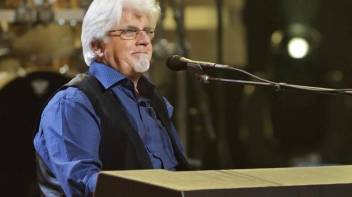
(Above: As he has done countless time through the years, Michael McDonald relishes “Takin’ to the Streets” on June 17, 2017 at the Kauffman Center in Kansas City, Mo.)

By Joel Francis
The Kansas City Star

Michael McDonald has enough hits in his five-decade career to please fans for days. On Saturday night at the Kauffman Center, the celebrated songwriter boldly chose to devote nearly half his set to introduce songs from his upcoming album.

The strength of the material rewarded McDonald’s decision. Although the songs were new, many sounded instantly familiar and blended well with the classic numbers. “Free Your Mind” had a funky Haight-Ashbury feel, while the slow blues “Just Strong Enough” featured several great solos from McDonald’s six-piece band. The upbeat “If You Really Wanted to Hurt Me,” perhaps the best of the bunch, found McDonald’s unintroduced backing vocalist signing along off-mic and dancing and clapping across the stage.

IMG_IMG_Michael_McDonald_2_1_2353JDV3_L135136365Enough hits from McDonald’s days with the Doobie Brothers and solo career were sprinkled throughout the 90-minute set to keep the audience engaged, even if they didn’t find their feet until “What a Fool Believes” near the end of the night.

Opening act Boz Scaggs took the opposite tack, delivering more than half of his bestselling “Silk Degrees” album. The 1976 smooth soul album sold 5 million copies and generated four Top 40 singles, which delivered the biggest cheers of the night.

Mixed among the familiar tunes were several covers, including Chuck Berry’s “You Never Can Tell” and Li’l Millet’s “Rich Woman.” Scaggs dedicated the former to “my favorite Missouri musician. Well, him and Miles (Davis), anyway.” The latter featured a honking sax riff and swampy feel that betrayed the song’s Louisiana origin and Scaggs’ Southern upbringing.

Both men were chatty, setting up less-familiar numbers with anecdotes about their inspiration. McDonald took the stage talking about growing up in St. Louis, and how when some of his relatives had too much to drink they’d end up driving to Kansas City.

A pair of blues songs provided the most compelling moments in Scaggs’ 85-minute set. “Some Change” was inspired by the kind of change that “seems to come along every four years” and featured some of Scaggs’ best guitar playing. The burning “Loan Me a Dime” gave all five band members plenty of time to stretch out and solo across its 10 minutes.

McDonald sent the mostly full room home happy with a gospel version of his first, and in many ways defining, Doobie Brothers hit, “Takin’ It Too the Streets.” The song opened with piano and organ gradually giving way to the full band and the admonition to let peace, love and justice rule.

Boz Scaggs setlist: It’s Over, Jojo, Rich Woman, Some Change, You Never Can Tell, Harbor Lights, Georgia, Cadillac Walk, Look What You’ve Done to Me, Lowdown, Lido Shuffle. Encore: What Can I Say, Loan Me a Dime.

Michael McDonald setlist: It Keeps You Runnin’, Sweet Freedom, Free Your Mind, I Keep Forgettin’, Find It In Your Heart, If You Wanted to Hurt Me, Just Strong Enough, Here to Love You, Beautiful Child, Half Truth, Minute by Minute, On My Own, What A Fool Believes, Takin’ It To the Streets.

Keep reading:

Review: Cheap Trick, Peter Frampton

Review: Bob Seger

Review: Farm Aid

Review: Roger Waters

(Above: “Dogs” and “Pigs” from the classic Pink Floyd album “Animals” captured Roger Waters’ disgust at the current political landscape.)

By Joel Francis
The Kansas City Star

As the lyrical and conceptual soul of Pink Floyd, Roger Waters’ music has helped define classic rock radio for nearly two generations.

Many of the songs Waters performed at his tour opener on Friday night at the Sprint Center are more than 40 years old but hold contemporary relevance in today’s fractured political landscape. In fact, his depraved, pessimistic views of humanity seem downright prescient.

Fans knew every note and syllable thanks to decades of continuous airplay, but Waters put the performances in a modern context by the films that accompanied the band on a huge screen that spanned the arena behind the stage. During the second act, another perpendicular screen was lowered over the floor.

LEDE REV ROGER WATERS 0114 SK 20The video for “Pigs (Three Different Ones)” was a devastating piece of anti-Donald Trump propaganda. Borrowing from the lyrics, the word “charade” splashed across the screens as unflattering illustrations of the commander-in-chief cycled in and out. During the long guitar solos, an inflatable sow wearing the phrase “piggy bank of war” flew over the crowd.

“Money” sustained the proletariat rage, as images of Trump’s failed casinos, Russian buildings and photos of Kremlin and cabinet officials accompanied the music.

A very few people headed for the exits – one man raised his middle finger to the stage while departing during “Money” – but they were easily outnumbered by fans raising their beers, singing along and reveling in the moment. “Pigs (Three Different Ones)” may have been the least subtle moment of the evening, but it also drew far more applause than any other non-radio track.

Waters got help from his 10-piece band, which included Kansas City native Gus Seyfort on bass and former Pink Floyd and The Who touring member Jon Carin on keyboards. Backing vocalists Holly Laessig and Jessica Wolfe stole the spotlight several times, including a duet on “Great Gig in the Sky” and the new song “Déjà Vu.” Dressed in platinum blonde wigs and black fringed dresses, the pair looked like Cleopatra as reimagined by Bryan Ferry.

The only material that didn’t come from the Floyd catalog were four new songs. All were well received and dealt with the same themes. Driven by piano and drums, “The Last Refugee” wouldn’t have been out of place on Waters’ previous solo album, 1992’s “Amused to Death.” Nestled near the end of the set, “Smell the Roses” emerged from a slinky guitar line and sounded like an outtake from Pink Floyd’s “Animals” album.

Ten local children lined the front of the stage during “Another Brick in the Wall.” After singing the familiar chorus, they shed their orange jumpsuits and danced around wearing black shirts that said resist. At the first notes of “Wish You Were Here,” seemingly every phone in the building was held aloft to capture every moment. The nostalgic ballad was a rare moment of reprieve from the scathing critiques and protests.

A similar moment arrived during the final song, “Comfortably Numb.” As Dave Kilminster tore into another guitar solo, Waters raised his hands and swayed back and forth. The crowd, bathed in soft lights and gently falling pink confetti, joined him. After nearly three hours of angry catharsis, it was time to heal.

Setlist: Breathe, One of These Days, Time > Breathe (reprise), Great Gig in the Sky, Welcome to the Machine, Déjà vu (new song), The Last Refugee (new song), Picture That (new song), Wish You Were Here, The Happiest Days of Our Lives > Another Brick in the Wall (parts two and three). Intermission. Dogs, Pigs (Three Different Ones), Money, Us and Them, Smell the Roses (new song), Brain Damage, Eclipse, band introduction, Vera > Bring the Boys Back Home, Comfortably Numb.

Keep reading:

Shine on Rick Wright

Jeff Beck relishes “Commotion”

Review: Prophets of Rage