Social Distancing Spins – Day 47

By Joel Francis

Stay strong and stay safe, my friends.

Johnny Cash – American IV: The Man Comes Around (2002) The final Johnny Cash album released in Johnny Cash’s lifetime is appropriately fixated on mortality. Then again, Cash has been singing about death since he shot a man in Reno to watch him die. The album works more often than it doesn’t. The title song is one of my favorite Cash compositions, funneling the Book of Revelations through a strummy Martin guitar. Similarly, Cash turns Depeche Mode’s “Personal Jesus” into a gospel song. He adds a layer of guilt and gravitas to Sting’s “I Hung My Head” that is absent from the original recording. Best of all, Cash infuses a lifetime of pain and addiction into “Hurt,” completely claiming the song from Nine Inch Nails. Most of the rest ranges from fine to worse. “Tear-Stained Letter” is too jaunty and “Desperado” and “Danny Boy” are unnecessary. Cash isn’t adding anything to those well-worn tunes. Even worse, are covers of “Bridge Over Troubled Water” (with Fiona Apple) and “In My Life.” Surprisingly, Cash seems lost on these songs, unsure of what to do with them. The high points more than make up for the milquetoast material – there is usually a little filler on Cash albums, but the result is the least consistent of the American releases to that point.

David Lee Roth – Eat ‘Em and Smile (1986) Diamond Dave is looking to settle scores with his solo debut. He brought in hotshot guitarist Steve Vai and bass player Billy Sheehan to generate one of the highest notes-per-second rock albums in an era that celebrated six-string excess. For better or worse, Roth can’t help being anything other than himself so even this grudge match was delivered with a broad wink and jazz hands. The key word in the album’s title is SMILE. All the songs push the fun factor to 11, but surprisingly nothing feels forced. Of course it’s all junk food, but like getting the extra butter on movie theater popcorn, sometimes you just can’t help it.

Four Tops – Second Album (1965) More often than not, especially in the 1960s, Motown albums were collections of hit singles padded with other recordings. The result was often uneven, but the album tracks on Second Album are pretty great in their own regard. No one can argue with the three Top 10 hits on the first side: “I Can’t Help Myself (Sugar Pie, Honey Bunch),” “It’s the Same Old Song” and “Something About You.” The second side doesn’t contain any hit singles but doesn’t suffer from it. “Darling, I Hum Our Song” has a great Levi Stubbs vocal performance (really, he’s great on everything here) in a Jackie Wilson-styled song from the period when Berry Gordy was writing hits for Wilson. “Since You’ve Been Gone” first appeared as the b-side of “Standing in the Shadows of Love.” The energy from Four Tops and the Funk Brothers on this track make me think it could have been a hit on its own. Back on the first side, “IS There Anything I Can Do” is one of the few songs on the album not to come from the pen of Brian Holland, Lamont Dozier and Eddie Holland. Written by Smokey Robinson and fellow Miracles Ronald White and Pete Moore, it’s not hard to imagine the Miracles performing this song. Surprisingly, as far as I know they never did. Come for the hits on Second Album but stay for the album tracks that illustrate just how special the Four Tops were.

The Damned – The Best of the Damned (compilation) It seems there are almost as many best-of collections for the Damned as there has been lineups. I picked this up at a garage sale because it has many of my favorite songs from their first three albums, back when they were more punk than goth. At some point I might expand my Damned album collection to include those early releases in their entirety, but until then this is a great overview of a tough band.

The Stooges – Fun House (1970) The hype sticker on my album proclaims “Iggy and the boys find their troglodyte groove.” I wholeheartedly agree with this sentiment. The music on Fun House connects on a primal level, like howling at the moon. In a strange way, it connects with me in the same way as Howlin Wolf or John Lee Hooker – straight in the gut, without any pretense. Like it is hitting the lowest rung of Maslow’s hierarchy of needs (food, shelter, etc.) In other words, the exact opposite of a pompous album review that references Maslow’s hierarchy of needs. The song “TV Eye” came from a phrase that Stooges rhythm section Scott and Ron Asheton’s sister used about men leering at her. It forces me to exceed the speed limit every time it comes on in the car. “Down in the Sleep” came to Iggy Pop in the middle of the night. He got out of bed trying to play the power chord he heard in his head, waking his wife in the process. Unlike Ziggy, Iggy didn’t play guitar. Perhaps he never found that chord.

After the opening assault, Fun House changes up a bit but remains just as gripping. Steven Mackay’s saxophone squonks across the second side like the group has just discovered fire for the first time.

This album needs to be played regularly to make sure you are still alive.

The Shins – Wincing the Night Away (2007) The third album from the Albuquerque indie rock quartet was their first release after Natalie Portman proclaimed them life-changing in the film Garden State. There was a lot riding on this release, but frontman and songwriter James Mercer wasn’t afraid to stretch the band’s sound. He sprinkles synthesizers and funk basslines among the familiar chiming guitars and la-la-la melodies. As a result, Wincing the Night Away isn’t as strong as the two Shins albums before it, but it is still very enjoyable.

Willie Nelson – Teatro (1998) Willie Nelson seems game to try just about anything. Reggae album? Sure. Duet with Kid Rock? Why not? Still, the decision to record in an old movie theater with producer Daniel Lanois was a solid nod. Nelson revisits several of his lesser-known songs from the 1960s with harmonica player Mickey Raphael and the marvelous Emmylou Harris on backing vocals. Many of the arrangements are Spanish or Mexican in spirit and give a vibe like we are lost in a marathon of Ennio Morricone films south of the border. Nelson, the other musicians and the songs thrive in this atmosphere, making this a distinctly unique album in Nelson’s vast catalog and also one of his best.

Peter Gabriel – Us (1992) It took Peter Gabriel six years to release a follow-up to his massively successful album So. That’s almost light speed, considering he’s only given us one other album of original material since then. But what an album Us is. Gabriel throws everything from bagpipes to a Russian folk group in the should-have-been-single “Come Talk to Me.” Other songs are just as overstuffed and immaculately excellent. The horn-driven “Kiss the Frog” ranks as one of the greatest extended sexual metaphors of all time. “Blood of Eden” and “Secret World” are passionately romantic. The only dud is “Steam,” aka Son of “Sledgehammer.” There is a lot to unravel in Us, but Gabriel gave his fans plenty of time to process all of it.

Social Distancing Spins – Day 46

By Joel Francis

The weather is nice and cabin fever is real. Stay safe and keep the faith.

Brian Wilson – Reimagines Gershwin (2010) The opening minute of this album is an absolute dream. Layers of harmony vocals music fans have enjoyed for more than half a century cascade into the melody of the iconic “Rhapsody in Blue.” The rest of the album isn’t quite as exquisite, but maintains the same premise: Two intimately familiar musical styles melting into something new. Wilson’s versions of “Summertime,” “They Can’t Take That Away From Me” or “I Got Rhythm” won’t make anyone forget about the legion of stellar interpretations that have come from Miles Davis, Ella Fitzgerald or Willie Nelson, to name but a few. But they do show how Gershwin’s pen was subconsciously at work in Pet Sounds, “Cabinessence” and “Surf’s Up.”

Rhett Miller – The Interpreter: Live at Largo (2011) In April, 2008, a few days after the University of Kansas Jayhawks won the men’s national basketball championship, my wife and I were in Los Angeles for vacation. I had heard about the club Largo over the years and was hoping to see their unofficial artist in residence, Jon Brion. The multi-instrumentalist wasn’t performing the when we were going to be there, so we happily grabbed tickets for Rhett Miller’s show instead. The Old 97s frontman was in a great mood, telling stories and playing some of his favorite songs by other people (and previewing material from the upcoming 97s album, Blame It On Gravity). About halfway through the set, Jon Brion took a seat behind the piano and the two banged out tunes like a pair of long-lost brothers. That night – and the following one, where Brion wasn’t present but Pixies guitarist Joey Santiago was – comprise the selections here on The Interpreter. Because I was there, it is impossible for me to grade this album objectively. It always takes me back to that night and makes me wish the full performance would be released on Nuggs or something similar. Your mileage may vary, but if you enjoy Miller’s voice and the songwriting of David Bowie, Elvis Costello, Ray Davies, Jeff Tweedy, Tom Petty and Bob Dylan, you are definitely in the right place.

King Curtis – Live at Fillmore West (1971)
Aretha Franklin – Live at Fillmore West (1971)
Both of these landmark live albums are taken from the same run of shows at the historic San Francisco venue, where King Curtis and his Kingpins were backing the Queen of Soul. Franklin’s album has more contemporary rock covers than her better-known soul material. After marching through Stephen Stills’ “Love the One You’re With,” Simon and Garfunkel’s “Bridge Over Troubled Water” and the Beatles’ “Eleanor Rigby,” Franklin manages to make Bread’s “Make It With You” engaging. Franklin starts cooking on the second side. After the slow blues “Dr. Feelgood,” Franklin and her incredible band – including Billy Preston on organ and the Memphis Horns – tear through “Spirit in the Dark.” As the song winds down after about five minutes, Ray Charles comes out and they do it all over again for another nine minutes.

Although less well-known, Curtis’ Fillmore album is just as incredible. Setting the table with “Memphis Soul Stew,” Curtis blasts through the Moody Blues’ “A Whiter Shade of Pale” and destroys Led Zeppelin’s “Whole Lotta Love.” The second side is just as good, with readings of “Signed, Sealed, Delivered I’m Yours” and “Ode to Billie Joe.” Unfortunately, this album also served as Curtis’ swan song. He was fatally stabbed outside his New York City apartment a week after it’s release.

In 2005, Rhino released a limited-edition collection of all three Fillmore shows in their entirety. Finally, fans could hear the music as it was presented each night, with Curtis opening the show, then Franklin coming out. This four-disc box set is definitely worth seeking out.

Jay-Z – American Gangster (2007) Sean Carter rolled into his alleged retirement – Did anyone really believe he was done? – on a hot streak. I confess to wondering if he could rise to the occasion on his inevitable comeback. And he didn’t – until American Gangster. Inspired by the Denzel Washington movie, Jay-Z played to his strengths and crafted 15 songs that revisit his oft-celebrated days as a drug dealer and Washington’s portrayal of black drug lord Frank Lucas. Though the album feels a couple songs too long to my ears, there isn’t a bad cut on the record. The long-awaited track with Nas lives up to the anticipation. American Gangster isn’t as good as The Blueprint or The Black Album, but it’s not far behind them either.

Two quick anecdotes before we move on. For a long time the downtown location of The Peanut hosted Hip Hop and Hot Wings on Sunday nights. (The Peanut has some of the best wings in Kansas City.) The fun usually started late and lasted later, which made for a rough Monday so I never got to attend as often as I wanted. About a month after American Gangster came out, around Christmas time, one of the DJs dropped the needle on “Roc Boys (And the Winner Is)” and the entire room exploded like a grenade had gone off. Strangers were high-fiving and everyone was signing along and dancing. “Roc Boys” got bonus local points for featuring Kansas City Chiefs running back Larry Johnson in the video.

Alright, the second story. On the same vacation in Los Angeles that I discussed in the Rhett Miller entry, my wife and I had tickets to see Jay-Z and Mary J. Blige at the Hollywood Bowl. Despite leaving hours early, we got there just in time to hear the opening song (all the traffic was between the exit and the parking lot). Jay-Z was touring in support of American Gangster and it was incredible to hear those songs in person, with a huge band backing him up. MJB was a solid bonus for the evening.

William Onyeabor – Who Is William Onyeabor? (compilation) Even though this collection spans three LPs and 13 tracks, by the end we are nowhere closer to knowing the answer about William Onyeabor than when we started. According to internet reports, the Nigerian producer self-released eight albums between 1977 and 1985, which were quickly bootlegged. It is not hard to see why so many people would want this music. It’s primitive electronics – clunky drum machines and Casio keyboards – married to Afro-beat rhythms, with a little P-Funk stirred into the sauce for good measure. Who is William Onyeabor? Well for the 75 minutes of this album he’s a fillpin’ musical savant. That’s who.

Various Artists – Red Hot + Riot (2002) The Red Hot charity albums have generally been pretty good, but this one, honoring Afro beat legend Fela Kuti, stands above the rest. For one, it features some of the top socially conscious/backpack rappers of the time: Blackalicious, Talib Kweli, Common and Dead Prez. Plus a mix of great soul singers, including D’Angelo, Macy Gray, Me’Shell Ndegeocello, Kelis and Sade. Finally, a sprinkling of jazz legends (Archie Shepp, Roy Hargrove), African musicians, Kuti’s son Femi Kuti and bluesman Taj Mahal. If this roll call doesn’t pique your interest, trust me, the result is even more impressive. Rap, jazz, blues, soul and gospel all flow into a river leading back to Mother Africa. Can you dig it?

Social Distancing Spins – Day 45

By Joel Francis

Since this is day 45 of the social distancing spins project, I thought it was only fitting we celebrate by spinning, what else, 45s. Here are 10 from my collection.

Penny and the Quarters – You and Me/You Are Giving Me Some Other Love (2011) “You and Me” was neatly tucked near the end of the Numero soul compilation Eccentric Soul: The Prix Label. The scant liner notes provide more questions than answers. Then Ryan Gosling heard this great soul love song and used it in his 2010 movie Blue Valentine. The film developed a devoted following – it’s quite good – and peoples started wondering about the love theme that brought the main characters together. Numero turned on the bat-signal, hoping to learn more about the mysterious Penny – and deliver some royalties. Finally, the mystery was solved. Penny was none other than Nannie Sharpe of Columbus, Ohio. She performed the song with her brothers in a studio in 1969, not knowing if they were actually being recorded. The tune itself sounds like it could have come from the golden age of doo wop, or at least Sam Cooke’s pen. The b-side, “You Are Giving Me Some Love,” is cut from the same cloth and features a lengthy spoken-word introduction. The lo-fi quality of both recordings only adds to the charm. Lost jewels like this are what makes the Numero Group so essential. I dare you to listen to this and not smile.

Mission of Burma – Innermost/And Here It Comes (2009) These are two non-album tracks recorded at the same time as their third reunion album (and fifth overall) The Sound the Speed and the Light. The album is the weakest release of their reunion relative to the rest of their catalog, which is to say it is still very good. I don’t know the record well enough to tell you if “Innermost” and “And Here It Comes” were unfairly excluded, but they aren’t a departure from the band’s arty, cerebral, intense punk. Of the two tracks, I prefer “And Here It Comes” for the guitar solo and sonic experimentation in the middle.

Brandon Phillips and the Condition – People Talk/Angel Say No (2019) Brandon Phillips is a staple of the Kansas City, Mo., music scene. He started off in the Gadjits with his brothers, before the three of them started the Architects, an incredible punk band. Now the Phillips brothers are back with Brandon out front in the Condition, a sonic tribute to early Elvis Costello and Joe Jackson. The pair of tunes here are so good it’s almost a cruel tease. I desperately want a full-length album to enjoy alongside Look Sharp! and Punch the Clock. Like the Phillips’ brothers other musical endeavors, the Condition have hooks and energy for miles, I hope they stick around long enough to give us more.

Ben Folds – Mister Peepers/A Million Years or So (2018) Piano man Ben Folds wrote this song about then-assistant attorney general Rod Rosenstein as part of a storytelling project for The Washington Post Magazine. I don’t think Folds has written another political song (please let me know in the comments if he has), but this track is a winner on several levels. First off, the lyrics, painting Rosenstein as a nerd getting picked on by the GOP jocks in the House of Representatives is perfect analogy. Folds also nails the hypocrisy baked-in to the bullying we’ve normalized from D.C. The lyric is worth quoting in full:

“You boys are Christians right? What would Jesus do? Would he bury crimes and carry water like a stooge? Or smear a family man in case he tells the truth/About the boss/Yeah what would Jesus do?”

Finally, the banjo and fiddle accompaniment is superb. I don’t think Folds has worked in this mode before either and I love the bluegrass tinge it provides. If we’re lucky, there might be a few more songs in this direction on Folds’ next album. Or he could cover Dr. Dre and Snoop Dogg again. Could go either way.

The b-side is a Roger Miller cover that Folds turns into a tear-jerking love ballad.

Jawbox – Motorist/Jackpot Plus! (1992) The single version of “Motorist” is quite a bit different from the album version that appeared on For Your Own Special Sweetheart a couple years later. The single version opens with a drum machine and the verses rest on the bassline and drums, until the guitar kicks in and takes the song over the top on the chorus. The album version opens with the chorus, then drops back to the first verse. The version here is a more raw performance and my favorite of the two readings. The b-side, “Jackpot Plus!” is another song that also appears on For Your Own Special Sweetheart. This time the arrangement and emotion are pretty similar. The biggest difference is J. Robbins’ vocals have a filter on the album version. I love this kind of no-frills, visceral punk.

The Beatles – Baby It’s You/I’ll Follow the Sun/Devil in her Heart/Boys (1994) I believe this was my first vinyl purchase. I don’t know if the turntable at home was even working at the time I bought this, I just knew I was happy to buy a new Beatles single just like my parents (could) have at my age. “Baby It’s You” was pulled from the Live at the BBC compilation. The other three songs are also BBC recordings, two of which were included on the 2013 collection On Air: Live at the BBC, Volume Two. These early sessions are great because they remind you just how amazing the Beatles were as live performers. Before they were turning the recording studio inside-out, they were a heck of a live band. John Lennon’s tender vocals on “Baby It’s You” made it a stand-out cut on the first BBC anthology. The other songs aren’t as essential, but it’s always fun to hear the Fab Four let it all hang out on “Boys.”

Alice Cooper – Clones (We’re All)/Model Citizen (1980) “Clones” doesn’t sound anything like Alice Cooper’s anthems “School’s Out” or “Eighteen,” but then again at the time this was recorded Cooper didn’t sound much like himself, either. He dabbled in 1950s noir on Lace and Whiskey and got ultra-personal on From the Inside. It’s clear Cooper didn’t know what to do at the time, so he hooked up with Cars and Queen producer Roy Thomas Baker and swapped the guitars for synthesizers. I haven’t listened to the album Cooper and Baker made together, but “Clones” has everything I love about those early Cars singles – handclaps! great keyboard hooks! sharp rhythm guitars! – and early ‘80s new wave in general. “Model Citizen” is closer to Cooper’s expected sound but Baker’s production tricks can’t completely hide the inane lyrics that aren’t nearly as clever as they think.

James Brown – The Payback Part One/Part Two (1973) My all-time favorite James Brown jam. The only bad things I can say about “The Payback” is that I get annoyed by having to flip the single over halfway through the song and that I’m always disappointed it doesn’t go on for twice as long. This song has been sampled a million times, but no one has been able to improve on the original. An angry Brown put the godfather in his Godfather of Soul nickname with this tale of revenge. Brown lays out how he’s been wronged and what he’s going to do about it over some funky chicken-scratch guitar. The horns punch like fists and Brown’s emphatic screams punctuate the anger and boasting with a sharp blast of frustration and impatience. You can see Brown pacing his corner of the boxing ring, psyching himself up and waiting for the bell to ring as this song builds. By the time it’s over, I’m ready hit the streets and find some trouble myself. Maybe it’s for the best this song isn’t longer, before I get caught in something I can’t handle.

The Clash – Bankrobber/Rockers Galore ….UK Tour (1980) Between releasing a two-LP masterpiece and it’s three-record follow-up, the Clash managed to released this gem, which never appeared on any of their albums. Joe strummer rides a terrific reggae groove talking about income inequality disguised as the story of his dad, a bank robber who never hurt anyone and just “loved to steal your money.” Think of it as Woody Guthrie’s “Pretty Boy Floyd” by way of King Tubby and Kingston, Jamaica. Reggae producer Mikey Dread added great dub effects to “Bankrobber.” On the b-side, Dread takes over, taking the mic for some toasting over an even more dubbed-out version of the “Bankrobber” track. When Clash guitarist Mick Jones joined Joe Strummer onstage for the first time in decades at a benefit show for striking firefighters, the two jammed on this song for nearly 10 minutes.

The Jimi Hendrix Experience – Can You Please Crawl Out Your Window/The Burning of the Midnight Lamp (1998) If memory serves, this was a promotional give-away that came with the Hendrix Live at the BBC double-disc set. After the success of the Beatles BBC collection, all the heritage bands got in on the act. “Can You Please Crawl Out Your Window” is a song that never appeared on any of the Experience albums, a Hendrix cover of an obscure Bob Dylan song that was only released as a single. Got that? Hendrix covering Dylan has historically been a good thing and this version is a solid addition to the Hendrix catalog, even if it isn’t as incendiary as “Watchtower.” The BBC version of “The Burning of the Midnight Lamp” shows how proficient Hendrix was at transforming his psychedelic studio creations into compelling live performances. Pairing this song with the Dylan cover shows how much an influence the Hibbing, Minn., folk singer had on Hendrix’ lyric-writing. He drops a lot of little details into “Lamp” that sometimes get lost among the guitar heroics.

Social Distancing Spins – Days 42-44

No write-ups for these. I’m taking the day off. Sorry.

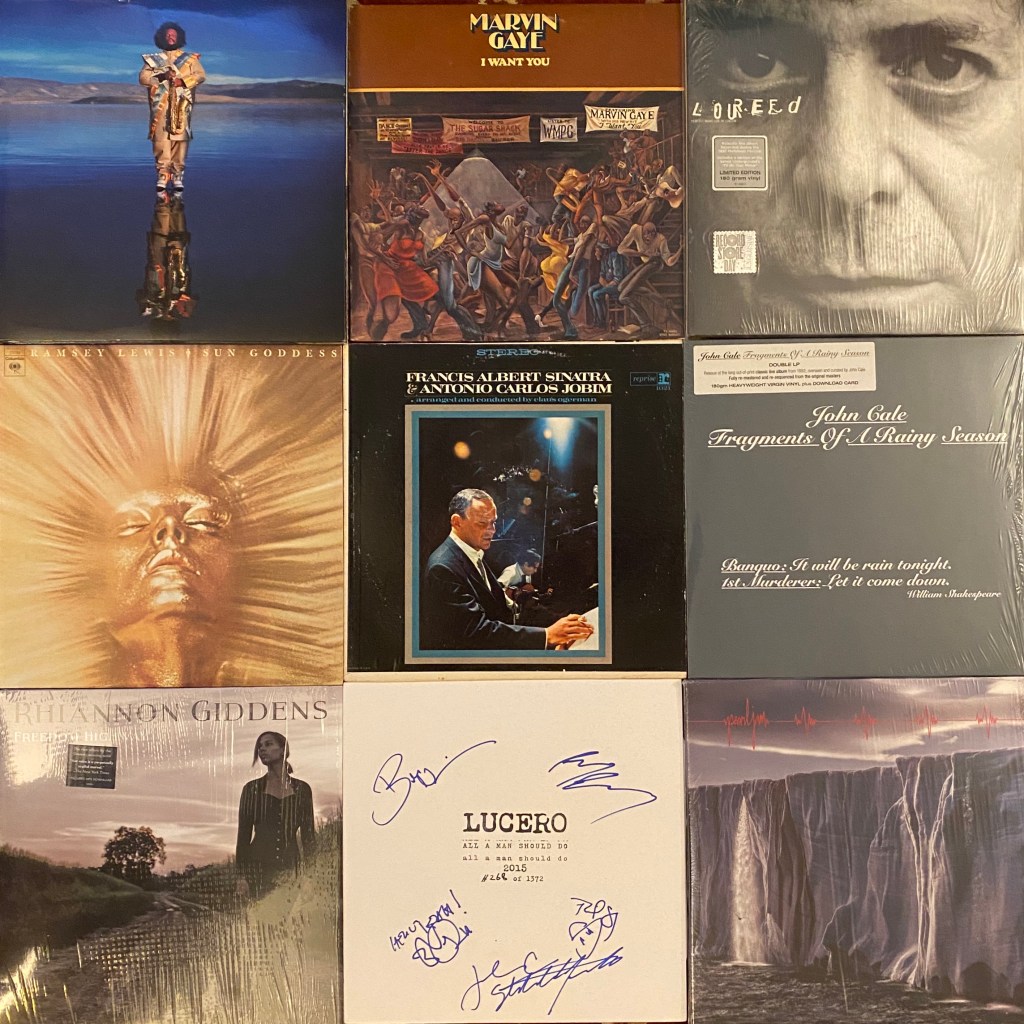
Rhiannon Giddens – Freedom Highway (2017)

Ramsey Lewis – Sun Goddess (1974)

Kamasi Washington – Heaven and Earth (2018)

Pearl Jam – Gigaton (2020)

Lou Reed – Perfect Night: Live in London (1998)

John Cale – Fragments of a Rainy Season (1992)

Marvin Gaye – I Want You (1976)

Lucero – All a Man Should Do (2015)

Frank Sinatra and Antonio Carlos Jobim – Francis Albert Sinatra and Antonio Carlos Jobin (1967)

Social Distancing Spins – Day 41

Sonny Rollins – The Freedom Suite (1958) The Civil Rights movement and bebop came of age together in the 1940s and ‘50s. It makes just as much sense for the jazz artists of that time to make music about the blatant racial inequality happening in America at the time as did for Chuck D, KRS-One and Mos Def to do it in their times. The hard-hitting title song lasts nearly 20 minutes and takes up the entire first side. In it Rollins displays his talent for twisting, flipping and turning a theme inside-out, only without any of the humor he usually infuses into his playing. Rollins is dead serious here and his point is driven home by Max Roach’s sympathetic and dynamic drumming. The second side is devoted to softer material, including a stellar reading of The Music Man’s “’Till There Was You” (also covered by the Beatles). Rollins’ pacing in the production of this album is just as impeccable as in his playing. He knows when to clench a fist and when to extend a hand.

Raffi – Singable Songs for the Very Young (1976) This was a favorite album from my childhood and my son now enjoys it. I wrote extensively about Raffi and his then-unknown producer some time ago. 

Les Vikings de la Guadeloupe – Enko on ti Tou: 1966-2016 (compilation) I don’t know anything about this band or this music except that I love it. Internet research tells me this is “one of the most important French Antillean band from the ‘60s and ‘70s.” This practically goes without saying. In all my acquaintances with other French Antillean bands from the ‘60s and ‘70s, Les Vikings de la Guadeloupe definitely rest on the top of that pile. The internet also tells me their music is “a unique mix of Biguine, funk, Latin, compass and early Zouk.” Don’t confuse Les Vikings de la Guadeloupe with a late Zouk band. They are strictly early Zouk. Look, here is all you need to know about this fantastic collection. Ready? You know how there aren’t many airplanes in the sky right now, because we can’t really leave our houses except to go to the grocery store? And you know how we all can’t wait for this to end and safely return to exploring our world? If you put this record on and close your eyes, you can take an easy vacation in your mind down to the Caribbean. No frequent flyer miles required.

Bob Dylan – Under the Red Sky (1990)
Joni Mitchell – Chalk Mark in a Rain Storm (1988)
Paul McCartney – Egypt Station (2018) Most longtime artists who hang around long enough reach a crossroads at a certain point in their careers. Do they want to continue pushing to be on the vanguard, or will they regroup and continue to create from their strengths? Typically, the audience figures this out an album or two before the artist. A common attempt to hang on the precipice of the cutting edge a little longer is to rope in several high-profile guests.

This is the place Bob Dylan and Joni Mitchell found themselves in the late ‘80s. Mitchell enlisted Tom Petty and Billy Idol to assist on “Dancin’ Clown,” with a result that is as head-scratching as it appears on paper. Other duets were more successful. Peter Gabriel steps into “My Secret Place” and makes it sound like a So b-side. Willie Nelson and Don Henley trade vocals with Mitchell on “Cool Water” and “Snakes and Ladders,” respectively. The best duet on the album, though, comes between Mitchell and saxophone legend Wayne Shorter on “A Bird that Whistles (Corrina, Corrina).”

The hype sticker on my copy of Under the Red Sky boasts special appearances by David Crosby, George Harrison, Bruce Hornsby, Elton John, Al Kooper, Slash, Jimmie and Stevie Ray Vaughan, Don Was and more, with each musician’s name in all caps. For all that star power it’s remarkable that only a few guests manage to differentiate themselves from standard studio pros. The other problem with Under the Red Sky is that some of the songs are embarrassing. It doesn’t matter which special guest plays the solo on “Wiggle Wiggle,” the ghost of Jimi Hendrix couldn’t save a tune with the lyrics “wiggle to the right, wiggle to the rear/wiggle ‘til you wiggle right out of here.” Dylan is still Dylan though, and he gives us the great “Born in Time” to counterbalance “Wiggle Wiggle.” But that’s the problem: the album is a wash.

Neither Chalk Mark or Red Sky are bad albums, per se. It’s that not only do the results fail to add major works to each artists’ considerable songbooks, they seem to be trying awfully hard to achieve this mediocrity. To be fair, half-baked Dylan and Mitchell are still better than the majority of songwriters, and there are some keepers hidden in both albums. But Chalk Mark and Red Sky are also the final contemporary-sounding albums each made before retreating to acoustic guitars and the style of music that made both of them icons and haven’t come close to anything close to modern again.

Paul McCartney has managed to avoid this trap for the most part. There was a time in the mid-to-late ‘90s after the Beatles Anthology came out that it looked like he was going down the heritage path, but he still believes he can land on top of the charts again. On McCartney’s most recent album, Egypt Station, he brought in producers Greg Kurstin, who has worked with Sia, Beck, Pink and Zayn Malik of One Direction, among others, and Ryan Tedder, who has worked with Beyonce, One Direction, Selena Gomez, Ed Sheeran and many more. Clearly McCartney was thinking about the zeitgeist when he selected these producers. And while the single “Fuh You” was obviously written for Top 40 appeal, it’s also not half as awkward as “Wiggle Wiggle” or “Dancin’ Clown.” Egypt Station won’t make anyone forget about Band on the Run, but it also feels a lot less forced that Under the Red Sky and Chalk Marks in a Rain Storm.

Obviously, Dylan and Mitchell went on to release some great albums after they embraced heritage status. I don’t know that McCartney has made an album as good as Love and Theft this century, but he also hasn’t resorted to a hits-with-strings live album or three consecutive standards album. (McCartney did one, 2012’s Kisses on the Bottom, and moved on.) That has to count for something.

Mavis Staples – Livin’ on a High Note (2016) Mavis Staples is a treasure. Her soulful voice never fails to put me at ease. For her 10th solo album, Staples is assisted by some of the top indie music songwriters today. Justin Vernon, Benjamin Booker, Valerie June, Aloe Blacc and Neko Case all contribute songs. Case’s work is rarely performed by other singers, so it is intriguing to hear Staples’ voice interpret Case’s unique phrasing. Vernon and M. Ward’s “Dedicated” is another standout track. I love the way Staples delivers the lyric “if it’s us against the world/Well I would bet on us” with so much hope and assurance. Livin’ on a High Note ends on a high note with “MLK Song,” a gospel folk song that incorporates one of Martin Luther King, Jr.’s speeches for the lyrics. Staples knew King well and marched with him several times in the 1960s. Again, her singing is full of hope and optimism, not sadness or loss. Livin’ on a High Note is a feel-good album for any time, but it seems especially needed right now.

Social Distancing Spins – Day 40

By Joel Francis

If you wondered how long Noah and his family were aboard the ark while the hard rain fell continuously, we’ve reached that point. Forty days (and nights). I don’t see any doves in the sky.

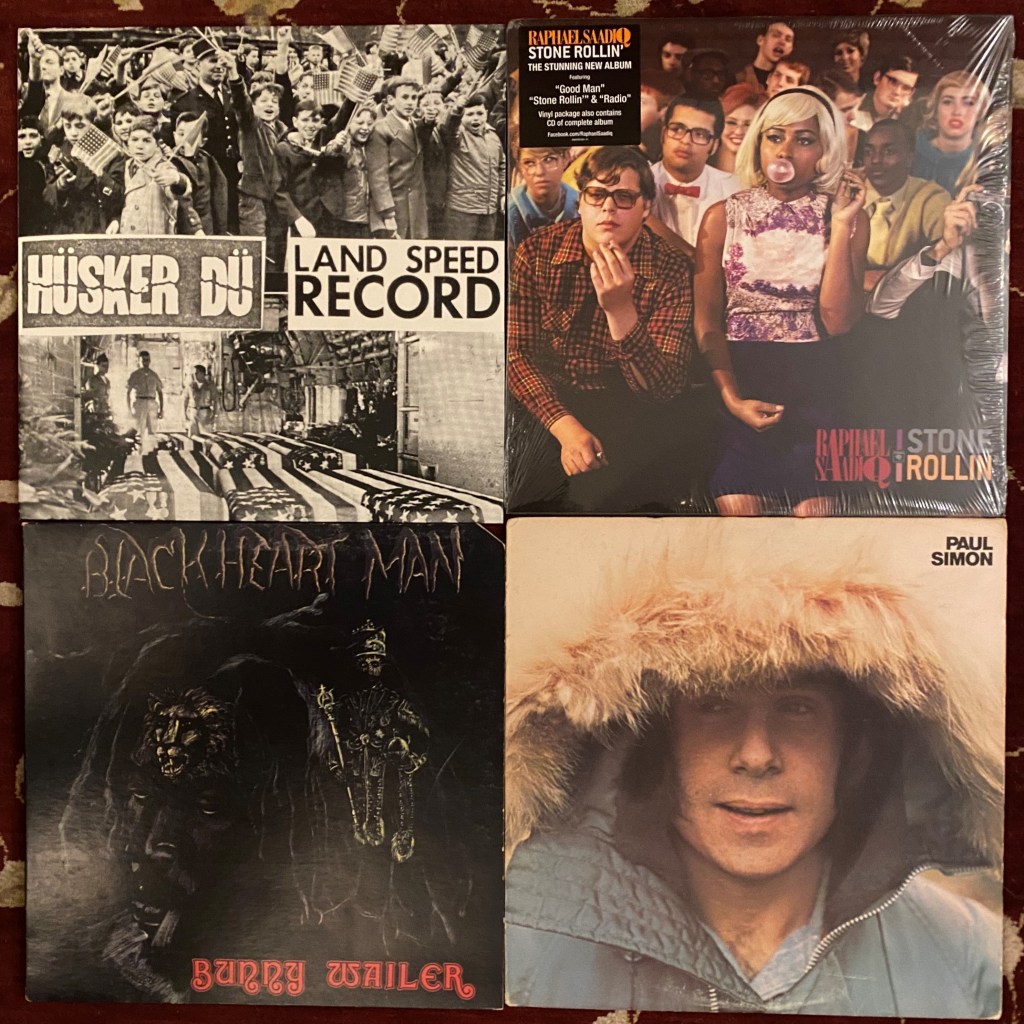
Paul Simon – self-titled (1972) Paul Simon’s solo debut (for all intents and purposes) arrived two years after the landmark Bridge Over Troubled Water. It’s a very different album from Bridge, but it is also established Simon as an artist who could operate completely independently of Art Garfunkel. If you’ve heard the album think about it for a moment. Where would you put Garfunkel? He certainly doesn’t fit on the big singles, “Mother and Child Reunion” and “Me and Julio Down by the Schoolyard.” Maybe on “Duncan” but not really anywhere else. Meanwhile, Simon’s dabbling in reggae, folk, blues, gospel, even hot jazz on the wonderful instrumental “Hobo’s Blues” with Stephane Grappelli. Simon would quickly eclipse this excellent album with his two subsequent releases, but really the blueprints for everything he would do next, even Graceland, can be found here.

Husker Du – Alternate Land Speed Record (1982) When the producers of the excellent Husker Du box set Savage Young Du were denied use of any material the hardcore punk trio recorded for SST, they did the next best thing and compiled an alternate version of the band’s debut live album Land Speed Record. Nearly the same songs, same order, same venue, different performances. I haven’t compared the two versions but I don’t find anything lacking on the numbers offered here. The 13 songs (there were 17 on the original edition) blast past like you are on the business end of a leaf blower. The second side features the In a Free Land single and a bevy of b-sides. Individually, each song rips and kicks like a chainsaw about to throw a part. Together, they flow like a violent sea of free jazz or an industrial raga. Either way, you won’t need to curl your hair or brush your teeth by the time it’s over.

Raphael Saadiq – Stone Rollin’ (2011) The mastermind behind Tony! Toni! Tone! came up in a big way on his third solo album, the Motown-inspired The Way I See It. Stone Rollin’ was his follow up release and if anything it builds on and improves the sound established before. Opening number “Heart Attack” sounds like a lost Sly and the Family Stone track, while Ray Charles was definitely in the house on “Day Dreams.” Another stand-out track, “Go To Hell,” opens with a big organ and tympani straight out of the ‘70s. And in a delightful twist the song is about someone trying to avoid the eternal fires, not send an enemy there. Hidden near the end, “Good Man” is the best album. Taura Stinson sings a hooky chorus that would work well on a hip hop track a la Mary J. Blige. Instead, Saadiq keeps it old school and paints a story of a blue collar man doing everything and still falling short, especially in love. The lush orchestration and horns add another layer of drama to the story. Stone Rollin’ is a stone classic that fans of the revival sound coming from Daptone and Colemine should definitely check out. Everyone else should hear it as well.

Bunny Wailer – Blackheart Man (1976) The third Wailers-related album to come out in 1976. Although all albums touch on each of these areas, the shorthand is that Bob Marley’s Rastaman Vibration is the political album, Peter Tosh’s Legalize It the playful one. Blackheart Man is definitely the most spiritual of the three releases. The title song opens the album and warns against going near the devil and how Jah will one day defeat the Blackheart Man. The album ends with a lengthy – and excellent – version of the classic gospel song “This Train.” Between these bookends, Wailer addresses reparations on “Dreamland,” draws a vivid portrait of poverty and imprisonment in “Fighting Against Conviction” and offers another warning about the end times on “Amagideon.” Blackheart Man is easily lesser-known of the three releases I’ve discussed over the past three days, but it is every bit the equal of the other two. It is a must-own for all reggae fans.

Social Distancing Spins – Day 39

By Joel Francis

Cabin fever has taken hold, but let’s not replace it with a real fever. Stay in and stay safe, my friends.

Bob Marley and the Wailers – Rastaman Vibration (1976) Bob Marley had a lot to prove with Rastaman Vibration as former Wailers Peter Tosh and Bunny Wailer also released their solo debuts that year. But dissonance in the Wailers camp turned to delight for music fans, because all three albums are reggae classics. (We looked at Tosh’s Legalize It yesterday and will likely examine Wailers’ Blackheart Man tomorrow.) Of course, Marley was the biggest star at the time and as such Rastaman Vibration had the greatest resonance. The eighth Marley album, Rastaman Vibration has some of the reggae legend’s best political songs. “Johnny Was” strikes at the casual violence that allows stray bullets to kill innocent bystanders. “Rat Race” calls out a suspected attempted by the CIA to subvert Jamaican politics. The best of them all, though – and arguably Marley’s greatest political song ever – is “War.” As Marley recites Halie Selassie’s 1963 address to the United Nations general assembly the reggae groove behind him simmers, gradually adding backing vocalists and horns. Selassie’s words remain powerful today: “That until the basic human rights/are equally guaranteed to all/without regard to race/this a war.” The song took on added meaning when Sinead O’Connor performed an a cappella version on Saturday Night Live, then tore up a photo of the pope to priests abusing children.

Rastaman Vibration isn’t without light-hearted moments, but songs like “Cry to Me” and “Positive Vibration” are come up short when matched against Marley triumphs “No Woman No Cry” and “Three Little Birds.” The funniest moment in the album comes from the suggestion printed inside the faux burlap textured gatefold sleeve: “This album jacket is great for cleaning herb.”

Marilyn Maye – A Taste of “Sherry!” (1967) Marilyn Maye is a treasure. She started performing around Kansas in the 1930s as a child and had her own live radio show as a teenager. In 1966, Maye was nominated for the Best New Artist Grammy (Tom Jones won). Across her seven decade recording career, Maye has appeared on The Tonight Show more than any other singer. To be honest, Maye’s style of jazz/cabaret singing usually isn’t my cup of tea, but after watching her perform at a local jazz festival several years ago I was converted. Her magic and mastery onstage doesn’t completely translate to this album, one of her earliest, but it is a great reminder of an incredible talent from a bygone generation.

The Libertines – Up the Bracket (2002) One of the greatest British punk albums exploded into the garage rock revival populated by the Strokes, the Yeah Yeah Yeahs, the White Stripes and a bunch of other decent bands we’ve all forgotten about. The Libertines stood out in this landscape populated by loud guitars and snotty attitudes by being a bit more in-your-face and noisy without being off-putting or obnoxious (well, OK, they could be obnoxious). Blessed with cover artwork that recalled The Clash’s “White Riot,” they did one better and got Clash guitarist Mick Jones to produce the album as well. The result is an aggressive, tuneful romp with catchy songs that manages to live up to its title, British slang for a punch in the throat.

Prince – Dirty Mind (1980) Before “Little Red Corvette” and “Let’s Go Crazy” made him a superstar, Prince was a just hard-working funk prodigy hailing from the Upper Midwest (or nowhere, by the standards of the suits on the coasts). After proving that he could handle all the instruments himself on his debut, For You, Prince was hungry for even more control and commercial success on his second, self-titled release. He achieved both goals. Dirty Mind invested all the victories from the first two albums and emerged as the first album Prince recorded in his native Minneapolis with the local musicians previously in his touring band.

Dirty Mind contains all of Prince’s calling cards: carefree pop – “Uptown,” “When You Were Mind” – sexual controversy – “Sister,” “Head” – and a mélange of genres that roamed from new wave to soul and from rock to funk across little more than half an hour. Dirty Mind was the first classic album of Prince’s career and it remains a must-own record today.

John Legend and The Roots – Wake Up! (2010) When this album came out a decade ago, Barak Obama had been sworn in as the first black president in American history and the Tea Party were still calling themselves tea baggers and had yet to take power in the halls of congress. It is important to establish the political context into which Wake Up! was released, because this collaboration between John Legend and The Roots is a very political anthem. The best band in hip hop and the soul crooner selected 11 largely unknown soul protest songs and recast them for this new (Obama) era. As always, The Roots are impeccable and the carefully selected guests add gravitas with their performances. Legend is a capable singer but I can’t help wish that Raphael Saadiq or D’Angelo were helming the project instead. There are several times – particularly during the lengthy version of Bill Withers’ “I Can’t Write Left Handed” and “Hard Times” (a song Curtis Mayfield wrote for Baby Huey, who we discussed back on Day 31) – where Legend’s voice is too smooth and lacks the depth to bring the anger and desperation of the lyrics fully to life. But perfect should never be the enemy of good and Wake Up! is very good indeed. It is also sadly all too relevant.

Blakroc – self-titled (2009) The words “Black Keys” only appear once on this album, in small print inside the gatefold. That’s too bad, because fans of the blues-turned-arena band would probably find a lot to like here. True, Dan Auerbach cedes his vocals to a dozen or so MCs, but the musical guts of this record are the undeniable – and unmistakable – guitar and drums grooves that have powered the duo’s rock releases. The pair provide some very Wu Tang-inspired backing for the RZA and Pharoahe Monch on “Dollaz and Sense.” The collaborations with Diplomat Jim Jones are some of few times when the traditional Keys sensibilities cut through. Jones guests with Mos Def on “Ain’t Nothing Like You (Hoochie Coo)” and appears with Nicole Wray and Billy Danze on “What You Do To Me.” Whether you are a hip hop head or rock fan, there is plenty of gold in Blakroc.

Social Distancing Spins – Day 38

By Joel Francis

Watching the anti-quarantine protests and five o’clock follies, I am trying to take comfort in these words by Walt Whitman:

Meditating among liars, and retreating sternly into
myself, I see that there are really no liars or lies
after all,
And that nothing fails its perfect return—And that
what are called lies are perfect returns.
 
Let’s get into the music.

Talking Heads – Fear of Music (1979) The Talking Heads’ third album is very much a transitional piece. You can hear some glimpses of where they are headed, into the full-blown, Brian Eno-assisted soundscapes that populate their next album, Remain in Light, but for the most part Fear of Music is spare. The song titles are just as lean. Most are one or two words, reading like a cryptic poem on the sticker placed on the pack of the album: “Mind,” Paper,” “Cities.” “Air,” “Heaven,” “Animals.” After the surprise success of “Take Me To The River” on their previous album, the Heads are intentionally running as far away from mainstream success as possible, exploring African rhythms and Ddaist nonsense on “I Zimbra,” feral primitivism on “Animals” and cinematic isolation on “Drugs.” “Cities” races with frantic paranoia and “Air” is laced with sinister synthesizers and processed vocals. Even the songs with strong melodies serve as warnings. “No time for dancing/or lovey dovey,” singer David Byrne proclaims on “Life During Wartime.” Later, “Heaven” is merely a place where nothing ever happens. The Talking Heads were never this stark – or dark – again. Which is why Fear of Music is my favorite Talking Heads album.

Thom Yorke – Tomorrow’s Modern Boxes (2014) The Radiohead frontman’s second solo album is more likely to rattle around in your head after a deep listen than spring from your lips like a Broadway melody. The music is moody and cerebral. And as I found out when I saw Thom Yorke in concert in the fall of 2019, surprisingly danceable and energetic when dialed up to 11. My favorite moments are when Yorke stretches out and lets the tracks hypnotize. “There Is No Ice (For My Drink)” is a glitchy wonderland. “The Mother Lode” manages to combine ambient music with dubstep. I’m not enough of a cryptologist to pretend to know what these songs are about, nor versed enough in EDM to compare this to other, similar pieces. What I can say is that Tomorrow’s Modern Boxes is a solid listen that helps place Radiohead’s The King of Limbs in context.

INXS – Kick (1987) Nearly 25 years after the death of lead singer Michael Hutchence, the music of INXS remains ubiquitous. The Australian band’s pop prowess is undeniable, but they always had trouble crafting great albums around those magnificent singles. Kick, their sixth album, is the one time everything clicked. OK, it helps that five of the dozen tracks here were big hits, but the other seven are no slouches. Opening track “Guns in the Sky” plays like a set of expectations the band will need met before delivering the hits. It sets the table nicely for the great run of “New Sensation,” “Devil Inside” and “Need you Tonight.” The first half concludes with “The Loved One,” the only cover on the album. The second side includes another amazing run of “Never Tear Us Apart,” “Mystify” and the title song. You’ve heard these songs so many times I don’t need to describe them. Kick was so big that even the songs that weren’t singles ended up being recognizable. Knowing the songs’ omnipresence you may question needing to own the album. The answer is yes, of course you do. Because even though you’ve heard them a million times, once you get done playing Kick, you’re going to want to flip it over and play it again.

Berwanger – Exorcism Rock (2016) Singer, songwriter and guitarist Josh Berwanger has been a fixture on the Kansas City music scene since The Anniversary broke through in the late ‘90s. Fans missing that great band might find the next best thing with Exorcism Rock. Former bandmate Adrianne deLanda contributes backing vocals on two tracks and former Anniversary producer Doug Boehm is back behind the boards. But you don’t need to know any of that to enjoy the infectious, hook-heavy songs. It’s impossible not to smile and sing along. The lyrics get catty sometimes – “Heard you on the radio/Song’s bad/I thought I’d just let you know,” goes the chorus on the title track – but the music is always sunny. Stir up Cheap Trick, Tom Petty and the Get Up Kids, another local favorite, and you’re getting close. I saw Berwanger last fall and the songs sound even better in person. I can’t wait to hear them again once all this blows over.

Paul McCartney – Tug of War (1982) Yes, this is the album with “Ebony and Ivory,” and yes that song is awful. But despite that transgression, Tug of War is a great album. First of all, there’s another, even better Stevie Wonder collaboration, the funky “What’s That You’re Doing.” Rockabilly legend Carl Perkins pops up for another duet on “Get It.” Jazz bassist Stanley Clarke also appears on two tracks. The most notable collaborator is producer George Martin, who wrote a great orchestral accompaniment for the title song and a very Beatle-esque horn line to “Take It Away.” Martin also added sublime strings to the affecting “Here Today,” McCartney’s tribute to John Lennon. Despite all this star power, McCartney is always in the driver’s seat. Side two kicks off with the upbeat “Ballroom Dancing.” Later, “Wanderlust” adds another composition to McCartney’s awesome ballad songbook. By the time you get to “Ebony and Ivory,” almost hidden away as the last song on the album, it starts to make a little more sense in the context of the album. Tug of War is easily found in the sale racks at a cheap price and should be an easy purchase next time you see it.

Peter Tosh – Legalize It (1976) Reggae guitarist Peter Tosh had a lot to prove on Legalize It, his solo debut. After coming up in the Wailers, Tosh was eager to establish himself as more than Bob Marley’s sidekick. Although the title song is a strident political statement (with supporting cover art), the rest of the album is surprisingly playful. “Ketchy Shuby” is a light-hearted look at love and “Whatcha Gonna Do” manages to stay perky despite a narrative about running afoul of the law. Think of it as the reggae equivalent of “Here Comes the Judge.” The most heartfelt moments arrive in the middle of the album. “Why Must I Cry” is an emotional breakup song written with Bob Marley. The next song is an excellent Rastafarian hymn, “Igziabeher (Let Jah Be Praised).” Legalize It successfully established Tosh as a star in his own right and ranks among his best work.

Social Distancing Spins – Days 35-37

By Joel Francis

The nice weather is giving me a different type of spring fever. I miss baseball and concerts and hanging out with friends. Thankfully, there is always music. Let’s dive back into the stacks.

Dave Douglas and High Risk – Dark Territory (2016) A few years ago, it felt like there was a trend, or maybe it was a micro-trend, of acoustic jazz musicians performing with electronic musicians. Pianist Brad Mehldau did it with drummer Mark Guiliana and trumpet player Dave Douglas collaborated with electronic artist Shigeto for two albums under the High Risk moniker. Both projects were mostly rewarding and enjoyable. I had the good fortune to see High Risk play at the Iowa City Jazz Festival in support of their first album. Watching Shigeto respond to Douglas’ playing, and then hearing how the rhythm section responded to their interplay was fascinating. I know there can be an easy temptation to assume electronic musicians pre-program beats and melodies and the acoustic musicians shape their music around that, but High Risk was a true live collaboration.  Dark Territory is the most recent High Risk album but I’m still holding onto hope that we might get another album from them at some point. I also hope more musicians explore this concept.

The Clash – Cut the Crap (1985)
Various artists – Recutting the Crap, Vol. 1 (2017)
Various artists – Recutting the Crap, Vol. 2/The Future Was Unwritten (2018) The final album from the seminal punk group The Clash is a mess, not even a hot mess. The conventional thinking is that solid songs were killed by poor (over)production. The good folks at Crooked Beat Records, a shop I used to visit regularly when I had relatives in Washington, D.C., tested this theory by rounding up several local bands to put their spin on the material written after guitarist Mick Jones was fired from the band and manager Bernie Rhodes assumed more control over the group’s music. It looks solid on paper and in truth it’s not bad on record, either. However, the thesis doesn’t hold up for a couple reasons. First, I don’t think all of the songs are as strong as they could be. Joe Strummer didn’t have Jones there to bounce ideas off and push him to improve the material. Secondly, the Clash are a hard band to cover. Sure, you can get the chords right and nail the lyrics, but the non-musical elements – the hunger, the spirit, the righteousness – can’t be taught or copied. You either have them or you don’t. A lot of big-name acts learned this the hard way on the disastrous Burning London tribute album back in 1999. 

Recutting the Crap is best when Cut the Crap is its worst; the lesser known, underdeveloped materials. The tribute runs into problems on “This Is England,” easily the best song on Cut the Crap, and the bonus album of songs that could have been Clash songs. Joe Strummer’s solo contributions to soundtracks and his collaborations with Mick Jones in Big Audio Dynamite. Here, the original material is so strong that the covers, however well-intentioned, come off as pale covers.

Both Cut the Crap and Recutting the Crap are interesting endeavors, but each fall short of the goal line for different reasons.

Sonic Youth – Dirty (1992) The NYC noise rockers found the perfect balance between their early indie releases and having a major label budget (and promotion) on Dirty, their seventh album. “Sugar Kane” and “Wish Fulfillment” strike the balance between melody and discord. “Youth Against Fascism” and “Chapel Hill” have a strong political message as urgent and unruly as what Rage Against the Machine was doing at the time (albeit with a different musical approach). Then there are savage cuts like “Drunken Butterfly” and “Purr” that no doubt confounded the record label executives. The deluxe edition I own contains two extra LPs containing b-sides and rehearsal tracks. A cover of Alice Cooper’s “Is It My Body” sung by Kim Gordon picks up the same feminist string as the Dirty album track“Swimsuit Issue.” A sideways tribute to the New York Dolls on “Personality Crisis” is a hoot. The works-in-progress recordings fill out the story of Dirty, but they’re not interesting enough on their own to keep me turning back to them as often as the album.

Dirty is my favorite major-label era Sonic Youth album. It’s likely that even casual Sonic Youth fans will get Dirty frequently. Anyone nostalgic for the early ‘90s alt-rock scene should check it out as well.

John Coltrane – Ballads (1963) Entire books and doctoral theses have been written about John Coltrane’s genius. I’m not sure I have anything to add, except to say that hearing Coltrane perform with his classic quartet – and especially McCoy Tyner, who we talked about way back on Day 2, is always a deep pleasure. Listening to him hold back the sheets of sound for this slower material provides yet another layer of reward. Put this on after a stressful day for the perfect lull in the storm.

U2 – Pop (1997) U2’s PopMart tour marked the first time I saw the band in concert, so I’m a little biased toward this album. Pop also feels like the last moment that U2 stopped trying to be U2 and while I enjoy several of their albums after this, they also feel very safe and calculated. At the time it came out, recording for the album ran late, cutting into tour rehearsal time and resulting in a rush-released product. You can still hear the effects of this today because the album feels disjointed. I think listening to Pop on vinyl improves the experience because there are forced pauses in the music between sides. The first side contains the opening three hard dance songs. More gentle, acoustic numbers comprise most of the second side, segueing into the most experimental (and weakest) material on the third side (“Miami” and “The Playboy Mansion”). Pop ends with three atmospheric, contemplative tracks on the final side. Being able to concentrate on one style of song at a time gives the album an extended EP feel, which helps it. Regardless how you feel about Pop, the sound of U2 swinging for the fences and missing here is still vastly preferable to the weak bunts and sacrifice fly balls they’ve been serving up for the most part ever since.

The Decemberists – What a Terrible World, What a Beautiful World (2015) The seventh album from the Portland, Ore., indie rockers was also the first release that they sounded like themselves for a while. They went all-in on the proggy concept album “The Hazards of Love,” then responded with the very poppy and folky The King is Dead (which we discussed back on Day 18). Finally, the pendulum arrived back in the middle for this excellent release. Several moments, including “Cavalry Captain” and “Mistral,” recall the high points of their early albums. They break the fourth wall on opening number “The Singer Addresses His Audience,” which comes across as a more academic (and less fun) version of “The Wilco Song,” only with references to Axe shampoo. The centerpiece is “12/17/12,” a response to the massacre at Sandy Hook Elementary School that leaves me with a lump in my throat every time. This is a good place to start if you are curious about the band. Longtime Decemberists fans will find much to love here as well.

The White Stripes – The White Stripes XX (2019) Arriving just in time for the 20th anniversary of the White Stripes’ debut album, this look back includes a record of studio outtakes from the album’s studio recording sessions, and a set from the duo’s tour opening for Pavement. (A DVD documents an additional show from that year.) The platter of outtakes reveal a couple items of curiosity. The is an early version of “Dead Leaves and the Dirty Ground,” which wouldn’t appear until the band’s third album. The smoking version of “Little Red Book” is nearly worth the price of admission on its own. The most surprising thing about the live set is that it exists at all. If you listened to the first season of the Striped podcast, you may remember that the Stripes were essentially driving themselves to these shows and losing money in doing so. It’s amazing that Jack and Meg had the money and foresight to roll tape on these gigs at all. The other revelation is how fully formed their sound is, right off the bat. The recording is a little distant, but the essence of the band that ended up playing arenas around the world is very present on this tiny club stage. Ultimately, there’s nothing here that replaces the raw, honest goodness of the White Stripes’ first album (with the exception of that “Little Red Book.” Yowza!) but the material here is the perfect complement. A dig through the detritus for those who want it.

Social Distancing Spins – Day 34

Day 34

By Joel Francis

Based on the announcements made today it looks like we’ll be doing this for at least another month. I hope everyone out there is safe and healthy.

Ringo Starr – Beaucoups of Blues (1970) The Fab Four drummer had a busy year in 1970. He not only released two solo albums, but was an integral part of Let It Be, the final Beatles album. Beaucoups of Blues was the last Ringo-related release of the year. Frankly, this is a criminally underappreciated album. The premise is simple: Ringo travelled to Nashville and cut a bunch of country tunes with the best session players in the city. The results are even better than expected. As demonstrated on songs like “Honey Don’t” and “Act Naturally,” Ringo has a great voice for country songs. The instrumental support is superb. Finally, the album barely breaks the half-hour mark, so it doesn’t overstay its welcome. If you like the Beatles, country music or top-shelf musicianship, don’t hesitate to grab Beaucoups of Blues next time you see it.

Mikal Cronin – MCII (2013) If you are a big fan of the prolife garage rocker Ty Segall, you may recognize Mikal Cronin as the bass player from Segall’s band. For his second solo album, Cronin brings a lot of the dirt and scuzz from Segall’s projects, but sweetens it up with lots of acoustic rhythm guitar and some keyboards and strings. The result is nearly 40 minutes of wonderful power pop that changes tempo and textures just enough to remain invigorating throughout. After kicking out the cobwebs with rockers like “Shout It Out” and “See My Way,” Cronin ends the album on a graceful, contemplative note with the slow, string-laden “Piano Mantra.”

MCII was my favorite album that year and it remains an absolute delight. Put this on, turn it up and let ‘er rip.

Ella Fitzgerald and Louis Armstrong – Ella and Louis (compilation) The First Lady of Song and Satchmo only appeared in the studio together a handful of times, likely because they knew the universe would not be able to handle this abundance of joy. The two-record set I own combines 1956’s Ella and Louis with 1957’s Ella and Louis Again. There has never been a time I’ve played this music that I haven’t felt better afterward. Dwell on that for a moment. Think about how much has changed in the world over the past 63 years, when these songs were released. And these two have been able to deliver unbridled bliss that entire time. If you don’t own this, there has never been a better time to buy it. We are all stuck at home, starving for human interaction. Think of it as therapy and have it delivered. If you own this, I hope I have inspired you to play it now. The world needs more gaiety, in all times, but especially now.

Rolling Stones – Goat’s Head Soup (1973) The Stones’ 13th U.S. long-player ended their incredible hot streak that started way back with 1966’s Aftermath. I’m fairly confident that the Stones were the best rock band on the planet during that run. You could argue the Beatles, but they broke up in 1970. In 1966, the Who were still figuring everything out on A Quick One (a fine album). The Kinks kept pace for most of that time, but peaked with 1971’s Muswell Hillbillies. Look, the point is that the Stones were very, very good for about seven years. And then Goat’s Head Soup came out.

Goat’s Head Soup isn’t a bad album, necessarily, it’s just not as good as the half-dozen albums that came before. “Dancing with Mr. D” starts the record on a tepid note and it takes the last two songs on the side to rescue the album. “Angie” was a No. 1 hit and the horn-driven “Doo Doo Doo Doo Doo (Heartbreaker)” is solid, but neither are as vital as “Wild Horses” and “Brown Sugar,” the songs that clearly inspired these. The second side is better just because it doesn’t try as hard. “Silver Train” is a ragged romp powered by Mick Taylor’s slide guitar that recall’s the better moments on Exile on Main Street. “Winter” is a beautiful downtempo number to which anyone who has experienced a season that just won’t let go – meteorological or otherwise – can relate. The performance is so good it almost makes up for the malaise plaguing the weaker numbers. There is enough good stuff on Goat’s Head Soup to make it a worthwhile addition, but temper your expectations.

Bruce Springsteen – Human Touch (1992) This was the first Bruce Springsteen album I owned. I know, I picked a really bad time to become a fan. I remember watching Springsteen on Saturday Night Live around the time of this release, when I was just starting to discover him (away from the omnipresent hits, at least). Everything I read said the stage was where Springsteen really came alive. I was underwhelmed. The new arrangement of “57 Channels” was too noisy for my tastes at the time and I didn’t know what to make of the other songs performed because they were on Lucky Town, the other album the Boss released on the same day. I didn’t know what to make of the guy. The live setting didn’t resonate so I kept going back to Human Touch, looking for something that I may have missed.

Here we are nearly 30 (!!!) years later, and I’m still not sure how much gold there is in hills of Human Touch. The album opens with the title track, easily the album’s best song and sonically similar to the Tunnel of Love material. From there it flatlines and coasts. The songs I liked best back in the day remain my favorites today: “With Every Wish,” “Roll of the Dice,” “Real World,” the title track, “Man’s Job,” “The Long Goodbye” – mostly clustered in the middle for some reason. It is only because of Devils and Dust and, especially, Western Stars that I am finally able to appreciate “Pony Boy.”

Thanks to the Tracks box set fans are able to sift through a dozen or so outtakes and piece together their own version of Human Touch. I think the album would have been better with “Sad Eyes,” “Trouble River,” “Red Headed Woman” and “All the Way Home” replacing “Soul Driver,” “Gloria’s Eyes,” “All or Nothin’ at All” and “Real Man.” More importantly, I think we’ve already given this record more time than it deserves. Let’s just move on.

Los Lobos – The Neighborhood (1990) A good friend of mine once commented that Los Lobos were like the second coming of The Band, a group of supremely talented multi-instrumentalists who could sound like themselves while still maintaining the spirit of any genre. For their fifth album, the East Los Angeles quintet enlisted an actual member of The Band to help them along their journey through New Orleans soul (“Jenny’s Got a Pony”), the bluesy swagger of “I Walk Alone” and the heavenly skip of “Angel Dance.” Helm sings on the ballad “Little John of God” where his vocals are understated but the perfect accent. The only element this album doesn’t touch is traditional Mexican music, but that was the focus of their entire previous album, La Pistola y el Corazon, so it’s understandable the wolves bypass it here. There’s not a bad track among the 13 songs here. The Neighborhood remains a high-water mark in the band’s formidable catalog.