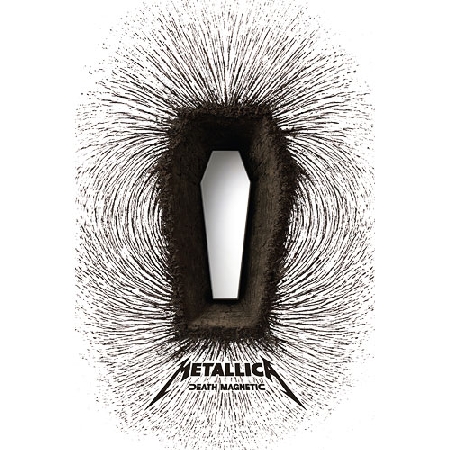
“Death Magnetic” is Metallica’s creative rebirth

By Joel Francis

For a band that takes five years between albums, quantity has never been an issue for Metallica. Indeed, every release for the past 20 years has clocked in at or well above the 70-minute mark.

The issue of quality has been a different matter. While each album may have flirted with the digital-capacity ceiling, they were also larded with lumbering material that didn’t stand up to multiple listens.

Until now.

“Magnetic Death” is Metallica’s finest album in a generation. Banished are the plastic drums and all-riff, no-solo approach of “St. Anger.” Gone is the straightforward, radio-approved songwriting of “Load” and “Re-Load.” Instead the quartet weaves through tricky time signature and twists through syncopated progressions with an energy that recalls “Master of Puppets” and “… And Justice for All.”

The first three songs tell the whole story. Lead guitarist Kirk Hammet is back applying his signature wah wah peddle accents. His guitar screeches, swoops and dives through solos like a Kamikaze fighter strafing the deck. James Hetfield’s voice nice blend of the melody learned on past few albums with his trademark primal growl. He’s still a lion, but one who’s learned a thing or two over a lifetime of hunts. Drummer Lars Ulrich has returned from the land of 4/4 time, relentlessly hammering sixteenth notes into his bass drums and navigating the intensity and dynamics of the material.

The centerpiece of the album is “All Nightmare Long,” an eight-minute campaign that starts with a dark funk intro and glides into the tight, stabbing attack that was Metallica’s bread and butter in the ‘80s. It is followed by “Cyanide,” another ‘80s throwback.

“The Unforgiven III” follows this powerful one-two punch with a piano and strings intro reminiscent of the “symphony and Metallica” experiment. The song serves two purposes – it allows the listener to catch his breath, and it shows the bands can still write a radio-ready single when it needs to.

Like all recent Metallica albums, “Magnetic Death” would benefit from some editing. Power ballad “The Day That Never Comes” is too much like the band’s ‘90s mainstream material, and while every other song rocks hard not every jam warrants more than five minutes (especially the 10-minute instrumental “Suicide and Redemption”).

These quibbles will mean nothing to the metalheads who exited at “Enter Sandman,” – this is the album they’ve been waiting for. And for those who jumped on the bandwagon at “Sad But True” the band has never sounded better.

Review: Vampire Weekend

Above: Vampire Weekend perform at Liberty Hall in Lawrence on Sept. 11, 2008. (photo by Melissa Meyer)

By Joel Francis

The Kansas City Star

While the official weekend doesn’t start until 5 p.m. Friday, the Vampire Weekend kicked off about 9:30 Thursday night.

The Brooklyn-based quartet breezed through their repertoire for a sold-out Liberty Hall crowd in little more time than it takes to play their only album. If anyone was disappointed they hid it well.

Vampire Weekend’s sound is best described as Paul Simon’s “Graceland” for the indie rock crowd. As on the album, “Mansard Roof” was the first number up. It, like most of the songs performed, sounded basically like it did on record. Which was the point – play the hits to the devoted and let them sing along.

Treated to the band’s first trip to the area, the crowd happily obliged. The high notes in the chorus of “Cape Cod Kwassa Kwassa” hung in the air like an organ in a cathedral. The call and response in “One (Blake’s Got A New Face)” nearly overwhelmed the band and even the balcony stood up to dance for “A-Punk.”

The two new songs were just as popular as the familiar material. The first new song was little more than guitar and drums over an ‘80s drum program. Temporarily freed from playing, bass player Chris Baio gleefully hopped around on the balls of his feet. Both it and the other new number were very much in the same vein and spirit as the other songs.

Overt references to Kansas drew bigger cheers that the subtle ones. Everyone yelled when the lyrics to “Byrn” namechecked The Sunflower State, but few recognized the snippets of “Over the Rainbow” keyboard player Rostam Batmanglij floated between songs.

After just 50 minutes onstage the band called it a night. Lead singer and guitarist Ezra Koenig apologized: “We promise next time we come we’ll have more songs to play for you.”

Setlist: Mansard Roof/Campus/Cape Cod Kwassa Kwassa/M79/new song/Byrn/Boston (The Ladies of Cambridge)/A-Punk/One (Blake’s Got a New Face)/I Stand Corrected/The Kids Don’t Stand a Chance/new song/Oxford Comma/Walcott (encore)

PE Still in Full Effect

The squeak on the front door to our office sounds strangely like Terminator X’s scratches on “Rebel Without A Pause.” Every time I’ve opened the door this week my mind has jumped to “the rhythm, the rebel.” Unfortunately, maintenance oiled the hinges last night. On the bright side, my friend Lindsay said his office fax machine sounds eerily like “Miuzi Weighs a Ton.”

Review: Jill Scott at Starlight

By Joel Francis
The Kansas City Star

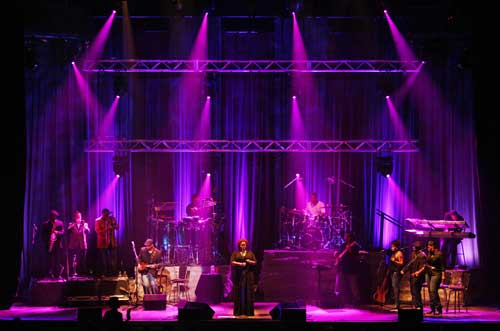
As her 11-piece band vamped, Jill Scott casually walked onstage Thursday night at Starlight, a notebook tucked under her arm, like she was a guest on a talk show. The crowd greeted her like she was Oprah.

It was an appropriate introduction for a show that was equal parts Apollo Theater and confessional conversation. The two-hour setlist leaned heavily on Scott’s most recent album, “The Real Thing,” which documents the end of Scott’s 12-year relationship with ex-husband Lyzel Williams.

For someone delivering the 21st century edition of “Here My Dear,” Scott was surprisingly exuberant. The album’s title song is built on an arena rock guitar riff and ‘80s drum sound, and was so important to Scott that she repeated the second verse a capella after the song was over and brought the full band back in for a reprise.

For songs from her first album, most of which were written about her love for Williams, Scott relied on the audience to carry her.  She introduced “A Long Walk” as a tribute to Roy Ayers before a sing-along erupted so forcefully that Scott relinquished the mic and let the crowd take over. It was a pattern repeated on much of her earlier material.

Scott is less a soul diva than a poet with pipes. Her spoken-word background shone when she would break a song down to discuss its themes. Scott is so comfortable talking with the audience that the moments chatting about relationships, sandals and women in music videos felt like friends dropping by for a living room chat.

She paused during “All I” to lament radio’s definition of old school – anything recorded between 1998 and 2004 – and showcase her backup singers with a medley of true old school classics: the Isley Brothers’ “Between the Sheets,” Teena Marie’s “Portuguese Love” and Prince’s “Do Me Baby.” Scott later started the encore set with “Gimme,” her version of old school, complete with a Kool and the Gang bassline and “sock it to ya” backing vocals.

Starlight was far from full – screens were placed across the back section of seats – and while the heavily female crowd was attentive, there were plenty of side conversations happening. Scott may have been Queen Bee for the night, but she still had to share time with other friends.

Scott’s singing is more Ella than Aretha. “He Loves Me (Lyzel in E Flat)” – a surprising selection given the subject matter – opened with a piano solo and a near-operatic delivery. The show should have ended there. Scott introduced her band, left the stage and the house lights came on. But as people were filing toward the exits, she returned to deliver “And I Heard,” a new number she had to get off her chest. Less a song than a poem set to melody, Scott had the audience singing like a gospel choir as her band quietly shuffled offstage again. It was an ending that affirmed the endurance of love, despite the pain it might bring.

Opening act Bilal took the stage at 7:30 sharp for a solid half-hour set that saw a lot of people still finding their seats. The high point was the keyboard/conga interplay topped with Bilal’s scat vocals that blurred the lines between jazz and soul and led into “Sometimes.” Bilal dedicated his song “Soul Sister” to the late record producer J. Dilla. 

Setlist:

The Rightness, Let It Be, The Real Thing, A Long Walk, Epiphany, Insomnia, Only You, Whenever You’re Around, Slowly Surely, Is It The Way, Do You Remember Me, How It Make You Feel, All I/Old School Medley, Come See Me, Imagination, Crown Royal (Encore:) Gimme, It’s Love, Golden, Hate On Me, He Loves Me (Encore 2:) And I Heard (new song)

Review: Cracker get on this (again) at Crossroads


Above: “The Man In Me,” honors the little Lebowski in all of us.

By Joel Francis
The Kansas City Star

Crossroads KC at Grinders plan last summer to harvest e-mail addresses in exchange for a free ticket to see Cracker went so well they decided to do it again. The pitch may have been déjà vu, but the shows were as different as night and day.

Cracker played a strong, satisfying set last summer, but the boys were on fire for the repeat performance Friday night. Opening number “One Fine Day” sounded like a lost Tom Petty track and stretched past the seven-minute mark as guitarist Johnny Hickman peeled off solo after solo. The performance was too good to end, so band leader David Lowery let go until it reached its natural conclusion.

That set the tone for the rest of the night: There was no letting up. The hilarious country send-up “Mr. Wrong” led into the epic travelogue “Euro-trash Girl,” which was framed with some Willie Nelson-style jazz guitar; the straight country of “Lonesome Johnny Blues” solidified the band’s Grand Ole Opry cred.

As the final notes of the wonderfully self-depreciative “Happy Birthday To Me” were still lingering, Lowery introduced the next number as “approximately the same song” and launched into “Take the Skinheads Bowling.” Although the song – Lowry’s most popular number from his pre-Cracker days in Camper Van Beethoven – was also in last summer’s set list, it was still a pleasant surprise.

If Lowery is the band’s heart then Hickman is its not-so-secret weapon. His guitar solos, high harmony backing vocals and turns as band leader stole the show. Case in point: Hickman’s surprising and outstanding cover of Bob Dylan’s “The Man In Me.”

Although the energy flagged a bit with the slow tempo of “Loser” and a reading of “Everybody Gets One For Free” that went on a bit too long, the night ended strong with crowd pleaser “Low.” Hickman again stepped behind the mic for the encore, “Another Song About the Rain.” The song from Cracker’s debut was the perfect capper to the evening: a slow builder that smoldered, then burned and showcased a smoking band.

First Friday and shows at the Sprint Center and River Market made for a competitive evening, which may explain why Crossroads KC was only about a quarter full. The 90-minute set may have been lighter on the hits than last summer’s show, but the faithful had had no room for complaint. Here’s looking to next August.

Setlist:

One Fine Day, Gimme One More Chance, The Riverside, Mr. Wrong, Euro-trash Girl, Lonesome Johnny Blues (Johnny Hickman – lead vocals), Teen Angst (What the World Needs Now), 100 Flower Power Maximum, How Can I Live Without You, The Man In Me (Bob Dylan cover, Johnny Hickman – lead vocals), Happy Birthday To Me, Take the Skinheads Bowling (Camper Van Beethoven cover), Loser, Everybody Gets One For Free, Low, Encore: Another Song About the Rain (Johnny Hickman – lead vocals)

What Bob Dylan Means To Me (part 2)

(Above: the video for “Most of the Time” off the “Oh Mercy” album.)

The second installment in this series comes from McKay Stangler, public relations writer for the University of Kansas Medical Center. For more of McKay’s writing, check out his great blog.

I wish I had a great Dylan story.

I wish I could say that some foggy memory lay buried in the deep recesses of memory, a brief excerpt from the halcyon days of youth in which I first discovered Robert Zimmerman. A day when I heard those first notes of “Sara” or “Oh Sister” and was set on an irreversible path toward musical enlightenment.

I wish the 15-year-old me had pulled a dust-covered copy of Blonde on Blonde from a bookshelf in my parents’ basement and become instantly captivated with its sounds. Or perhaps that some tune hummed by the corner vagabond would have remained lodged in my mind’s musical echo chamber, quickly crowding out the assorted noise of the mid-90s, pushing into oblivion the Collective Souls and Blink 182s of the time.

Alas, the truth is much more boring. Although my parents did have Blonde on Blonde, I was first exposed to Dylan through the local oldies radio station. This fixture of the family autos and our kitchen was where I first heard the (overplayed) classics such as “Like a Rolling Stone” and “Knockin’ on Heaven’s Door.” I liked them but mostly because they became family sing-alongs by the second verse. Hell, I had the same feelings for “Hang on, Sloopy” and “Daydream Believer” – still do, in fact.

My Dylan knowledge expanded exponentially in college, when I lived for two years with an avowed Dylan-ophile. Tom collected bootlegs and basement tapes with a fervent fixation bordering on obsession – and it was great. He exposed me to the Dylan pop culture often forgets, the wandering, brooding, haunted man who produced some of his best work when the industry was busy forgetting his genius. I heard enough to know I wanted to hear more.

In August 2001, I saw Dylan live for the first time, at the Missouri State Fair in Sedalia with my roommate and another college friend. It was a forgettable venue: we sat in the grandstand of the racetrack while much of the man’s sound was lost in the open summer air. Much of our attention was immediately seized, though, by the charming rural couple seated behind us. They were from Smithville, Mo., and were named, somewhat improbably, Jim and Jane Smith. They’d had a few beers already – the only option at the concert was the gargantuan 24 oz. cup – and said they’d buy us a beer if we correctly predicted what Dylan’s opening song would be.

We thought we were golden. After all, we had my roommate Tom, the Dylan savant! He went with “Roving Gambler,” which had been the opening song at a few recent concerts he had attended. Tom was wrong, but thanks to Jim’s video poker windfall we were clutching beers anyway. Despite being underage, Jim was happy to buy us a round. And then another. And then another. And then about five more.

The end of the concert found us a drunken and boisterous crew, with us promising to visit the munificent couple in Smithville. Dylan’s spotlight had been improbably stolen by the generous, corruptive strangers. Our groups diverged in the main concourse when Jim insisted on throwing money at sideshows. The three of us wandered around for a bit but eventually set a course for the parking lot.

Then we saw Jane. She was wandering alone, drunk and confused. When we asked about her mate, she told us he was lost. L-O-S-T gone. Our offers to help find him were mixed with poorly suppressed laughter at the inanity of the situation. We had Jim paged over the Fair loudspeaker, then flagged down a Missouri Highway Patrol golf cart to help look.

And this was how our night ended. The three of us plus a deeply intoxicated Jane Smith, riding around the Fair with Officer Friendly, finally locating Jim behind a row of public toilets. He was passed out cold, but upon rousing was mighty glad to see Jane and, oddly, us. We rode with them back to their campsite. The magnitude of the night’s misadventures was too much for three drunken students to comprehend.

And this, I suppose, is what Dylan means to me: memories of friendship. Hearing his songs makes me think of college, of sitting around with Tom, futilely trying to stump him with Dylan trivia. Of meeting a couple who would change the course of our night and give us a story to tell for the rest of our lives. Of insisting that the friendly officer take his picture with the five of us, right before Jim passed out again, all of us grinning broadly around the golf cart amid the sparkling bonfires of the campsites. Of listening to Oh Mercy on the way home, none of us speaking a word about the evening until we pulled into a late-night eatery. Of the three of us laughing hysterically, even months or years later, as we recounted the tale for friends.
 
Huh. Maybe I do have a great Dylan story.

Review: Chris Hillman thumbs through his back pages

Above: Chris Hillman and Herb Pederson perform “Turn Turn Turn.”

By Joel Francis

The Kansas City Star

Chris Hillman is not a household name, but the influence of the bands he has been a part of has emanated from home stereos for nearly two generations. As a member of the Byrds, the Flying Burrito Brothers and Manassas, Hillman helped blur the lines between rock, country and folk.

He visited all parts of his career during his free 100-minute concert Friday night at Olathe’s Frontier Park. His time with Gram Parson’s Burrito Brothers was represented by “Wheels,” which featured accompanist Herb Pederson on lead vocals. Two songs off the first Manassas album (with Stephen Stills) were also performed, but it was, of course, the Byrds numbers that drew the most applause.

“Turn Turn Turn” appeared early in the set and “Eight Miles High” closed it. In between, Hillman and Pederson performed several songs from their time in the Desert Rose Band: staples like “Together Again,” which was dedicated to Buck Owens, “Good Time Charlie’s Got the Blues” and “The Water Is Wide.” Former Bonner Springs resident and fellow Byrd Gene Clark got a shout-out before a reading of his “Tried So Hard to Please Her.”

Hillman prefaced “Mr. Tambourine Man” with a story about joining the Byrds and how the group didn’t like the song the first time they heard it. Crediting Roger McGuinn with the guitar arrangement, Hillman proceeded to play it in a style closer to Bob Dylan’s original version.

With Pederson anchoring on six-string acoustic guitar and Hillman switching between mandolin and guitar, the vibe was more Greenwich Village than Monteray Pop. While the performances were well-executed, the limited instrumentation and style started to wear thin about halfway through.

The set picked up when Sam Bush joined the duo for three songs on the violin. Bush’s fleet-fingered fiddle playing drew big cheers on the Grateful Dead’s “Box of Rain,” but “The Old Cross Roads” was the highlight. The blend of Hillman and Pederson’s vocals recalled the Louvin Brothers, while Bush’s violin accentuated the country-gospel arrangement.

Hillman complained throughout the night about the humidity. It may have killed the tuning on his mandolin, but it also provided a platform for Hillman to tell stories about his influences and songwriting while tuning between songs. Although the humidity may have been miserable to a Southern California native like Hillman, a Midwesterner couldn’t have asked for a prettier mid-July evening.

About 500 people spread over the outfield for the show. Seated in camping chairs or on blankets, they brought their kids, dogs and magazines. With conversation at more than a murmur throughout, it was clear the music was just a reason to be outside, not the focus.

That was too bad, because while Peterman wasn’t McGuinn or David Crosby, his vocals complemented Hillman’s nicely. Both artists have been honing their craft for a long time, and they played off each other with a musicianship that is skillful, but not showy.

Bush concluded the evening with a set of his own. Leading his quintet on mandolin, Bush married traditional bluegrass with a rock backbeat on songs like Randy Newman’s “Mr. President (Have Pity on the Working Man).”

Review: For The Roots It’s All In The Music

Above: “You Got Me” in Japan earlier this year.

By Joel Francis

The Kansas City Star

Underground artist Girl Talk has generated some buzz with his second album, which layers Public Enemy over Heart, mashes M.I.A. with the Cranberries and mixes “C’mon N Ride It (The Train)” into “99 Tears.”

What Girl Talk does on his laptop, the Roots did live on stage for two hours on Thursday in the sold-out Harrah’s Voodoo Lounge. Whether it was bass player Owen Biddle quoting the melody for Duke Ellington’s “Caravan,” MC Black Thought leading the way through Curtis Mayfield’s “Move On Up” or between-song riffs on “Iko Iko” or “Ding Dong! The Witch Is Dead,” the septet touched on nearly every facet of recorded music.

The Roots’ biggest hit, “You Got Me,” was also the most transformed. The song somehow morphed from neo soul ballad into “My Favorite Things,” a bass solo/metal jam and Led Zeppelin’s “Immigrant Song” before wrapping up.

The evening started quietly, with guitarist Kirk Douglas alone onstage, noodling away. With a tip of the hat to the Talking Heads, the other band members slowly joined him and picked up their instruments. By the time everyone was assembled MC Black Thought ripped into “I Can’t Help It.” They wouldn’t let up for the next hour.

Prowling the stage like panthers, the super-tight ensemble dropped volume and tempo on a dime, majestically flowing each song into the next regardless of style or arrangement — the ultimate mixtape.

There were no down moments or low points. Each song fed off the previous number’s energy and all were spectacular. Of particular note was a reading of “Quills” taken at Ramones speed that showcased Black Thought’s amazing breath control and stamina.

When most bands want more low end they turn the bass up. The Roots hired a tuba player. Damon Bryson, a.k.a. Tuba Gooding Jr., leapt joyously about the stage despite his heavy instrument, blasting away “All in the Music” and buoying the typically horn-heavy “Jungle Boogie.” Longtime Roots collaborator James Poyser sat in for missing keyboard player Kamal Gray and added a Dr. Dre synth line to “I Will Not Apologize.”

The centerpiece of the evening was a 15-minute rendition of Bob Dylan’s “Masters of War.” Performed by the trio of drummer Questlove, Tuba and Douglas, the song was previously played at the band’s rapturous performance in Kansas City at Harrah’s last year. Questlove said they were going to keep doing it until the war in Iraq was over. The song bobbed and weaved its way through the “Star Spangled Banner,” “Taps,” a military drum cadence, a Black Sabbath send-up and a drum solo. Owing more to Jimi Hendrix’ “Machine Gun” than Woody Guthrie, the song ended with Douglas and Tuba working their way through the crowd, soloing furiously. It was an eerie prelude to Independence Day.

For people who need classifications, the Roots are typically filed under hip hop. For everyone else, they are everything that’s right with music today.

Setlist: I Can’t Help It, Rising Up, Please Don’t Go, In the Music, Star, Quills, Step Into the Realm, Proceed, Long Time, Mellow My Man, Act Too (The Love of My Life), Criminal, Masters of War, I Will Not Apologize, You Got Me, Get Busy, Jungle Boogie/Don’t Feel Right, The Next Movement (encore:) The Seed 2.0, Men at Work

Below: The first third of “Masters of War” from Montreal last May.

The Miracles – “You’ve Really Got A Hold On Me”

The Miracles – “You’ve Really Got A Hold On Me” Pop #8, R&B #1

Another stone classic from the pen of Smokey Robinson. Counting his songs for Mary Wells, this is Robinson’s fourth No. 1 hit (his first song with Wells stalled at No. 2 on the R&B charts). The song was famously covered by the Beatles It continues to be popular today. Cyndi Lauper covered it in 2003 and it popped up earlier this year on actress Zooey Deschanel’s delightful album with M. Ward, “She and Him.”

It’s no surprise so many artists have been drawn to this song. The melody and backing vocal lines are strong and supportive enough that the lead singer doesn’t need a great voice to pull it off (check out Cher’s version with then-husband Gregg Allman for proof). On the other hand, good vocalists have plenty to make their own. British invasion bands loved it for the snakey guitar line that could cover missing piano and horn parts.

The Miracles have the whole package, though: Robinson’s great singing, the full complement of Motown’s Funk Brothers musician’s stable and Barry Gordy’s impeccable production. The crescendo peaks with Robinson playing off the Miracles and pleading with his woman to “hold me (please)/hold me (squeeze)/hoooold me.” This certainly wasn’t the first time backing vocalists had been used so effectively, but it is a great demonstration of the subtle creativity Robinson employed in arranging the song. It’s no wonder the Beatles were so anxious to pay tribute to their idol when they finally reached American shores a little over a year after this song was released. — By Joel Francis

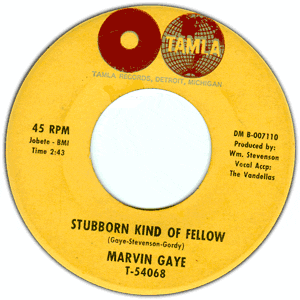
Marvin Gaye – “Stubborn Kind of Fellow”

Marvin Gaye – “Stubborn Kind of Fellow,” Pop #46, R&B #8

Aside from Smokey Robinson, no one completely dominates Motown’s landscape like Marvin Gaye. Gaye’s debut album was the second record released by the label – right behind the Miracles first platter. Gaye and Robinson’s songwriting credits littered the charts until the Holland, Dozier, Holland and Whitfield, Strong teams took over. Gaye was famously married to Barry Gordy’s sister, Anna, while Robinson named his first son in honor of the label’s founder. The impact and legacy of these two men is intertwined and it is impossible to imagine the Motown empire with them.

Gaye’s initially fancied himself a Frank Sinatra-styled singer. His vocals were always smooth, but the lounge vocals have moved out front to the sidewalk. The opening drum roll and “say yeah, yeah, yeah” vocal hook immediately draw in the listener. It’s a great opening, not only for Gaye’s first major Motown solo hit, but for his amazing catalog. — By Joel Francis