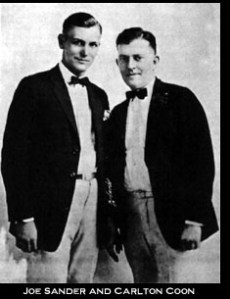
KC Recalls: The Coon-Sanders Night Hawk Orchestra

coon

(Above: Joseph Sanders, left, and Carleton Coon.)

By Joel Francis

The music Carleton Coon and Joseph Sanders made for a dozen years together helped put Kansas City jazz on the map. Their Nighthawk Orchestra may have broken up in 1932, but it’s two bandleaders have been silently reunited for 40 years at Mt. Moriah Cemetery in Kansas City.

Coon and Sanders first met at a downtown Kansas City music store in 1918. Tall, handsome and quick-tempered Sanders, was an amateur baseball player on leave from the Army. He was practically the antonym of the pudgy, extroverted Coon. Despite their physical and temperamental differences, both men quickly found they shared a love of jazz and complementary tenor voices.

The following year, when Sanders got out of the Army, the two teamed up, formed a jazz combo and started booking gigs around Kansas City. With Coon handling business, Sanders writing songs and city boss Tom Pendergast ignoring prohibition with his “wide open” bars, clubs and brothels, the Coon-Sanders Novelty Orchestra was soon one of town’s in-demand outfits.

Shortly after Thanksgiving, 1922, the orchestra was booked to play on radio station WDAF. The success of that performance helped launch their weekly show, broadcast from 11:30 p.m. until 12:30 a.m. When the announcer let slip that “anyone who’d stay up this late to hear us would have to be a real night hawk,” thousands of listeners spread across Canada, Mexico and most of the United States let him know that they were proud to be “night hawks.”

Sanders quickly penned a theme song “Night Hawks Blues” and the pair rechristened their ensemble the Coon-Sanders Original Night Hawk Orchestra. In 1924, they recorded for the Victor record label in Chicago and agreed to let burgeoning Chicago promoter Jules Stein book a four-week tour. Stein parlayed his profits from that tour into his own booking company, which he called Music Corporation of America, or MCA.

On the strength of that tour, the Night Hawk Orchestra relocated to Chicago where their performance opening the Balloon Ballroom of the Congress Hotel was broadcast on KYW. Two years later, they moved to the Blackhawk Restaurant where fan Al Capone frequently left $100 tips for the band. On the strength of WGN radio broadcasts and reputation built playing around Chicago (including Capone’s Dells supper club in Morton Grove, Ill.), the Coon-Sanders Orchestra relocated once again in 1931.

Broadcasting weekly from Terrace Room in the Hotel New Yorker on CBS radio, Coon and Sanders found themselves in the same Big Apple circles as Bing Crosby and Guy Lombardo. Coon loved the night life, frequenting the Cotton Club and other Harlem jazz clubs, and making friends with Cab Calloway and Duke Ellington.

Sanders, on the other hand, was less enamored. He longed for the Midwest and made his sentiment plain the final number recorded by the Coon-Sanders Original Night Hawk Orchestra, “I Want to Go Home.”

Unfortunately, circumstances forced the bandleaders’ hands. Popular taste was shifting away from the Caucasian stylings of Coon and Sanders and toward all-black ensembles like the Ellington, Calloway and Kansas City’s Bennie Moten orchestras.

These circumstances, coupled with the Great Depression, forced the Night Hawks back to Chicago in April, 1932, for an engagement at the College Inn. Sander’s delight to be back in familiar territory was tempered when Coon was admitted to the hospital in critical condition. He died a few weeks later from blood poisoning from an abscessed tooth.
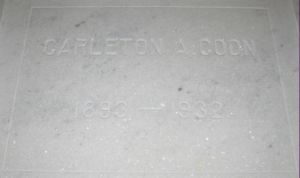
kc-graves_coon1

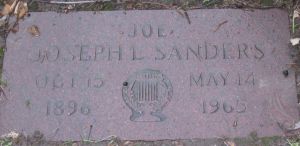
Coon’s 1932 funeral was one of the largest Kansas City had seen. Although his procession carried on for miles, his band’s legacy did not stretch so far. Less than a year after Coon’s death, Sanders dissolved the group and moved to Hollywood to write movie scores. Although Sanders was active in music for the rest of his life, he never regained the popularity he found with the Nighthawk Orchestra. In 1965, he died after having a stroke and was buried about 200 yards sound of his friend, Carleton Coon, at Mt. Moriah Cemetery.

Today, the Coon-Sanders Original Night Hawk Orchestra is a footnote in the Kansas City jazz story that includes big bands lead by Bennie Moten, Count Basie, Andy Kirk and Jay McShann, and soloists like Big Joe Turner, Mary Lou Williams, Walter Page and, of course, Charlie Parker. But Coon and Sander’s early triumphs helped paved the way for all who followed them out of Kansas City.

Ironically, the Night Hawks are most celebrated in Huntington, West Virginia, where the Coon Sanders Nighthawks Fans’ Bash has been held on the weekend after Mother’s Day for 39 years.sanders
Another Side of Norah Jones

Above: Norah Jones strolls through Wilco’s “Jesus, Etc.” at the 2008 Bridge School Benefit concert.

By Joel Francis

When Beyonce sang “a diva is a female version of a hustler” she probably wasn’t thinking of Norah Jones.

Jones has made her name with impeccable background music that is tasteful to a fault and straddles the line between folk and jazz. It appears she saves the more interesting facets of her personality for her side projects with the Little Willies, El Madmo, a punk one-off, and her burgeoning side career as hip hop chanteuse. Jones’ appearances with Talib Kweli, Andre 3000, Wyclef Jean and Q-Tip prove there may be more than a little hustler in her after all.

“Take Off Your Cool” with Andre 3000 of Outkast, from “Speakerboxxx/The Love Below”

Jones was a little more than a year removed from the massive success “Come Away With Me” when this number appeared. Both camps took shots from a surprised public. Andre 3000 was blasted for pandering by working with the reigning adult contemporary queen and Jones was flamed for lowering herself to the low level of hip hop. Of course, the final result proved all naysayers wrong.

Anchored by a finger-picked acoustic guitar, the gentle production wouldn’t out of place on Jones’ own album – that is if Jones’ stuffy supporters could get past Andre 3000’s greasy come-ons.

“Any Other Day” with Wyclef Jean, from “The Carnival Vol. II: Memoirs of an Immigrant”

This song, which first appeared on the Hurricane Katrina relief charity album “Come Together Now,” has more in common with the Dave Matthews Band than the Fugees. Wyclef Jean’s acoustic guitar leads the way, but it is essentially Jones’ showcase. She affectingly croons the story of someone trapped by a storm, while Jean drops in a faux-Bob Marley patois.

A quick glance and the writing credit explains Jones’ prominence. The song is a true collaboration, with Jones and her then-boyfriend Lee Alexander sharing authorship with Jean and his producer Jerry “Wonder” Duplessis.

“Soon the New Day” with Talib Kweli, from “Ear Drum”

Even so-called “conscious rappers” aren’t above desires of the flesh. This celebration of one-night stands is draped across producer Madlib’s backdrop of smooth ’70s soul. As Talib Kweli boasts about his conquest, Jones’ voice surfaces like the first rays of dawn gently forcing their way into the bedroom through the closed shade.

Although Jones is essentially limited to one line, she makes the most of it, adding heart and emotion to Kweli’s calculated braggadocio. But don’t mistake Jones as the conscience of the story – there is no remorse from either party. She clearly enjoyed it just as much as he did, just in a different way. Despite their disparate deliveries, the two voices work naturally together – neither performer sounds of his (or her) element.

“Soon the New Day” is a stand-out tune on a great album that should have been a single.

“Life Is Better” with Q-Tip, from “The Renaissance”

This cut is essentially a jam, with Q-Tip and Jones giving props to hip hop pioneers like the Cold Crush Brothers, the Leaders of the New School and, of course, Tip’s close friend J. Dilla. Jones gets the song to herself for the first two minutes and she makes the most of it. It’s fun to hear her away from her natural reference points singing of hip hop songs “banging for you” against a thumping bass line and jazzy sample. Tip’s verse is a roll call of his favorite artists.

Jones’ strong performance in her most urban setting to date makes one wish she’d take similar chances on her own albums. But if she’s not willing to alienate her own audience, it’s nice to see her spreading her wings elsewhere. Don’t be surprised when she shows up on the next Snoop Dogg album.

Happy Clash-mas Eve

Above: Elvis Costello, Bruce Springsteen, Dave Grohl and Little Steven Van Zant do “London Calling” at the Grammys for Joe Strummer.

By Joel Francis

I remember getting the call from my brother-in-law like it happened yesterday. I was sitting in my apartment, it was the night before Christmas Eve, 2002 His words slowly trickled out: “Joe Strummer is dead.” The next day I loaded my CD changer with nothing but Clash and Mescelaros music and played it on shuffle for the entire day. Every Christmas Eve since then has been Clash-mas Eve, with at least a couple hours devoted to celebrating the art of Joe Strummer. To borrow a line from The Hold Steady’s “Constructive Summer,” let’s “raise a toast to St. Joe Strummer” and revisit five of his greatest moments.

“Letsagetabitarockin'” by the 101ers, from “Elgin Avenue Breakdown Revisited”
The 101ers drew more on the bluesy rock of the Rolling Stones and classic American rock and roll than they did on the jagged precursors of punk rock. Formed in 1974, Joe Strummer knew his band was done in 1976 after hearing just five seconds of the Sex Pistols. When the 101ers lone single, “Keys to Your Heart” came out later that year, the group was already over. Having seen the light, Strummer jumped ship to join the Clash, but the 101ers remained a curious footnote of Strummer’s pre-punk powers. In 1981, the group’s few studio and live recordings were cobbled together for release.
“Letsagetabitarockin'” kicks off that album with a shot high-octane rockabilly recorded in 1975 that would become the Stray Cats stock in trade several years later. Stylistically, it’s not much of a leap from this to the music Strummer was making in the Clash. The change in attitude and approach, however, is huge.

“1977” by the Clash, from “Super Black Market Clash”
Strummer eviscerates his former life as a pub rocker and skewers rock’s sacred cows with his cry of “no Elvis, Beatles or the Rolling Stones” on the chorus of “1977.” An early calling card for the band, it appeared on the b-side of their first single and helped establish them as the new guard of rock and roll.
Written by Strummer and Clash guitarist Mick Jones, the two packed a lot into their 99 seconds. In addition to denouncing the previous generation’s music, they draw on the Rastafarian prediction of July 7, 1977 bringing chaos and tip a hat to George Orwell’s novel “1984” by counting up to that year before ending abruptly.

“Brand New Cadillac” by the Clash, from “London Calling”
“Letsagetabitarockin'” and “Brand New Cadillac” are both rockabilly songs, but the similarity pretty much ends there. Strummer not only changed his surrounding musicians, his voice has transformed. His singing has the edge of a switchblade knife and you can hear his sneer as he angrily spits likes like “Jesus Christ, where’d you get that Cadillac?”
That line wasn’t in the 1958 version of “Brand New Cadillac” written and recorded by Vince Taylor and his Playboys. Taylor’s version was menacing in its own right back then, but he sounds less inclined to track his woman down. Strummer, on the other hand, is ready to do more than slash her tires.

“Magnificent Seven” by the Clash, from “Sandinista!”
Rap music wasn’t much older than punk when the Clash cut this track in 1981. Strummer throws stream-of-conscious lyrics over a bass loop composed not by Clash bass player Paul Simonon, but Norman Watt-Roy from the Blockheads. The arrangement over the loop is strongly influenced by reggae and dub, two of the cornerstones of the Clash’s sound.
The result, though, was unlike anything recorded up to that time. Preceding Blondie’s “Rapture” by six months, this was white rock’s first attempt to write a rap song.
Strummer delivers his story about a good working boy with his typical swagger, but throws a curveball in the third verse – the work isn’t to make ends meet, but to buy all the junk he sees advertised on TV. Emboldened by his anti-consumerist diatribe, Strummer tosses Ghandi, Karl Marx and Richard Nixon into the final verse before musing who’s better known, Plato the Greek or Rin Tin Tin.

“Straight To Hell (live)” by the Clash, from “From Here To Eternity: Live”
Recorded live at The Orpheum in Boston on the Combat Rock tour, the band stretches this reading of “Straight To Hell” more than three minutes longer than its LP run time. Given more space, the song becomes even more moody. Strummer wallows in the beat as he damns those who mistreat immigrants by closing steel mills or burning their communities.
The deliberately slow tempo shows how much the Clash have grown since their rapid-fire debut just five years earlier. The arrangement again echoes strongly of reggae and dub elements and was borrowed by M.I.A. for her hit “Paper Planes.”
The defining moment comes at the end when Strummer yells at the crowd to “sing in tune, you bastards.” For a man who always wore his emotions on his sleeve, it doesn’t get more heartfelt than this.

Classic Christmas Carol: “In the Bleak Midwinter”

By Joel Francis

When Scribner’s Monthly asked for Christmas poem submissions in 1872, Christina Rossette wrote “In the Bleak Midwinter.” For unknown reasons, however, the poem was never sent in and remained unread until it was published after her death in 1904. Two years later, composter Gustav Holst, best known for his symphony “The Planets,” set the words to music.

Rossette’s words paint a picture of the stark, unlikely setting in which Christ was born in which “Earth stood hard as iron, water like a stone.” It’s not difficult to imagine the isolation of a land where “snow had fallen, snow on snow, snow on snow.”

Holst’s melody is subtle. There are no big crescendos or explosive choruses. Instead, the song builds gradually, like the falling snow, settling cozily on the contemplative lyrics.

In the second and third verses, Christ is born in a manger and worshipped by the animals. The final verse is the best-known. It’s lyrics are as touching as they are humble.

What can I give him,
Poor as I am?
If I were a shepherd
I would bring a lamb,
If I were a wise man
I would do my part,
Yet what can I give Him –
Give my heart.

“In the Bleak Midwinter” never entered the top-tier Christmas pantheon like “Joy to the World” and “Silent Night.” Unlike those hymns, one can go an entire holiday season without hearing this song. It’s nice to be able to seek refuge in a song as lovely as this rather than having it incessantly pumped through speakers at the mall.

Classic Christmas Carol: “Greensleeves”

(Above: Paul Desmond and the Modern Jazz Quartet put their spin on “Greensleeves.”)

By Joel Francis

The melody for “Greensleeves” dates to 16th century England. It is been rumored that King Henry VIII for his lover Anne Boyeln – the subject of the recent “The Other Boyeln Girl” novel and film. According to historians, however, the best case scenario is that ol’ Hank just stuck his words on an existing melody.

Double entendres were common in the love songs of the Renaissance. At the time, the color “green” was a charged term. It implied the color that a woman’s clothes would turn if she made love outside. Lady Greensleeves, the subject of the song, was said to be a prostitute, or at least a promiscuous woman.

As with the words, no one knows who wrote the melody. It was likely developed by English minstrels and troubadours as they traveled the countryside. The tune was first published in a 1580 broadside entitled “A New Northern Dittye of the Lady Greene Sleeves.” Four years later, it turned in A Handful of Pleasant Delights as “A New Courtly Sonnet of the Lady Green Sleeves.”

Nearly 300 years later, Englishman William Dix penned new lyrics to the familiar, lilting melody. At age 29, Dix was confined to several months of bed-rest after a nasty bout with a near-fatal illness. Manager of maritime insurance company by day, Dix used the opportunity to write several hymns. The new words became “What Child Is This?” and draw on the nativity story from the Gospel of Luke.

It’s hard to believe such a cherished song grew from such bawdy beginnings. Over the last 60 years, it has been performed by everyone from singers Odetta and Olivia Newton-John to rockers Jethro Tull and Jeff Beck. John Coltrane made it a jazz standard and organist Garth Hudson of The Band played it over the closing credits of Martin Scorsese’s film “The Last Waltz.”

Classic Christmas Carol: “I Heard the Bells on Christmas Day”

(Above: Pedro the Lion hear The Bells.)

By Joel Francis

Henry Wadsworth Longfellow penned the poem “Christmas Bells” on Christmas Day, 1864. Christmas had become a bleak occasion for Longfellow. In July, 1861, shortly after the start of the Civil War, Longfellow’s wife, Fanny, decided to preserve a lock of their child’s hair. As she was sealing the hair in wax, a few drops landed on her dress, which caught fire. Panicked, Fanny ran to her husband for help, but he was unable to extinguish the flames in time. Fanny died the next morning. Severely burnt on the face, arms and hands, Longfellow was in no condition to attend the funeral.

Five months later, Longfellow was still in the throes of grief. His Christmas Day journal entry reads “How inexpressibly sad are all holidays.” Exactly one year later he wrote “Perhaps someday God will give me peace.” Christmas Day, 1863 was compounded when Longfellow learned his son had been severely injured fighting for the Union in the Civil War. There was no Dec. 25 journal entry that year. His despair is reflected in the second-to-last verse of “Christmas Bells:”

And in despair I bowed my head;
“There is no peace on earth,” I said;
“For hate is strong,
And mocks the song
Of peace on earth, good-will to men!”

Just one year later, Longfellow was starting to emerge from his grief. Lt. Charles Longfellow had survived his injury and lifted his father’s heart. In addition, the re-election of President Abraham Lincoln gave the senior Longfellow hope that the Civil War would end soon. With newfound hope in his heart he wrote of hope and redemption. The poem closes with the realization “old familiar” chorus of the bells are God’s promise to never forget His children.

Then pealed the bells more loud and deep:
“God is not dead; nor doth he sleep!
The Wrong shall fail,
The Right prevail,
With peace on earth, good-will to men!”

“Christmas Bells” has been set to several tunes. The first arrangement appeared in 1870, when Longfellow’s poem was renamed “I Heard the Bells on Christmas Day” and his seven verses were trimmed to five. The melody used today was written by Johnny Marks in 1956 – nearly 100 years after Longfellow set his words to paper. Holiday music would not be the same without the songs written Marks. His contributions to the Yuletide cannon include “Jingle Bell Rock,” “Have A Holly Jolly Christmas” and “Rudolph the Red-Nosed Reindeer.”

Review: Neil Diamond

(Above: Neil Diamond delivers the excellent “Pretty Amazing Grace.”)

By Joel Francis
The Kansas City Star

For nearly two hours on Monday night, Neil Diamond and his beautiful noise turned an arctic December evening to a hot August night.

After opening with high-energy performances of “Holly Holy” and “Beautiful Noise,” Diamond slowed down for “Love on the Rocks.” Strolling the perimeter of the stage, the applause swelled every time Diamond approached a new seating section. Although the Sprint Center wasn’t full – the end sections were curtained off up top – Diamond worked the crowd like he was playing a massive living room.

Diamond revisited the first side of his classic live album “Hot August Nights” with the one-two of “Crunchy Granola Suite” and “Done Too Soon.” He followed that up with a different, but equally moving pairing. Prefacing the autobiographical “Brooklyn Roads” with a story about growing up in the borough, Diamond performed the song as childhood photos floated by on the screens above the stage. It was followed by another song about New York, “I Am… I Said.”

The old songs were the highlights, but the new songs got the best performances. “Home Before Dark,” found Diamond seated on a stool at stage left, fingerpicking an acoustic guitar. “Pretty Amazing Grace” started with a stripped-down arrangement that worked its way into a calypso groove. It was on these numbers and the main-set closers of “Man of God” and “Hell Yeah” that Diamond’s singing was at its most heartfelt and expressive.

Forgoing special effects, Diamond’s stage was decorated with his 13-piece band on a series of six risers that slid back and forth across the stage. As expected for such a large ensemble, the arrangements were epic and cinematic, recreating orchestras for “Play Me” and Cinemascope arrangements for “Crunchy Granola Suite.” The only time the band failed him was on a slowed-down reading of “Solitary Man.” Diamond’s new tempo made the song even lonelier, but the intrusion of the backup singers on the chorus broke the spell every time.

Despite working a notoriously audiophobic room with so many instruments, the sound was great. The mix was so precise individual instruments could be singled out without harming the overall sound.

The houselights came on for “Forever in Blue Jeans” and they stayed up for “Sweet Caroline.” That one had everyone on their feet and singing along like it was Fenway Park. Diamond was so pleased he gave the number a victory lap. Even though he has performed the song a million times and even though he had just performed it, Diamond sang with conviction, drawing out the last night as if he didn’t want it to end.

The night ended with the sure-fire crowd pleasers of “Cracklin’ Rosie,” “America” and Brother Love’s Traveling Salvation Show” that had everyone on their feet, singing along.

Setlist: Holly Holy/Beautiful Noise/Love on the Rocks/Play Me/Cherry Cherry/Home Before Dark/Don’t Go There/Pretty Amazing Grace/Crunchy Granola Suite/Done Too Soon/Brooklyn Roads/I Am…I Said/Solitary Man/Forever in Blue Jeans/Sweet Caroline/Sweet Caroline (reprise)/You Don’t Bring Me Flowers/I’m a Believer/Man of God/Hell Yeah//encores: Cracklin’ Rosie/America/Brother Love’s Traveling Salvation Show

Top 10 Albums of 2008 (haiku remix)

raphael_saadiq_-_the_way_i_see_it

By Joel Francis

Raphael Saadiq – The Way I See It
Classic soul throwback.
Avoids tribute clichés by
keeping spirit true.

TV on the Radio – Dear Science
Great band gets better.
Bowie-meets-doo-wop epics.
Tunes for brain and feet.

Wynton Marsalis and Willie Nelson – Two Men with the Blues
Disparate worlds?
Not so fast. Legends say no.
Smiles all around.

David Byrne/Brian Eno – Everything That Happens…
Restless souls rejoin.
Straight-ahead compared to last album
Twenty-three years ago.

Randy Newman – Harps and Angels
Not Pixar film score.
Track 4 tears Dub-ya new one.
Mark Twain of music.

Justin Townes Earle – The Good Life
Old country played right.
More Hank Williams than Junior.
Dad Steve should be proud.

Erykah Badu – New Amerykah, Pt. 1
Esoteric beats
and furious politics
make for dark album.

Portishead – Third
More dark atmospheres,
Dormant band surprises all;
Not trip-hop retread.

She and Him – Vol. 1
Vanity project?
Hell no. Zooey is for real.
M. Ward is great foil.

Q-Tip – The Renaissance
Ten years not Tip’s fault,
stupid labels shelve three tries.
Glad to have you back.

Review: Buddy Guy


Above: Buddy Guy preaches the blues via Cream, Hooker and Hendrix.

By Joel Francis

The Kansas City Star

Buddy Guy isn’t mentioned in the film “Cadillac Records” but he made a strong case for his inclusion among the Chess label’s pantheon of greats Friday night at the Uptown Theater.

After a brief introduction by his four-piece band, Guy walked onto the stage and straight into a guitar solo. When he finally tired of pulling notes from his cream-colored Stratocaster, Guy walked to the mic and began to sing. Rattling off the names of his mentors and influences – Son House, Muddy Waters, Howlin’ Wolf, and Willie Dixon – he passionately cried “they’re the ones who made the blues, tell me who’s going to fill those shoes?” It was a reverent, but rhetorical question.

Guy has no trouble whipping a crowd into a frenzy, but he can silence them just as easily by placing a finger to his lips. He stayed in a quiet mode for most of the evening, dripping a spare, creeping version of “Hoochie Coochie Man.” The classic Waters number was propelled by Guy’s expressive singing and the familiar bass line while a sprinkling of piano and smattering of guitar solos were drizzled over the top. That number worked its way into two more Waters’ tunes, “Love Her With A Feeling” and “She’s Nineteen Years Old.”

While his playing was still fiery, Guy was content to smolder for an evening. With the drums gently clicking like metronome, band played so subtly they were easily overwhelmed by conversation when the audience grew restless. The steady flow of bodies to the beer stands said the crowd wasn’t expecting so much restraint.

Likewise, Guy probably wasn’t expecting such an empty house. The Uptown’s balcony was closed off and while the floor was basically full, there were still plenty of vacant seats.

Opening act Tom Hambridge, who also produced Guy’s latest album, hopped onstage to lend vocal support to “Skin Deep.” Guy’s journey as the child of Louisiana sharecroppers to witnessing his fellow Chicagoan Barack Obama claim the presidency gives his song for racial equality extra poignancy. The soul ballad ended with the audience singing along. Bolstered by a Hammond organ, the song wasn’t quite gospel, but it felt a lot like church.

A tribute to Albert King opened with one of the mellowest readings of “I’m Going Down” of all time. The song heated up, though, when Guy jumped offstage and slowly made his way through the assembly. Feeding off the crowd’s energy, Guy devastated “Drowning On Dry Land.” Walking into the foyer, Guy unleashed the most blistering solo of the night with few witnesses around. With his guitarist and bass player swaying to a synchronized two-step on stage, Guy sauntered back into the theater and plopped down in one of its seats without missing a note. Guy’s six-string field trip ended with a passionate performance of B.B. King’s “Rock Me Baby.”

The second half of the show was essentially a mega medley of Guy’s blues heroes. Rotating from John Lee Hooker to Little Walter to Cream to a dialed-down cover of Peggy Lee’s “Fever,” Guy switched songs so often it was almost like their was a penalty for playing a number all the way through. He found a wah wah peddle and the volume switch for “Voodoo Child” and channeled James Brown for a stellar snippet of “I Go Crazy.” After nearly 90 minutes onstage, Guy closed with a bit of “Kansas City.”

Review: Robert Randolph and the Family Band

Above: Robert Randolph persuades the ladies of Albany to shake their hips.

By Joel Francis

The Kansas City Star

A casino is as unlikely a setting for church as beer employees are a congregation. Yet on Friday night, Robert Randolph and the Family Band snuck 90 minutes of gospel on an unsuspecting crowd that loved every minute of it.

The quintet opened with a jam that sounded like the Allman Brothers dropped into an AME church, and found Randolph grinning from ear to ear, smacking his gum while working the horizontal fretboard of his pedal steel guitar.

The next song up, “I Need More Love,” was propelled by a funky six-string bassline and sounded like a lost Sly and the Family Stone track. Swaying in his seat, Randolph segued perfectly into an instrumental cover of Michael Jackson’s “Wanna Be Starting Something” that kept everyone on the dance floor moving.

After the MJ workout, Randolph stood up and strapped on Telecaster for a country-flavored jam led by some call-and-response vocals by his sister Lenesha Randolph. He was quickly back behind the pedal steel, though, for a John Lee Hooker boogie that packed three dozen women from the crowd onstage and invited them to shake their hips. Everyone obliged.

There was no setlist; songs grew spontaneously out of what the group was feeling. Each note was kinetic. They band may not know their destination, but they made sure everyone had fun getting there.

A tribute to Bo Diddley gradually grew out of a groove based on –- what else? -– the Bo Diddley beat. With Randolph playing one of Diddley’s trademark square guitars, the band launched into a thunderous version of the song “Bo Diddley” that worked its way into “Who Do You Love?” Randolph was so enamored with the square axe he played it for the rest of the main set.

A surprisingly subdued journey through the Doobie Brother’s “Black Water” played up the “funky Dixieland” aspect and kept the audience involved.

Randolph has torn apart the pedal steel stereotype of making only lonesome country twang. His playing is equal parts Stevie Ray Vaughan and Stevie Wonder and his music is so infectious one could forgive audience for missing the message peppered throughout songs like “Deliver Me.” In that one Randolph sang “Should I get on my knees and pray?/I know I, I just can’t make it through another day/I got to, I got to, I got to get away/Deliver me.”

The free show was a thank you to Bud Light employees and boosters. While the Voodoo Lounge was only two-thirds full, it didn’t feel empty. The extra elbow room allowed plenty of space for dancing and the crowd used every inch.

The band left after 75 minutes, but the music didn’t stop. An offstage bass solo slowly built into a jam that found the band back in front of the crowd. The closing song of the night sounded like Led Zeppelin and echoed a thought likely ringing through most minds: “Ain’t Nothing Wrong with That.”

Keep Reading:
Robert Randolph and the Family Band at Crossroads, 2009