Steve Earle, Prince album covers

Random record reviews: Steve Earle, Prince

By Joel Francis

Steve Earle – Ghosts of West Virginia

Ostensibly a song cycle about coal miners, Ghosts of West Virginia, the newest album by singer/songwriter Steve Earle, also works as a metaphor for blue collar work. Although the songs were written years ago for a theater production, they seem particularly timely right now, in the midst of a pandemic when sectors of the workforce are literally labeled essential.

Steve Earle - The Ghosts of West Virginia

The album opens with an a capella song that sounds like an old Appalachian hymn. From there, Earle unearths the heritage and history of the coal mining profession and covers the folk song “John Henry” for further context. 

The emotional tour de force “It’s About Blood” opens the second side. As the guitars build, Earle names all 29 miners killed in the 2010 Upper Big Branch coal mine explosion. A climax this intense would conclude most albums. Instead, Earle pivots into the tender ballad “If I Could See Your Face” sung by Elanor Whitmore. This ability to empathetically explores different facets of a coal miner’s life, is not only what makes Earle a cut better than many other songwriters, but also makes Ghosts of West Virginia stand out in his own vast catalog.

Prince – One Nite Alone

Prince’s final shows were billed as the Piano and a Microphone tour, but One Nite Alone shows this context was not a new one. Recorded in 2002, this 35-minute collection finds Prince exploring his jazzier side. The recordings are gorgeous, elegant and intimate, putting the listener in the room with Prince. But like a decadent desert, these songs work best in small doses. Although some tracks, like “Here on Earth,” feature touches of synthesizer and percussion, they all work in the same stately mood, blunting the effect across the course of the album.

One Nite Alone is the album to play when you finally open that bottle of wine you’ve been saving, want to impress a certain someone or just want to curl up in the dark and escape with a gifted artist. Finally having it on vinyl will make the experience seem even more immediate. It won’t be played as much as Purple Rain, but One Nite Alone will be perfect when time comes.

Prince – The Rainbow Children

Once freed from the shackles of a major label, Prince was able to indulge all of his impulses, for better or worse. His 2001 album The Rainbow Children is a jazz concept album about … who knows. I’ve never quite been able to figure it out. The looser arrangements and nearly 70-minute running time allow Prince more space to jam and solo. Whether or not it works depends on your taste in jazz and self-indulgence.

The Rainbow Children is a long way from Prince’s groundbreaking, hit-filled albums of the ‘80s. That said, there are some stand-out tracks. The James Brown funk workout “The Work, Part 1” could have been an R&B hit in an alternate world. Closing songs, “The Everlasting Now” and “Last December” also number among the album’s strongest moments.

Long out of print, Prince completists will be delighted they no longer have to shell out exorbitant figures to own The Rainbow Children on vinyl. Less devoted fans may want to sample the album digitally before deciding if they want to take custody of The Rainbow Children.
Social distancing spins on pause

Social distancing spins started as a silly little experiment during the coronavirus shutdown. While the virus is still a very real threat, writing about what records I play each day seems too frothy in the face of the very real, very heavy issues currently at the forefront of America today. The series may be back in the fall, when we all will probably need a reprieve from real life.

Until then, check on your friends, support your favorite artists and do something each day to expand your worldview. I am stepping away for now. Thank you all for reading. Don’t forget to check out The Daily Record archives.

Social Distancing Spins – Day 76

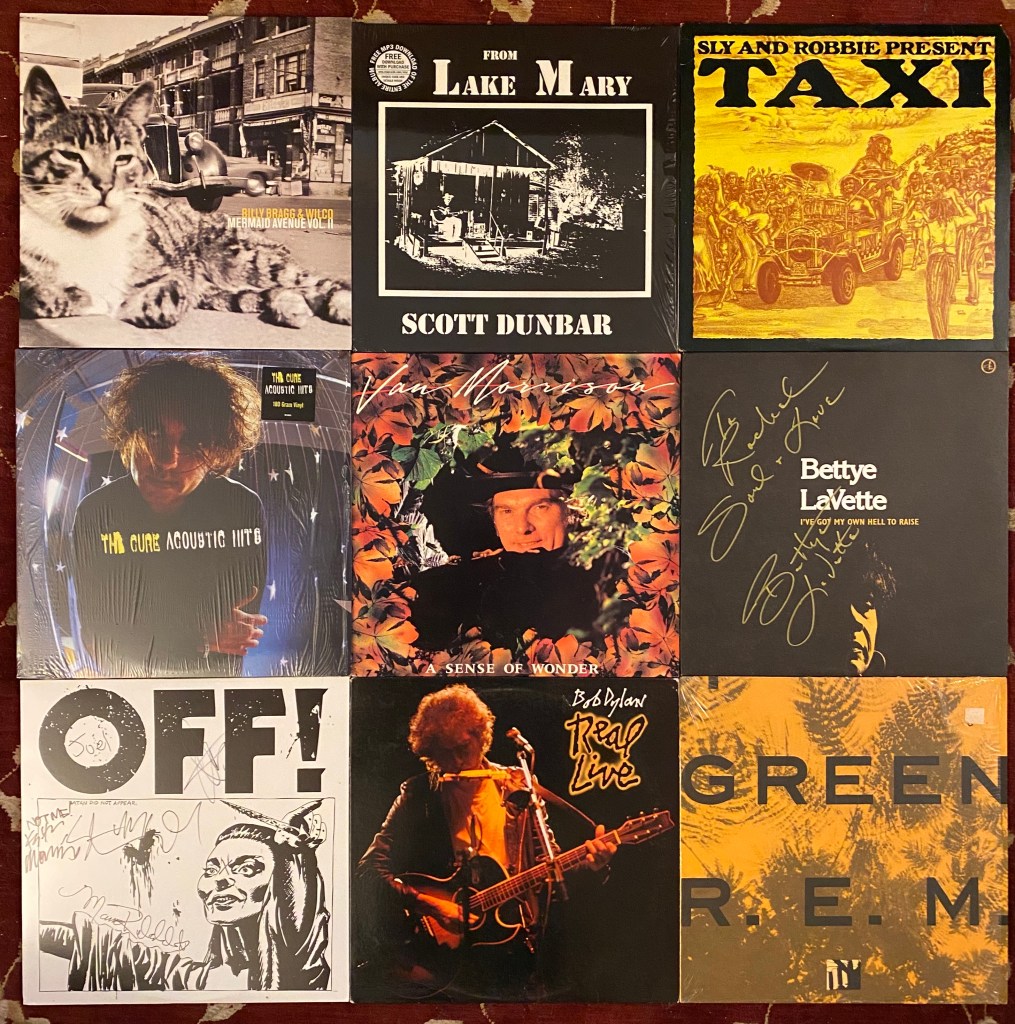
I’m still taking a break from writing for a while, but may start creeping back in and adding my thoughts on some albums. I am also happy to take requests. If there’s an album you’d like me to write about, please let me know in the comments section and I’ll do my best to share my thoughts. As always, you, dear reader, are welcome and encouraged to share your insight.

Scott Dunbar – From Lake Mary (1970)

The Cure – Acoustic Hits (2001)

Bob Dylan – Real Live (1984)

Bettye LaVette – I’ve Got My Own Hell to Raise (2005)

Sly and Robbie – Present Taxi (1981)

Van Morrison – A Sense of Wonder (1985)

R.E.M. – Green (1988)

Off! – Self-titled (2012)

Billy Bragg and Wilco – Mermaid Avenue, Volume Two (2000)

Social Distancing Spins – Day 75

I’m still taking a break from writing for a while, but will be happy to make an exception. If there’s an album you’d like me to write about, please let me know in the comments section.

John Cale – Music for a New Society (1982)

Various artists – Nuggets: Original Artyfacts from the First Psychedelic Era, 1965–1968 (compilation)

The Roots – Home Grown! A Beginner’s Guide to Understanding the Roots, Vol. 1 (compilation)

The Roots – Home Grown! A Beginner’s Guide to Understanding the Roots, Vol. 2 (compilation)

Maxwell – BLACK Summer’s Night (2009)

Bob Dylan – Modern Times (2006)

Sleater-Kinney – All Hands on the Bad One (2000)

Buddy Guy – Skin Deep (2008)

Social Distancing Spins – Days 70-74

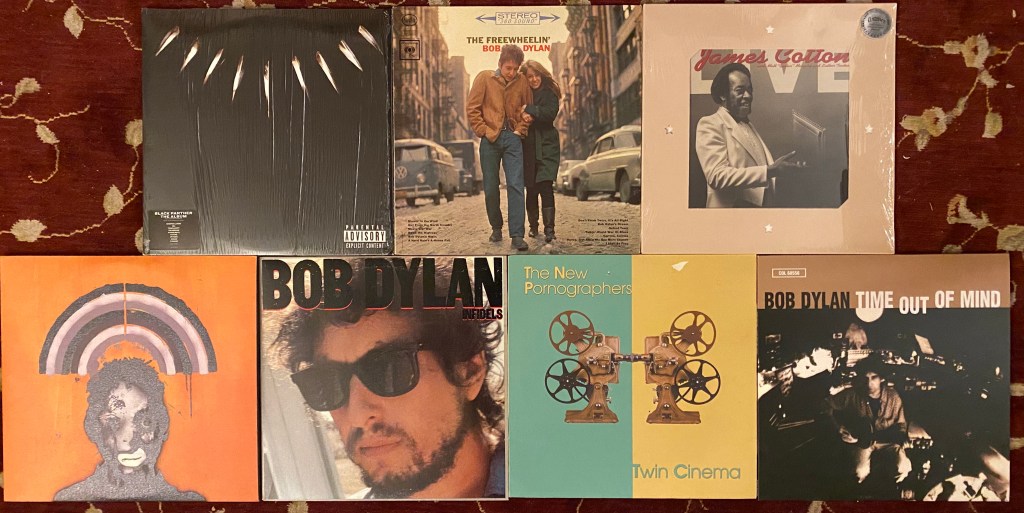
I hope everyone had a great Memorial Day weekend. In case you didn’t notice from the photo, the greatest living American songwriter turned 79 over the weekend. Don’t worry, I’ll be back to writing up each day’s spins soon. As always, if there’s an album you’d like me to write about, please let me know in the comments section.

Massive Attack – Heligoland (2010)

New Pornographers – Twin Cinema (2005)

Various artists – Black Panther: The Soundtrack (2018)

James Cotton – Live at Antoine’s Night Club (1988)

Bob Dylan – The Freewheelin’ Bob Dylan (1963)

Bob Dylan – Infidels (1983)

Bob Dylan – Time Out of Mind (1997)

Social Distancing Spins – Day 69

I’m going to take a break from writing for a while, but will be happy to make an exception. If there’s an album you’d like me to write about, please let me know in the comments section.

Nas – Hip Hop is Dead (2006)

Lionel Hampton – You Better Know It!!! (1964)

Gogol Bordello – Gypsy Punks: Underdog World Strike (2005)

Randy Newman – Little Criminals (1977)

Social Distancing Spins – Day 68

I’m going to take a break from writing for a while, but will be happy to make an exception. If there’s an album you’d like me to write about, please let me know in the comments section.

Tweedy – Sukierae (2014)

The Rolling Stones – Their Satanic Majesty’s Request (1967)

Esperanza Spalding – Chamber Music Society (2010)

Prince – Musicology (2004)

Nikki Lane – Highway Queen (2017)

Social Distancing Spins – Day 67

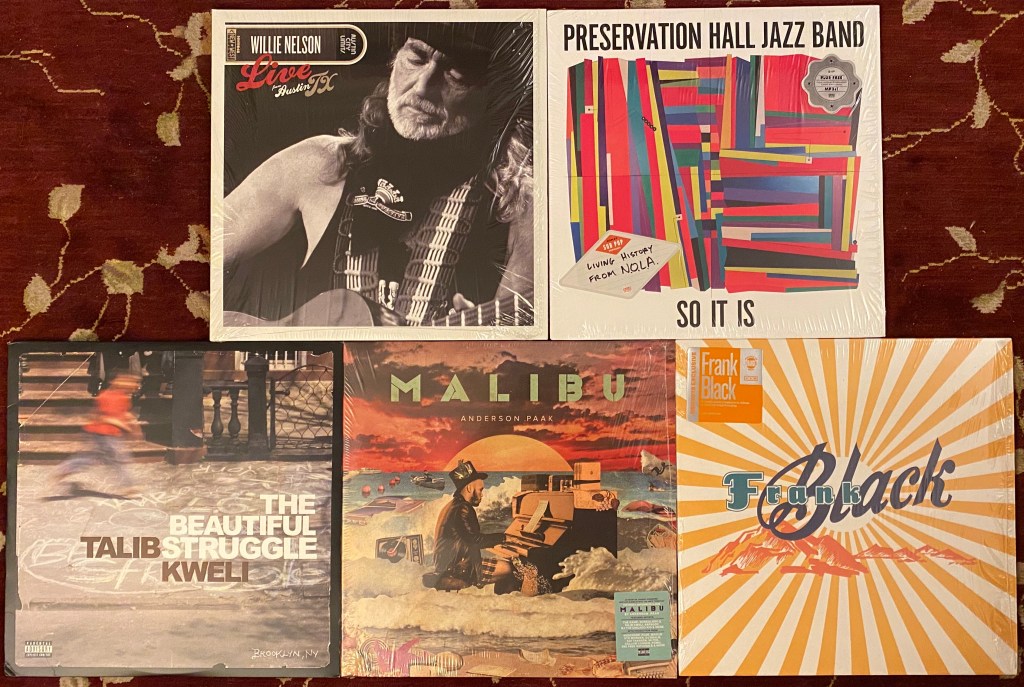
I’m going to take a break from writing for a while, but will be happy to make an exception. If there’s an album you’d like me to write about, please let me know in the comments section.

Talib Kweli – The Beautiful Struggle (2004)

Frank Black – self-titled (1993)

Willie Nelson – Live from Austin, TX (1990)

Preservation Hall – So It Is (2017)

Anderson .Paak – Malibu (2016)

Social Distancing Spins – Day 66

By Joel Francis

Peter Gabriel – Up (2002) As a fan who discovered Peter Gabriel in the early ‘90s, the decade between Us and Up seemed interminable. I’m glad no one told me at the time that I’d be waiting at least twice at long for his next platter of original material. Because of the lengthy delay, Up didn’t have the commercial impact of Us and So. Up is also a much darker album that features electronic elements in several songs. “The Barry Williams Show,” the first single released from Up, is easily its worst track. The arrangement never really gels and the lyrics lampooning talk shows and reality TV seems forced. (Lord, if Gabriel ever knew where those twin genres of trash television would lead us today ….) Sadness and mortality are themes in a couple songs, including the moving “I Grieve,” first showing up on the City of Angels soundtrack four years before Up’s release. Pakistani singer Nusrat Fateh Ali Kahn assists on the album’s emotional apex, “Signal to Noise.” As Gabriel has continued to move further away from rock music, hearing him surrounded by guitars, drum, bass and keyboards feels almost as gratifying as when this original material was first released.

Thelonious Monk – Solo Monk (1965) ‘Tis a pure delight to hear Thelonious Monk work without a band, with no filter between his mind and the music. The 13 songs on this wonderful album include standards, like the jaunty “Dinah,” which opens the collection, and the wistful, sentimental “These Foolish Things (Remind Me of You),” which ends the album. Monk scatters his own compositions among the standards, including “Ruby, My Dear,” one of his signature pieces, “Monk’s Point” and “North of the Sunset.” In his autobiography, pianist Randy Weston talks about Monk holding court at his New York City apartment, sitting at the piano, playing whatever comes into his mind. Solo Monk is as close as we’ll get to eavesdropping on one of those private sessions. Solo Monk is a treasure in every way.

The Kinks – Sleepwalker (1977) The Kinks had such a long career they managed to peak twice. Between 1966 and 1971, they released an amazing cluster of albums, including Something Else, Arthur and Muswell Hillbillies. Then, in the late 1970s they peaked again, starting with Sleepwalker. Disco-era Kinks were a very different group than their swinging ‘60s counterparts. The group had ballooned to five members, to accommodate a keyboard player, and the sound was more hard rock than twee pop. Songwriter Ray Davies abandoned the concept albums that had bogged down most of the band’s 1970s albums, and brought sleek, stand-alone rock songs. Brother Dave Davies turns his guitar up loud enough to reach the cheap seats in the sports arenas they would wind up playing on tour. The subject of songs “Life on the Road” and “Juke Box Music” are evident in their titles. “Life Goes On” is an upbeat anthem guaranteed to brighten any bad day. Sleepwalker isn’t the best album from the Kinks revival, but it sets the table nicely for the pair of albums that follow and improve on this direction.

Lee Ranaldo – Between the Times and the Tides (2012) As a member of Sonic Youth, guitarist Lee Ranaldo’s solo releases were art projects not intended for mainstream audiences. Thankfully his first effort after Sonic Youth’s unfortunate demise is an accessible, low key indie rock album in the same vein as his old band’s album Murray Street. Ranaldo wrote all the songs for Between the Times, but he assembled an all-star band to bring the material to life. Sonic Youth drummer Steve Shelly, Wilco guitarist Nels Cline and Medeski, Martin and Wood jazz keyboard player John Medeski. My favorite song on the album is “Xtina as I Knew Her,” a haunting look back at underage drinking parties and the danger constantly lurking under the veneer of good times. Here are the lyrics to the bridge, which sets up a stinging Cline solo: “Slip behind the valley curtain/Looking for a place to hide/Shaky and those times uncertain/Everyone drunk on red wine.” The other songs are equally solid, proving that underneath are the abstract noise experiments beats the heart of a pop songwriter.

Steve Earle and the Dukes – So You Wanna Be an Outlaw? (2017) It feels like Steve Earle releases a new album of original material about 18 months. If you don’t like his current musical disposition, wait a few seasons and he’ll be there again in a different mood. Fortunately, So You Wanna Be an Outlaw?, a return to country-ish material, is a keeper. By virtue of being so prolific, Earle’s songwriting has gotten tighter and tighter, to the point where he can write a tribute to the people fighting forest fires simply because he learned they’d never had one (“The Firebreak Line”). Most of the other songs on the album deal with troubles: with women, money and society. Willie Nelson pops by to lend his voice to the title song. Earle ends the album with several earnest covers of classic outlaw country songs, including Billy Joe Shaver’s “Ain’t No God in Mexico” and Waylon Jenning’s “Are You Sure Hank Done It This Way?”

Pearl Jam – Live at Easy Street (2019) In the spring of 2005, Pearl Jam stopped by a Seattle record shop to play a few songs and spread some hometown love. Seven of those songs were released on an CD exclusively available in independent record shops. Several years later, those same seven songs were released on vinyl for Record Store Day. My biggest complaint with this release is that I wished they would have released the full 16-song set on two albums, rather than the 27 minutes of material that populates this EP. What we’re given is great, though. Two songs from Riot Act, the band’s newest album at the time, one each from No Code and Ten and three covers. John Doe even comes out to perform X’s “The New World” with the band.

Last fall I ended up in Seattle for work. After making an obligatory stop at the Jimi Hendrix gravesite, I was hungry for both breakfast and crate digging. Both desires were satiated at Easy Street, which features a nice little brunch menu and an impressive expanse of vinyl. The large murals commemorating Pearl Jam’s concert brought two and two together for me. If you find yourself in the neighborhood, Easy Street is definitely worth a stop.

Social Distancing Spins – Days 62-65

By Joel Francis

Robert Fripp and Brian Eno – Evening Star (1975)
Brian Eno and Kevin Shields – The Weight of History (2018) The second album from King Crimson guitarist Robert Fripp and former Roxy Music effects wizard Brian Eno continues down the same experimental path established on their first album. Layers of audio are bounced between two tape decks, building up sheets of sound that are then manipulated and augmented with guitar solos and other effects. If this sounds too technical fear not: Evening Star is a supremely pastoral album, especially on the first side. As with Eno’s other ambient projects the point of this music is to almost disappear in the background and enhance the mood and atmosphere of a space. The first side of Evening Star succeeds on this level, projecting a layer of calm into my house each time it is played. The second side, the 28-minute track “An Index of Metals” is more textured, incorporating dense levels of guitar distortion. While distorted manipulations keep the piece from fading into aural wallpaper the result is still soothing.

More than 40 years after collaborating with Fripp, Eno partnered with another guitarist know for dense layers of distortion. The guitar player in My Bloody Valentine, Kevin Shields was the primary auteur behind the shoegaze masterpiece Loveless. The music Shields and Eno have crafted together seems like it builds on the foundation Eno established with Fripp. Like “An Index of Metals,” their work forces some attention to appreciate its wonder. Shields and Eno have only collaborated on two songs so far, but the 12-inch single containing these tracks make me want a more.

Murder by Death – The Other Shore (2018) The eighth album by the Bloomington, Ind. Goth-country rockers is a concept album that according to press materials is “a space-western about a ravaged Earth, its fleeing populace and a relationship in jeopardy.” Well that clears things up. Fortunately the music is so engaging that it masks any plot problems. Their brand of roots rock is bolstered by a dedicated cellist, which brings a sweeping Southern Gothic feel to the music. The music on The Other Shore is certainly more nuanced than the petal-to-the-metal live show I saw from them several years ago at Middle of the Map festival. That said, all the songs on The Other Shore feel like they would translate well to the stage. Murder by Death have built a loyal following over the past two decades. The Other Shore is accessible enough to please the existing fans and win them even more.

Roy Lee Johnson and the Villagers – Self-titled (1973) If the name Roy Lee Johnson rings any bells, it might from the song “Mr. Moonlight,” which he wrote and was covered by the Fab Four on the album Beatles for Sale. Johnson’s lone outing with the Villagers bears no resemblance to that song whatsoever. Opening number “Patch It Up” sounds like James Brown and the J.B.s. The next number, “I’ll be Your Doctor Man” continues in this very funky vein, with the distinct accompaniment of the Memphis Horns. Recorded at Muscle Shoals, Roy Lee Johnson and the Villagers drips with Southern soul and funk in every track. Unfortunately for Johnson, two events coincided to keep him from becoming a star. First, Stax was in shaky financial state when this album came out. Poor distribution killed any chance of this success. Fans couldn’t find the album in stores to buy it and send it up the charts. Secondly, the Villagers young bass player Michael James died suddenly, leading to the end of the Villagers. James’ playing plays a prominent role in the album’s success, adding to the melody line while simultaneously holding down the groove. The side two instrumental “Razorback Circus” is a prime example of what James brought to the material. Johnson didn’t release another album until the mid-‘80s. His most recent album is 1998’s “When a Guitar Plays the Blues.”

The Creation – Action Painting (compilation) If you know any of the Creation’s songs, it is probably “Making Time,” used in the brilliant film Rushmore. It’s the first track in this collection, meaning there are 22 other 1960s British garage rock classics to discover here. Fans of early Who, Small Faces and the Kinks will find a lot to love. As always, the Numero Group has done an excellent job of presenting the music with the best mastering possible and putting it in context as well. All the band’s singles are here as well as a handful of pre-Creation singles by Creation Mark Four and songs that only popped up on later compilations. The Creation like to pose as ruffians on songs like the tough “Biff, Bang, Pow” and the cocksure “Can I Join Your Band,” but their true colors are revealed on several goofy numbers. “The Girls Are Naked” sounds like the nutty younger cousin of the Who’s “Pictures of Lily.” Covers of “Cool Jerk” and “Bonie Maronie” conjure images of awkward dance steps in a school gymnasium. The Creation never seem to take themselves too seriously – they have a song about “Ostrich Man” – but their Mod sensibilities make this an essential addition to any 1960s Anglophile’s collection.

Jane’s Addiction – Nothing’s Shocking (1988) Most of the songs on the major label debut by the Los Angeles-born alternative party band still sound fresh today. I hadn’t listened to this album in a long while before this spin, but Eric Avery’s bassline on “Up the Beach” that opens the record still got the adrenaline going. Nothing’s Shocking was a staple in my college dorm room, but I think nostalgia isn’t the only force powering the album today. Dave Navarro’s guitars and Stephen Perkins drums kick like a blast of dynamite as singer Perry Farrell counts in the band on “Ocean Size.” “Mountain Side” still hits like an avalanche, but it’s not just the heavy songs that land. “Ted, Just Admit It…” is a longer, more experimental piece. “Standing in the Shower … Thinking” is a piece of faux funk that concludes the first side. “Summertime Rolls” is another atmospheric experimental piece carried by Ferrell’s voice. The horns on “Idiots Rule” and the radio staple singalong “Jane Says” are the only dated moments on the album. The brass on “Idiots Rule” sounds like shades of “Sledgehammer” and “Jane Says” suffers from overexposure. Jane’s Addiction have broken up and regrouped several times in the 32 years since Nothing’s Shocking came out, but none of those projects have come close to matching their original output.

Lucinda Williams – Good Souls Better Angels (2020) The 14th studio album from Southern singer/songwriter Lucinda Williams couldn’t arrive at a better time. At a time when COVID-19 shutdowns have people feeling frustrated, sad, angry and hopeful (sometimes experiencing each emotion within minutes of each other), Williams channels these states of mind through her lyrics and amplifier.

On “Big Black Train,” Williams confronts her bouts with depression and determination not to get onboard again. “Man Without a Soul” is a hot pellet of rage directed at the current occupant of 1600 Pennsylvania Avenue. The album ends with “Good Souls,” a hopeful prayer to “Keep me with all of those/who help me stay strong/and guide me along.”

Williams’ band expertly augments her emotions throughout the album, often working in a swampy blues or Rolling Stones rock form. After an hour of searing, electrified full-band arrangements, the vinyl version of Good Souls Better Angels includes five acoustic demo bonus tracks. They are the perfect palate cleanser. Having shared this emotional catharsis, we are renewed to defeat the next challenge.