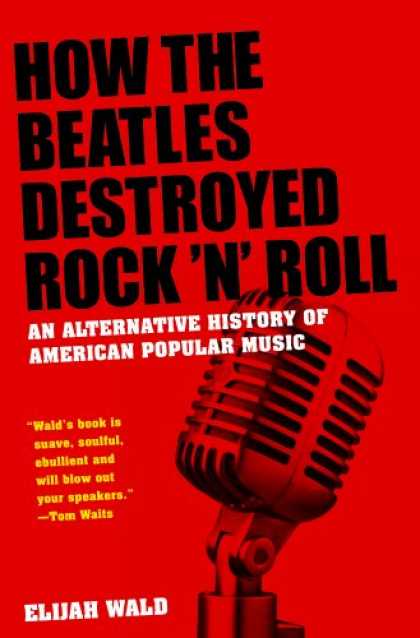
(Above: Don’t read “How the Beatles Destroyed Rock ‘n’ Roll” expecting author Elijah Wald to bash the Fab Four.)
By Joel Francis
The Daily Record
Elijah Wald’s provocatively titled book slipped into the marketplace about the same time the much-ballyhooed Beatles remasters slammed retail shelves. But Wald isn’t trying to turn fans against their beloved Fab Four. He’s trying to reinforce their importance by approaching their arrival with a magical mystery tour that examines music from a populist perspective.
For the most part, Wald’s narrative manages to ignore critics and historians and answer the greater question of “Why did people like this?” Starting 100 years ago with ragtime, Wald walks through the growth, progression and trends that emerged in the first half of the 20th century.
Wald focuses on the Beatles because they were able to make artistically respectable music while staying true to their genre. Their foil is Paul Whiteman, who despite accomplishing the same feat, has been forgotten.
Whiteman was a Caucasian big band leader who crowned himself “King of Jazz.” Despite earning the endorsements from Duke Ellington and Louis Armstrong and selling millions of records, Whiteman’s career has been largely dismissed by jazz historians because his arrangements were so genteel. Indeed, part of Whiteman’s mission was to sand the rough edges off of jazz and respectable, if unchallenging, middle-brow dance music.
By eschewing the conventional narrative based on critical favorites, Wald shows how mainstream performers and tastes shaped the progression of music. Traditional viewpoints and assumptions are confounded again and again as Wald shows how the popular persuades the acclaimed. For example, Wald tells how Guy Lombardo’s arrangements influenced Armstrong’s celebrated Hot Five and Hot Seven records.
He also builds interesting parallels between celebrated trendsetters and those who are slighted for their foresight. In one instance, romantic crooner Vaughn Monroe was savaged in the press when his stage shows were little more than reconstructions of his singles. Yet only a few years later, as recorded music replaced live interpretations on the radio, it became what audiences expected.
Wald covers a lot of territory in a hurry, but it rarely feels like any corners are cut. Although the history is told in a linear fashion, Wald is a master of connecting previously unseen dots. The lines he draws between the Bennie Moten Orchestra and Elvis Presley, or Parlimanent-Funkadelic and Benny Goodman are both ingenious and obvious in retrospect. While not all of Wald’s parallels or arguments work, they are worth pondering.
In a way, “How the Beatles Destroyed Rock and Roll” is the natural outgrowth of Wald’s previous book, “Escaping the Delta.” That volume examined the curious arrival of Robert Johnson as the figurehead of “authentic” pre-war blues. In looking at Johnson’s forgotten peers like Peetey Wheatstraw and Bumble Bee Slim, Wald not only places Johnson’s music in context, but draws attention to arguably more deserving performers.
Admittedly, Wald may be giving himself the upper hand by focusing on unheard and unheralded performers. But while Wald’s arguments are contrarian, they are also well-researched and measured. In fact, the only argument Wald fails to back up is his title. Not only does Wald leave the Fab Four’s legacy intact, he doesn’t address them directly until the final two chapters. Fans of the British Invasion and Boomers looking to relieve their adolescence are bound to be disappointed.
Armchair historians and musicologists are bound to be the most pleased with this text. Wald is not encouraging the reader to explore Whiteman’s catalog or discard his or her favorite performers, only look at them through a longer lens.
(Above: Although forgotten by both jazz and pop historians today, bandleader Paul Whiteman was a major figure in early 20th century music. A central figure in Elijah Wald’s latest book, “How the Beatles Destroyed Rock and Roll,” here is the trailer for Whiteman’s 1930 film “King of Jazz.”)
By Joel Francis The Daily Record
Author Elijah Wald has dedicated his past two books to stripping away the legend and mythology surrounding two of music’s most iconic figures, and placing them in the context of their times. In “Escaping the Delta,” Wald demonstrates how Robert Johnson was very much a product of his time, and how his deification was established. Wald’s latest book expands that motif, and bears the inflammatory title “How the Beatles Destroyed Rock and Roll.”
Wald recently took the time to speak with The Daily Record about some of the themes in his new book and, of course, how the Beatles changed rock and roll.
In the book you talk about how “everything old becomes new again,” and use the Twist to illustrate your point. What are some of the other examples of cyclical trends you discovered?
To be fair, I don’t say everything old can always be recycled. When something new comes along, we tend to look back and find things that seem similar to us. But I think that may be less a recognition of real cycles than a way of making the present seem less strange.
Clearly, things come back, but when they do come back they are different. I’m not sure things are cyclical. It may just be they way we get comfortable with them. When the Twist came around, the way the entertainment industry handled it was to talk with Irene Castle and say “This is like what was happening in 1914, isn’t it?”
Why do you call “Rhapsody in Blue” the “Sgt. Pepper’s” of the ‘20s?
This is really the germ of the whole book. I was reading how people in the people in the 1920s wrote about “Rhapsody in Blue” and noticed how similar it was to what was said about “Sgt. Pepper’s” in the 1960s.
(In the 1920s) everyone was saying how until now jazz was a lot of noise and music for rowdies and kids, but now this had turned it into a mature art form. This is exactly what happened with “Sgt. Pepper’s.” Leonard Bernstein said he was excited about it and Lennon and McCartney were compared to Schubert. Just as “Rhapsody in Blue” created a respectable thing that could still be called “jazz,” “Sgt. Pepper’s” created something respectable that was still considered rock.
Who was Paul Whiteman and what was his impact on music? Why has he largely been forgotten today?
I spend a whole chapter in the book on this, but in a nutshell, Paul Whiteman was the most popular bandleader of the 1920s. He was the man who transformed the perception of jazz from noisy, small groups into large orchestras who played not only fun dance music, but also at Carnegie Hall.
I think Whiteman is largely forgotten because he didn’t swing by and large and was resolutely white. We have understood the history of jazz to largely be a history of African-American music. Whiteman tried, for better or worse, to separate jazz from that heritage.
In many ways, the 1940s parallel today, in that there is fear new technology will usurp the traditional way artists got paid. Then it was a fear of jukeboxes and radio’s reliance on pre-recorded music and today, of course, the dominant issue is digital piracy. What are some of the similarities and differences you’ve observed between these two decades?
The huge difference is that all the things we talked about in the ‘40s did involve musicians getting paid, just different musicians. It was R&B and country musicians getting paid instead of big bands. A lot of people previously neglected became huge stars.
What’s happening now is really dangerous, in terms of musicians continuing to be able to make a living. It is exciting, in terms of everyone being able to make their music available to millions of listeners, but it is getting harder and harder to make a living in music. It’s more like a lottery – win and become a star or lose and go on to something else.
There are skills you develop as a professional musician that we’re seeing less and less of because people don’t perform as much. Everyone in my book went through an apprenticeship playing seven nights a week for four or five hours a night. Those opportunities no longer exist. There’s no way to build those kinds of skills today.
Explain the difference between hot and sweet combos. Why have the hot survived while the sweet are dismissed?
A lot of people will say this is a false dichotomy. Everyone played some sweet and some hot, but the best way to explain the difference to people of my generation is to go back to the British Invasion. In the U.S., we thought of both the Beatles and the Rolling Stones as belonging to the same genre. In England, however, the Beatles were called pop and the Rolling Stones were called R&B, and it’s easy to understand why.
The way we look at it today, hot bands played for boys who were into music as fans and listeners, while sweet bands were for sappy girls. That’s not the way I would phrase it, but it’s not necessarily wrong. Women have always been the determining pop buyers, because they like to dance, but men have always been the main critics. In any case, in the 1930s the two extremes were Guy Lombardo on the sweet end and Count Basie as hot, but most bands were in the middle.
One reason the hot bands live on is because by and large the only people listening today are jazz fans and they always liked the hot bands better. There’s also the racial component I mentioned earlier. I don’t disagree that what is exciting in American music was largely taken from African-American music—I would argue that it’s more complicated than that, because they are always interchanging, but as a listener I am certainly more excited by Basie than by Lombardo. As a historian, though, I am interested in both, and well aware that in their era Lombardo was far more popular.
What is the connection between swing and rock and roll?
It was the hot dance music, youthful, noisy dance music. We think of these worlds as separate, but a lot of the same musicians crossed over. The first house band for Alan Freed’s rock party was the Count Basie Orchestra. Bill Haley and the Comets all did their apprenticeships playing swing. Musically, there was a lot of overlap.
How did the success of the Beatles and other late-‘60s rock bands segregate the music industry? What are the lasting effects of that segregation?
Two things happened at once. One, the Beatles arrived when the industry was moving very heavily toward black music. The myth is the Beatles rescued us from Frankie Avalon, but they really rescued us from Motown and girl groups. If you look at the charts, black groups had so completely taken over, they actually stopped having separate charts.
The Beatles and British Invasion bands were exciting, but their rhythm sections were old fashioned. In a world of Motown and James Brown they played archaic styles. Black kids were not much interested in the British bands, because they weren’t as much fun to dance to—and it was not just black kids, but everyone who was dancing to Motown, which included a lot of white kids, especially white girls.
At the same time, the discotheque craze was hitting, so people didn’t have to have live bands. The lasting effect of that is that you no longer had to have one band who could play every style of music. Before you couldn’t have a band play only black or white music, because people wanted to dance to and hear the full range of current hits. In the ‘60s, though, you could have one band only play one kind of music, because when you wanted to hear a different kind you could just change the record.
In the epilogue you discuss how rock and dance music gradually began playing to divergent audiences. Do you think they will intersect again?
Today we don’t have bands that have to play anything, period. It’s a sad reality that if you listen to hit records – or even records that aren’t hits, by little-known, local performers – the number of records where the group on the album plays regularly is vanishingly small. The number of hits that can be recreated without recordings is virtually none.
Don’t get me wrong; hip hop couldn’t exist in a world where you had to play everything live and I think hip hop is exciting. Overall, however, the world of live music is becoming extinct. There are certainly plenty of people for whom live music is important, and I’m sure there always will be, but they are increasingly a minority.
The Temptations – “Ball Of Confusion,” Pop # 3, R&B # 2
By Joel Francis
The Daily Record
Clocking in at over four minutes, “Ball of Confusion” was an epic by Motown standards. The arrangement and themes, however, were very much in line with the top-shelf, psychedelic social commentary songwriter and producer Norman Whitfield had been consistently turning out.
Sonically and thematically, “Ball of Confusion” doesn’t stray from the formula Whitfield developed for the Temptation in 1968 with “Cloud Nine.”
If Sly Stone were Martin Luther, this is how he would have delivered his 95 Theses. In a cadence cribbed in Bob Dylan’s delivery from “Subterranean Homesick Blues,” Dennis Edwards lists his grievances: “segregation, determination, demonstration, integration, aggravation, humiliation, obligation.”
The arrangement is just as claustrophobic and frustrated as the lyrics, with nearly every instrument – electric organ, wah guitar, drums and vocals – threatening to strangle each other in the mix. Brief bursts of harmonica or horns provide the only moments of relief. Edwards handles the lion’s share of the singing, but once again the other four members tag-team lead duties. Bass singer Melvin Franklin memorably punctuates each verse with the adage of complacency – “and the band played on.”
“Ball of Confusion” isn’t exactly a fun song, but it is a lot of fun to listen to. The song was the Tempts’ second strong single of the 1970s, landing in the Top 5 on both the pop and R&B charts. It also marked their third straight solo Top 10 hit.
The complex number isn’t easy to replicate, but that hasn’t stopped others from trying. Shortly after the Tempts’ number had dropped in the charts, Berry Gordy handed the tune to another Motown group, the Undisputed Truth, to try their hand. A generation later, pop band Duran Duran and metal outfit Anthrax both released covers in the 1990s. The 21st century also saw a resurgence of interest in the song, with the Neville Brothers, Widespread Panic and Tesla all releasing covers.
The song also appeared as a centerpiece in the film “Sister Act Two: Back in the Habit” (featuring a young and then-unknown Lauryn Hill). It’s biggest distinction outside of Motown, however, is in kick-starting Tina Turner’s solo career in the early ‘80s. Turner’s reading appeared on a 1982 tribute album, it wasn’t a big hit in the United States or United Kingdom, but it did hook her up with the songwriters and producers who helmed Turner’s multi-platinum comeback effort, “Private Dancer.”
Tito, Jermaine, Jackie, Marlon and, of course, Michael Jackson blasted to the top of the chart with their debut single, “I Want You Back.” Five months later, they duplicated the feat with their second effort, “ABC.”
Like their previous release, “ABC” was written and produced by the Corporation, the faceless entity label head Berry Gordy created in the wake of Holland-Dozier-Holland’s departure. Never again would Motown’s writers and producers usurp the performer’s fame. Structurally, “ABC” also resembles “I Want You Back;” the two songs share the same spirit and melody lines.
“ABC” opens with a bright burst of fuzz guitar and piano a split second before Michael wordlessly sings the equivalent of sunshine and a smile. Michael had yet to enter his teens, but his voice pops out of the speakers with remarkable authority and maturity.
Because of their ages, the Jackson 5 were branded “bubblegum” in the early years of their career. The tag isn’t completely unfair – their debut album does open with a version of “Zip-a-Dee-Doo-Dah” – but the way Michael yells “Sit down girl, I think I love you!” is pure soul.
With its great bass line, the way the syncopated drumming plays off the piano line, and sprinkling of Latin percussion over the top “ABC” is pop perfection.
The song’s concept came from Corporation member Freddie Perren, a former school teacher. Perren noted the similarity between teaching and producing, namely forming a lesson play, or song idea, then having the students/musicians echo it back until attaining perfection.
“ABC” is one of Motown’s biggest song, but Gordy never saw fit to give the tune to any of his other artists. It hasn’t even been sampled that often (the less said about Ghostface Killah’s version, the better). Although the song today has been unfairly relegated to children’s compilations and oldies collections, “ABC” rocked the house parties of both young and old alike back in the day.
(Above: Alice In Chains’ new singer William DuVall has no problem claiming “Dam That River.”)
By Joel Francis
The Kansas City Star
As Alice in Chains took the stage Sunday night at the Midland, a large, beating heart was projected onto a curtain. Nearly two hours later, the reformed grunge band proved to the sold-out crowd they were still very much alive.
The band had its foot on the gas and eyes on the rearview mirror. The quartet proved they were once again a going concern by delivering more than half of its new album, “Black Gives Way to Blue.” In turn, longtime fans were rewarded with nearly all of the classic 1992 album “Dirt.”
New singer William DuVall had no problem filling the shoes of Layne Staley, the band’s former lead singer who died of a drug overdose in 2002. While DuVall’s vocals are eerily similar to Staley’s, he puts enough of himself in the performance to prove it’s not just karaoke. In a way, his style recalls H.R. of the Bad Brains. Like H.R., DuVall can be soulful and hard as nails at the same time.
But while all eyes were judging DuVall, there were no questions about who was leading the show. Guitarist Jerry Cantrell was the first member hit with the spotlight, and frequently stationed himself center stage. The band’s chief songwriter, Cantrell sang lead or harmony vocals on nearly as many songs as DuVall, and never failed to elicit cheers with his solos.
Several times the crowd’s lusty singing threatened to overwhelm the band. Cantrell encouraged the crowd to join in on the chorus of “Got Me Wrong,” but they needed no enticement when the opening line of “Would?” rumbled out of Mike Inez’ bass guitar. Classics “Man in the Box,” “No Excuses” and “Rooster” also turned into massive sing-alongs.
The succession of the three opening numbers on “Dirt” early in the set were so vital and energetic it was hard to believe the material was nearly 20 years old. Later, the already psychedelic “Sickman” was somehow even more trippy, as the band dragged the throng through the sonic undertow.
While Staley wasn’t missed onstage, he was noticeably absent from the songwriting process. Staley had a way of tightening and punching up Cantrell’s songs. Unfortunately, several of the newer songs lacked Staley’s urgency. “Last of My Kind” went nowhere for nearly six minutes. There is an unquestionably great song buried somewhere in the seven minutes of “Acid Bubble.” Unfortunately, it too was content to plod along unchecked at mid-tempo.
While the new material didn’t get the massive responses of the tried and true, they still went over well. There were plenty of hands in the air and heads nodding along to show the crowd hadn’t come out to see a nostalgia act. New songs “Check My Brain” and “Your Decision” should figure into setlists for some time.
It would have been easy for Alice in Chains to take the easy route and cash in. The Doors, Queen and INXS have all lost a charismatic frontman and tried to plug a stand-in into the spot. Alice in Chains have succeeded thus far because they are looking beyond the flannel shirt/Doc Martens set. They’re not preaching to the choir, they’re still looking to convert.
“Sometimes,” Cantrell said, “it takes a few times banging your head against the wall until you finally get through, if you know what I mean.”
Setlist: All Secrets Known, It Ain’t Like That, Again, Check My Brain, Them Bones, Dam that River, Rain When I Die, Your Decision, Got Me Wrong, We Die Young, Looking In View, Down in a Hole, Sickman, Lesson Learned, Acid Bubble, No Excuses, Angry Chair, Man in the Box. Encore: Sludge Factory, Would?, Rooster.
(Above: B.B. King and Buddy Guy jam on “Rock Me Baby” with Eric Clapton and Jimmie Vaughan at a recent Crossroads Festival.)
By Joel Francis The Kansas City Star
Few in the sold-out crowd that greeted B.B. King, the 84-year-old King of the Blues, at the Midland theater on Friday night expected the energy and vitality of King’s essential “Live at the Regal” album, released 45 years ago. It is also likely few expected the extensive banter that filled King’s 90 minutes onstage.
King’s set opened with a 10-minute vamp that allowed everyone in his eight-piece backing band the chance to solo. Once King took the stage, he proved he still had the chops and voice fans love. His excellent reading of the blues warhorse “Key to the Highway” melded nicely into King’s own “Blues Man.”
Another classic, “See That My Grave Is Kept Clean,” was driven by a military cadence on the snare drum. When coupled with King’s four-piece horn arrangement, the song recalled a New Orleans funeral march. The band followed that number with a song King recorded with U2 back in the ‘80s. In their most upbeat performance of the night, the King and his band lit into “When Love Comes To Town” with surprising energy. Sadly, it was not to last.
From there King’s set was as much a monologue as it was a musical dialogue. Here are some of his best one-liners: • “You can look at me and tell I ain’t no Michael Phelps. I don’t smoke.” • After hitting a bum note on Lucille, his guitar: “I know I shouldn’t have let her go to the liquor store.” • After the audience response didn’t meet expectations: “I think you’re teasing me. You sound like Tiger Woods.”
As King’s chitchat neared the 20-minute mark, fans started to grow restless. Some shouted song requests; others just yelled “play something.” King apologized for not being able to play one of the requests, then continued rambling about Viagra and instructing men how to set the mood by playing Willie Nelson’s “Always On My Mind.”
After a bizarre musical riff on ED medications, King finally gave the crowd another song in the form of “Rock Me Baby.” The aborted performance led into King’s signature number, “The Thrill Is Gone.” Even then, King littered the song with asides and shout-outs to the sound men and lighting crew. When the throng realized they weren’t going to get another full performance, they started leaving en masse.
No one can fault King for growing old. He’s lived a rich life and brought joy to millions of people around the globe. Perhaps King feels he needs to stay onstage for so long to justify his high ticket price. If this is the case, he may be better off knocking a couple bucks off the ticket and cutting half of his horn section. (The quartet was only onstage half the time anyway.) While King’s onstage generosity is commendable, fans might be more appreciative of a shorter set loaded with music than the current drawn-out arrangement.
It would be unfair to label Chicago blues legend Buddy Guy the evening’s “opening act.” Guy just happened to go onstage first.
Listening to Guy is like hearing the history of electric blues on shuffle. Backed by a tight four-piece band, the 73-year-old guitarist tore through a 65-minute tribute to his heroes and contemporaries.
Guy teased out an abstract solo over the familiar opening chords of “Hoochie Coochie Man” in a setting that was more Thelonious Monk than Muddy Waters, and took particular delight in delivering the song’s more racy lyrics. Guy’s tribute to his late friend and collaborator Junior Wells on “Hoodoo Man” was another high point.
The night’s signature moment started with Guy playing so quietly one could hear his amp buzzing over the P.A. As “Drowning on Dry Land” progressed, Guy eased his way off-stage and into the crowd. He nailed a long solo while walking nearly two-thirds of the way up the floor, and finished it plopped down in a surprised fan’s seat.
Before leaving the stage, Guy paid tribute to his friend and inspiration, B.B. King. Growing up in Louisiana, Guy said, there were no music shops, just stores that happened to have instruments in one corner. Before King’s records came out, inventory was priced to move. But after “Three O’Clock Blues,” guitars were suddenly harder to come by.
B.B. King setlist: I Need You So, Let the Good Times Roll, Key to the Highway>Blues Man, See That My Grave Is Kept Clean, When Love Comes To Town, You Are My Sunshine, “ED Medication Blues,” Rock Me Baby, The Thrill Is Gone.
Buddy Guy setlist: Nobody Understands Me But My Guitar, Muddy Waters medley: Hoochie Coochie Man/She’s 19 Years Old/Love Her With A Feeling, Hoodoo Man, Slippin’ Out, Slippin’ In, Drowning On Dry Land, Close to You, Boom Boom, Strange Brew, Voodoo Chile, Sunshine of Your Love.
(Above: Ozzy Osbourne has done a lot of crazy stuff in his life. This might be the most surreal.)
By Joel Francis The Daily Record
The trails and adventures of Ozzy Osbourne’s life have been repackaged and sold nearly as often as the metal god’s greatest hits.
Between an episode of “Behind the Music,” countless articles and three seasons of reality television on MTV, there’s little new ground for Ozzy’s new autobiography, “I Am Ozzy” to cover.
But just like “Crazy Train” and “No More Tears,” just because you’ve heard them before doesn’t mean you don’t want to hear them again. “I Am Ozzy” may hold few surprises, but it’s still a breezy and entertaining read.
Fans looking for insight into Ozzy’s musical process should look elsewhere. Animal activists are also advised to keep away. In the course of the book’s 391 pages, Ozzy not only (infamously) bites the head off of a dove and a bat, but decapitates his seven-foot stuffed bear and mows down his backyard flock of pet chickens during a drunken rampage.
That phrase, “during a drunken rampage,” is the preface to 99 percent of the book’s stories. It is amazing that Ozzy survived his rampages. Even more incredibly, the cumulative effect of so many successive episodes makes Ozzy’s unthinkable actions seem rational. After reading “I was drunk, so I figured ___” so many times, one starts to become numb to the consequences and may find himself frequently nodding in agreement.
The most entertaining and musically focused chapters detail Ozzy’s time in Black Sabbath. Before recording “Sabbath Bloody Sabbath,” the band holed up at Clearwell Castle in England. The time supposed to be used for rehearsal quickly devolved into a series of pranks designed to convince the others the castle was haunted. These stories show an innocent playfulness than reinforces the bond between band mates and makes them feel more human.
“I Am Ozzy” could also serve as an alternate screenplay for “This Is Spinal Tap.” Ozzy details his difficulties finding the perfect midget to hang onstage and how he placed blood capsules in a wig so it looks like he is suffering head trauma. He also recalls the difficulties of performing in a suit of armor – particularly when fans are flinging handfuls of raw meat onto the stage – and the night the pyrotechnic hand designed to lift him over the crowd malfunctioned.
Despite the hi-jinks, there is a serious side to the book. Ozzy somberly discusses the death of his guitarist and greatest foil, Randy Rhoades, a lawsuit filed by the family of a fan after he committed suicide and dealings with religious fanatics, both Satanists and Christians. Ozzy expresses his regrets, but doesn’t expound on the details (probably because he never had to deal with them).
For the past three decades, Ozzy’s long-suffering wife and manager Sharon has embraced the role of janitor. The Marge to Homer’s Ozzy, Sharon not only had to deal with the consequences of her husband’s addictions, but also had to repeatedly stand up to her father, Don Arden. As Ozzy and Sabbath’s former manager, he uses every dirty trick in the book to steal Ozzy back from his daughter. Sharon is frequently painted as an opportunist, but “I Am Ozzy” leaves little doubt that Sharon had to work very hard for her empire and may even deserve a smidgen of sympathy.
After spending two-thirds of his text on Sabbath and Rhodes, Ozzy breezes through the final 25 years of his life. Guitarists Jake E. Lee and Zakk Wylde (who played with Ozzy for 20 years) get only a passing mention. Ozzy slows down over the last 50 pages to discuss his resurrection on MTV, and health issues.
“I Am Ozzy” may not win any literary awards, but a special prize should be awarded to Chris Ayres for making the Ozz-man sound coherent and engaging. Although the conversational tone is loaded with profanity and British colloquialisms, they make the stories seem even more natural and personal.
If there’s one surprise in “I Am Ozzy” it is how much of Ozzy’s life feels like destiny. Despite the trappings of his fame and success, one gets the feeling Ozzy would have turned out pretty much same. Ozzy the Crazy Ex-Con or Ozzy the Slaughterhouse Worker (both were pre-fame occupations) just seem like lower-budget versions of Ozzy the Metal God.
Motown’s signing of Rare Earth in 1968 was the sign of a label attempting to spread its wings. Although Rare Earth wasn’t the first all-white rock group signed by to Motown (that would be the Messengers in 1967), it was the most successful.
“Get Ready” was the Earth’s second and biggest single. The song was originally recorded by the Temptations in 1966 when it rose to No. 29. It was written by Smokey Robinson and Pete Moore and Bobby Rogers of the Miracles. When the Temptations version of “Get Ready” failed to chart high enough, Robinson passed production reigns of the group over to Norman Whitfield.
But that was four years ago, before the psychedelic movement and power trios started stretching songs to fill an entire album side. Which is exactly what Rare Earth did to “Get Ready.” Modeled after their show-closing performances, the song reached more than 21 minutes and packed the entire second side of their Motown debut.
The quintet lobbied label honcho Berry Gordy to release the song as a single, but given the song’s length he balked at the proposition. Finally, a three-minute edit was released in February, 1970 and the song shot up the chart.
Despite the genre transplant, “Get Ready” emerged relatively unaltered. The horn line was replaced with electric guitar, and faux crowd noise was added. The biggest change was Pete Rivera’s gritty white soul vocals replacing Eddie Kendricks’ tough falsetto. A saxophone solo by Gil Bridges closes the number.
The song became a staple not only for Rare Earth and the Tempts, but was a sort of label warhorse. It was included on albums by the Supremes, Miracles, Smokey Robinson on his own, and again by the Temptations in 1991.”Get Ready” was also covered by pop-punk band Ash, the Scottish folk band the Proclaimers and sampled by the Black Eyed Peas, who later turned it into a full-blown cover for their singer Fergie on her solo album.
(Above: The Delmore Brothers landed a hit with “Blues Stay Away From Me” in 1949 on King Records.)
By Joel Francis
The Daily Record
In a musical landscape that lionizes pioneering indie labels Chess, Motown and Atlantic, Cincinnati’s King Records is at best remembered as a footnote and the early home of James Brown.
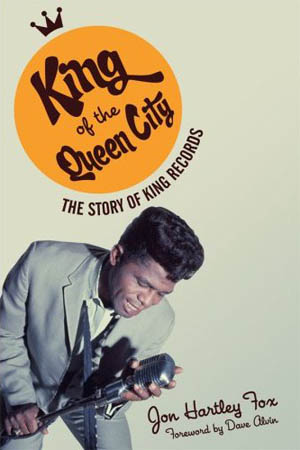
Author Jon Hartley Fox aims to correct that perspective with his new book “King of the Queen City: The Story of King Records.” While Brown receives his due, Fox spends a great deal of time making the case that King was the most diverse and innovative label of its time.
King Records was founded in 1943 by Syd Nathan, a 40-year-old Cincinnati businessman with asthma and poor eyesight. Nathan’s got into the music business started by reselling old jukebox platters at the tail end of the depression. The venture proved so successful he opened Syd’s Record Shop on Cincinnati’s Central Avenue in 1940.
The first artists Nathan signed to King were Grandpa Jones and Merle Travis. Their success, coupled with the early hit “I’m Using My Bible for a Road Map,” led Nathan to advertise with the slogan, “If it’s a King, it’s a hillbilly.”
In 1945, Nathan dipped his toe in the waters of “race music” (the term “rhythm and blues” wouldn’t be coined for another three years), with Queen Records. The success of early artists like Bull Moose Johnson led the subsidiary to be moved onto the proper King label.
Nathan’s pursuit to make records for the “little man” took him into nearly every conceivable genre of music. Throughout his quarter century at the helm of King, the label produced hits on the country, blues, gospel, pop, R&B and jazz charts. A cross section of King’s staggeringly diverse roster includes Freddie King, Hank Ballard and the Midnighters, the Stanley Brothers, Homer and Jethro and, briefly, John Lee Hooker, Hot Lips Page and Johnny Otis.
The label’s biggest artist, however, nearly didn’t make it out of the studio. James Brown came to King through a demo of “Please, Please, Please.” Nathan hated the track with a passion, and released it only to humiliate the producer, who staked his career on its success. The Hardest Working Man in Show Business went on to have an unprecedented string of hits on King beginning with “Please, Please, Please” 1956 and continuing until 1971, when Brown and his back catalog moved to Polydor.
The label’s success went beyond its across-the-board chart triumphs. In the early 1940s it was the first independent label to have its own fully functioning recording studio. Nathan was also at the vanguard of race relations, hiring black producers to supervise sessions with white musicians. Eight years before the hometown Cincinnati Reds would let blacks and whites play on the same team, Nathan had integrated crews in nearly every facet of the label.
Clearly, Fox has a lot of ground to cover in his book, and he does a good job of presenting the material in easy-to-digest portions. Each chapter covers a different facet of the label, such as country, gospel, solo or group R&B acts, production and distribution. From one-hit wonders to major performers, Fox does a good job breaking down the biographies of all the key players. In one or two pages, Fox paints a tight picture of everything the subject did before, during and after King. In that regard, the book functions almost as well as an encyclopedia of mid-century, Midwestern performers.
That approach, however, can also suffer from losing sight of the forest from all the trees. Nathan’s persona could have provided an easy and useful narrative thread, but he disappears for pages at a time. We don’t learn about his failing health until Fox casually mentions Nathan had a heart attack during a treatise on Brown. We also don’t learn much about Nathan’s personality – when he showed up at the office, his lifestyle, where he lived or his personal life.
The book’s timing also puts Fox at a disadvantage. Nathan died in 1968 and Brown in 2006. Most of the other performers are also deceased, giving Fox few primary sources to work with. Despite these difficulties, Fox proves himself a good researcher who draws on previously published material and interviews to tell his story.
The concise book covers a lot of territory in just over 200 pages. “King of the Queen City” is a brief but compelling work that should be devoured by music historians, both professional and amateur.
Once Marvin Gaye proved he could write and produce a hit song with “Baby I’m For Real,” he set out to show it wasn’t a fluke. Released less than a year later, “The Bells” replicated the success of its predecessor, for both Gaye and the Originals.
Like “Baby,” “The Bells” is a mid-tempo ballad that never picks up the pace past a pleasant trot. That said, whoever is playing the drums lays down some funky licks during the bridge (“I hear the bells/ringing in my ears”). The song closes with a spoken verse with smooth saxophone accompaniment, presaging the Quiet Storm movement.
Less than six months after “The Bells” ascended near the top of the charts, Gaye was again in the studio with the Originals, this time recording his landmark album “What’s Going On.”
Although “The Bells” earned the Originals a gold record, the group had a hard time finding their previous success sans Gaye. Their next four singles failed to chart. It wasn’t until five long years later, in 1975, that their disco effort “Good Lovin’ is Just a Dime Away,” nibbled at the bottom of the charts. Their 1976 single “Down to Love Town” fared better, hitting No. 1 on the dance chart.
The Originals broke up in 1981 after the death of singer Ty Hunter. Twenty-five years later, founding member Hank Dixon toured with a reformed version of the Originals. Ironically, he was the only original member in the lineup.
In 1971, Laura Nyro covered “The Bells” with Patti LaBelle contributing backing vocals. In 1994, New Jack Swing group Color Me Badd put the song back on the R&B charts.


 By eschewing the conventional narrative based on critical favorites, Wald shows how mainstream performers and tastes shaped the progression of music. Traditional viewpoints and assumptions are confounded again and again as Wald shows how the popular persuades the acclaimed. For example, Wald tells how Guy Lombardo’s arrangements influenced Armstrong’s celebrated Hot Five and Hot Seven records.



 joelfrancis.com