Review: Flaming Lips New Year’s Freakout

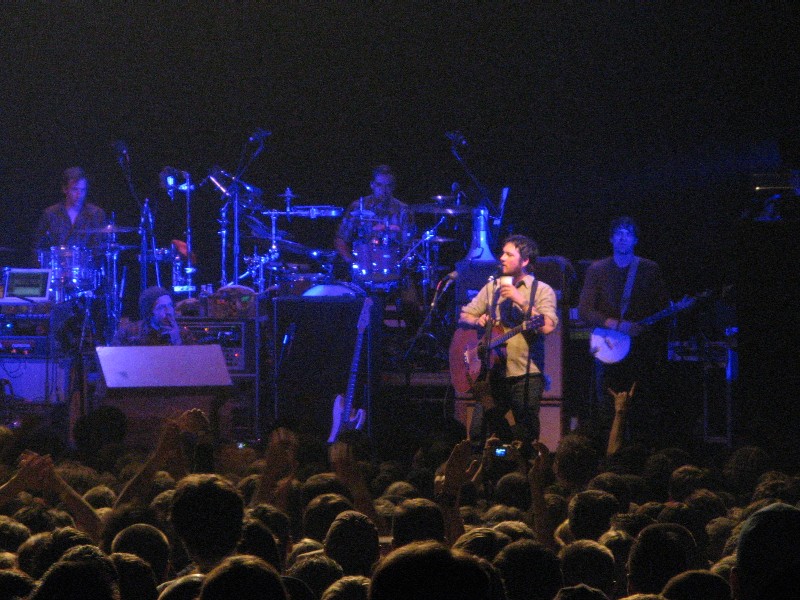
(Above: “Us and Them,” one of the few unaltered numbers from the Flaming Lips performance of Pink Floyd’s “Dark Side of the Moon” in the early hours of 2010.)

By Joel Francis
The Daily Record

OKLAHOMA CITY – The average Flaming Lips concert already feels like the greatest party on earth. Spending New Year’s Eve with the band in their hometown felt like living inside a kaleidoscope.

For nearly three hours, the Lips said goodbye to 2009 and hello to 2010 with a 90-minute main set and a rare performance of Pink Floyd’s classic album “Dark Side of the Moon.” For that feat, the band had assistance from Stardeath and White Dwarfs, the opening act, fronted by lead Lip Wayne Coyne’s nephew, Dennis Coyne.

The Lips/Stardeath version of “Dark Side” is less an homage than a deconstruction. If Floyd’s vision was a Cecil B. DeMille epic of careful, layered arrangements, then the Lips’ plays like one of Steven Soderbergh’s handi-cam experimental films, loving thrown together on a low budget, more intent on capturing the spirit than articulating the original performance.

“Breathe” was stripped of its shimmering guitars and lush harmonies and given the same blocky textures and blunt rhythms and bass lines that fuel much of the Lips’ new album, “Embryonic.” Similarly, “On the Run” was no longer a pattern of tape loops and manipulations, but fuzzed-out orgy of noise.

“Dark Side”’s most well-known number was also the least recognizable. The minimalist take of “Money” reduced the song to its signature bass line, with electronically manipulated vocals.

There were several nods to Pink Floyd in the Lips’ original material. “Vein of Stars” foreshadowed the straightforward reading of “Us and Them,” right down to the piano part and laser effects. “Pompeii am Götterdämmerung” sounded like something the Syd Barrett era of the Floyd would have pounded out in the late-‘60s London underground.

The spirit of Floyd was also evident in the material from “Embryonic.” Its songs are a little more abstract and less focused than anything the band has delivered in more than a decade. Although it was a bit jarring to shift from the ultra-catchy fan-favorites to the new material, it was nice to hear the band spazz out.

With its perpetual thump of bass and guitar, “Sea of Leaves” felt like being run over by an 18-wheeler. Wayne Coyne delivered the last half of “Silver Trembling Hands” from the shoulders of a person in a gorilla suit, a bizarre vision for a bizarre song.

The poppier moments of the first set drew the biggest response. The crowd threw a lot of force into “The Yeah Yeah Yeah Song” and the air was charged when the house lights came up and everyone joined in on the chorus (“with all your power”). The slower arrangement of “Yoshimi Battles the Pink Robots (Part 0ne)” felt like a giant campfire. “She Don’t Use Jelly” was a reliable feel-good moment.

Although the arena was two-thirds full and loaded with energetic fans, the band seemed to have trouble filling the void. It was unusual and unexpected, because I’ve twice seen them rock a vast field at the Wakarusa Music Festival. Maybe it was the abundance of slower, spacier songs and unfamiliar new material, but the Cox Arena – which resembles a slightly larger, late-‘60s edition of Kansas City’s Municipal Auditorium – felt spacious.

Whatever the reason, it wasn’t for lack of trying. Most bands tarp off the unseated sections behind the stage. The Lips filled them with balloons. As fans filed in, hundreds of the brightly colored latex orbs waited to be bumped, thrown and ultimately popped when the appointed moment arrived.

As the Lips floated into a poignant, sing-along reading of “Do You Realize??,” the balloons slowly started cascading from the balcony to the floor. When the song ended, it was nearly midnight and the house lights came up. As the crowd counted down, the band vamped and balloons filled the coliseum, obscuring the stage. Somewhere in the melee a wedding proposal was accepted.

While the music blared and balloons bounced, the stage crew had the thankless job of clearing debris from the stage for the second act. A flurry of confetti fell again over the crowd as one of the stage hands used a leaf blower to clear the area.

Despite the crew’s efforts it was a tedious 40 minutes of sound checking and testing before the Floyd set took flight. Once-giddy fans now laid or sat down in the back of the floor and yawns abounded. When the heartbeat that signaled the start of “Breathe” finally started, the crowd responded with a cheer of both anticipation and appreciation.

Material aside, the second set was markedly different from the first. After the powerful downbeat and swirling intro to opening number “Race for the Stars” the arena was awash in balloons, confetti and streamers. As the audience danced, Coyne grabbed a fistful of streamer and started twirling around like a cross between a color guard and Roger Daltrey.

But that was hours ago. The joviality and props disappeared when the band ventured into the “Dark Side.” In their place was a hovel of nearly a dozen musicians, surrounded by fog, hunched over their instruments. Although Coyne still danced, striking a cymbal with his maraca in the center of the stage, it was obvious this was Serious Music.

Coyne may have been the ringmaster, but “Dark Side” was clearly guitarist/keyboard player Steven Drozd’s show. He served as conductor, signaling the changes and conducting the performers. During “Great Gig in the Sky,” he sang the wordless melody into a megaphone, creating the musical equivalent of an epileptic seizure.

Nepotism aside, Stardeath were a great enlistment for the feat. The majority of the songs in their 45-minute opening set had a druggy, progressive bent straight out of the early ‘70s. The band showed their hand early by opening with a cover of Black Sabbath’s “Sweet Leaf.” Uncle Wayne showed his approval rocking out from the wings of the stage.

Stardeath’s centerpiece was “The Birth,” a side-long proggy throwback complete with Theremin solo and lengthy bass/drums breakdown. The set ended with an imaginative cover of Madonna’s “Borderline.”

As the final pulse of “Eclipse” beat out, a last blast of confetti showered the crowd. The New Year was only 90 minutes old, but had already logged its first great rock moment.

Set List:
Race for the Prize, Silver Trembling Hands, The Yeah Yeah Yeah Song, Vein of Stars, In The Morning of the Magicians, Convinced of the Hex, Evil, See the Leaves, Yoshimi Battles the Pink Robots, Pompeii, The W.A.N.D., She Don’t Use Jelly, Do You Realize?? New Year’s countdown and intermission. Dark Side of the Moon (with Stardeath and White Dwarfs): Speak To Me, Breathe, On the Run, Time, The Great Gig in the Sky, Money, Us and Them, Any Colour You Like, Brain Damage, Eclipse.
Top 10 Concerts of 2009


(Above: Modest Mouse’s concert at the Uptown Theater in March deserves an honorable mention.)

By Joel Francis

Stevie Wonder, Starlight Theater, June 27

One day after the shocking death of Michael Jackson, Motown legend Stevie Wonder took the stage before a packed Starlight Theater to both grieve and celebrate his old friend. Wonder’s songbook and the scarcity of his performances – he last played Kansas City in 1986 – already guaranteed a special evening. The timing made it historic. Keep reading….

Bela Fleck, Uptown Theater, April 2

Banjo legend Bela Fleck ditched his band the Flecktones for a half dozen African musicians he encountered on his musical adventure across the continent. The three-hour showcase not only exposed the audience to artists they likely wouldn’t have otherwise been able to experience, but brought the performers to the nooks and crannies of America. Keep reading ….

Sonny Rollins, Walton Arts Center (Fayetteville, Ark.), April 16

Saxophone legend Sonny Rollins marked his first performance in the state of Arkansas by reminiscing about radio host Bob Burns, aka the Arkansas Traveler and crowing about his idol, native son Louis Jordan. In between stories, Rollins and his four-piece band made transcendence standard with extended performances of chestnuts like “In A Sentimental Mood” and newer material. Keep reading ….

Leonard Cohen, Midland Theater, Nov. 9

Leonard Cohen knew that most of his biggest fans had never seen him in concert and that this tour would be their only chance to experience him in person. Accordingly, Cohen, 75, generously packed his three-hour concert with all his big numbers – “Hallelujah,” “Famous Blue Raincoat,” “Chelsea Hotel No. 2,” “Everybody Knows,” and about two dozen more – some album cuts and one new song.

Helping Cohen through this immaculate musical buffet was an impeccable six-piece band. Javier Mas’ performance on bandurria and 12-string acoustic guitar frequently stole the spotlight. His playing added new shades and textures to the songs and his solos were always breathtaking. Reed man Dino Soldo was also impressive on clarinet, sax, harmonica and other wind instruments. Three backing vocalists, including Cohen’s longtime collaborator Sharon Robinson, helped smooth the rough patches in Cohen’s gravely baritone.

The adoring, sold-out crowd marinated in every moment, cheering at choice lines and raining ovations on the surprisingly spry singer as he skipped and hopped joyously around the stage. Cohen may have been forced back on the road for financial reasons, but both he and his audience delighted in celebration.

Sly and Robbie, Folly Theater, June 6
Lee “Scratch” Perry, Beaumont Club, August 30

This summer was a great time to be a reggae fan in Kansas City. Jamaican visitors included two biological sons of Bob Marley, and several metaphorical ones, including Toots and the Maytals, the reconstituted Wailers and Matisyahu. Pioneers Sly and Robbie and Lee “Scratch” Perry were the season’s bookends.

Sly and Robbie, veterans of literally hundreds of reggae recordings, kicked off the unofficial summer of reggae with nearly two hours of rumbling riddims at the Folly Theater. Nearly three months later, the eccentric and prolific producer “Scratch” Perry kept a small Beaumont Club crowd waiting for hours, before finally appearing with a psychotropic set of Bob Marley numbers he produced and originals like “Roast Fish and Cornbread” and “Pum Pum.”

Keep reading:

–          Sly and Robbie
–          Lee “Scratch” Perry

Jimmy Cobb, Gem Theater, October 17

As the last living performer from Miles Davis’ landmark jazz recording, Jimmy Cobb left a crowded Gem Theater crowd feeling anything but kind of blue. The drummer and his five-piece So What Band celebrated the 50th anniversary of “Kind of Blue” by playing all of its numbers, but treating the lauded original recordings more like an outline than a blueprint. When Cobb finally unleashed a drum solo more than an hour into the set, he was rewarded with the standing ovation he deserved. Keep reading ….

Pogues, Midland Theater, October 25

It took the renowned Irish acoustic punk band nearly three decades to reach Kansas City, and the groups notorious singer Shane McGowan wasn’t going to vacate the stage quickly. Alone onstage, the dying chords of “Fiesta” still ringing out, McGowan delivered a very inebriated, off-key version of “Kansas City.” A drink in each hand and cigarette dangling from his mouth, McGowan finally shuffled off to whoops and cheers.

The rest of the Pogues, recently reunited and sober (with one exception), have learned to live with these incidents. It’s probably safe to say a good portion of the crowd showed up because of them. Both the morbidly and musically curious had plenty of cause to be glad. After his only face plant of the evening, McGowan replied with aplomb “That’s why they call me Mr. Trips.” Overall, though, he was in good enough shape to deliver great versions of “If I Should Fall From Grace With God,” “Dirty Old Town” and “Bottle of Smoke.”

Despite suffering from a muddy mix, the rest of the band held up their end of the bargain, especially accordion player James Fearnley who ran and slid around the stage like Bruce Springsteen at the Super Bowl and tin whistle-ist Spider Stacy’s percussive beating of his head with a cookie sheet during “Fiesta.” The McGowan songbook was augmented by the traditional Irish numbers “Irish Rover” and “I’ll Tell Me Ma” and late-Pogues number “Tuesday Morning.” There were a few stones left unturned – “Fairytale of New York” was missed – but more than enough good moments to justify the wait.

Alice Cooper, Ameristar Casino, August 8

Alice Cooper’s theatrics aren’t as shocking as they were 30 years ago. What is shocking is how captivating and entertaining his stage show remains. Cooper’s adventures with the noose, guillotine, iron maiden, hypodermic needle, wheelchair, guns and swords mesmerized a fist-pumping, sold-out audience who sang along to every syllable of “No More Mr. Nice Guy” and nearly every other song in the set. Keep reading ….

Raphael Saadiq, Voodoo Lounge, March 13

While not officially tied to the 50th Anniversary commemoration of Motown, Raphael Saadiq’s 75-minute concert in front of a pitifully small crowd at the Voodoo Lounge was an homage to old-school soul, complete with David Ruffin’s horned glasses, tight suits and choreographed dances. The best aspect, though, was that all the music was new and original material written by the former Tony! Toni! Tone! frontman, much of it drawn from his incredible album “The Way I See It.” Keep reading …

Keep Reading:

Top 10 Concerts of 2008

Review: Megadeth

(Above: Megadeth perform “Hangar 18” in England earlier this year. The audio quality is pretty much what it sounded like inside the Beaumont Club as well.)

By Joel Francis
The Kansas City Star

Blazing fast guitar licks, double-kick bass-drum riffs and an armada of metal anthems: Dave Mustaine brought everything that made Megadeth famous to the Beaumont Club on Saturday night.

The majority of the quartet’s 90-minute set drew from its reign at the top of the thrash heap in the late ‘80s and early ‘90s, when it played before massive crowds alongside Slayer and Anthrax and was compared to Mustaine’s former bandmates, Metallica.

Although Mustaine had to rehearse the crowd’s part for “Head Crusher,” one of four songs performed off the band’s current album, “Endgame,” most of the time he was able to step back and let the mob rule the mic. The schizophrenic “Sweating Bullets” and outro to “Peace Sells” were especially lusty sing-alongs. The audience vocals were frequently clearer than Mustaine’s, which were buried in an abysmal mix that made every number sound and feel like brick to the head.

Snarling vocals aside, Megadeth’s other hallmark is lightning-fast, labyrinthine fretwork gymnastics. Although he’s yet to celebrate his second anniversary in the band, guitarist Chris Broderick was more than up to the task, ripping up the extended instrumental half of “Hangar 18,” tearing through the epic “In My Darkest Hour” and trading solos with Mustaine on “She-Wolf” and the warp-speed new song “1,320’.” Ever the gracious host, Mustaine frequently retreated to bang his rusty locks alongside the bank of Marshall amplifiers lined across the back of the stage while Broderick took center stage.

The rhythm section of Shawn Drover and James LoMenzo – Megadeth veterans with six and four years of service, respectively – guided the groove into “Trust” and held down the framework for the guitar pyrotechnics.
While many metal songs focus on war, Mustaine has never been afraid to get political. Megadeth’s previous album was called “United Abominations” and features a song called “Washington is Next!” The closing triptych revealed an interesting point of view.

“Symphony of Destruction” deals with political puppets propped up by a government bent on war. “Peace Sells” discusses disillusionment and hypocrisy of politicians who aim for peace but somehow end up perpetuating war. (The song’s refrain is “Peace sells/but who’s buying?”) “Holy Wars” started out as a referendum on Northern Ireland, but features several Middle Eastern guitar breaks and echoes jihad theory.

Surprisingly, it wasn’t war Mustaine wanted to talk about. Instead, he interrupted “Peace Sells” for an anti-Obama screed, blasting the president without using his name for selling the country to the Chinese and giving away civil rights. Mustaine’s solution was to “write my own (expletive) name in there” on the ballot come election day.

(It is curious that in the week following Obama’s announcement of an Afghani surge after running a campaign on ending the war, Mustaine would ignore these parallels for clichéd attacks.)

After peaking on the charts in the late ‘90s, Mustaine broke up the band in 2002. Two years later, he resurrected the name as the only continuing member, but has yet to regain drawing power as a live act. While the Beaumont was plenty crowded, tickets were still being sold at the door after the band had taken the stage.

If the stumble from stadiums to clubs frustrated Mustaine, it didn’t show. He took time before “44 Minutes” to express heartfelt thanks to everyone for letting them play, and long after the rest of the band had departed, Mustaine lingered onstage after “Holy Wars” to shake hands and congratulate fans.

Setlist: Dialectic Chaos, This Day We Fight, Wake Up Dead, Skin of My Teeth, Head Crusher, A Tout Le Monde, She-Wolf, Tornado of Souls, 1,320’, In My Darkest Hour, Sweating Bullets, Hangar 18, 44 Minutes, Trust, Symphony of Destruction, Peace Sells. Encore: Holy Wars.

Review: Metric

(Above: Metric roar through “Dead Disco” in their native Toronto.)

By Joel Francis

It’s hard not to be impressed by the Midland Theater. The opulent 3,500-seat venue has hosted scores of acclaimed performances in its 82-year history. Both Spoon and the Bravery commented on the austere surroundings during their sets at the annual “The Night the Buzz Stole Christmas” concert on Thursday night. And why not? The grand old venue was both more stately and spacious than the clubs and outdoor festivals they were accustomed to playing.

Emily Haines, the vibrant front woman for the indie pop quartet Metric, however, did not comment on the hall; she owned it. Overcoming an unkind mix and unfamiliar audience, Haines commanded the stage and the band slowly won over the crowd with its merger of ‘80s pop, dance, industrial and indie rock.

Filled by the swirling synthesizers of opening number “Twilight Galaxy,” the Midland felt more like a basement club than a cavernous theater. Metric is much edgier in concert and they put it to good use. Haines strapped on an electric guitar for “Help I’m Alive” and locked eyes with guitarist James Shaw while he peeled off a solo that recalled Mike Campbell’s on “Runnin’ Down a Dream.” “Dead Disco,” the lone number not drawn from “Fantasies,” the ensemble’s celebrated new release. Packed with several crescendos, it was an industrial barrage that felt like a Nine Inch Nails outtake.

The first half of the 40-minute set felt like a teaser for the second. Haines prefaced “Gimme Sympathy,” a song that revives the age-old debate over the Beatles and the Rolling Stones, with part of Neil Young’s “Hey Hey, My My.” The performance drew a spirited response from the crowd. Metric seized on this newfound attention by segueing into the spiky “Sick Muse,” which drew even more cheers and hands in the air.

By the time Haines roared into “Stadium Love,” it felt like the band was ready to play Arrowhead. Although Metric headlined the much smaller Granada Theater six months ago, and couldn’t command a crowd this size on their own – the band was second on the “Buzz” bill of four acts – they’ll get there soon enough. And when they do, they’ll be ready for it.

Setlist: Twilight Galaxy, Help I’m Alive, Gold Guns Girls, Gimme Sympathy > Sick Muse > Dead Disco, Stadium Love

Review: Chuck Brown Winds Up Annapolis

(Above: Chuck Brown reworks the “Batman” theme at the 2009 New Orleans Jazz and Heritage Festival.)

By Joel Francis
The Daily Record

ANNAPOLIS, MD – When you’re as well-known and revered as Chuck Brown, it’s hard going anywhere unnoticed. Especially onstage.

Brown rattled off shout-outs, hellos and congratulations for several minutes before his eight-piece band finally settled down to business for the first of two Black Friday shows at Rams Head Live.

As the reigning Godfather of Go-Go, Brown showed off his guitar chops and sharp horn section with the extended opener “Love Theme from The Godfather.” Brown then put everyone in the holiday mood with a reading of “Merry Christmas, Baby” that lived somewhere between B.B. King and George Clinton. But the dance floor set up to the left of the stage remained conspicuously vacant.

The opening words of “Run Joe” – a cross between the Coasters, hip hop, reggae and a children’s song – unleashed a stampede to the floor. The moving multitude knew exactly when to throw Brown’s catch-phrases back at him, and forced the 73-year-old performer to split his time between the bodies in front of the stage and the spirited congregation on the side.

Go-go is a funk hybrid driven by congas and percussion and a palette wide enough to include jazz, blues, pop and Caribbean influences. Brown helped pioneer the form in the mid-‘70s. Born in Washington, D.C., the genre has yet to catch on beyond the Mid-Atlantic states. Brown’s shows feel like a cross between Parliament-Funkadelic and Jimmy Buffett.

Like Buffett, Brown has a dedicated following who know all the calls and responses and relish the opportunity to feel like part of the band. And like P-Funk, Brown’s band carries a strong groove that can hang on or switch up as often – and quickly – as their leader commands.

The heart of the show was Brown’s magnificent medley of “It Don’t Mean A Thing (If It Ain’t Got That Swing),” “Midnight Sun,” “Moody’s Mood for Love” and the “Woody Woodpecker” theme. These songs were old when Brown started performing them a couple decades ago, but they’ve rarely felt as vital. Brown resuscitated these standards and made them feel like not nostalgic night club pieces but animated dance club anthems. For a moment, it felt a little like how all the stories described the Savoy Ballroom in its heyday.

But Brown’s set isn’t rooted in the past. He invited his daughter, keyboardist K.K., out front to lead the crowd through Lady GaGa’s “Pokerface” and Beyonce’s “Single Ladies (Put A Ring On It).” Thanks to the energy of the crowd and spirited performance by the band, these ubiquitous numbers also felt fresh. The band also proved a lesson that contemporary record producers have yet to learn: Pop music sounds infinitely better with a live rhythm section driving the track.

The evening ended with Lil Benny, another guest singer, leading the crowd through the pop and lock and other dance moves. In a year packed with Michael Jackson tributes, the Benny delivered one of the best. His version of “Butterfly” brought the song out of its cocoon.

Although he never left the stage, Brown closed the set by reclaiming the mic and performing “Bustin’ Loose,” his signature song. At 80 minutes, the performance felt a little light, and Brown conceded too much time to the other vocalists, but no one seemed to mind. Besides, another show was always right around the corner.

With the house lights up, Brown ended the night just as it started, talking with the crowd. Although Rams Head Live isn’t much bigger than the Bottleneck in Lawrence, Kan. – the biggest difference is that the room is positioned horizontally with the stage in the middle, instead of vertically with the stage at the end – it was going to Brown a while to reach the dressing room. And he was going to enjoy every moment of the journey.

Review: Get Up Kids

(Above: The Get Up Kids perform “Martyr Me” at the second show of their two-night stand at the Record Bar in Kansas City, Mo.)

By Joel Francis
The Kansas City Star

Nearly a year to the date after reuniting, the Kids are still alright.

Homegrown heroes the Get Up Kids capped off a two-month tour opened their dual-night stand at the Record Bar Friday night in front of an energetic crowd. Both shows benefit the family of the late Recycled Sounds owner Anne Winter.

No one in the band mentioned Winter during their 80 minute set. Instead they dashed through 20 songs that encompassed their decade of glory, inspirations and a couple new numbers.

The night started with a frenetic, nonstop explosion through “Holiday,” “I’m a Loner Dottie, A Rebel” and “The One You Want.” After slowing things down with “Valentine,” the Kids kicked into a new number.

“Your Petty Pretty Things” doesn’t deviate from the sounds and themes that made the hometown band famous around the world, but has enough wiggle room in its three and a half minutes for the band to kick it into high gear during the outro and ride the riff together before abruptly wrapping up. That energy was channeled into a powerful reading of “Come Clean.”

The band was lined up four across with the drums in the back of the corner stage. Keyboard player James Dewees was pushed so far to stage left that it seemed like he faced out the windows and into the parking lot more often than into the crowd.

As usual, Dewees was the band’s not-so-secret weapon. He shined an acoustic duet of “Campfire Kansas” with guitarist Jim Suptic on lead vocals, but Dewees’ most interesting contribution came on “Keith Case.” The second new song of the night, “Case” appeared out of a left turn from “No Love.” Driven by Rob Pope’s fuzz bass, Dewees applied a shimmering sci-fi synth line that makes the sound stand out in Kids’ catalog. Later, Dewees’ classic piano riff formed the bridge from “Holy Roman” into “Mass Pike.”

Although the Record Bar was full, there was still plenty of elbow room. The faithful throng delighted in throwing back frontman Matt Pryor’s words with same energy they were delivered. “Act and Action” erupted into one of the biggest sing-alongs of the night until “Don’t Hate Me.” The atmospheric “Walking on a Wire” kept slowly building layer by layer until both the crowd and the band took it through the roof.

In lieu of an encore, the band went straight into their cover of “Close To Me.” The Cure’s  1985 hit was obviously a big influence on the band, but the Kids nearly manage to one-up their heroes with Ryan Pope’s buoyant drum line propelling the song.

The set ended at midnight with the final words to “Ten Minutes” ringing out: “Everything will work out fine.” So far, it has.

Setlist: Holiday; I’m A Loner Dottie, A Rebel; The One You Want; Valentine; Your Petty Pretty Things (new song); Coming Clean; Woodson; Out of Reach; No Love; Keith Case (new song); Red Letter Day; Campfire Kansas; Holy Roman; Mass Pike; Act and Action; Walking on a Wire; Close To Me; Beer For Breakfast; Don’t Hate Me; Ten Minutes

Review: Widespread Panic

(Above: Widespread Panic jam with DJ Logic at a 2008 show in Charlotte, N.C.)

By Joel Francis
The Kansas City Star

Call it hippie-hop. The surprise appearance by DJ Logic late into Widespread Panic’s sprawling set at the Midland Theater Tuesday night set both the evening and the audience on its ear.

Singer John Bell may have been claiming “this ain’t no nightclub” during the jam band’s faithful cover of the Talking Heads song “Life During Wartime,” but Logic’s turntables and the mood of the room said otherwise.

Logic’s scratching added another texture to the Georgia-based jam band’s already expansive palate. As the evening’s wild card, he pushed and challenged the Georgia-based jam band to meet his challenge.

Percussionist  Sonny Ortiz responded by soloing around a loop that Logic provided. Keyboard player JoJo Hermann sprinkled some ‘80s synth sounds into his normal B3 repertoire. The result was a jam/rap hybrid somewhere between Snoop Dogg and Ratdog.

The timing couldn’t have been better. The sextet was three hours into their set and had just wrapped a marathon performance of “Hatfield” when Logic -– who was in town for his own engagement at Crosstown Station -– and his turntables rolled out of stage left. Based on the legend of Fort Scott, Kan., Native Charles Hatfield, the song was the biggest moment so far. With the house lights up for the chorus, the crowd enthusiastically sang along.

As the band made its way from “Hatfield” into “Fishwater,” the crowd predicted the number and erupted. What had been bob-and-weave dancing before turned into some serious getting down. After several minutes of “Fishwater,” the group suddenly doubled the tempo kicked into the Heads number. Panic covered the Heads song “Papa Legba” in their first set, but thoroughly assimilated everything but the signature guitar riff into their own monolithic sound. “Wartime,” however, felt and sounded like the second coming of “Stop Making Sense.”

Although nothing topped their half-hour with Logic, there many other memorable moments throughout the night. A marathon reading of “Diner” primed the pump for “Hatfield.” Hermann channeled Billy Preston during a medley of the instrumental “Disco” and the song “You Should Be Glad.” Earlier in the night, he applied Stevie Wonder’s clavinet sound to “Worried.”

“Barstools & Dreamers” started with a slap bass and slide guitar intro and drew the first signs of fervor. Bell unleashed a guitar solo in that number that sounded like his instrument was strung with barbed wire. The instrumental “Party at Your Mama’s House” was the product of acoustic and slide guitars, slap bass and buoyant percussion. It felt like sipping lemonade on the back porch then kicking a soccer ball around on the beach.

Tuesday night was the band’s first two shows in town, and the Midland was far from sold out. Although the floor was packed, there were acres of empty seats in the balcony. Panic probably could have packed the house by playing a one-night stand, but brevity and efficiency seem to be less important than passion and ability.

When the band finally said good night, they had been performing for nearly four hours (including a 40 minute intermission). Anyone wanting more would have to wait another 20 hours until the start of tonight’s show.

Setlist:
Better Off, Little Kin; Worried, Gradl; Barstools & Dreamners; Jack; Lil’ Drums; Papa Legba (Talking Heads cover); Party at Your Mama’s House; Ribs and Whiskey. Intermission. Let’s Get Down to Business; Disco;  You Should Be Glad, Diner; Hatfield; Fishwater (with DJ Logic); Life During Wartime (Talking Heads cover, with DJ Logic); drum solo (with DJ Logic); Fishwater (with DJ Logic). Encore: Nobody’s Loss; Fixin’ to Die.

Review: Snoop Dogg with Method Man and Redman

 (Above: Snoop Dogg performs a medley of old hits on Nov. 6 at Harrah’s Voodoo Lounge in Kansas City, Mo.)

By Joel Francis
The Kansas City Star
The revue that brought rappers Snoop Dogg, Method Man and Redman to the Voodoo Lounge on Friday was called the “Wonderland High School Tour.” The promoters should have inserted the word “reunion.”

Hip-hop has turned the corner as a genre. Its former disposable nature and willingness to discard any artist who dared to fall behind a trend, regardless of their past successes, has shifted to establishing legacy artists.

Despite releasing new –- and very good –- material, the three artists were more than happy to trade on their old numbers for most of the evening’s performances.

The sold-out crowd couldn’t have been happier.

After opening with a trio of cuts from his new album-length collaboration with Redman, “Blackout! 2,” including the excellent singles “A-Yo” and “City Lights,” sometime Wu-Tang Clan MC Method Man announced his intentions.

“We want to take this back to when hip-hop was good,” he declared, before launching into Redman’s 1992 song “Time 4 Sum Aksion.” That was followed by Meth’s signature song, the 1993 Wu-Tang classic “Method Man.”

A couple hours later, Snoop Dogg echoed the sentiment. Asking the crowd who came to hear the “classic stuff,” he beamed when the audience erupted in screams.

Snoop opened his 80-minute set with “The Next Episode.” The five-piece backing band added muscle and intensity to Dr. Dre’s nimble arrangements. The hits “P.I.M.P.,” originally recorded with 50 Cent in 2003, and 1993’s breakthrough “Gin and Juice” followed, sending the audience into ecstasy.

Snoop was so enamored with his early ‘90s, Death Row heyday he brought out Lady of Rage to deliver her part on a song from “Doggystyle,” Snoop’s debut album, and her one hit, “Afro-Puffs.”

Rage has been missing in action for better than a decade, but everyone sang along to her hit like Newt Gingrich had just announced the Contract with America. Snoop was all smiles, slinking around the stage and working the crowd as Rage took the spotlight.

The Death Row glory days connection was reinforced when Snoop paid tribute to 2Pac with a performance of “Hail Mary.”

There were some concessions to newer material. “Riding in My Chevy” was well received, but the magnificent “Drop It Like It’s Hot” was tethered to a cover of House of Pain’s 1992 hit “Jump Around.” Why did Snoop feel he needed to attach his song to a one-hit wonder? Also a mystery is why Snoop chose to ignore his upcoming album except for a quick plug at the end of the set.

At any rate, “Hot” was the finest musical moment of the night. The full band fleshed out the bare-bones album arrangement, adding deeper bass and bigger bass. The performance gradually built in intensity until both band and crowd alike were flat-out rocking.

The biggest problem with Snoop’s set was his over-reliance on back-up MCs Kurupt and Daz Dillinger. Their solo turns took time away from other song Snoop could have performed and their backing role was the equivalent of Garrett Morris delivering the news for the hearing impaired on Saturday Night Live.

A medley of “Deep Cover,” “Nuthin’ But A ‘G’ Thang” and “B— Please” went off like a flash pot. A delirious crowd devoured every beat, recited every syllable and danced furiously. It was the hip hop equivalent of “Jump” or even “Jumpin’ Jack Flash.” Snoop closed with another crowd-pleaser: “Who Am I? (What’s My Name?)”

Snoop’s laid-back delivery and contentment to stroll and swagger across the stage stood in contrast to the kinetic energy of Method Man and Redman. The pair barely stood still throughout their hour-long set, delivery Wu-Tang favorites, solo cuts like “Bring the Pain” and “You’re All I Need To Get By” and the obligatory tribute to deceased Wu-Tang member Ol’ Dirty Bastard.

The duo was backed by frequent Wu-Tang producer Mathematics and DJ Nice and scored points with the pro-cannabis crowd by performing weed anthems “How High” and “Part II.” Marijuana was a reoccurring theme of the night. A pair of sheriffs camped on either side of the club entrance and the beginning of the night and a lingering presence later in the night quashed many would-be smokers. The dense clouds produced by the overhead smoke machines created enough cover for the rest.

The evening kicked off promptly at 8 p.m. with the only performer who wasn’t tied to the 1990s. Devin the Dude provided an hour of rhymes about women and weed. His base lyrics and laconic delivery found many fans in the crowd but were no match for what followed.

Bruce Springsteen rocks the Hall (part 2)

(Above: Bruce Springsteen and the E Street Band back Chuck Berry at the 1995 Concert for the Rock and Roll Hall of Fame in Cleveland.)

By Joel Francis
The Daily Record

“Rock Hall Live,” an exquisite nine DVD box set of performances and speeches from the past 25 years of Rock and Roll Hall of Fame induction ceremonies is a treasure trove for all music fans, but it should especially attractive to Bruce Springsteen fans. Springsteen appears on all but two of the discs in more than a dozen performances and nearly as many speeches. As the unofficial MC of the collection, Springsteen makes more appearances than anyone else.

On Monday, The Daily Record examined the first half of Springsteen’s performances on the “Rock Hall Live” box set. Today, we look at Springsteen’s appearance at the Concert for the Rock and Roll Hall of Fame, his triumphant E Street reunion kick-off and sitting in with U2.

1995 – “Johnny B. Goode” (with Chuck Berry)

In the classic Chuck Berry film “Hail Hail Rock and Roll,” Springsteen tells the story of how he and his pre-E Street band backed Berry in the 1970s. More than two decades later, at the Concert for the Rock and Roll Hall of Fame, Springsteen reprises the role here, this time with his E Street brothers in tow. Springsteen is relegated to backing vocals and rhythm guitar, but Clarence Clemons punctuates Berry’s lyrical bursts with stings of saxophone a la King Curtis. Sporting a goatee and ear-to-ear grin, Springsteen sheds his backup roll to peel off a brief solo after Berry’s duckwalk.

1995 – “Whole Lotta Shakin’ Going On” (with Jerry Lee Lewis, rehearsal)

In this bonus feature Springsteen and the E Street band rehearses “Whole Lotta Shakin’ Going On” with Jerry Lee Lewis before the Concert for the Rock and Roll Hall of Fame. The musicians soundcheck their instruments as the crew preps the stage. There’s one dry run through the number, which is unfortunately edited out. Even though everyone is just messing around they still earn applause from the resting workers on the side of the stage. The footage isn’t incredible enlightening or interesting, but it’s worth watching once.

1999 – “The Promised Land,” “Backstreets,” “Tenth Avenue Freeze-Out,” “In the Midnight Hour” (with Wilson Pickett)

The E Street Band were on the cusp of their first tour together in 11 years when they teased the world with a four-song set at the Waldorf-Astoria hotel in New York. Although the entire performance is captured in the “Rock Hall Live” box, it is frustratingly spread across four discs. Springsteen calls each band member one at a time to join him during onstage during his induction to the hall. While there’s no rust from the decade apart in the opening “The Promised Land,” the band is still getting warmed up. There’s no sweat on Springsteen’s dress shirt at the end of the number.

One can tell from the opening chords of “Backstreets” that this is going to be a special performance. Springsteen unloads every ounce of his soul into the microphone and beats a great solo out of his battered Telecaster. The band is majestic and powerful and inspired the normally staid attendees to dance around their banquet tables.

As photos of a young Springsteen flash on video boards behind the band, the Boss drops to his knees as the classic Little Steven horn arrangement to “Tenth Avenue Freeze-Out” kicks in. Sans guitar, Springsteen uses his arms, legs and hips to cue the band and animate the crowd. It works. Everyone onstage and in the crowd is firing on all cylinders when Billy Joel slips beside Roy Bittan on the organ bench and Wilson Pickett enters to deliver “In the Midnight Hour.” Pickett’s voice is as powerful as ever and Springsteen draws on his years of “Detroit Medley” experience to match that ferocity while delivering the second verse. The band burnishes their credentials as the best house band in the business. If anyone were looking to update “The Last Waltz” and showcase a classic ensemble and their influences, the E Street Band should be the top candidate.

2005 – “I Still Haven’t Found What I’m Looking For” (with U2)

“When I say that America is not just a country, but an idea, I’m thinking about people like Bruce Springsteen,” Bono says, introducing the song over The Edge’s chiming guitar chords. As the second verse starts, we catch a glimpse of Springsteen in the wings, waiting for his entrance. It takes the Boss a moment to get oriented before delivering the third verse, which kills the momentum of the performance. The moment is a bit superfluous – U2 doesn’t need his help – bit it’s a nice gesture. Springsteen matches Bono’s vocal passion and closes the performance on a powerful note.

Keep reading:

Bruce Springsteen and Tom Morello – “The Ghost of Tom Joad”

Review: Springsteen’s “Dream” Needs More Work

Springsteen in the Waiting Room: Drop the Needle and Pray

Review: “Big Man” by Clarence Clemons

New DVD Set Celebrates Rock Hall Performances

More Bruce Springsteen on The Daily Record


Review: Kind of Blue turns 50

(Above: Jimmy Cobb’s So What Band delivers “The Theme” – and a drum solo.)

By Joel Francis

Jimmy Cobb had been onstage at the Gem Theater for over an hour Saturday night before he finally gave the capacity crowd what they came for: a drum solo.

As the last living musician from the landmark Miles Davis sessions for “Kind of Blue,” Cobb would have deserved an ovation regardless of what he played. The taught and thunderous riffs that snapped from his 80-year-old wrists would have been impressive from someone half Cobb’s age.

All year Cobb and his sextet, dubbed the So What Band, have toured the world celebrating the 50th anniversary of “Kind of Blue.” Since Cobb is the last living musician from those sessions, it’s a noble gesture and fantastic marketing, but the execution could have been deadly. Play it too close to the original and you end up with paint-by-numbers Davis and John Coltrane. Improvise too much and the music not only loses its spirit, but the evening seems like a gimmick.

Fortunately, the band played it down the middle, playing homage without slavish dedication. As the trumpet player, Wallace Roney had the greatest cross to bear. While not emulating Davis, Roney’s similar moody tone and posture made comparisons inevitable. Tenor saxophonist Javon Jackson seemed hesitant and overwhelmed at times in his role filling Coltrane’s shoes but overall added a strong voice to the night.

As the stand-in for the lesser-known Cannonball Adderly, alto sax player Vincent Herring had the most flexibility. Herring took advantage by chipping in adventurous solos that varied the textures laid by Roney and Jackson. Pianist Larry Willis was the ensemble’s hero, vamping on the chords behind the soloists with flourish and relishing every turn in the spotlight.

The band whipped through “Kind of Blue” in order, extending the original LP’s run time by about a half hour. “So What” started at an aggressive tempo accentuated by Roney’s angry solo that made “Freddie Freeloader” seem almost jovial in contrast.

Willis opened “Blue In Green” with a tremendous solo before Roney took over. The melancholy number was made even more poignant by the way Roney whipped away from the mic after his solo, leaving before the note was finished and before any resolution.

Since there was no drum solo on “Kind of Blue,” the band added “The Theme,” a piece from Davis’ period on the Prestige label, as a showcase for Cobb. He took another brief solo during “Four,” the joyous victory lap of an encore.

After striking the right tone, the ensemble had carte blanche with the rapturous crowd. The musicians were speaking through an established vocabulary with the emphasis on the right syllables. There would be no funk breakdowns, hip hop remixes or hard rock power chords. While the conservative approach often cuts against the genre’s best interests, Saturday night it sounded magnificent.

Setlist: So What, Freddie Freeloader, Blue In Green, All Blues, Flamenco Sketches, The Theme. Encore: Four.