Marvin Gaye – “Pride and Joy”

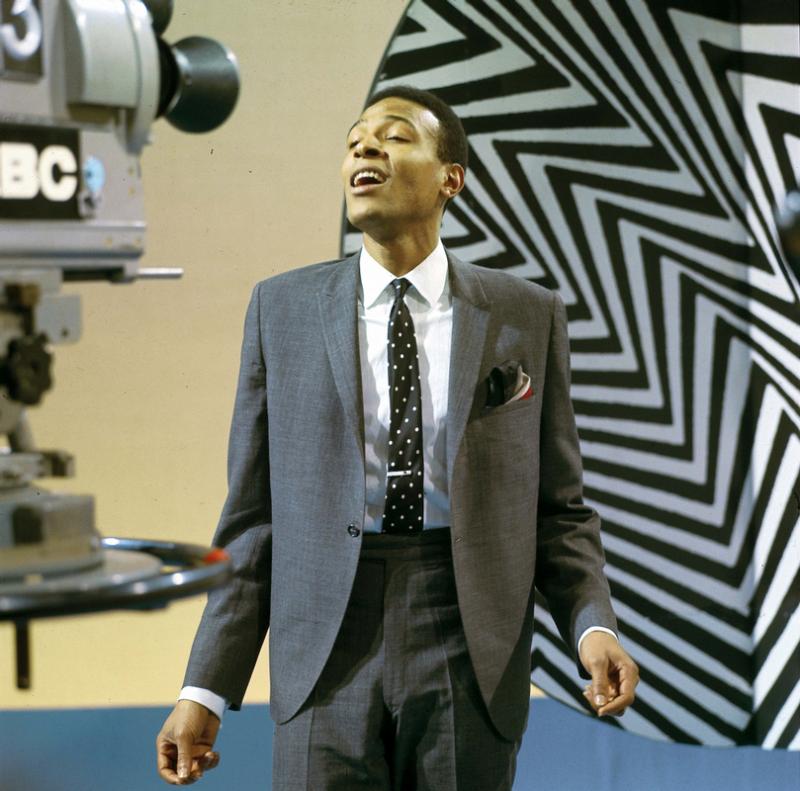
Marvin Gaye – “Pride and Joy,” Pop #10, R&B #2

The bouncy piano that opens and propels this track may be pure Chicago blues and Gaye’s singing more jazz than soul, but the backing vocals are pure Motown.

Supported by Martha and the Vandellas, Gaye reunited with Norman Whitfield and Mickey Stevenson for this jaunty ode to label boss Barry Gordy’s sister, Anna. This songwriting trio may have misfired on “Beechwood 4-5789,” but everything works here. Not only was the song Gaye’s first Top 10 hit, but Anna Gordy went on to marry Gaye. — By Joel Francis

Martha and the Vandellas – “Come and Get These Memories”

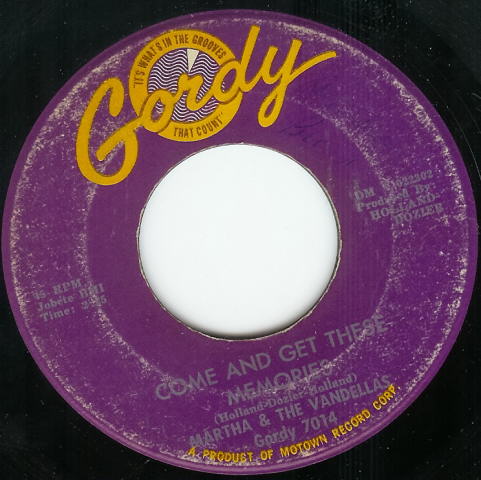
Martha and the Vandellas – “Come and Get These Memories,” Pop #29, R&B #6

“Come and Get These Memories” would be less memorable were it not the Motown debut of both singer Martha Reeves and the songwriting team of Brain Holland, Lamont Dozier and Eddie Holland.

Though Holland-Dozier-Holland would dominate both the charts and the Motown landscape during the mid-‘60s, they got off to an inauspicious start here. Reeves is confident in her delivery, but the songwriting and arrangement is tepid. Before the first minute is over we’ve heard the chorus three times and two verses. The piece sounds more like a jingle than a song at this point. The horns bop back and forth without swinging and the backing vocals of “come and get ‘em” are too peppy to convey any sense of heartbreak.

The song fares better in its second half. The horn break at the halfway mark is like flipping a light switch. The brass arrangement grows more aggressive and supportive and Martha, the Vandellas and the Motown musicians really swing through the bridge (“because of these memories/I never think of anybody but you”) that fades into the outro. It’s as if the cast has finally been given direction.

According to legend, Tom Petty and the Heartbreakers were in the studio working out the arrangement to “Breakdown,” when someone walking by in the hall recommended they move the guitar lick from the outro to the beginning. It’s a shame that no one offered similar advice here. Instead the public would have to wait five months for Martha and Holland-Dozier-Holland’s follow-up effort, “Heatwave.” They had mastered the learning curve by then. — by Joel Francis

The Miracles – “You’ve Really Got A Hold On Me”

The Miracles – “You’ve Really Got A Hold On Me” Pop #8, R&B #1

Another stone classic from the pen of Smokey Robinson. Counting his songs for Mary Wells, this is Robinson’s fourth No. 1 hit (his first song with Wells stalled at No. 2 on the R&B charts). The song was famously covered by the Beatles It continues to be popular today. Cyndi Lauper covered it in 2003 and it popped up earlier this year on actress Zooey Deschanel’s delightful album with M. Ward, “She and Him.”

It’s no surprise so many artists have been drawn to this song. The melody and backing vocal lines are strong and supportive enough that the lead singer doesn’t need a great voice to pull it off (check out Cher’s version with then-husband Gregg Allman for proof). On the other hand, good vocalists have plenty to make their own. British invasion bands loved it for the snakey guitar line that could cover missing piano and horn parts.

The Miracles have the whole package, though: Robinson’s great singing, the full complement of Motown’s Funk Brothers musician’s stable and Barry Gordy’s impeccable production. The crescendo peaks with Robinson playing off the Miracles and pleading with his woman to “hold me (please)/hold me (squeeze)/hoooold me.” This certainly wasn’t the first time backing vocalists had been used so effectively, but it is a great demonstration of the subtle creativity Robinson employed in arranging the song. It’s no wonder the Beatles were so anxious to pay tribute to their idol when they finally reached American shores a little over a year after this song was released. — By Joel Francis

Mary Wells – “Two Lovers”

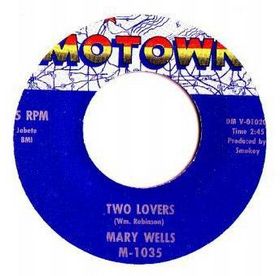
Mary Wells – “Two Lovers,” Pop #7, R&B #1

Mary Wells’ follow up to “You Beat Me to the Punch” found her back with Smokey Robinson with the same results: a No. 1 R&B hit.

This song tends to get lost in the wake of the runaway success “My Guy,” but is the most complete musical Wells/Robinson collaboration. Here the sophistication of “The One Who Really Loves You” is improved – without being overshadowed – by a great chorus. What sounds scandalous at first blush, a early ‘60s black women singing openly about having more than one lover, takes a great turn in the final verse. (I’ll leave it to you to listen to the twist for yourself.)

By this point Wells had really stepped into her own as a singer. Her double-tracked vocals are both confident and confiding, as if she’s sharing a seductive secret. Wells sounds like a woman who could not pull off having two men at once, but enjoy it. And yet, there’s some hesitation and vulnerability present as well. Wells isn’t just boasting about her love, she’s working it out in her head at the same time.

This song, along with Wells’ two other No. 1 hits, demonstrates why Wells was Motown’s first true diva and remains one of its best female vocalists. — By Joel Francis

Marvin Gaye – “Stubborn Kind of Fellow”

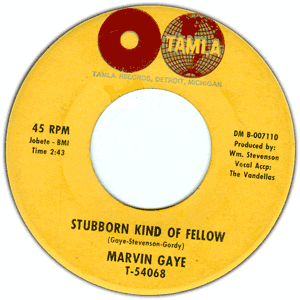
Marvin Gaye – “Stubborn Kind of Fellow,” Pop #46, R&B #8

Aside from Smokey Robinson, no one completely dominates Motown’s landscape like Marvin Gaye. Gaye’s debut album was the second record released by the label – right behind the Miracles first platter. Gaye and Robinson’s songwriting credits littered the charts until the Holland, Dozier, Holland and Whitfield, Strong teams took over. Gaye was famously married to Barry Gordy’s sister, Anna, while Robinson named his first son in honor of the label’s founder. The impact and legacy of these two men is intertwined and it is impossible to imagine the Motown empire with them.

Gaye’s initially fancied himself a Frank Sinatra-styled singer. His vocals were always smooth, but the lounge vocals have moved out front to the sidewalk. The opening drum roll and “say yeah, yeah, yeah” vocal hook immediately draw in the listener. It’s a great opening, not only for Gaye’s first major Motown solo hit, but for his amazing catalog. — By Joel Francis

Mary Wells – “You Beat Me To the Punch”

Mary Wells – “You Beat Me To the Punch,” Pop #9, R&B #1

If the Contours’ “Do You Love Me” was Motown at its most raw, “You Beat Me to the Punch” was really where the “Motown sound” started to be defined. The vibes in the background smooth all the rough edges while the bongos add an extra bounce to the melody. Backing vocals from the Love-Tones add to Mary Wells’ delivery without distracting from it and foreshadowed the relationship this song’s writer, Smokey Robinson, would have on record with The Miracles.

Wells sounded insecure in her debut single, “The One who Really Loves You,” (although the pedestrian songwriting doesn’t give her much to work with), but she nails the surprise and thrill of new love here. Smitten from the first time she saw her man, the shy girl is delighted to learn her feelings are reciprocated.

This is an underrated gem in Wells’ too-small Motown catalog. –By Joel Francis

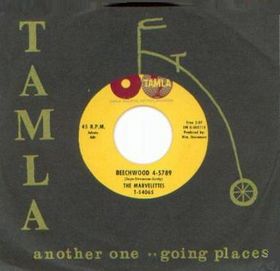
The Marvelettes – “Beechwood 4-5789”

The Marvelettes – “Beechwood 4-5789” Pop #17, R&B #7

The Marvelletes’ follow-up single wasn’t as successful as “Please Mr. Postman.” Berry Gordy hoped to cash in on the telephone song trend that included Glenn Miller’s earlier big-band hit “Pennsylvania 6-500” and Wilson Pickett’s “634-5789,” but the chorus wasn’t as strong or memorable as either of those songs or the Tommy Tutone’s ‘80s hit “Jenny (867-5309).”

Gladys Horton’s earnest lead vocals sound more desperate than inviting. Although she’s trying to sound casual, it’s clear that Horton’s request for the boy of her dreams to call her up for a date, “any old time” is her frustrated, final attempt at being noticed. While the dream date may never have phone, this number did become the most popular in America until Jenny arrived on the scene in the ‘80s.

The song was written by Marvin Gaye, Berry Gordy and musical director William “Mickey” Stevenson, who was memorialized in The Miracles’ song “Mickey’s Monkey.” Like “Please Mr. Postman,” “Beechwood 4-5789” was also covered by The Carpenters. Time has preserved the superior renderings of both of these songs. — By Joel Francis

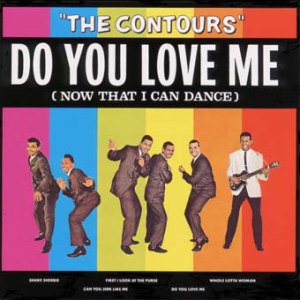
The Contours – “Do You Love Me”

The Contours – “Do You Love Me,” Pop # 3, R&B # 1

“Do You Love Me” sounds more its cross-town cousin Detroit garage rock than the Hitsville factory. Completely devoid of the “Motown sound,” this is the rawest release from the label until the signing of Rare Earth seven years later.

After the guitar accompaniment of the spoken intro, the song is all piano, drums and handclaps. The lead vocals borrow more than a little from James Brown, but the sheer joy and exuberance of everyone in the room is what carries the song. The five singers are having too much fun to care to care about love. If this woman won’t have them back, they know there are plenty more hopping in line.

Like a party that steamrolls past curfew, this song has too much energy to stop. The first attempt at shutting down is little more than a hiccup. After a false fade that fools absolutely no one, the Contours are right back in the pocket. If it weren’t for radio restrictions, this bash would have carried on all night. Ultimately, the engineer has no choice but to fade the track.

Legend has it this song was originally going to be a Temptations vehicle, but I can’t imagine anyone topping this performance. Forty-five years later, the smiles are still audible. — By Joel Francis

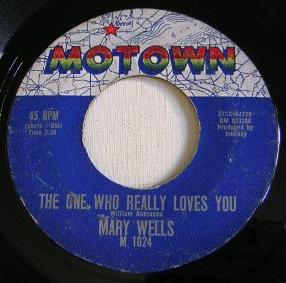
Mary Wells – “The One Who Really Loves You”

Mary Wells – “The One Who Really Loves You,” Pop # 8, R&B # 2

Mary Wells was billed as “Motown’s First Female star” but she got off to a slow start with this song. Penned by the usually reliable Smokey Robinson, “The One Who Really Loves You” suffers from overly simplistic lyrics and a melody that doesn’t try much harder. Wells’ vocals are frequently flat as she basically just calls out her smitten rivals – like Silly Lily – and points out their flaws. After listening to the song a half-dozen times, I think the singer may be exaggerating the threat of Ginnie and Minnie to steal her man, but I’ve also never been a lovelorn teenage girl. Then again, neither has Smokey Robinson.

Thankfully, while this song doesn’t work, it didn’t take long for the Robinson-Wells collaborations to click. Special note should also be made of Eddie “Bongo” Brown’s lilting percussion, supposedly inspired by the island rhythms of Harry Belafonte. — By Joel Francis

Eddie Holland – “Jamie”

index-hdh1.jpg

Eddie Holland – “Jamie,” Pop #30, R&B #6

Like Barrett Strong, who co-wrote this song, Eddie Holland was more comfortable composing than performing. He only had two hits in front of the mic, but teamed with Lamont Dozier and brother Brian Holland to pen a staggering 25 No. 1 pop hits in six years. You could call Holland-Dozier-Holland the Neptunes of their time, but the reverse is probably more accurate.

“Jamie” was a big enough hit that Motown built an self-titled album around it and dropped it in stores in late 1962. The album didn’t sell well, but Holland continued to turn out singles for the next couple years. None of them replicated enough of “Jamie”‘s chart success to warrant release of a second album. Today, all of Holland’s Motown solo material has been rounded up on the “Complete Eddie Holland” import collection. — by Joel Francis