George Clinton is bringing the funk

(Above: This song is a “Quickie” but George Clinton’s musical career as a funk pioneer has encompassed more than five decades.)

By Joel Francis
The Kansas City Star

If James Brown cleared the road from soul to funk, then George Clinton paved it.The link between the two is undeniable, not only in the style of music Brown and Clinton created, but because they used many of the same artists to create that music, and because Clinton modeled his P-Funk empire in part on Brown’s business blueprint.

Clinton and Parliament-Funkadelic, which includes his longtime drummer Frank “Kash” Waddy, play Crossroads, 417 E. 18th St., on Wednesday with 4 Fried Chickens and a Coke and Browntown.

The Godfather of Soul

George Clinton’s first impression of James Brown was not favorable.

“Back then, in my Motown days, we used to criticize him, until we knew better,” Clinton said of his days in the mid-’60s as a songwriter at the legendary Detroit label. “At Motown, we specialized in lyrics. Berry (Gordy, Motown’s president) made sure we got a story out of every song.”

Brown’s storytelling skills didn’t measure up to Hitsville U.S.A.’s standards.

“Everyone thought James wasn’t saying anything,” Clinton said. “It wasn’t until hip hop came along that we realized James was saying more in one ‘unh’ than all of our stories combined.”

Clinton left Motown and started a doo-wop group called The Parliaments. When The Parliaments record label folded, their backing band, The Funkadelics stepped into the spotlight. Funkadelic ushered in the 1970s with an aggressive blend of Jimi Hendrix, Sly Stone and James Brown.

While Clinton was tinkering with the formation of Funkadelic, Brown was turning America on to hard funk and inspiring countless imitators.

“Bootsy Collins, his brother Catfish and I all grew up in Cincinnati together playing music,” said Frank “Kash” Waddy. “Back then, every town would have a group that tried to sound like James Brown. We’d come up with false IDs, draw moustaches on our faces, wear sunglasses and a shirt and tie — anything to try to look as manly as possible so we could sneak into bars and play.”

The mid-adolescent trio of Bootsy on bass, Catfish on guitar and Waddy on drums did well enough on regional tours and local shows to eventually attract the attention of The Godfather himself.

“Little by little James got word of us and he’d come and sit in on our shows. That was some major validation,” Waddy said. “Really he was prepping us for if he needed us to join his band, but we didn’t know because we were totally naïve.”

After sitting in on studio sessions and short tours with Hank Ballard, Arthur Prysock and other artists on Brown’s King record label, Waddy and the Collins brothers got the call to join James himself onstage.

“It all happened so fast. He start by calling off a song and a key and count off,” Waddy said. “Since I was behind the drums I could see the whole scene. Bootsy and Catfish were bunched up by me. Kush (trumpet player Richard Thompson), Strawberry and (saxophonist) Pee Wee Ellis — all guys we idolized — were onstage with us, and in front was the biggest crowd we’d seen. We were scared out of our minds.”

Brown formed the original lineup of The J.B.s around those musicians and for the next couple years, Kash, Bootsy and Catfish toured the world with Brown.

“It was a good two months that we went around pinching ourselves, because we went from nothing to James Brown,” Waddy said. “James Brown had hotels. He was so powerful it was unbelievable. He had his own radio stations and record label.”

Brown had built a vertically integrated empire of recording, publishing, airplay and promotion, but he didn’t have everything.

“We got to looking at the guys who were with James all the time, and they all seemed to be kind of depressed,” Waddy said. “We didn’t understand it, but it wouldn’t be nothing to see a grown man cry or be upset, and James would keep them like that. I began to realize there was not happiness at the end of this rainbow.”

In 1971, the Cincinnati trio bolted from Brown and formed The Houseguests, a band whose sound was constantly being compared to Funkadelic’s.

“We had never heard Funkadelic before, but one night in Detriot we were playing on a bill between Funkadelic and Gladys Knight,” Waddy said. “George heard us that night and hired the whole band. The rest is history.”

The Hardest Working Man In Show Business

Recruiting Brown’s old rhythm section opened the door for more defections, as Fred Wesley, Maceo Parker and others eventually joined the Funkadelic family.

“At one time, we had all of James Brown’s band with us,” Clinton said through a laugh. “Working with James was something they’d complain about and idolize at the same time. You had to be the best in the world to be with James, because coming out of it almost any of those guys could run their own organization.”

Freed from the militaristic management of Brown, Clinton’s band was a playground for Brown’s former musicians.

“We left such a regimented, staunch environment with James, and got total freedom from George,” Waddy said. “It was a happy medium. We brought professional discipline and introduced George to The One (Brown’s style of emphasizing the one beat in his grooves).”

Clinton didn’t manage, he made sure shows were lined up, studio time was available and let the results speak for themselves.

“Man, I just got onstage and let them play what they wanted to play,” Clinton said. “Personality-wise I’d just let them be the bandleaders and tell them what I wanted.”

Building on the Motown model and Brown’s King label, and foreshadowing Prince’s Paisley Park empire, Clinton let his musicians front their own outfits under his production and input. Fred Wesley and Maceo Parker led the Horny Horns, while Waddy and Catfish became core members of Bootsy’s Rubber Band. Other Clinton combos included The Parlets, The Brides of Funkenstien and Parliament, a happier, dance-friendly outlet for the Funkadelic musicians.

“We had a whole studio in Detroit called United Sounds to ourselves,” Waddy said. “We weren’t told you work on this and you work on this. You’d just go in, listen to a track and jump in if you could. George would come in and listen and might give one cut to the Horny Horns, another to the Rubber Band. Sometimes we’d go in and wouldn’t see daylight for three days.”

By the end of the decade, nearly all of Clinton’s bands were dominating dance floors and concert stages across the country. The ripple effect of that music was inescapable from the onslaught of imitators trying to capture that sound and feeling.

“For us funk was a way of life,” Waddy said. “We wouldn’t listen to TV or the radio because we didn’t want our stuff to be tainted. That’s why these songs have stood the test of time; they weren’t a fad, they were a way of life.”

Soul Brother No. 1

Clinton first got the idea for the mothership watching Lt. Uhura on an episode of Star Trek.

“I was thinking about putting black people where folks wouldn’t picture them. That’s why I got the idea of a spaceship with me sitting outside like a pimp mobile,” Clinton said. “Once Parliament got a hit record with ‘Up for the Downstroke,’ I took the royalty money and bought a spaceship. I wanted to do something big onstage like Sgt. Pepper or The Who’s Tommy.”

With the Brides of Funkenstien, The Parlets and Bootsy’s Rubber Band opening the show and everyone onstage for Parliament-Funkadelic’s set, Clinton set the new standard for stage performances.

“It changed the whole industry, because prior to us it was all three-piece suits with bass, guitar and an amp. Black guys would try to get by with as little as possible to keep overhead low,” Waddy said. “Now after us, all acts had to invest to compete.”

The stage wasn’t the only place Clinton was reinventing music.

“Our language was street talk,” Clinton said. “At the time black DJs with personalities were on the way out for Quiet Storm. We became our own DJs on our records and made that the standard. After that, DJs in the club started doing the same thing. Give yourself a few more years and artists were doing it over records, which became hip hop.”

There’s not much subtlety in the Clinton catalog, but the political content of his lyrics are a consistently understated element.

“I never wanted to write about boy/girl, black/white issues. I wanted to keep it vague, Clinton said. “I always avoided strict interpretations of politics, because I thought if people got caught up in that, the political winds were libel to change and people would just end up fighting against a particular stance.”

There are brains behind the bounce on songs like “Chocolate City” and “Think, It Ain’t Illegal Yet.”

“I applaud George, because he was always reading and wanting to teach. Issues we’re talking about today, like cloning, we talked about 30 years ago on ‘Placebo Syndrome’ when they were not mentioned,” Waddy said. “Politically, George was East Coast and James was Southern. James was just a dead hit with his lyrics. George was a little slicked up, more coy.”

Mr. Dynamite

Despite all his success and innovation, shortly after the 1980s dawned, Clinton and his bands found themselves without record contracts.

“One or two somebodies orchestrated all the negotiations with the labels in 1980,” Clinton said. “I didn’t think they’d throw us to the curb that quickly with all our hit records, and it all stopped at the exact same time I started Uncle Jam records.”

Clinton likened his experience to what happened to Prince in the early ’90s and revealed, “we’re just starting to get into the courts to see those papers and see what really happened, and I promise the full story will come out soon.”

“A lot of people say we got high and used up all our money on drugs,” Clinton said with a laugh. “It’s not true. We hadn’t gotten paid yet!”

Clinton had some success, but several of his musicians drifted away. Fortunately, for every musician who left, seemingly 10 rappers discovered the P-Funk sound. Clinton’s songs, along with Brown’s, are the most sampled in hip hop.

“Hip hop kept funk alive,” Clinton said. “I made a relationship with the artists, that instead of fighting them, I kept them close to me. Our records are like James Brown’s – they never get old.”

The proliferation of Clinton samples kept his catalog fresh. Even if listeners had never heard a P-Funk song, they probably knew “The Humpty Dance,” which relies on Clinton’s “Let’s Play House,” “Me, Myself and I,” which uses “(Not Just) Knee Deep” or any number of songs that liberally borrow “Atomic Dog.”

“We’ve been traveling around and playing so long that live music has caught back on,” Waddy said. “People don’t want to hear music from sequencers anymore. They want to hear live instrumentation and be entertained. Our crowds range from high schoolers to middle aged people.”

Or as Clinton puts it: “The charts don’t mean near as much anymore once you have a following.”

Today Clinton has a reality TV show in the works, a new record label, a reputation as a great live act and when Brown died on Christmas Day, claim to being the biggest living link to the funk era.

“There’s a lot of James Brown in our music, but it’s not only James Brown. We’ve got Motown and Jimi and Sly Stone and Ray Charles,” Clinton said. “There’s always so much of that stuff built into our music that by the time it got there, it was hard to pick out just one thing.”

Waddy, who is working on a book about his times with Brown and Clinton, is less modest.

“In my mind, James and George were nose and nose for years, but James always had a bit more of the edge because of seniority,” Waddy said. “Now that James is gone, George is the man. People are feeling it without realizing it. The public always has to have their guy, and right now George is on top of the heap.”

Keep Reading:

Concert review: George Clinton (2007)

Concert Review: George Clinton, May 6, 2005 at the Beaumont Club

Concert Review: George Clinton heats up cold night

Review: George Clinton and the P-Funk All-Stars (2009)

Concert review: Toots and the Maytals

toots-and-the-maytals

The Kansas City Star

By Joel Francis

Toots and the Maytals rocked the Folly Theatre with a righteous rain of reggae in what has to be the first-ever Easter Saturday sunset service.

Toots Hibbert, his five-piece band and two female singers testified for two hours with the union of gospel and soul converted into groundbreaking reggae that had the near-capacity crowd dancing in the aisles, clapping on command and reveling in the spirit.

They didn’t waste any time getting to the good stuff. The opener, “Pressure Drop,” steamrolled right into classics like “Time Tough,” “Sweet and Dandy” and “Pump and Pride.”

Hibbert worked the crowd with the fervor of an evangelist with his energetic delivery and call and responses. The show was the fourth installment of “Cypress Avenue Live at the Folly,” and was its most successful to date.

The entire evening was a delight, but the highlights were a cover of “Country Roads Take Me Home,” and “54-46 Was My Number,” the final song of the night. The gospel moments, like the intro to “Country Roads Take Me Home” and the spiritual medley near the end of the main set had everyone singing, dancing and testifying.

The only blemish on an otherwise inspired evening was that Hibbert’s voice was difficult to hear all night. Shouts of “turn it up” resonated from the balcony, there was little the sound engineer could do to make Hibbert hold his microphone above chest level.

That his mic captured as much as it did is a testament to Hibbert’s powerful delivery. Before the show, one person mused how the show would work at the Folly, a space with limited room for dancing. He thought the Maytals were better suited for a venue like the Uptown.

He may have been right, but the staid surroundings didn’t stop anyone from having a great time. If they didn’t make it up in time for Easter services, one might understand: They’d already been taken to church.

Set list: Pressure Drop; Time Tough; Sweet and Dandy; Reggae Got Soul; Pump and Pride; Never Get Weary Yet; Bam Bam; Peeping Tom; Broadway Jungle; Country Roads (Take Me Home); Funky Kingston; True Love Is Hard To Find; Treat Me Good; Medley: It Was Written Down/Shining Light/Amen; Monkey Man. Encores: Love Gonna Walk Out On Me; Roots, Rock Reggae (jam); 54-46 Was My Number.

Broken Teeth bites on more metal

(Above: Metal band Broken Teeth roll over.)

Road warriors have heavy therapy to dish out Monday at the Hurricane.

By Joel Francis
The Kansas City Star

“If you’re going to be into something, be into it to the death,” said Jason McMaster, singer and songwriter for the hard rock band Broken Teeth.

If anyone should know, it’s McMaster, a self-proclaimed “heavy metal kid at heart” who, when growing up, bought the entire catalogs of his favorite bands.

“Heavy metal fans are like a ninja or samurai. It’s something you’re born into,” McMaster said. “It’s not like one day you decide, ‘This isn’t working for me, I’m going to try something else.’ ”

Talk about knowing your clientele.

“That kid at school with black fingernails, dyed hair wearing a Motorhead T-shirt … those are my people,” McMaster said. “That’s who I’m talking to.”

It is evident in his speech, which is peppered with references to Judas Priest, Kiss and AC/DC and quotes Lemmy, that he was — and still is — one of those kids.

If that’s the case then think of Monday at the Hurricane as a sort of group therapy. That’s when McMaster and Broken Teeth will serve an adult slab of hard rock for those who love it loud.

“People should realize we’re not just heavy metal. I call it hard rock,” McMaster said. “There are people who like country music who are into Broken Teeth. Some people who like Slayer are into Broken Teeth.”

And like a lot of metal fans, Broken Teeth fans tend to be fanatics.

“A lot of our fans overseas have every record by their favorite band. That says something about rock fans,” McMaster said. “There sure were a lot of records I bought and liked at one time or another. I tried to do my homework. If I was into it, I was into it.”

The music he was “into” comes through loud and clear in Broken Teeth: the classic metal sound cultivated after 1975.

“ ’75 is a good place to start: Deep Purple, Motorhead, (Judas) Priest and the like,” he said. “You can hear our style in all of those bands. I think it’s important to let our influences shine. Those ingredients all come out when we’re writing. It’s a big soup.”

McMaster has been writing a lot lately with his band mates: guitarists Jared Tuten and Dave Beeson, bass player Brett McCormick and drummer Bruce Rivers.

“We played 115 shows in 2006,” McMaster said. “We write on the road. When something’s good, I can say, ‘Hey, guys, come listen to this.’ It’s one more reason to stay out on tour.”

Broken Teeth haven’t released a new album since 2004 and haven’t pushed a new studio album since 2002, but all that’s about to change.

“We finally got some good distribution for our album coming out this spring,” McMaster said. “That one will be half old songs and half new stuff, because a lot of people are going to discover Broken Teeth for the first time with this.”

If older fans decide to take a pass on this album, McMaster said, they won’t have to wait long for the next one.

“Now the new material is what we’re really excited about,” McMaster said. “That’s all we talk about. That album (of all new material) may come out in late ’07.”

Top 10 Albums of 2006

Game Theory – The Roots
The Boxing Mirror – Alejandro Escovedo
The Obliterati – Mission of Burma
St. Elsewhere – Gnarls Barkley
Fox Brings the Confessor – Neko Case
Fishscales – Ghostface Killah
Return to Cookie Mountian – TV on the Radio
In the Pines – In the Pines
Begin to Hope – Regina Spektor
Modern Times – Bob Dylan

On its new record, the new Saliva passes the taste test

Metal band has new guitarist and a new album to share.

By Joel Francis
The Kansas City Star

Local Saliva fans will get their stockings stuffed early this year.

Its new album won’t be in stores until January, but the hard-rock band will preview material at its concert Friday at the Uptown Theater.

“This tour is awesome because we get to test the waters and see what reaction we get (from the new material),” said Saliva drummer Paul Crosby. “They (the fans) are all singing every word to ‘Ladies and Gentleman,’ which has only been on the radio for a month.”

Saliva has been opening its concerts with another new song, “Black Sheep.”

“ ‘Black Sheep’ is a great start to the show because it has a great groove and it’s heavy,” Crosby said. “We’re only playing two new songs in the set, but the fans seem to be liking them.”

Crosby describes Saliva’s new album, “Blood Stained Love Story,” as an amalgamation of the band’s first three albums.

“It’s like all our records combined into one, but better,” Crosby said. “If you liked anything about any of the others, you’ll like something on this one.”

Few of the tracks display the nu-metal trend that Saliva rode onto the airwaves a decade ago.

“Our songs now are more towards straight-ahead rock than (a) hip-hop orientation,” Crosby said. “If you listen to our three records, it’s obvious how we’ve changed.”

Some of those true-life changes — marriages, births, divorces — were expected. The abrupt exit of longtime guitarist Chris Dabaldo last summer, was not.

“Considering how I was driving down the road, and the DJ came on (the radio) and said, ‘Chris Dabaldo has quit,’ I guess you could say it was shocking,” Crosby said. “I pulled over and called everyone else in the band; nobody saw it coming.”

He’s excited, however, about the band that emerged after Dabaldo’s defection: Crosby, singer Josey Scott, guitarist Wayne Swinny, bassist Dave Novotny and new guitarist Jon Montoya.

“Chris’ leaving definitely didn’t hurt us. It seemed to make us a stronger band,” Crosby said energetically. “Jonathan Montoya came to us from Full Devil Jacket. He’s a better player and entertainer. Our shows are now better, and our sound is now better.”

And while new material is sprinkled in the set, the new version of Saliva also plays old favorites, from the early swagger of “Your Disease” to the straightforward rock of “Rest in Pieces.”

“It’s totally fun. They’re still there in our set,” Crosby said. “We’ve written a lot of different kinds of songs, which makes it more fun for me. I’m not just playing the same style all night.”

The versatility of songwriting styles may explain why Saliva can still draw a decent crowd when many of its nu-metal contemporaries are struggling.

“Most bands only get one or two (albums); this is our fourth,” Crosby said. “I believed in this band from the beginning. I could tell from being in other bands that everybody here had that mindset and wanted it.”

That determination has served the band well the last decade.

“It’s all up to the fans, but I really don’t know why we’ve lasted,” Crosby admitted. “I like to think it’s because of the good music we write. We have evolved and grown a lot. There’s a natural progression. We’re more mature and older.”

Rising beyond stereo

Quartet is cooking up a four-way sound experience.

Kansas City Star

By Joel Francis

Justin Timberlake may be bringing sexy back, but the jam band the Disco Biscuits is retrieving a relic of the ’70s.

“Quadrophonic sound hasn’t been popular in many years, but we’re going to bring it back,” said Biscuits singer, guitarist and songwriter Jon Gutwillig. “Roger Waters came through town, and he did it, because he’s from the ’70s. Our keyboard player went to the show and said, ‘Why don’t we?’ It turns out it’s not that hard.”

But the antique-cum-cutting-edge sound system won’t be debuted until the Biscuits’ New Year’s Eve show in Philadelphia. Fans who show up on Friday to hear the band play the Granada in Lawrence will have to settle for two-channel, stereo sound.

“We keep getting bigger, and I don’t understand it. Every time we go back to your town, we’re bigger than the last time we were there,” Gutwillig said. “It makes us feel like we’re moving in the right direction.”

One reason for the unexpected success might be the following the quartet has built and the availability of most of their shows, bootlegged or otherwise.

“We were playing in Pittsburgh the other night, and I looked at the crowd and thought to myself, ‘I’ve never seen these people in my life,’ ” Gutwillig said. “But it was very real. They knew our music, knew the band members and knew our style. They learned about us the old-fashioned way: They got bootlegs from their older brother, the same way I did.”

If brother can’t provide, the band certainly can. Many of the band’s performances are recorded and available for sale on their Web site, http://www.discobiscuits.com. With no label, pressing, packaging and distribution costs involved, the Biscuits — made up of Gutwillig, bass player Marc Brownstein, drummer Allen Aucoin and keyboard player Aron Magner — are able to reinvest the majority of the earnings.

“The downloading has been incredibly successful. It’s afforded us the opportunity to spend money to improve the quality considerably,” Gutwillig said.

Online shows used to come from a DAT machine on the soundboard. Now the shows are picked up by microphones onstage, in the audience and on the board.

“The sound is as good as show boots have ever sounded. We can produce a high-quality concert recording in less than two hours,” Gutwillig said. “We try to have a show on the Net as quickly as possible without it sounding bad.”

Since the Biscuits keep all of their songs in their performance repertoire, the archives give fans instant access to the entire catalog.

“When I was a kid into Phish, I’d hear this song, (and) I had no idea what it was. It would take me a month to find out,” Gutwillig said. “Now I could learn how to play that song from tape 10 hours after I heard it. Everything is quick and hard-core now. You’re not waiting for something to come in the mail.”

A lot of the Disco Biscuit’s universe has accelerated since the band’s inception on the University of Pennsylvania campus in the mid-’90s.

“I used to walk around a public school singing songs into a voice recorder. I got a lot of great songs that way,” Gutwillig said.

“Making time now to write music is definitely an issue. Now I write faster, but there’s less time. I used to have all the time in the world, nothing going on. Now it seems I have to leave the country for a few months to get anything done, which I’m thinking about doing.”

Hail Death Cab

Expect a ‘faster and louder’ show at the Bleeding Kansas Festival.
Cover story, August 03, 2006

By Joel Francis
The Kanas City Star

Elvis Costello, Atlantic Records, Franz Ferdinand and Lollapalooza have at least one thing in common: Death Cab for Cutie.
The Seattle band had been building a loyal fan base since 1998 when last year it signed to Atlantic Records and released the album “Plans.” The fans rejoiced when the big label association didn’t alter the music. In fact, the band wasn’t done pushing its core conceptions.
“We knew full well when we signed (with Atlantic) that we didn’t have to,” said keyboard player, guitarist and producer Chris Walla. “If they didn’t give us what we wanted, they wouldn’t get us. What we wanted was to be able to do exactly what we were doing but with more resources and access to people.”
Walla and the rest of the band — singer, guitarist and chief songwriter Ben Gibbard, bassist Nick Harmer and drummer Jason McGerr — are headlining the Bleeding Kansas Arts & Music Festival at Burcham Park in Lawrence on Saturday. The steamy outdoor setting isn’t ideal for “Plans,” an album best suited for rainy afternoons indoors.
“We’re not performancy performers. There are no rock-star moves or laser shows,” Walla said. “Festivals are difficult for us because there are so many ‘X’ factors. We just turn it up and play faster and louder than we would otherwise.”
The more popular Death Cab gets, however, the more it plays in places that serve thousands of fans than it does intimate clubs. In June, Death Cab played Bonnaroo; Friday the band plays Lollapalooza in Chicago. In both places, Walla said, the band will adjust.
“It’s a different mind-set,” he said. “The whole performance from the stage keeps having to get bigger and bigger to reach the back of the places we’re playing.”
That’s not the only adjustment fans have had to make. It recently toured with Franz Ferdinand, whose frenetic disco rock is the complete opposite of Death Cab’s introspective, mellow sound.
“It was an exercise in counterpoint,” Walla said. “Franz could go out with American Hi-Fi or the Arctic Monkeys, but how much of one thing do you need?”
The bands were already mutual fans and quickly embraced the idea, alternating opening and closing nights.
“If we were the first band up that night, we’d start big, but if Franz would open then we’d start out super quiet,” Walla said. “We bring it back as far as we could. To highlight and contrast (the two bands) just seemed to be the thing to do.”
Death Cab recently performed with Elvis Costello for VH1’s televised “Legends” concert.
“It was especially exciting for me because Elvis Costello, Talking Heads and the first few XTC albums are my bread and butter,” Walla said. “It was difficult to find a song that made sense to us and that we could play (with Costello). It would be completely inappropriate for us to play anything from ‘This Year’s Model.’ I wanted to play ‘Peace in Our Time,’ but it didn’t work out.”
In the end, “Accidents Will Happen” and “Kinder Murder” won out.
So what are the consequences of all this mingling with strange bedfellows and playing huge festivals?
“Our musical direction right now is pretty static,” he said. “We’re just playing shows. There are no new songs or decisions about the next record.”
For a band that has been as adventurous as Death Cab has been lately, static is a new direction.

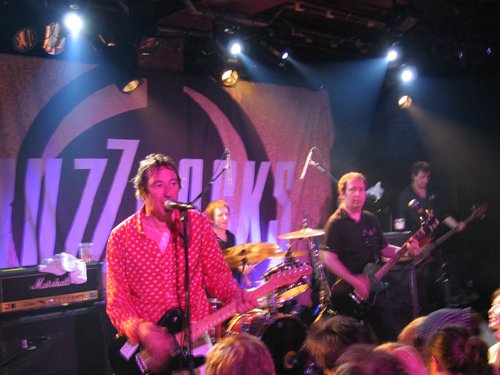
Ever Fallen For The Buzzcocks?


Buzzcocks 2006First-gen Brit punk band is an inspiration to groups that follow.

Kansas City Star

By Joel Francis

It’s hard to keep a band together for 30 years.
It’s even harder to stay relevant for that long. But to achieve both and outlast contemporaries like the Sex Pistols, The Clash and the Damned – the original families of the British punk movement – is a rock ‘n’ roll hat trick.
“It’s strange to think that we’re the last gang in town. Funny how that works,” Steve Diggle, the Buzzcocks’ guitarist and singer. “Our inspiration is still to write good songs, and it’s still possible for us to do that. People – the younger people now, which surprises me a bit – still want to see us and that’s what keeps us going.”
The band’s durability has not gone unnoticed.
“We just got Mojo magazine’s Inspiration Award,” Diggle said. “I’m not big into awards but I think this one sums it up, rather than saying ‘lifetime achievement’ or something.”
Diggle may not be big into awards because, as he later revealed, this was the first one the band has received.
“We’ve never won an award in our life, but this is a good one to have,” Diggle said. “It was hard to accept without freaking out a bit because Elton John was there saying ‘I love the Buzzcocks.’”
John, who was being inducted into Mojo’s Hall of Fame, also said he’s had a ball performing the Buzzcock’s classic “Ever Fallen in Love.”
The Buzzcocks formed in Manchester in 1975. Singer/guitarist Pete Shelley, the other longest-tenured member of the band, met Diggle at a Sex Pistols show and asked him to be the band’s bass player.
“In Britain at that time music was stale all around us. It was all progressive rock bands, but there was no music for our generation,” Diggle said. “We made the most uncommercial music possible, with rough guitars and weird mixes.”
After a series of artistically successfully/commercially dismal singles and albums the band broke up. Foreshadowing the current reunion trend by nearly a generation, the classic Buzzcocks lineup regrouped in 1989.
“It was supposed to be a two-week tour of America, because there was no farewell tour before,” Diggle said, explaining why the band regrouped. “From my point of view, me and Pete were getting on and things were cooking between us.”
Shelley and Diggle permanently returned the Buzzcocks to the music scene in 1990, when bass player and producer Tony Barber and drummer Phil Barker were hired. The quartet has played twice as long as the original incarnation.
“You know on the first day if it’s a good decision” to reunite, Diggle said. “You have to have your head on straight, be realistic and analyze it. Is it as good?
If a band can’t perform as good, if not better, than it did before, there’s no point in getting back together, Diggle said.
Music had changed a lot in the Buzzcocks’ absence. Punk had given way to a new wave on the carts and hardcore in the underground.
“In some ways everyone is a punk rocker now. (Punk) is a long way from what we started,” Diggle said. “These new bands have taken the works of Shakespeare and put on a play. What they’ve done is make it entertainment.”
Far from being bitter, Diggle is happy to headline the Warped Festival and share the bill with so many younger bands.
“I’m not knocking them completely,” Diggle continued, “but they’re a few yards, or maybe 200 miles, away from what we do.”

You Want Moe Jams, You’ve Got Moe Jams

May 3rd, 2006

Fans appreciate band making its music assessable to them.

Kansas City Star

By Joel Francis

Jam band.
The words evoke images of tie dyed clothing, long hair, VW vans and the aroma of perspiration and smoke.
Yet despite its improvisational and organic nature, the genre is diverse and its fans are committed.
Take Moe, the upstate New York quintet.
“One thing I’ve discovered is that people don’t come to our shows by accident,” guitarist Al Schnier said. “If you show up, you’ve meant to be there. Either you’re a fan, or a friend goaded you into coming, or you heard our music.”
Some of those conscientious first-timers are likely to be surprised by what they hear. The twin-guitar attack of Schnier and Chuck Garvey owes just as much to Eddie Van Halen as it does Duane Allman.
“The thing about the jam band scene is that there’s a wide spectrum of music,” Schnier said. “The Yonder Mountain String Band are essentially a bluegrass band, but they put on a long show that stretches out and is definitely not the traditional bluegrass structure. Then there’s the Disco Biscuits, who incorporate progressive rock, classical and electronica into their shows and music. And yet both are jam bands.”
Keeping fans in the fold is vital to a band that tours hard and makes records sparingly. Moe hasn’t yet released a follow-up to 2003’s “Wormwood.”
“Going into the studio is still something we struggle with,” Schnier said. “I’m not sure it makes sense financially. After 15 years, we’ll get some … radio play, but I don’t expect us to cross over into the mainstream. We can’t afford to pay radio enough to play our records.”
So on its Web site, the band states that “audience taping is highly recommended at all times.” Those live recordings give fans some new material to listen to, but even Schnier admits: “My favorite things to listen to are not live albums but studio recordings: ‘OK Computer’ or Abbey Road’.”
Moe returned to the studio not once, but twice this year. Early recording sessions resulted in “vague, lifeless versions” of songs the band first presented long ago in concert. So the band returned, “deconstructed the songs and exploited the studio,” Schnier said.
With one studio album in the can and a live DVD planned for fall release, new songs are floating around.
“We’re geared up to do a studio album of new material, which we can take out and premier live like a traditional band does,” Schnier said,. “We constantly have material. It’s a matter of scheduling it in. The other side of being in a jam band is that you’re always on tour.”
Fans will support what the radio won’t, provided they always have an outlet to tap into.
“You have to hit as many markets as possible with frequency,” Schnier said. “Make shows as reasonably close together as possible so people can come two nights in a row if they want.”
But if fans are encouraged to follow the band, they need variety.
“The same show every night doesn’t work. People won’t come,” Schnier said. “So you have to be willing to take chances onstage. And it follows suit that you’d better have a semi-decent grasp on an instrument to pull it off.”
Just as important is the relationship between band and fans, he said. Before there was Myspace or even the Internet, Moe gave away its music.
“If people came with a blank tape, we would give them a copy of a prerecorded show,” Schnier said. “The (record) industry doesn’t get it. If you make yourselves available, fans will build a lifelong relationship.”

Concert Review: Dinosaur Jr April 13 at Liberty Hall

Dinosaur Jr

By Joel Francis
The Kansas City Star

There’s just no pleasing some people.
Faced with the opportunity to see the original lineup of Dinosaur Jr perform for the first time in 18 years, some morons would rather throw trash onstage and heckle the band.
Fifty minutes into the band’s set and partway into the song “Sludgefeast,” singer and guitarist J Mascis angrily knocked his mic stand over and threw his guitar to the ground while he walked offstage. The rest of the band – bass player Lou Barlow and drummer Murph – followed, leaving the audience to piece together what happened: someone hit Mascis’ mic stand while he was singing, and the microphone hit him in the mouth.
Mascis confirmed that when the trio returned a few minutes later.
“Sorry about that. I just didn’t want to lose my teeth,” he said as the band assaulted the song “Kracked,” which led into “Freak Scene,” which merged into “Chunks.”
The trio had been playing well before impromptu break in the show; when they returned to the stage, they played even louder, more aggressively and, well, better.
They soon left again. Most of the fans used this time to coax them back out for an encore; but someone started throwing trash onstage. He was escorted out.
After two rushed numbers, including a cover of “Just Like Heaven,” Dinosar Jr left for good. They had been onstage for 75 minutes.
The evening started more promisingly. After nearly two decades of fighting and bitterness, all seemed forgiven and forgotten when Barlow and Mascis traded stanzas on the opening number, “Gargoyle.”_The band and its material, which drew almost exclusively from its first three albums, sounded astonishingly fresh, especially when they stretched out on “Forget the Swan” and “Bulbs of Passion.”
The unlikelihood of this reunion was not lost on the crowd, many of whom were too young to have seen the band the first time around. The show wasn’t sold out, but almost everyone seemed delighted and appreciative of anything played for them – almost everyone. It’s a shame a couple jerks had to interrupt the evening for everyone.

Setlist: Gargoyle, Tarpit, No Bones, the Wagon, Forget the Swan, Bulbs of Passion, the Lung, Little Furry Things, Lose, In A Jar, Sludgefeast (aborted), Kracked, Freak Scene, Chunks. Encore: Just Like Heaven (The Cure cover), Mountain Man

Keep Reading:

Out of the Tar Pit Back Onto the Stage

Dinosaur Jr Sets High Bar For Reunion Albums