Review: Roy Ayers, the Impressions

(Above: Roy Ayers dedicates “Everybody Loves the Sunshine” to Miles Davis.)

By Joel Francis
The Kansas City Star

Before James Brown was black and proud and Marvin Gaye asked what’s going on, the Impressions were a winner who got people ready for the train a-comin’.

The Impressions message of racial harmony and black empowerment laid the roots for the black pride movement in soul and the native tongues/backpacker strain of hip hop today. The soul trio’s performance Saturday at the 40 Acres and a Mule Activity Campus in southeast Kansas City, Mo. capped the first day of the Juneteenth Family Festival, which celebrates the end of slavery in America.

Taking the stage in matching white suits, the Impressions quickly touched the sky with “Move On Up,” a song that established their leader and songwriter Curtis Mayfield as a solo artist. Although the set bounced between Impressions and Mayfield material, the songs were rooted in Mayfield’s late ‘60s/early ‘70s prime.

“Choice of Colors” felt like a hymn and was followed by the buoyant “We’re A Winner,” which got a healthy portion of the crowd of 300 clapping or on their feet. Impression Reggie Torian donned a black cape and white hat while the bass thumped the familiar melody to “Superfly.”

Torian had the unenviable job of taking Mayfield’s place. Although Mayfield, who died 10 years ago, will never be replaced, Torian did a good job capturing Mayfield’s rich falsetto on “I’m So Proud” and “I Loved and Lost.”

In an age of reunion bands and acts carrying on with only one original member, it would be easy to dismiss the Impressions as a Mayfield tribute act. Fortunately, the singers flanking Torian onstage are Fred Cash and Sam Gooden,  the very people who sang, toured and recorded alongside Mayfield back in the day.

Backed by a seven-piece band that included a nearly obscured three-piece horn section, the Impressions were swinging through “Woman’s Got Soul” when a 40 Acres staff member came onstage. Confused, the band ended the song and announced that it was time for them to go.  Ending with a rushed version of “It’s Alright,” they departed 40 minutes after taking the stage.

The Impressions’ set was likely cut short because Roy Ayers’ ran long.  Ayers immediately preceded the Impressions, and while he made his name blurring the lines between jazz and funk in the early ‘70s, his 70 minute set concentrated on the slick R&B that made him a radio staple in the last half of the decade.

Backed by the local octet Ronnie Reed and the Millennium, Ayers took the stage halfway through a jam based on the JB’s “Pass the Peas” and quickly showed why he’s been the go-to guy for everyone from the Roots to Fela Kuti.

Ayers’ playing is at once funky and smooth. His approach to the vibraphone renders it a sonic mutant of drums, piano and guitar. His solos were so captivating that they rendered Millennium’s horn players irrelevant. As Ayers’ hammered away backed by the bare minimum of a groove, the suddenly extraneous horn section were relegated to synchronized dancing duty.

After an instrumental introduction, Ayers took over the mic and romped through four crowd pleasers. “Everybody Loves the Sun” drew many to their feet and Ayers got the rest involved by leading them through the lyrics. “Running Away” stayed in the same vein and featured a lengthy trumpet solo. Ayers was gracious in letting everyone in Millennium take long solos throughout the night.

Ayers ended his set walking through the crowd personally giving out free copies of his new live album. It seemed generous at the time, but ended up being an exchange of live music for recorded. Although the Impressions seemed ready to give more, no one was complaining either.

Setlists:
The Impressions – Move On Up; Mighty Mighty (Spade and Whitey); Choice of Colors; We’re A Winner; Superfly; I Loved and Lost; Gypsy Woman; I’m So Proud; Woman’s Got Soul; It’s Alright

Roy Ayers – Pass the Peas; Everybody Loves the Sunshine; Running Away; Don’t Stop the Feeling; Searching

Review: Sly and Robbie

(Above: Sly and Robbie drop heavy riddim at Red Rocks in 2008.)

By Joel Francis
The Kansas City Star

If Robbie Shakespeare’s job as a musician fizzles, he could probably make a living bringing down buildings. Alongside rhythm partner Sly Dunbar, Shakespeare’s bass rattled the foundations of the Folly Theater for nearly two hours Saturday night.

Backed by the four-piece Taxi Gang, Sly and Robbie delivered their signature reggae sound, which has appeared on literally tens of thousands of records, encompassing everyone from Bob Dylan to Peter Tosh.

The night started with an instrumental that exceeded 20 minutes in which the musicians passed solos like a jazz combo. As the trombone and saxophone bridged the gap between Afro-beat and ska, the keyboards and guitar subliminally sparkled underneath. When the guitarist popped to the forefront he delivered solos that recalled Carlos Santana, displayed Eddie Van Halen’s two-finger tapping and went Jacques Cousteau on his wah peddle for a solo that sounded like it was played underwater.

Though they politely shared the spotlight, Sly and Robbie were never far from the forefront. Robbie’s bass was so loud it drowned out most of the vocals and probably registered on the Richter scale. Sly’s drums sat neatly on top, crisp, precise and articulate. Their playing wasn’t flashy, but their grooves spoke volumes.

The Folly was half-full at best, but the band worked the room like it was packed. Putting down his horn, the trombone player paced the stage leading the crowd in call and response. He delivered a great cover of LeRoy Smart’s “Ballistic Affair,” which featured Sly and Robbie on the original 1976 recording, and drew the biggest applause of the night with a reading of Bob Marley’s “Rastaman Chant.” The sextet slowed that number ever so slightly, accentuating the song’s gospel elements.

Though their playing was engaging, the music did get a little samey after about an hour. The echo-laden drums and behind-the-beat accompaniment typical of deep dub only hold so much room for exploration. Fortunately, a surprise appearance from singer Peter Gayle rescued the set.

Acting as if there were a secret ordinance against standing still, Gayle was constantly kicking his feet along with the beat, twirling his long dreadlocks or suggestively swinging his hips. His G-rated cover of Webbie’s “I Miss You” excited the crowd and the energy stayed high after he was gone.

The concert was part of the “Cyprus Avenue Live at the Folly” series, and came just one night after the ensemble’s performance at the Wakarusa Music Festival in its new home at Ozark, Ark.

The band opened their encore set with a cover of Tex Ritter’s Oscar winning ““High Noon (Do Not Forsake Me).” Robbie said this was their first time performing the number and the arrangement was little more than his vocals and Sly pounding out the Bo Diddley beat on his bass drum. They closed with “Welcome to Jamrock,” which after several minutes somehow morphed into a gentle jazz saxophone solo. After saying good night, half the ensemble left the stage. Seemingly oblivious, the saxophone and keyboard players and guitarist played on, lost in the rhythm.

Review: The Decemberists

(Above: “The Rake Song,” a standout cut from “The Hazards of Love.”)

By Joel Francis
The Kansas City Star

What you thought of Wednesday night’s concert by the Decemberists at the Uptown Theater is largely based on your opinion of the band’s latest release, “The Hazards of Love.”

The Portland-based lit-rockers played the album in its entirety during the first set of their 2-hour, 15-minute set. That meant fans who weren’t familiar with the record (or just wanted the old stuff) had to wait over an hour before the band gave them the goods.“The Hazards of Love” isn’t a standard catalog entry. It’s a full-on concept album that nearly buckles under its own weight. The story involves a woman in love with a changeling who lives in the forest and gets kidnapped by a jealous queen. Somehow an angry rake is also involved.

And while the Decemberists had hints of progressive rock in their music before, they have now embraced it completely. “Hazards” isn’t too far from the being the indie equivalent of “Tales of Topgraphic Oceans.” In other words, the evening needed a huge caveat before the first note was played.

But what a note it was. Organist Jenny Conlee took the stage alone pumping huge cords out of her B3 organ as her bandmates slowly joined her. The music shifted from acoustic numbers to heavy blues-based Black Sabbath riffs, country and canticles as different themes and characters were introduced.

To help with their production, the quintet enlisted Becky Stark of Lavender Diamond and Shara Worden of My Brightest Diamond to play the beau and queen. Both artists were committed to their roles. Stark wore an all-white, flowing princess dress and would sway back and forth and gently swing her arms when her character appeared in the plot. Worden, whose band opened for the Decemberists last time they were in town, succeeded in her efforts to look and sound sinister.

While delivering the unabridged “Hazards of Love” may not be the most palatable approach, in hindsight it is understandable. Each number was largely dependent on the songs around it. Only a few numbers might have stood alone.

“The Wanting Comes In Waves” has a great pop chorus that ultimately serves as the climax to the tale. “The Rake Song” found everyone on stage, save songwriter/frontman Colin Meloy and bass player Nate Query banging on small drum sets placed throughout the stage. The power of those four additional drummers brought the hammer of the gods to the song.

“Margaret in Captivity” was another highlight. Backlit by a huge white light, Stark looked ethereal as the band played an intriguing melody that unfortunately shared the same chord changes as Bon Jovi’s “Dead or Alive.”

Meloy’s “thank you” at the end of “Hazards” was his first acknowledgement of the audience. However, after the half-hour break, Meloy returned as his usual loquacious self.

The band came back sans Stark and Worden took their time delivering favorites from across their catalog, stopping to tell jokes, organizing sing-alongs, explaining their songs and goading the audience. Before they played “Oceanside” Meloy explained what an ocean is because “I know that many of you have never seen an ocean. It’s much bigger than your muddy Missouri (River).”

Nearly every song in the second hour was greeted with big applause and loud singing. The crowd especially got into “Dracula’s Daughter,” the unreleased number Meloy called his worst song ever. That flowed right into “O Valencia,” which got the biggest response of the night.

At the end of “Valencia,” Worden and Stark snuck back onstage as a single spotlight focused on Meloy playing a familiar Spanish-tinged solo on his acoustic guitar. Suddenly the stage lit up and the rest of the band hit the riff to Heart’s “Crazy On You.” Worden and Stark threw themselves into their new roles as Ann and Nancy Wilson, showing off some great rock and roll pipes.

The encore kicked off with Meloy delivering a solo acoustic reading of the love song “Red Right Ankle.” That was followed by “A Cautionary Song,” which found everyone but Meloy, Query and Conlee parading through the audience with drums, tambourines and other percussion. Somehow Meloy orchestrated that maneuver into a lighthearted restaging of “Lawrence of Arabia.”

Whatever. Anyone who sat through an hour of music involving a rake and bought a ticket for something the band called “A Short Fazed Hovel Tour” was definitely up for anything thrown at them.

Setlist: The “Hazards of Love” album. Intermission. Oceanside; July July!; Billy Liar; We Both Go Down Together; The Engine Driver; The Sporting Life; Dracula’s Daughter; O Valencia; Crazy On You; Encore: Red Right Ankle; A Cautionary Song

Review: George Clinton and the P-Funk All-Stars (2009)

(Above: Clinton. Letterman. Enough said.)

By Joel Francis
The Kansas City Star

For the third consecutive spring, George Clinton brought the Mothership Connection to Crossroads KC.

Unfortunately, Friday night’s two-and-a-half-hour set could never build momentum and was capsized by too many limp numbers. Although the repertoire hardly changed from previous years, the band’s setlist-free jams were a double-edged sword. Songs were either exciting or went nowhere.

Clinton’s P-Funk All-Stars are less a band than a troupe. At one point there were six guitarist stretched across the front of the stage. Everyone was in costume. There’s axeman with the rainbow-colored Afro, angels out of a Victoria’s Secrets ad, Diaper Man Gary Shider, another male guitarist in a wedding dress and veil, several backup singers in Mardi Gras masks and Sir Nose, the acrobatic agitator in a white fur coat.

In the middle of it all was Clinton himself, clad in a black jacket and pants, sporting his trademark Crayola-sponsored headpiece and a necklace that looked like it was borrowed from Flava Flav.

While the depth and diversity of the ensemble is a great strength –- musicians can cycle on and off stage leaving fresh fingers and never-ending jams -– it is also an Achilles heel. For a band so tight, the performances tend to sprawl. And while his democracy is to be commended, Clinton gives each of his performers often unnecessary time in the spotlight. I’d much rather have heard “Bop Gun” than watched Roller Girl dance and sing the next-to-closing number.

The night got off to a solid start with perennial opener “Funkentelechy” and the instrumental “Cosmic Slop.” The evening’s high point came early. The 15-minute version of “Flashlight” featured a pair of wicked horn solos and the band demonstrating why Clinton’s songs hold up so well over a generation later.

“Freak of the Week” initially seemed like a great follow-up, but despite incorporating parts of “Sentimental Journey” and a scat-vocal interlude, the song was stuck in a slow pace that never really got off the ground.

This set the pattern. The dynamic “Give Up The Funk (Tear The Roof Off The Sucker)” was part of an uber-medley with “Up For the Down Stroke” a sax solo and a tribute to James Brown. It was sandwiched by an unusually mellow “One Nation Under A Groove” and the turgid “Bounce 2 This,” which was little more than a bassline and repetition of its title.

At the start of the night, the two-thirds-full lawn was ready to dance and get down, but the crowd started thinning during “Maggot Brain,” the instrumental tour de force that appeared an hour into the set. By the end of “Bounce 2 This” the lawn was empty past the sound tent, save a few pockets of dedicated dancers.

The night ended on a high note with “Atomic Dog,” but by then it was too late. Too many stops and starts had killed the night’s groove. Fortunately, everyone will likely be back next spring to redeem themselves.

Keep Reading:

Feature: George Clinton is bringing the funk

Concert Review: George Clinton heats up cold night

Concert review: George Clinton (2007)

Concert Review: George Clinton, May 6, 2005 at the Beaumont Club

Review: Cake

(Above: An early live performance of “Jolene” for San Francisco’s Fog Town Network in 1994.)

By Joel Francis
The Kansas City Star

Cake’s sold-out performance to open the third season of shows at Crossroads KC was less a concert than an extra-large backyard party.

The Sacramento-based college rock quintet so blurred the line between band and audience that a lot of fans must have felt like they were part of the performance, even if they weren’t all necessarily onstage.The night opened with “Short Skirt/Long Jacket,” an easy crowd-pleaser, though to be fair every number aired was greeted with an immediate and visceral response. It’s easy to see why. Every song is built on a surf, country or funk guitar line, bolstered by a serpentine bassline and steady drumming, accented with keyboards or trumpet — the band’s defining instrument — and secured by singer John McCrea’s mesmerizing monotone delivery.

“Frank Sinatra” employed one of the band’s best tricks. After the song’s natural crescendo, the band brought it back down, brought the audience in and built it up again. The move was just as effective when they repeated it later for the rarely played “Satan Is My Motor.”

After closing an hour-long opening set with a great version of “Jolene” (not the Dolly Parton song), the band took a 10-minute break and then returned for another hour of music. They kicked off that set with the instrumental “Arco Arena” and treated the multitude to an extended version of “Italian Leather Sofa.”

Although McCrea had no trouble coaxing the audience to sing, he still worked the crowd hard, prowling the front of the stage and encouraging singing or clapping in nearly every number. The results were frequently impressive. The crowd chimed in so loudly at their cue in “Rock N Roll Lifestyle” that the band repeated the verse, letting the audience carry it, a capella.

McCrea also took time to talk with the audience between every song. He cherished the band’s freedom from major labels, lamented the lack of3/4 time in modern pop music and even gave away the potted tree prominently placed near the front of the stage. Since the band operated sans setlist, they frequently huddled to figure out what to play next (and so they could hear each other over the barrage of requests shouted from the crowd).

The first encore was a bass-propelled cover of “War Pigs,” which the band thoroughly made their own. While Cake’s reading may have been less menacing that Black Sabbath’s, it was more fun, with a trumpet solo and sea of hands raised clapping along at the end.

The night ended as everyone wanted it to, with Cake’s biggest hit “The Distance.” There wasn’t much further anyone could go after all that anyhow.

Setlist: Short Skirt/Long Jacket, Comfort Eagle, Stickshifts and Safetybelts, Frank Sinatra, Wheels, Shadow Stabbing, It’s Been A Long Time (new song), Satan Is My Motor, Jolene. Intermission. Arco Arena, Pentagram, Italian Leather Sofa, Mexico, Opera Singer, Rock N Roll Lifestyle, Daria, Guitar, Never There. Encore: War Pigs (Black Sabbath cover), Sick of Me (unsure if this title is right), The Distance

Review: Talib Kweli & Hi-Tek

(Above: “Back Again” from the forthcoming Talib Kweli/Hi-Tek album.)

By Joel Francis
The Kansas City Star

Ten years ago, rapper Talib Kweli and DJ Hi-Tek united to produce two of the genre’s landmark albums. Teaming with Mos Def they created “Black Star;” on their own they released “Train of Thought.”  The duo celebrated their past and future before a nearly full Granada Theater in Lawrence, Kan. on Sunday night.

The set started with a new song which showcased Kweli’s dense delivery and more-words-per-breath approach. From there the evening got more familiar with “Move Something” and “Eternalists,” two of several cuts to come off “Train of Thought.”

With barely a breather in between, the songs came in rapid-fire succession: “Too Late,” “Definition,” “Africa Dreams,” “Love Language,” “Down for the Count,” “Respiration,” “Memories Live.” Each number brought a big response -– a sea of hands and chorus of vocals.

Early in the set the pair switched spots, with Kweli on the turntables and Hi-Tek prowling the front of the stage in rhyme. The performances were passable, but neither as in his element. Kweli later ceded the mic again to DJ a 10-minute medley of songs Hi-Tek has produced for others. Most of the cuts were drawn from his trilogy of “Hi-Teknology” albums.

Hi-Tek was just as accommodating as DJ, working in ample Kweli hits produced by others like will.i.am’s “Hot Thing,” Just Blaze’s “Hostile Gospel,” Madlib’s “Over the Counter.” The room broke into pandemonium when Hi-Tek dropped into a loop of Kanye West’s “Get ‘Em High.” Instead of reprising the verse he cut for West’s album, though, Kweli freestyled, dropping references to the University of Kansas. It may have been pandering, but it was very effective.

For past tours, Kweli has brought backing vocalists and other onstage help. None of that was necessary this night. With Hi-Tek behind the turntables and on a riser, the MC had all the support and camaraderie he needed.

Live hip-hop is a deservedly suspicious beast. Many an MC has been cut to size by a performance that fails to replicate the studio magic and a DJ who cannot conjure the vibe. Hi-Tek’s varied samples, encompassing African rhythms, quiet storm, reggaeton and more, kept the music sonically interesting, while Kweli continually proved his microphone prowess.

The main set ended with two of the evening’s strongest songs. “Back Again” was another new song. Laced with African drums and R&B vocals it sounded like a “Train of Thought” outtake. The crowd wasn’t familiar enough to be singing along yet, but before Kweli’s next swing through town they will be. The audience had no problem, though, chiming in for “Get By,” Kweli’s biggest number and set closer.

After 70 minutes the concert morphed into an after-party. Audience members were invited onstage while Kweli and Hi-Tek played past and current hip-hop favorites. After a couple numbers, the stage was so crowded the headlining duo were barely visible.

Once the after-party started, the crowd split two ways: half took to the stage and the rest of us, faced with a drive back to Kansas City in a hard rainstorm, headed for the door.

Review: Toadies

(Above: “Possom Kingdom,” in case you forgot how it goes.)

By Joel Francis
The Kansas City Star

The Toadies’ career has been one of fits and spurts, so it was only fitting their concert at the Beaumont Club Thursday night be filled with stops and starts.

The Fort Worth hard rock quartet broke into the mainstream with their 1994 hit “Possom Kingdom” but didn’t get around to releasing their sophomore album until 2001, just in time for the band to break up. They regrouped in 2006 and cut their third album last year.

Just as most bands don’t wait seven years to deliver a follow-up, most also take their soundchecks before performing. The Toadies, however, let the roadies test their instruments for 10 minutes, starting less than a half hour into the 90-minute set. An hour later, the band aborted “Possom Kingdom,” the one song everyone in the room came to hear, to chastise a couple overly aggressive fans up front.

When the number resumed, it was a success for the same reason the band was even able to have a career at this point: The audience’s enthusiasm helped recapture any momentum that may have been lost.

The night opened with “I Come From the Water,” which fed the crowd’s hunger and got them involved early. The band knew just what the audience wanted – stuff from their breakthrough first album, “Rubberneck” – and gave them plenty of it. Before the evening was through, they’d played nearly every song of that release and a handful of tunes from the other two records.

The warhorses – “Backslider,” “I Burn,” “Away” – hadn’t lost any of their punch. The newer songs, like “Sweetness” and “So Long Lovely Eyes,” were cut from the same cloth and distinguishable only by the smaller number of people were singing along.

After waiting so long, the third-full room was appreciative of everything it got. The anthemic “Tyler” won back any goodwill squandered by the mid-set soundcheck. The band, meanwhile, worked out their sonic frustrations out with an especially angry “Velvet.”

Although most performances were taught readings of the album arrangements, the band took some time to stretch out during “Hell in High Water.” The new number started with an extended instrumental – too calculated for a jam, but looser than anything else played that night – and featured two guitar solos and another lengthy breakdown.

The band wasn’t shy about showing its influences. They snuck a snippet of “Eruption” into the closing of one number, and teased the audience with fragments of ZZ Top, “I Can’t Explain” and “Aqualung.”

Singer Todd Lewis summed up both the band and the crowd in the lyrics to “I Am A Man of Stone”: “You said baby don’t change/and I did not change.”

Derek Trucks: 15 Nights with the Allmans

large_allmanclapton

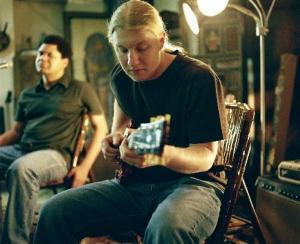
(Above: Allman Brothers guitarists (from left) Woody Haynes, Derek Trucks with guest Eric Clapton at the Beacon Theater in New York, March 2009.)

By Joel Francis
The Kansas City Star

The Derek Trucks Band tour started last week, just days after the final show in the Allman Brothers’ 15-night residency at the Beacon Theater in New York City.

Numerous guests, including Dr. John, Chuck Leavell, members of Phish, Sheryl Crow and Kid Rock stopped by to help celebrate 40 years of the Allmans.

“This was the most enjoyable Beacon run I’ve been a part of in the 10 years I’ve been doing it. That first night with Taj Mahal and Levon Helm was great,” Trucks said. “The show on (March) 26th was the band’s actual 40th anniversary. We had no guests and did the first two records in order. That was probably the best show of the run.”

This year was also the 20th anniversary of the band’s first Beacon residency. For nearly as long, it has been rumored Eric Clapton would join the band onstage. This year he finally did, adding extra weight to the run of shows dedicated to founding guitarist and slide legend Duane Allman.

Each night opened with a montage of old photos as guitarists Haynes and Trucks played Allman’s moving acoustic instrumental “Little Martha.” Allman’s daughter was also present for each performance.

“It was a fitting tribute, but especially doing the Derek and the Dominos tunes with Eric and hearing the Allmans’ numbers with Eric was an amazing collision,” Trucks said of the legendary album “Layla and Other Assorted Love Songs” Clapton and Allman recorded together in 1970. “Obviously Duane was the key to that. I don’t think Eric and the band would be playing together otherwise.”

The Derek Trucks Band makes old-school rock new

derek_trucks_band

By Joel Francis
The Kansas City Star

Guitarist Derek Trucks was 12 years old when Bob Dylan asked him onstage during a show to play “Highway 61 Revisited.”

For Trucks, it was just another gig. The look on his dad’s face, however, told a different story.

“I knew who Dylan was because my dad was a massive fan, but it didn’t hit me then like it would have now or even 10 years ago,” Trucks said. “But even though I didn’t realize the significance, I could see it in my dad’s eyes that this was life-changing.”

Trucks and his father were both right. Playing with Dylan was just another encounter for the prodigy who would go on to play with Buddy Guy, Carlos Santana, Eric Clapton and numerous others. But it also opened the door to other possibilities.

Trucks, who turns 30 in June, now helms his own eponymous group (performing Friday at Harrah’s Voodoo Lounge) and also plays in the Allman Brothers Band. He returned Dylan’s favor with his supercharged blues cover of Dylan’s “Down in the Flood,” which opens his sixth and newest studio album, “Already Free.”

“I try to pick covers with some connection to the band,” Trucks said. “Part of that is Dylan is such a good songwriter with a great amount of tunes, but on top of that I figured after Katrina and the flooding in Iowa, the title and the lyrics were just a great metaphor for all that.”

Trucks didn’t go into the studio planning on cutting a record. Finding himself with downtime at his Jacksonville, Fla., home – atypical for a man who averages 300 shows a year – and a recently completed home studio called Swamp Raga Studio, Trucks and his band decided to lay down some tracks just to see how the room felt.

“The first day we wrote and ” Trucks said. “The next thing we recorded (the song) ‘Already Free,’ knew there were a dozen, then two dozen songs. We started calling people from (wife and blues guitarist) Susan (Tedeschi)’s band, Doyle (Bramhall II), Warren Haynes, Oteil Burbridge, to come in.”

The resulting release has a laid-back yet focused organic vibe that inhabits the best of the Allman Brothers’ Capricorn albums.

“It’s the most natural record I’ve done,” Trucks said. “It was very comfortable recording, and I think you can feel it. We captured tunes hours after they were written. There’s a freshness that comes across when songs are captured so quickly.”

Unsurprisingly, Trucks wanted to translate that urgency to the road as quickly as possible. The Derek Trucks Band tour kicked off last week.

For someone who has seemingly played with everyone, Trucks had the opportunity to encounter another legend and influence last year.

When you record two John Coltrane numbers on your debut album, and the opportunity to play with Coltrane’s longtime pianist McCoy Tyner arises, you don’t say no.

Still, Trucks was intimidated. Especially when he walked into the studio and saw bass player Ron Carter and drummer Jack DeJohnette.

“Those guys are legends in their own right, but McCoy is on his own level,” Trucks said. “He was such a sweet guy. He really made it feel comfortable.”

Trucks entered the studio with a list of four songs he hoped to play with the trio, but as the last guitarist on the session, some of his choices had already been recorded.

“My first choice of song was ‘Contemplations,’ but (jazz guitarist Bill) Frisell had already recorded it,” Trucks said.

The two-day session yielded collaborations with Trucks, Frisell, Bela Fleck, Marc Ribot and John Scofield. Trucks was the only “rock” guitarist invited, but he works well on his two featured cuts, “Slapback Blues” and “Greensleeves.” Trucks’ presence in the company of such eclectic legends is unsurprising given the range of covers his band performs – everything from Pakistani qawwali singer Nusrat Fateh Ali Khan to Delta bluesman Son House – and the diversity of the band playing them, which contains a four-decade age span.

Trucks said his innate musical curiosity has not only expanded his palate but has also given him a level of comfort playing with nearly anyone.

“It started at such a young age. I was always around musicians, so I’d try to pick their brains and see what influenced their music,” Trucks said. “A huge part of being able to stay on the road and on top of the game is to keep finding inspiration. You keep finding different things that turn you on, things that tweak different parts of the brain. In the long run you’re a better musician for it.”

Trucks hopes that same level of comfort and curiosity extends to his home Swamp Raga Studio.

“I’ve spent a lot of time with Willie (Nelson) in Maui, and anywhere he is has a clubhouse vibe. I can see that communal feeling. Wherever you are with him – on his bus, in his home – he makes sure everybody is absolutely comfortable,” Trucks said. “That’s kind of what it’s (Swamp Raga) starting to turn into in the month and a half we’ve gotten into it.”

Swamp Raga is not only musician-friendly but environmentally friendly as well.

“The beauty of building from scratch is that you can think about stuff ahead of time,” Trucks said. “When I figured the electric bill would be double, not only was that a financial hit, but psychologically I started feeling guilty because of all the energy we’d be using. We went out of our way to be conscious of that. We made it a point to do everything as efficiently as possible.”

To that end, Trucks and Tedeschi installed 26 solar panels on the studio and their home. And in the months when the family is out on tour, the local utility company pays them for the energy their panels generate.

“Sometimes our bill comes in right around zero,” Trucks said. “By doing the right thing it actually works out better in the end.”

Despite such 21st century enterprises, Trucks believes his band and his music are a throwback to a time where wooden instruments were hand-crafted and stepping onstage meant being ready to cut some heads.

“When you get on stage, you have to bring it,” Trucks said. “I get a sense from new music that the idea is to outsmart your audience or be so ultra-hip you can pull one over on them.

“With a band like ours, we try to represent a more honest music. We’re musicians representing our craft first and then trying to connect with people.”

Review: Bela Fleck’s Africa Project

(Above: Vusi Mahlasela at Live 8.)

By Joel Francis
The Kansas City Star

Bela Fleck has taken his banjo to some unexpected forays into jazz, classical and holiday music. For his latest project, not only did Fleck bring his banjo to Africa, but he brought several of his African collaborators with him on tour.

For three hours Fleck and his Africa Project mesmerized a half-full Uptown Theater Thursday night.

Starting promptly at 8, Fleck opened with a 10 minute solo improvisation based on the melodies and techniques he picked up in Africa. After introducing thumb pianist and Anania Ngoliga and guitarist John Kitime from Tanzania, Fleck ceded the stage to the duo. That set the pattern for the night: Fleck’s introduction, a couple solo numbers followed by a couple duets.

Ngoliga’s thumb piano was a wooden box about the size of a sampler with about three dozen metal strips of varying lengths attached. Backed by Kitime’s buoyant acoustic guitar, the pair sang about their native country. After 15 minutes, Fleck came out for “Kabibi.” Ngoliga sang that one in a voice so high it almost sounded like a children’s song. His happiness was so infectious it’s hard to imagine anyone not cracking a smile while listening.

There were only two drawbacks to Fleck’s format. Just as it seemed the performers were getting in a groove, it was time for the next act. Perhaps more frustrating was the high level of entertainment and musicianship from the artists. Each could easily carry a show of their own. With any luck, some of them will come back through again.

On the other hand, Fleck is to be commended for introducing these musicians to his audience. During his set, kora player Toumani Diabate recalled the last time he was in Kansas City … 18 years ago. It is very conceivable this was the first (and only) performance our town will see from the rest of the artists.

Next up was D’Gary and Mario, a guitarist and percussionist from Madagascar. D’Gary’s playing style was like Spanish flamenco married to Ali Farka Toure’s African blues. D’Gary’s playing was virtuosic, yet warm and inviting. He was joined by Mario who played a small tin can filled with glass, sealed and attached to a stick. It may not sound impressive, but somehow Mario managed to turn the simple instrument into an uber-maraca.

After sitting in with the pair for one number, Fleck brought out bluegrass violinist Casey Drieson to join them on “Kinetsa.” Drieson was initially absent in the mix. Frustrated, he walked across the stage and started playing into D’Gary’s microphone. The cheers that erupted were so great that when Drieson tried to retreat, Fleck urged him to take another solo.

(Above: The six-string wonders of D’Gary.)

Vusi Mahlesela came out after a 20-minute intermission. His guitar style was closest to the Western tradition. It’s easy to imagine him in the South African equivalent of a Greenwich Village coffee shop. A former anti-apartheid activist, Mahlesela sang in an expressive tenor. Like most of the performers, he didn’t sing much in English, but he put his whole body into what he said.

The joyous “Thula Mana” was dedicated to Mahlesela’s grandma, who protected him from the Afrikaans police force. If Fleck added the least to this pairing, it is only because Mahlesela’s presence was so complete.

Finally, Fleck introduced kora master Toumani Diabate. A native of Mali, Diabate has collaborated with Taj Mahal and Bjork and was the best-known of Fleck’s guests. Clad in a traditional golden robe, Diabate’s instrument was the most traditional and formal of the night. After a long solo piece, Fleck came out and urged Diabate to explain his instrument. Diabate’s kora looked like an industrial broomstick with many protruding strings stuck in a gigantic half-gourd. After demonstrating the four-finger picking technique (thumbs and two index fingers), Diabate slowly built a song starting with the bassline, adding melody and finally improvisation.

Dierson returned – this time with a working mic – to join Fleck and Diabate on “Throw Down Your Heart.” Banjo and kora work well together because both instruments are treble-heavy and prone to twang. Playing double stops on the low strings, Dierson’s violin was a pleasant counterpoint that added fresh textures.

The night ended with everyone onstage together for an improvised jam and Mahlesela’s “When You Come Back,” a tribute to his home continent.

Western artists have been mining African music since before they wouldn’t play Sun City, but Fleck may be the most accommodating. He acted as less a host than a facilitator who was honored to sit in with his guests.

The collaborations were so organic it seemed they could have taken place anywhere – the studio, living room, outside. They just happened to be experienced in the Uptown this night.

(Below: Toumani Diabate rocks the kora.)