Review: Toadies

(Above: “Possom Kingdom,” in case you forgot how it goes.)

By Joel Francis
The Kansas City Star

The Toadies’ career has been one of fits and spurts, so it was only fitting their concert at the Beaumont Club Thursday night be filled with stops and starts.

The Fort Worth hard rock quartet broke into the mainstream with their 1994 hit “Possom Kingdom” but didn’t get around to releasing their sophomore album until 2001, just in time for the band to break up. They regrouped in 2006 and cut their third album last year.

Just as most bands don’t wait seven years to deliver a follow-up, most also take their soundchecks before performing. The Toadies, however, let the roadies test their instruments for 10 minutes, starting less than a half hour into the 90-minute set. An hour later, the band aborted “Possom Kingdom,” the one song everyone in the room came to hear, to chastise a couple overly aggressive fans up front.

When the number resumed, it was a success for the same reason the band was even able to have a career at this point: The audience’s enthusiasm helped recapture any momentum that may have been lost.

The night opened with “I Come From the Water,” which fed the crowd’s hunger and got them involved early. The band knew just what the audience wanted – stuff from their breakthrough first album, “Rubberneck” – and gave them plenty of it. Before the evening was through, they’d played nearly every song of that release and a handful of tunes from the other two records.

The warhorses – “Backslider,” “I Burn,” “Away” – hadn’t lost any of their punch. The newer songs, like “Sweetness” and “So Long Lovely Eyes,” were cut from the same cloth and distinguishable only by the smaller number of people were singing along.

After waiting so long, the third-full room was appreciative of everything it got. The anthemic “Tyler” won back any goodwill squandered by the mid-set soundcheck. The band, meanwhile, worked out their sonic frustrations out with an especially angry “Velvet.”

Although most performances were taught readings of the album arrangements, the band took some time to stretch out during “Hell in High Water.” The new number started with an extended instrumental – too calculated for a jam, but looser than anything else played that night – and featured two guitar solos and another lengthy breakdown.

The band wasn’t shy about showing its influences. They snuck a snippet of “Eruption” into the closing of one number, and teased the audience with fragments of ZZ Top, “I Can’t Explain” and “Aqualung.”

Singer Todd Lewis summed up both the band and the crowd in the lyrics to “I Am A Man of Stone”: “You said baby don’t change/and I did not change.”

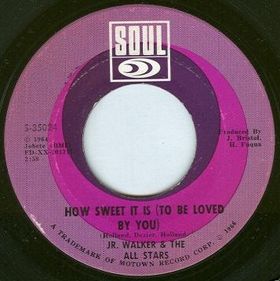
Jr. Walker and the All Stars – “How Sweet It Is (To Be Loved By You)”

sweet

Jr. Walker and the All Stars – “How Sweet It Is (To Be Loved By You),” Pop #18, R&B #3

By Joel Francis

Because he owned both the label and its publishing, it’s no surprise that Berry Gordy frequently had other label artists cut versions of earlier Motown hits. While there are several notable exceptions, for the most part these covers are either curiosities or album filler.

Jr. Walker, however, broke out of the mold with his reading of Marvin Gaye’s 1964, Top 5 hit “How Sweet It Is (To Be Loved By You).” After an extended saxophone intro, Walker puts down his horn. He has clearly overcome the microphone shyness that plagued him during the recording of his breakthrough hit “Shotgun.” Walking in Gaye’s shoes is no small feat, but Walker’s voice credibly handles the soulful, demanding melody.

While Gaye’s version was slick, joyous anthem, Walker’s is a little seedier – and all the better for it. Producer Harvey Fuqua, who signed Walker and changed his band name from the “Rhythm Rockers” to the “All Stars” in 1961, gave the song a faux-live feel that makes it sound like it was captured in a Southern roadhouse. The purposefully ragged backing vocals are more like enthusiastic audience intrusions. Close your eyes and you can smell alcohol and cigarette smoke while listening.

Others have covered this number since Gaye and Walker, of course, but a moratorium should have been placed after this interpretation. Finally, it should be noted that the year after he recorded “How Sweet It Is,” Walker memorably stole “Come See About Me” from the Supremes – no small feat – with his 1967 cover.

Review: Sonny Rollins

(Above: At 79 Sonny Rollins still has plenty to say with his horn.)

By Joel Francis

Sonny Rollins’ saxophone has the power to bend time. For nearly two hours Thursday night, the jazz legend and his five-piece band melted minutes like hot butter in front of a near-capacity crowd at the Walton Arts Center in Fayetteville, Ark.

The first number, “Sonny, Please,” set the mood for the night. The song started slowly, with Rollins repeating the melody, like a cook tasting the broth before serving it for dinner. Once Rollins’ palette was whet, he cued the band and the song was twisted, flipped and cavorted into as many different ways as possible. The format was almost like a congenial roundtable discussion: If a musician had something to say, they jumped in and said it for as long as it took.

Rollins opened “Park Palace Parade” with an a capella solo before the band dropped into a reggae beat behind him. At five minutes it was one of the shortest songs of the night. For another song he strolled to the front of the stage and delivered a solo on the precipice, leaning over the audience.

Although several songs reached over 20 minutes, there were never any filibusters. In fact, time seemed to accelerate with each solo. The opening three-song, 40-minute set seemed fleeting.

After a 25-minute intermission, the band wordlessly dropped into a reading of “In A Sentimental Mood” that somehow disposed of 50 years of schlock and clichés. Rollins’ longtime bassman Bob Cranshaw was given a lengthy solo and the ensemble performance wound down after 20 minutes with another extended, a capella sax solo.

Rollins was gracious in ceding the stage to his band. Trombonist Clifton Anderson and guitar player Bobby Broom took the majority of the solos. Anderson’s mellow horn and Broom’s tasty licks provided a nice counter-texture to Rollins’ saxophone. When he was really feeling their solo, Rollins would snap his fingers and bob his head in rhythm. Drummer Kobe Watkins made the most of the three-bar fills Rollins repeatedly gave him on Noel Coward’s “Someday I’ll Find You.”

This was Rollins’ first performance in Arkansas and he announced how proud he was to be playing his idol Louis Jordan’s home state. Later in the set, he interrupted himself during the intro to “Nishi” to reminisce about a radio host he used to listen to as a child, Bob Burns, better known as the Arkansas Traveler.

For a man who could compress time so pleasurably and succinctly, introducing Burns, who died more than 50 years ago, to the present was no big deal.

Police On My Back: Five Musicians Convicted of Murder

(Above: Honorable mention R.L. Burnside, who was convicted of murder 1959 and sentenced to Parchman Farm. Burnside later said, “I didn’t mean to kill nobody. I just meant to shoot the sonofabitch in the head. Him dying was between him and the Lord.”)

By Joel Francis

Phil Spector is hardly the first musician to be convicted of murder. He’s not even the most famous or influential one. But he is the latest. In honor of Spector’s recent sentencing, The Daily Record recognizes five other musicians convicted of murder.

Cool C and Steady B

Cool C and Steady B both came of age in the 1980s Philadelphia rap scene. Steady, nee Warren McGlone, was one of the first Philly rappers to taste the mainstream, while Cool, born Christopher Roney, was a member of the Hilltop Hustlers. The two teamed up in the early ’90s to form C.E.B., which was short for Countin’ Endless Bank. Taking their moniker a little two seriously, the duo decided to rob an actual bank.

On Jan. 2, 1996 – perhaps fulfilling a New Year’s resolution – C, B and Mark Canty, another Philadelphia rapper, attempted to rob a PNC bank in the City of Brotherly Love. Needless to say, the heist didn’t go as planned. When officer Lauretha Vaird responded to the silent alarm, she was shot and killed by Cool C. Steady B exchanged shots with another officer as the trio hopped into a stolen minivan and made their escape.

Steady was arrested at his apartment shortly after the crime. When two handguns left at the bank were traced back to him, he confessed to the crime.

In October, 1996, Cool was convicted of first degree murder and sentenced to death by lethal injection. Steady got off with a second degree murder conviction and life in prison. Cool was granted a stay of execution in 2006, by Pennsylvania Governor Ed Rendell (probably a closet C.E.B. fan), but remains on death row. Steady also remains incarcerated.

Little Willie John

In the late 1950s, Little Willie John traveled in the same soul circles as his contemporaries Sam Cooke, Jackie Wilson and Hank Ballard. His parade of hits started in 1955 with “All Around the World” and included “Need Your Love So Bad” (later covered by Peter Green’s Fleetwood Mac) and “Fever,” which Peggy Lee made famous and took to the U.S. Top 10.

John had a golden voice, but he also had a bad temper and a taste of alcohol. Those three traits collided backstage at a concert in 1964 when John stabbed a man to death. He was convicted of manslaughter and sentenced to Washington State Prison. John was appealing his conviction and aiming for a comeback when he died of pneumonia in 1968.

Don Drummond

In the fall of 1964, trombone player Don Drummond was living the good life. The band he helped form, the Skatalites, were finally breaking through, thanks to a song he wrote. “Man in the Street” was a Top 10 U.K. hit and for many their first taste of reggae. One year later, Drummond’s arrangement of the Guns of Navarone also hit the U.K. Top 10. But 1965 was not as kind to Drummond.

Drummond earned the nickname “Don Cosmic” for the erratic behavior brought on by his manic depression. When the body of Drummond’s girlfriend exotic dancer Marguerita Mahfood was found in Drummond’s home with several knife wounds, the police quickly arrested Drummond and charged him with murder. Drummond was judged legally insane at his trial and committed to Bellevue Hospital in New York City. Drummond died in Bellevue in 1967 at the age of 39. His death was ruled suicide, but because no autopsy was performed conspiracy theories persist to this day.

Drummond left behind a catalog of more than 300 songs and pivotal role backing Lee “Scratch” Perry, the Wailers, Delroy Wilson at their earliest sessions.

Jim Gordon

Drummer Jim Gordon started his career backing the Everly Brothers in 1963. By the end of the decade he’d performed on “Pet Sounds,” “The Notorious Byrd Brothers” and numerous other albums. When Jim Keltner pulled out of a tour with Delaney and Bonnie, Gordon was brought in as the replacement. Gordon got on so well with the rest of the band, which included Eric Clapton, bass player Carl Radle and keyboardist Bobby Whitlock, that the quartet played on Clapton’s first solo album, the first post-Beatles album by Clapton’s friend George Harrison (“All Things Must Pass”) and even a session with Ringo.

The group is most memorable, however, for the album it produced with Duane Allman. As Derek and the Dominoes, Clapton was able to pour out his unrequited love for Harrison’s wife Patti Boyd and Allman was able to lay down some of his best licks. Gordon gained notoriety for writing the piano coda to “Layla.” He composed the piece independently and had to be persuaded to let Clapton incorporate into what became one of the biggest rock singles of all time.

After Derek and the Dominoes broke up in 1971, Gordon played in Joe Cocker’s Mad Dogs and Englishmen tour. He also toured with Traffic and Frank Zappa. Gordon’s session work also flourished. He played drums on Carly Simon’s “You’re So Vain,” and the Incredible Bongo Band’s “Bongo Rock” album. Gordon’s drum solo on “Apache” is one of the most sampled licks in hip hop.

In the late ’70s Gordon complained of hearing voices. Treated for alcohol abuse instead of schizophrenia, the voices had pushed Gordon out of music entirely by 1981. They pushed him even further in 1983 when Gordon killed his mother with a hammer. Gordon was properly diagnosed in his 1984 trial and sentenced to sixteen years to life with the possibility of parole. Gordon remains in prison.

Lead Belly

Most musicians wait until after they’re famous to start killing people. Not the man born Huddie Ledbetter. Before he recorded a note for Alan Lomax, the towering legend of folk and blues had escaped from a chain gang in Texas, served seven years for killing a relative in a fight over a woman. Lead Belly learned new songs and honed his craft while in prison, eventually earning a pardon from Texas Governor Pat Neff, who enjoyed the religious songs Lead Belly had played for him. Five years later, Lead Belly was back in prison, this time for attempted homicide. After serving three years for knifing a white man in a fight, he was discovered by John and Alan Lomax, who fell under his spell and petitioned to have him released.

After taking Louisiana Governor O.K. Allen a recording of “Goodnight Irene,” Lead Belly was released (the official reason was time off for good behavior). He recorded several albums for the Library of Congress based on his book “Negro Folk Songs as Sung by Lead Belly.” Unfortunately, Lead Belly could not shake his criminal past, and was back in jail again in 1939 for stabbing a man in a fight in New York City. Again, Alan Lomax jumped to Lead Belly’s defense, dropping out of graduate school and helping Lead Belly record an album of songs to pay for his legal expense.

Lead Belly became a fixture of the New York City folk scene in the 1940s. He appeared on the radio, performed with Brownie McGhee, Sonny Terry, Woody Guthrie, and others and recorded a wide range of music. Acolyte Bob Dylan once said Lead Belly was “One of the few ex-cons who recorded a popular children’s album.”

“Goodnight Irene” became Lead Belly’s most popular song. Unfortunately, he did not live long enough to see Pete Seeger’s group the Weavers make it a No. 1 hit.

Lead Belly died in 1949, leaving behind a treasure of songs that includes “Midnight Special,” “Cotton Fields” and “Rock Island Line.”

Post Script: Derek Trucks and Bela Fleck

(Above: The Derek Trucks Band covers Nusrat Fateh Ali Khan.)

By Joel Francis
The Daily Record

The day I interviewed Derek Trucks happened to be the same day I attended Bela Fleck’s spectacular Africa Project concert.

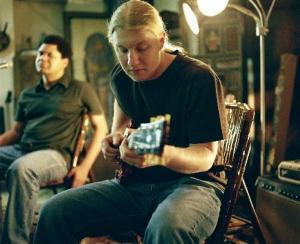
The Derek Trucks Band is known for its wide range of covers. In addition to performing two John Coltrane numbers on their first album, the band has been known to drop covers ranging from Nusrat Fateh Ali Khan to Rahsaan Roland Kirk to Son House. During the interview, I asked Trucks about his wide range of influences.

Trucks replied that growing up around musicians and being able to pick their brains for what turned them on created an insatiable appetite to learn and experience new things, musically and otherwise. He then told me about his latest find: a guitarist from Madagascar named D’Gary.

Hey, I told Trucks. I’m actually seeing him tonight.

That night, D’Gary more than lived up to Trucks’ praise. His fingers moved lightning fast, but retained the warmth associated with slower players. If you could transfer Eddie Van Halen’s finesse with B.B. King’s tone to an acoustic guitar, you’d be close.

After the show, all the African performers gathered with Fleck in the lobby of the Uptown Theater to sign autographs and talk with fans. I couldn’t resist approaching D’Gary.

Do you know the guitarist Derek Trucks? I asked.

He paused for a moment.

Yeah, yeah, the slide player, right, he said, moving a rigid index finger through the air imitating a slide.

I told D’Gary that I had spoken with Trucks that morning and that Trucks had spoken highly of him. D’Gary smiled and nodded his head in approval.

I have no idea if anything will come of this musical matchmaking. D’Gary and Trucks are both versitale enough that I’m sure bridging the ocean and cultures that lie between them will be no challenge.  But if anything happens between the two of them, be sure to let me know.

Derek Trucks: 15 Nights with the Allmans

large_allmanclapton

(Above: Allman Brothers guitarists (from left) Woody Haynes, Derek Trucks with guest Eric Clapton at the Beacon Theater in New York, March 2009.)

By Joel Francis
The Kansas City Star

The Derek Trucks Band tour started last week, just days after the final show in the Allman Brothers’ 15-night residency at the Beacon Theater in New York City.

Numerous guests, including Dr. John, Chuck Leavell, members of Phish, Sheryl Crow and Kid Rock stopped by to help celebrate 40 years of the Allmans.

“This was the most enjoyable Beacon run I’ve been a part of in the 10 years I’ve been doing it. That first night with Taj Mahal and Levon Helm was great,” Trucks said. “The show on (March) 26th was the band’s actual 40th anniversary. We had no guests and did the first two records in order. That was probably the best show of the run.”

This year was also the 20th anniversary of the band’s first Beacon residency. For nearly as long, it has been rumored Eric Clapton would join the band onstage. This year he finally did, adding extra weight to the run of shows dedicated to founding guitarist and slide legend Duane Allman.

Each night opened with a montage of old photos as guitarists Haynes and Trucks played Allman’s moving acoustic instrumental “Little Martha.” Allman’s daughter was also present for each performance.

“It was a fitting tribute, but especially doing the Derek and the Dominos tunes with Eric and hearing the Allmans’ numbers with Eric was an amazing collision,” Trucks said of the legendary album “Layla and Other Assorted Love Songs” Clapton and Allman recorded together in 1970. “Obviously Duane was the key to that. I don’t think Eric and the band would be playing together otherwise.”

The Derek Trucks Band makes old-school rock new

derek_trucks_band

By Joel Francis
The Kansas City Star

Guitarist Derek Trucks was 12 years old when Bob Dylan asked him onstage during a show to play “Highway 61 Revisited.”

For Trucks, it was just another gig. The look on his dad’s face, however, told a different story.

“I knew who Dylan was because my dad was a massive fan, but it didn’t hit me then like it would have now or even 10 years ago,” Trucks said. “But even though I didn’t realize the significance, I could see it in my dad’s eyes that this was life-changing.”

Trucks and his father were both right. Playing with Dylan was just another encounter for the prodigy who would go on to play with Buddy Guy, Carlos Santana, Eric Clapton and numerous others. But it also opened the door to other possibilities.

Trucks, who turns 30 in June, now helms his own eponymous group (performing Friday at Harrah’s Voodoo Lounge) and also plays in the Allman Brothers Band. He returned Dylan’s favor with his supercharged blues cover of Dylan’s “Down in the Flood,” which opens his sixth and newest studio album, “Already Free.”

“I try to pick covers with some connection to the band,” Trucks said. “Part of that is Dylan is such a good songwriter with a great amount of tunes, but on top of that I figured after Katrina and the flooding in Iowa, the title and the lyrics were just a great metaphor for all that.”

Trucks didn’t go into the studio planning on cutting a record. Finding himself with downtime at his Jacksonville, Fla., home – atypical for a man who averages 300 shows a year – and a recently completed home studio called Swamp Raga Studio, Trucks and his band decided to lay down some tracks just to see how the room felt.

“The first day we wrote and ” Trucks said. “The next thing we recorded (the song) ‘Already Free,’ knew there were a dozen, then two dozen songs. We started calling people from (wife and blues guitarist) Susan (Tedeschi)’s band, Doyle (Bramhall II), Warren Haynes, Oteil Burbridge, to come in.”

The resulting release has a laid-back yet focused organic vibe that inhabits the best of the Allman Brothers’ Capricorn albums.

“It’s the most natural record I’ve done,” Trucks said. “It was very comfortable recording, and I think you can feel it. We captured tunes hours after they were written. There’s a freshness that comes across when songs are captured so quickly.”

Unsurprisingly, Trucks wanted to translate that urgency to the road as quickly as possible. The Derek Trucks Band tour kicked off last week.

For someone who has seemingly played with everyone, Trucks had the opportunity to encounter another legend and influence last year.

When you record two John Coltrane numbers on your debut album, and the opportunity to play with Coltrane’s longtime pianist McCoy Tyner arises, you don’t say no.

Still, Trucks was intimidated. Especially when he walked into the studio and saw bass player Ron Carter and drummer Jack DeJohnette.

“Those guys are legends in their own right, but McCoy is on his own level,” Trucks said. “He was such a sweet guy. He really made it feel comfortable.”

Trucks entered the studio with a list of four songs he hoped to play with the trio, but as the last guitarist on the session, some of his choices had already been recorded.

“My first choice of song was ‘Contemplations,’ but (jazz guitarist Bill) Frisell had already recorded it,” Trucks said.

The two-day session yielded collaborations with Trucks, Frisell, Bela Fleck, Marc Ribot and John Scofield. Trucks was the only “rock” guitarist invited, but he works well on his two featured cuts, “Slapback Blues” and “Greensleeves.” Trucks’ presence in the company of such eclectic legends is unsurprising given the range of covers his band performs – everything from Pakistani qawwali singer Nusrat Fateh Ali Khan to Delta bluesman Son House – and the diversity of the band playing them, which contains a four-decade age span.

Trucks said his innate musical curiosity has not only expanded his palate but has also given him a level of comfort playing with nearly anyone.

“It started at such a young age. I was always around musicians, so I’d try to pick their brains and see what influenced their music,” Trucks said. “A huge part of being able to stay on the road and on top of the game is to keep finding inspiration. You keep finding different things that turn you on, things that tweak different parts of the brain. In the long run you’re a better musician for it.”

Trucks hopes that same level of comfort and curiosity extends to his home Swamp Raga Studio.

“I’ve spent a lot of time with Willie (Nelson) in Maui, and anywhere he is has a clubhouse vibe. I can see that communal feeling. Wherever you are with him – on his bus, in his home – he makes sure everybody is absolutely comfortable,” Trucks said. “That’s kind of what it’s (Swamp Raga) starting to turn into in the month and a half we’ve gotten into it.”

Swamp Raga is not only musician-friendly but environmentally friendly as well.

“The beauty of building from scratch is that you can think about stuff ahead of time,” Trucks said. “When I figured the electric bill would be double, not only was that a financial hit, but psychologically I started feeling guilty because of all the energy we’d be using. We went out of our way to be conscious of that. We made it a point to do everything as efficiently as possible.”

To that end, Trucks and Tedeschi installed 26 solar panels on the studio and their home. And in the months when the family is out on tour, the local utility company pays them for the energy their panels generate.

“Sometimes our bill comes in right around zero,” Trucks said. “By doing the right thing it actually works out better in the end.”

Despite such 21st century enterprises, Trucks believes his band and his music are a throwback to a time where wooden instruments were hand-crafted and stepping onstage meant being ready to cut some heads.

“When you get on stage, you have to bring it,” Trucks said. “I get a sense from new music that the idea is to outsmart your audience or be so ultra-hip you can pull one over on them.

“With a band like ours, we try to represent a more honest music. We’re musicians representing our craft first and then trying to connect with people.”

Five Jazz Legends Still Adding to Their Legacies

(Above: The Dave Brubeck Quartet “Take Five” at the Ottawa Jazz Festival.)

By Joel Francis

In a belated post-script to The Daily Record’s series on 15 jazz greats to emerge in the past 20 years, we look at five artists who are still significantly contributing to their legendary status. Although their reputations were cemented generations ago, it would be criminal to overlook their most recent works.

Roy Haynes

At the 2005 Newport Jazz Festival, Chick Corea, Pat Metheny, Christian McBride, Joshua Redman and several others all paid tribute to drummer Roy Haynes on the occasion of his 80th birthday. These musicians honored Haynes not only for his resume, which includes stints with Lester Young, Bud Powell, Thelonious Monk and Sarah Vaughan, but because he has allowed the younger artists to grow and learn under his guidance. Haynes has released six albums this decade, starting with “The Roy Haynes Trio,” which recaps his career through new performances, “Birds of a Feather,” a tribute to his former bandleader Charlie Parker, and the strong live set “Whereas.”

Dave Brubeck

One of the most important – and popular – jazz pianists of the post-War era, Dave Brubeck landed on the cover of Time magazine and became a legend with his groundbreaking, yet accessible, work with saxophonist Paul Desmond. Although the 16 years Brubeck and Desmond played together in the Dave Brubeck Quartet form the crux of his catalog, Brubeck has built an impressive resume in the 40-plus years since.

Brubeck’s current quartet, consisting of drummer Randy Jones, bass player Michael Moore and saxophonist/flautist Bobby Militello, may be the best ensemble he’s worked with since his mid-’70s pairing with Gerry Mulligan. Unlike many of his contemporaries, there has never been a Brubeck comeback; there are no lulls or low periods in his catalog. Brubeck has continued to write, record and perform regularly well past his 88th birthday. Of the nearly dozen albums Brubeck has released this decade, three stand out. “The Crossing” kicked off the 21st century with nine strong, new selections, including an ode to longtime drummer “Randy Jones,” Militello’s delightful solo on “Day After Day” and the title song, Brubeck’s interpretation of a chugging ocean liner. Brubeck blends old and new songs on “London Flat, London Sharp,” and the his quartet sizzles on the live album “Park Avenue South,” which mixes standards and favorites with more recent material.

Wayne Shorter

After two years of auditioning other horn players, Wayne Shorter’s saxophone turned out to be the piece missing in Miles Davis second great quintet. An alumni of Art Blakey’s Jazz Messengers, Shorter not only filled the spot vacated by John Coltrane, but contributed many key songs to the group’s repertoire. As if that weren’t enough, he was simultaneously cutting magnificent solo albums on Blue Note. Shorter followed his bandleader’s path into fusion, but took a more pop approach in Weather Report, the group he co-founded with keyboardist Joe Zawinul, another Davis alum. Shorter floundered in the days after Weather Report’s demise in the mid-’80s, but his three most recent albums are among the most inspired of his career. After a 12-year absence from recording, Shorter returned with “Footprints Live,” which documents his reinvigorated 2001 tour. He fronted an acoustic band for the first time in over a generation on “Algeria,” which paired Rollins and his “Footprints” rhythm section with Brad Mehldau for several selections. Shorter’s hot streak continued with his most recent album “Beyond the Sound Barrier” and his inspired playing on Herbie Hancock’s Grammy-winning “River: The Joni Sessions.”

McCoy Tyner

More people have probably heard McCoy Tyner than know who he is. The backbone and counterfoil in John Coltrane’s masterful quartet for six years, Tyner’s piano has graced well-known recordings like “My Favorite Things” and “A Love Supreme.” Tyner also put out several stellar albums under his own name on Blue Note and Impulse in the 1960s. No less active today, Tyner collaborated with Bobby Hutcherson for the live album “Land of Giants” and played tenor Joe Lovano and the awesome rhythm section of Christian McBride and Jeff “Tain” Watts for 2007’s  self-titled release. Tyner’s latest album, “Guitars,” was recorded over a two-day span that paired Tyner, Ron Carter and Jack DeJohnette with several of six-string luminaries, including John Scofield, Bill Frisell, Marc Ribot, Bela Fleck and Derek Trucks. Uninformed fans should stay away from 2004’s “Illuminations,” however. A dream pairing on paper of Tyner, McBride, Terence Blanchard, Lewis Nash and Gary Bartz, the performances are ruined by a glossy production that smothers the quintet’s interplay and is suitable only for shopping for a sweater at Nordstrom with your mom.

Sonny Rollins

Sonny Rollins’ legacy includes recordings with Charlie Parker, Miles Davis, Thelonious Monk, Dizzy Gillespie, Max Roach, Bud Powell and Clifford Brown – and that’s just in his first decade of playing. In the half-century since then, Rollins (along with contemporary John Coltrane) established himself as the preeminent post-Bird saxophonist. Although the pace of Rollins’ releases has slowed considerably, what he has put out have only added to his reputation. Recorded in Boston just four days after the Sept. 11 attacks in New York City, “Without A Song” is an emotional listen finding Rollins channeling his conflicted emotions through long solos. “This Is What I Do” continues Rollin’s penchant for transforming b-quality songs into must-listen melodies with the Bing Crosby standard “Sweet Leilani.” Rollins’ most recently release, “Road Songs, Vol. 1” mines the archives for several cherry-picked performances that prove that the passion on “Without A Song” was no fluke.

Keep Reading: 15 Jazz Legends to Emerge in the Last 20 Years

Part One

Part Two

Part Three

Springsteen’s “Dream” Needs More Work

bruce-dream

By Joel Francis

For someone whose live converts are so immediate and visceral, Bruce Springsteen’s studio albums often need time to marinate before digesting.

Unlike Springsteen’s previous album – 2007’s “Magic” – “Working On A Dream” has not revealed any new flavors since its release two months ago. The record is overcooked in parts, underdone in others and often lacking necessary ingredients.

Opening cut “Outlaw Pete” is an obvious overcooked number. Clocking in at eight minutes, the arrangement shows Springsteen’s love of Ennio Morricone, but nicks part of its melody from Kiss’s late-’70s disco hit “I Was Made For Loving You.” This faux pas would be more forgivable if Springsteen hadn’t borrowed “Jenny (867-5309)” for his previous album’s opener, “Radio Nowhere.” The real problem, though, lies in the words. Pete’s story is never as interesting as its musical setting, and the lyrics are flat-out lazy, rhyming “feet” with “Pete,” “Dan” with “man” and “side” with “slide.” It would be easy to mistake this as a children’s song if everything else weren’t so earnest.

On the other side, “Queen of the Super Market” is severely underdone. The attempted portrait of a supermarket as an erotic smorgasbord is even sillier in song than it appears on paper. Again, Springsteen’s word choice is questionable, dropping an f-bomb in the last verse so out of place it could have been a suggestion from Ryan Adams.

Most tracks fall somewhere in between. Lead single “My Lucky Day” is good, but doesn’t stand out as an evergreen concert staple a la “Badlands” or “Mary’s Place.” Ditto for the second single, “Working on a Dream,” which would work better without the whistled solo.

Several numbers find Springsteen flexing his pop muscles, singing sunny love songs in under three minutes. The best of these, “Surprise,” is little more than a constant repetition of the title in a Brian Wilson vein that works, um, surprisingly well.

When the band gets it right, the results are spectacular. “Good Eye” and bonus track “A Night With the Jersey Devil” are distorted blues stompers that could have appeared on a Fat Possum release. “The Wrestler” is a dark human portrait in the vein of “Devil’s and Dust” that deserves all the accolades and awards it received from its connection to Mickey Rourke’s film.

Easily the best song, though, is “Last Carnival,” a tribute to fallen E Streeter Danny Federici. The affecting ballad has a gorgeous vocal arrangement along the lines of “My City of Ruins” and poignant lyrics that use a fairground as a metaphor for lost friendship.

Ultimately, “Working on a Dream” works best as an appetizer that can tickle the taste buds at times, but is unsatisfying as an entrée.

Review: Boss is Bigger than Big 12 Tourney (2008)

Bruce Springsteen and Tom Morello – “The Ghost of Tom Joad”

Book Review: “Big Man” by Clarence Clemons

Springsteen in the Waiting Room: Drop the Needle and Pray

Springsteen Rocks the Hall (part 1)

Springsteen Rocks the Hall (part 2)

More Bruce Springsteen on The Daily Record

Review: Bela Fleck’s Africa Project

(Above: Vusi Mahlasela at Live 8.)

By Joel Francis
The Kansas City Star

Bela Fleck has taken his banjo to some unexpected forays into jazz, classical and holiday music. For his latest project, not only did Fleck bring his banjo to Africa, but he brought several of his African collaborators with him on tour.

For three hours Fleck and his Africa Project mesmerized a half-full Uptown Theater Thursday night.

Starting promptly at 8, Fleck opened with a 10 minute solo improvisation based on the melodies and techniques he picked up in Africa. After introducing thumb pianist and Anania Ngoliga and guitarist John Kitime from Tanzania, Fleck ceded the stage to the duo. That set the pattern for the night: Fleck’s introduction, a couple solo numbers followed by a couple duets.

Ngoliga’s thumb piano was a wooden box about the size of a sampler with about three dozen metal strips of varying lengths attached. Backed by Kitime’s buoyant acoustic guitar, the pair sang about their native country. After 15 minutes, Fleck came out for “Kabibi.” Ngoliga sang that one in a voice so high it almost sounded like a children’s song. His happiness was so infectious it’s hard to imagine anyone not cracking a smile while listening.

There were only two drawbacks to Fleck’s format. Just as it seemed the performers were getting in a groove, it was time for the next act. Perhaps more frustrating was the high level of entertainment and musicianship from the artists. Each could easily carry a show of their own. With any luck, some of them will come back through again.

On the other hand, Fleck is to be commended for introducing these musicians to his audience. During his set, kora player Toumani Diabate recalled the last time he was in Kansas City … 18 years ago. It is very conceivable this was the first (and only) performance our town will see from the rest of the artists.

Next up was D’Gary and Mario, a guitarist and percussionist from Madagascar. D’Gary’s playing style was like Spanish flamenco married to Ali Farka Toure’s African blues. D’Gary’s playing was virtuosic, yet warm and inviting. He was joined by Mario who played a small tin can filled with glass, sealed and attached to a stick. It may not sound impressive, but somehow Mario managed to turn the simple instrument into an uber-maraca.

After sitting in with the pair for one number, Fleck brought out bluegrass violinist Casey Drieson to join them on “Kinetsa.” Drieson was initially absent in the mix. Frustrated, he walked across the stage and started playing into D’Gary’s microphone. The cheers that erupted were so great that when Drieson tried to retreat, Fleck urged him to take another solo.

(Above: The six-string wonders of D’Gary.)

Vusi Mahlesela came out after a 20-minute intermission. His guitar style was closest to the Western tradition. It’s easy to imagine him in the South African equivalent of a Greenwich Village coffee shop. A former anti-apartheid activist, Mahlesela sang in an expressive tenor. Like most of the performers, he didn’t sing much in English, but he put his whole body into what he said.

The joyous “Thula Mana” was dedicated to Mahlesela’s grandma, who protected him from the Afrikaans police force. If Fleck added the least to this pairing, it is only because Mahlesela’s presence was so complete.

Finally, Fleck introduced kora master Toumani Diabate. A native of Mali, Diabate has collaborated with Taj Mahal and Bjork and was the best-known of Fleck’s guests. Clad in a traditional golden robe, Diabate’s instrument was the most traditional and formal of the night. After a long solo piece, Fleck came out and urged Diabate to explain his instrument. Diabate’s kora looked like an industrial broomstick with many protruding strings stuck in a gigantic half-gourd. After demonstrating the four-finger picking technique (thumbs and two index fingers), Diabate slowly built a song starting with the bassline, adding melody and finally improvisation.

Dierson returned – this time with a working mic – to join Fleck and Diabate on “Throw Down Your Heart.” Banjo and kora work well together because both instruments are treble-heavy and prone to twang. Playing double stops on the low strings, Dierson’s violin was a pleasant counterpoint that added fresh textures.

The night ended with everyone onstage together for an improvised jam and Mahlesela’s “When You Come Back,” a tribute to his home continent.

Western artists have been mining African music since before they wouldn’t play Sun City, but Fleck may be the most accommodating. He acted as less a host than a facilitator who was honored to sit in with his guests.

The collaborations were so organic it seemed they could have taken place anywhere – the studio, living room, outside. They just happened to be experienced in the Uptown this night.

(Below: Toumani Diabate rocks the kora.)