Contest: Win the entire No Doubt catalog

(Above: No Doubt light up Starlight Theater in Kansas City, Mo. on July 6, 2009.)

Tickets to see No Doubt on their first tour in five years weren’t cheap. But the band has done their best to alleviate part of that sting by giving everyone who bought a ticket a free download of their entire catalog.

Three weeks after covering No Doubt’s energetic, fan-friendly set at Starlight Theater, I received an e-mail providing me access to the following albums:

The Singles 1992-2003 (2003)
Everything In Time (B-Sides, Rarities, Remixes) (2003)
Rock Steady (2001)
Return Of Saturn (2000)
Tragic Kingdom (1995)
The Beacon Street Collection (1995)
No Doubt (1992)

The download also includes No Doubt’s first recording since reuniting, a cover of Adam and the Ant’s “Stand and Deliver.”

The hidden message in this goodwill statement is that 13 years of recordings aren’t worth as much as a ticket to a 95-minute concert. I’m sure decision wasn’t met with open arms at Interscope, the band’s label.

While No Doubt fans are delighted and Interscope is disgusted, I am mostly apathetic. Although the show was a blast, I haven’t found myself pining to play any No Doubt material since the concert. This might be short-sighted of me, but my musical shortcomings, dear readers, are your gain.

I am giving away my access code to the entire No Doubt discography. To win everything the band has recorded, reply to this post with your best No Doubt story, or why you feel you deserve to win. After 10 days, I will contact the person with the best story and give them my download code.

Good luck, now start typing!

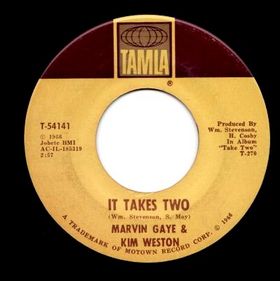
Marvin Gaye and Kim Weston – “It Takes Two”

it takes two
Marvin Gaye and Kim Weston – “It Takes Two,” Pop # 14, R&B # 4

By Joel Francis

“It Takes Two” was one of the last songs Kim Weston recorded for Motown. Its success established Marvin Gaye as a capable duet partner. Gaye was already one of Motown’s bigger stars, but his brief pairing with Weston and subsequent success with Tammi Terrell helped earn Gaye the titles of “Prince of Motown” and “Prince of Soul.”

The coupling of Weston and Gaye was fairly obvious. Gaye had collaborated with Weston’s husband, William “Mickey” Stevenson on “Dancing in the Street,” “Stubborn Kind of Fellow” and “Pride and Joy.” As Stevenson’s romantic song came together, his two frequent collaborators came to mind.

On paper, this song should have been a miserable, schmaltzy failure. That it didn’t come off as corny and syrupy is a testament to the talents of Gaye, Weston and Stevenson (who also produced the cut).

His arrangement is responsible for removing most of the sappiness. The strings add a romantic touch without going too far and the horn line during the chorus keep the song swinging. Benny Benjamin’s drumming is the coup de grace, ensuring that the song will never be a slow dance number.

As great as Gaye and Weston are on this track, they are nearly upstaged by Otis Redding and Carla Thomas’ fabulous version released the same year on the essential “King and Queen” album. Lightning did not strike a third time, however, when Tina Turner and Rod Stewart trotted out their cover in 1990. The song went to No. 5 in the UK but mercifully did not chart in America. Bruce Springsteen frequently incorporates “It Takes Two” into his live versions of “Two Hearts.”

Rock Hall celebrates the 40th anniversary of Woodstock

Rock & Roll Hall Of Fame

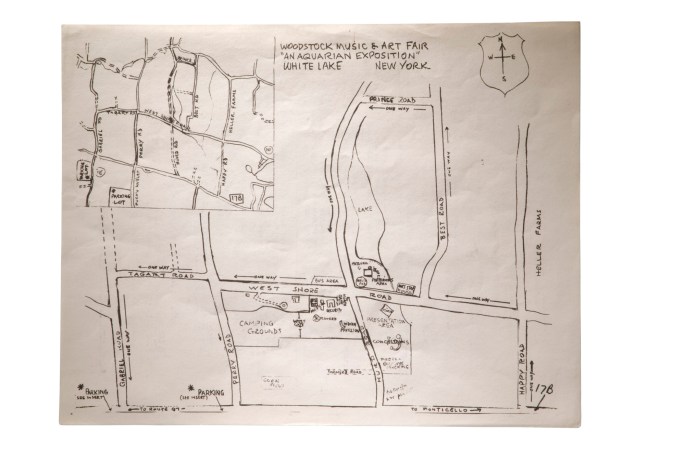
(Above: Woodstock Festival organizer Michael Lang’s hand-drawn layout of the festival grounds. The drawing is part of a new exhibit celebrating the 40th anniversary of Woodstock at the Rock and Roll Hall of Fame and Museum. All photos courtesy of the Rock and Roll Hall of Fame and Museum.)

By Joel Francis

The enduring image of Woodstock is iconic: a fringed performer – Jimi Hendrix, Roger Daltrey, David Crosby or Sly Stone – onstage, in front of a staggering mass of people. But how did the performers get to the stage, and where do all the fans answer nature’s call?

“Woodstock: The 40th Anniversary,” a new exhibit at the Rock and Roll Hall of Fame, sheds light on the logistical side of America’s first and greatest rock festival.

“One of the things that interested me the most in putting this exhibit together was just seeing what went into planning of the festival,” said Jim Henke, chief curator at the Rock and Roll Hall of Fame. “There was a massive amount of planning involved, and a lot of it had to be done at the last minute because the city fathers of Wakill, N.Y. didn’t want that many people to descend on them and made the organizers move the site.”

Festival organizer Michael Lang didn’t get much rest in the weeks leading up to the Woodstock and as evidenced in the “Woodstock” film, Lang had his hands full throughout the event as well. Lang made quite the statement on film making several last-minute arrangements, deals and accommodations in a hand-designed leather vest, also fringed, of course. The vest is just one of several items Lang loaned to the hall for the exhibit.

“Lang’s vest is still in decent shape today,” Henke said. “I’m sure he didn’t get any sleep during that period, but it seems like for whatever reason he was able to keep it together.”

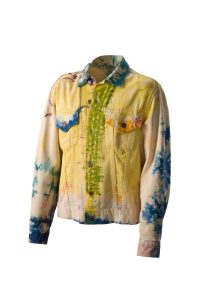
Other clothing in the exhibit includes the tie-dyed cape and jacket John Sebastian wore during his five-song set, and the spectacles Robbie Robertson wore during The Band’s performance.

Rock & Roll Hall Of FameSurrounding the garments is the contract Crosby, Stills, Nash and Young’s performance contract, drawings and layouts of the festival grounds, Lang’s handwritten management and operations plan, and an early press release stating the original location of Wallkill and that “Woodstock does not figure on gate crashers.”

“One of the more interesting items we have is a letter from Apple offering the services of James Taylor and Billy Preston for Woodstock,” Henke said. “It turned out Lang and the others didn’t get it in time, so no one appeared.

The letter offered the services of the Plastic Ono Band, which it described as “a series of plastic cylinders incorporated around a stereo sound system.”

“The letter didn’t say John Lennon and the Plastic Ono Band,” Henke said, “so I’m not sure if he would have been there or not. I do know Lennon played the Live Peace festival in Toronto a month later, so it could have been a possibility.”

“Woodstock: The 40th Anniversary” appears in the museum’s Ahmet M. Ertegun Main Exhibit Hall through November. The museum will be showing an edited version of the restored Woodstock film in the theater adjacent to the exhibit.

“In addition to having an amazing musical lineup, Woodstock was also the culmination of the anti-Vietnam war movement and the peace and love movement. It was a natural merger that pushed them of being underground movements,” Henke said. “For some of our visitors, this exhibit will bring back memories. The younger audience may not know as much going in, but hopefully they will learn how one of the seminal moments in rock and roll history came about.”

For museum hours and ticket and general information, visit the Rock and Roll Hall of Fame Website.

Keep Reading:

Rock Hall Celebrates 50 Years of Motown

George Kalinsky: Painting with Light (Rock Hall photo exhibit)

Bruce Springsteen Rocks the Hall (part one)

Bruce Springsteen Rocks the Hall (part two)

Beatles’ cash grab redefines “Money for Nothing”

(Above: Generations later, Paul’s message still rings out: “You Never Give Me Your Money.”)

By Joel Francis
The Daily Record

Hold tight to your pocketbooks; 9/9/9, the inverted day of the Beast draws neigh.

As any Beatle fan will tell you, Aug. 9 is not only the day Beatles edition of Rock Band lands in stores, but when the remastered Beatles albums will finally be released. On CD, that is, not to iTunes.

That information has been second only to anything related to Michael Jackson or Jack White in the online news hemisphere. The buried story, however, is that the Beatles trail only KISS in their devotion to part fans from their money.

Earlier this week, Paul and Ringo teased the public with their “Box of Vision,” an LP-sized storage container-cum-book for the upcoming remasters. The $90 artifact contains full-size replicas of all the original LP artwork, spiffy new sleeves to house the disc and a “Catalography” guidebook. Inventing new words doesn’t make this a better value.

Basically what you get with this set is a guidebook of discography information readily accessed online, blow-ups of all the artwork that will accompany the CDs and a mega-expensive flip-book. To top off the insult, the flip-book contains slots not only for the traditional catalog (i.e. “Please Please Me” through “Let It Be”) but posthumous releases like “Live at the BBC,” “Love,” and the “Anthology” series. That’s fine, but why are there spaces designated for the red and blue albums and “1” collection? That material is already presented throughout the rest of the catalog.

It’s easy to be cynical and say this move is designed to rankle completes and make them buy redundant collections. It’s easy because even a quick glance at the Beatles online store will jade the most intensely optimistic fans.

When the 40th anniversary of the White Album hit last summer, the Beatles did not release the long hoped-for remastered edition. They offered a $530 white pen. Last year also marked the 40th anniversary of the “Yellow Submarine” film, which one could commemorate with a $200 9-inch figurine or a $65 Yellow Submarine “musical globe with Nowhere Man base.” (I wonder who decided they could get more for a Nowhere Man base over a Blue Meanie base.) Oh, and don’t forget to get a jump start on the 45th anniversary of “Help” buy grabbing the $121 deluxe edition DVD with a reproduction of the script and 60-page book with rarely seen photos.

Official band stores are rarely a bargain, but asking $33 for “Live at the BBC,” $30 for the red and blue albums and $35 for the “Anthology” entries is insulting, especially since all these items may be found on Amazon for about $10 (some are significantly cheaper). You can find a used version of the “Help” deluxe edition for $25 there, too.

The Beatles have a big and diverse enough fan base that more than a few of their admirers can afford to spend extravagantly. But shouldn’t they be getting more bang for their buck than $1,000 album cover lithograph collection?  (I wonder if there’s a connection between these prints and what appears in the Box of Vision.) Is a Beatles edition of Monopoly or Trivial Pursuit really worth double the price ($40)?

Instead of wasting fans’ time and money with worthless trinkets, the band giving the fans what they want. The remastered CDs would have meant something if they appeared six or seven years ago when the upgraded Bob Dylan and Rolling Stones catalogs were introduced. And instead of hoarding the non-album and alternate cuts until the Past Masters and Anthology releases, they could have been sprinkled on the intended albums, creating a sense of context.

Ironically, by trying to dictate the conversation and sell overpriced novelties, Paul and Ringo have inadvertently left piles of cash on the table. Unable to find legitimate remasters, the “purple chick” bootlegs appeared. Unable to legally download the catalog, torrents and illegal MP3s proliferated the Web.

If Paul and Ringo really wanted to create a stir and control the game, they would mine the Apple vaults and create something as innovative, comprehensive and entertaining as Neil Young’s “Archives” box set. Instead, the pair end up looking as backwards and out-of-touch as all the bands that tried to keep up them back in the ‘60s.

The Four Tops – “Standing in the Shadows of Love”

1341603
The Four Tops – “Standing in the Shadows of Love,” Pop # 6, R&B 2

By Joel Francis

Holland-Dozier-Holland had so much fun and success with the arrangement of “Reach Out (I’ll Be There)” they decided to do it again as “Standing in the Shadows of Love.” Unlike most sequels, this one was just as good and just as fun.

Despite the upbeat arrangement and dance rhythms, this song is as bleak as they come. Check the opening lyrics: “Standing in the shadows of love/getting ready for the heartache to come,” or “You’ve taken away all my reasons for living/when you pushed aside all the love I’ve been giving.” This stuff makes the Cure’s “A Letter to Elise” look like a nursery rhyme.

Levi Stubbs dumps a lifetime of anguish into his vocals. Fortunately, the Funk Brothers take away a lot of the pain. Check out the instrumental version of “Shadows’ from the original master tapes on the second disc of the “Standing in the Shadows of Motown” deluxe edition. The performance there is so strong and tight, the number practically stands on its own. The combination of the Funk Brothers and Four Tops on this song is so propulsive, it’s baffling to realize the song never hit No. 1.

The Jackson 5 put their spin on the song in 1971, but the lads lacked the gravitas to give a convincing performance. Barry White, a man with considerably more weight and emotion in his delivery, added an extended instrumental opening to his 1973 version. The song was turned into a dance number in the ‘80s by France Joli and attempted by Hall and Oates on their 2004 album.

When Aerosmith released this single “The Other Side” in 1990, Holland-Dozier-Holland thought the song bore enough similarity to “Shadows” that they threatened with lawsuit. Aerosmith caved, giving HDH a shared credit with Steven Tyler and song doctor Jim Vallance.

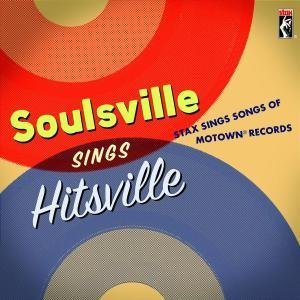
Soulsville sings Hitsville

soulsville sings hitsville

By Joel Francis

Rare was the time Berry Gordy would let Motown artists record songs outside of the Hitsville catalog (and its lucrative publishing).  Fortunately, Jim Stewart at Stax did not have the same stipulation. Thanks to the 2007 compilation “Soulsville Sings Hitsville: Stax Sings the Songs of Motown Records” soul fans have at least one direct barometer to use in the never-ending debate of Stax vs. Motown.

Rivalries and arguments aside, “Soulsville Sings Hitsville” is a great 15-song collection that casts many soul nuggets worn out by oldies radio in a new light. Soul fans from either side of the Mason-Dixon line will find a lot to enjoy here. And now for the 15-round battle in the head-to-head match of Stax vs. Motown.

Round 1:  – “Stop! In the Name of Love”

Margie Joseph vs. the Supremes

The Supremes took this song to No. 1 in 1965 and made it one of their defining songs. Margie Joseph adds a lengthy monologue and a completely new arrangement that transforms the song. They lyrics are about the only element these versions share. Although it’s hard to top Holland-Dozier-Holland production, Joseph accomplishes the feat by making the song her own and having an infinitely better singing voice than Diana Ross.

Winner: Stax

Round 2:  – “I Don’t Know Why I Love You”

David Porter vs. Stevie Wonder, the Jackson 5

David Porter made his name as half of the Porter-Isaac Hayes hitmaking machine in the ‘60s before striking out on his own in the ‘70s. His version of “I Don’t Know Why” easily tops the Jackson 5’s reading. Michael Jackson just isn’t old enough to put the necessary grit in his vocals and ends up practically shouting the song. The gold medal here, though, goes to the co-author and original performer Stevie Wonder. Released as a single from his 1968 album “For Once In My Life,” the song peaked at No. 16 on the R&B charts. Wonder’s vocals simmer, building in intensity until they boil over at the 1:40 mark. Wonder sings so hard he’s almost out of breath as the great arrangement continues to build until the only options are to explode out of the speakers or fade out. Faced with potential lawsuits from music lovers, the track ends just under the three-minute mark.

Winner: Motown

Round 3 – “You’ve Got to Earn It”

Staples Singers vs. the Temptations

One of the Staples Singers’ biggest hits, this song is so closely identified with the group that I didn’t even know the Temptations recorded the original. This Smokey Robinson-penned number was released in 1965 on the b-side of “Since I Lost My Baby.” The Tempts version is serviceable, but aside from Eddie Kendricks’ lead vocals isn’t that memorable. The Staples version trumps on every level: Mavis Staples great singing, the spectacular arrangement featuring a signature descending horn line and harmonica, and the soulful playing and support of Pops and Yvonne Staples.

Winner: Stax

Round 4 – “Can I Get a Witness”

Calvin Scott vs. Marvin Gaye

In the NFL, when a play is challenged and the officials go under the hood for review, there must be incontrovertible evidence to overturn the call. So goes it with covers. It is not sufficient to merely equal the original recording, the burden of the cover is to surpass the original. Calvin Scott does a good job putting his twist on one of Marvin Gaye’s earliest hits, but he doesn’t add anything to it either. Take pity on Scott, however – topping Gaye is no small feat.

Winner: Motown

Round 5 – “Reach Out (I’ll Be There)”

Mar-Keys vs. Four Tops

Although some session credits are available, the Mar-Keys kind of became the catch name for whoever was playing with the Memphis Horns. Some of their cuts ended up on Booker T. and the MGs or Isaac Hayes albums, some were added to Bar-Kays releases and others credited to the Mar-Keys themselves. The Mar-Keys’ 1971 version of “Reach Out (I’ll Be There)” is one of the numbers that has fallen through the cataloging cracks – Stax historians aren’t really sure who played on it. However, one fact is indisputable: this track rocks. Andrew Horn blows a mad sax solo with enough grit and soul to match Levi Stubbs’ incomparable voice, while the rest of the musicians strip the sheen laid by the Funk Brothers on the original Motown recording. That said, the Four Tops version became one of their defining performances for good reason. The decision here comes down to preference: the dirtier R&B of Stax or the polished soul of Motown. I like ‘em both.

Winner: Push

Round 6 – “Never Can Say Goodbye”

Isaac Hayes vs. Jackson 5

Isaac Hayes and the Jackson 5 both released their interpretations of Clifton Davis’ “Never Can Say Goodbye” in 1971. The results couldn’t be more different. The pain in Hayes’ deep voice pits him as a grown man with life experience against a bunch of talented kids acting their hearts out. In the weeks following the death of Michael Jackson, the J5 performance has become an unofficial tribute to their singer. It’s a fine sentiment, but, as Mos Def would say, this is grown man business. Hayes wins, no contest.

Winner: Stax

Round 7 – “My Cherie Amour”

Billy Eckstein vs. Stevie Wonder

In the 1940s, Billy Eckstein’s orchestra was one of the first large bop combos in jazz, providing an early home for Dexter Gordon, Miles Davis, Art Blakey, Charlie Parker and Dizzy Gillespie. In the ‘50s, Eckstein’s smooth voice influenced up-and-coming soul singers like Sam Cooke and Solomon Burke. Eckstein dabbled in both soul and jazz in the 1960s, even popping up on  a couple Motown LPs. Although his career was pretty much over by the ‘70s, Al Bell was able to coax the legend to cut a few albums for Stax. Unfortunately, Eckstein’s 1970 delivery of “My Cherie Amour” borders on parody and sadly resembles Jim “Gomer Pyle” Nabors’ version of “You Are the Sunshine Of My Life” that may be found on the Golden Throats series.

Winner: Motown

Round 8 – “Oh, Be My Love”

Barbara Lewis vs. Smokey Robinson and the Miracles

Barbara Lewis actually got her start as a teen soul singer in early ‘60s Detroit before finding greater success on Stax. Based on this number, it’s odd that Berry Gordy passed on Lewis at a time when he was seemingly signing every promising young singer in the city. Lewis’ voice is a perfect fit for the Motown sound. Then again, maybe it’s for the best Lewis didn’t join the Motown family. Chances are she would have ended up another in the long line of promising female talents discarded in the wake of Diana Ross. Lewis does a fine job with this interpretation of a 1967 Miracles b-side penned by Smokey Robinson. Unfortunately, the original version could not be located for comparison.

Winner: No decision

Round 9 – “I Hear a Symphony”

Booker T. and the MGs vs. Diana Ross and the Supremes

On paper, this looks like a slam dunk: Remove Ross’ weak vocals and replace it with one of the tightest, funkiest groups of the day. But somehow, the MGs’ performance just doesn’t add up. The melody just doesn’t sound complete coming only from Steve Cropper’s guitar and Booker T. Jones’ organ can’t replicate the fullness of the Funk Brothers playing. The Supremes’ version is definitely more than the sum of its parts, and a testament to the acumen of the Holland-Dozier-Holland team.

Winner: Motown

Round 10 – “Chained”

Mavis Staples vs. Marvin Gaye

Marvin Gaye took a break from cutting duets with Kim Weston and Tammi Terrell to lay down this funky number in 1968. The backing vocals and atmosphere give the track a live feel and the sax break is as close to the Stax sound as Motown gets. Mavis Staples cut her version a year later. She more than holds her own against Gaye’s vocals, and the arrangement is just as energetic. Both versions can pack the dance floor, yet are just different enough to stand on their own. Why choose one performance when you can have both?

Winner: Push

Round 11 – “Ask the Lonely”

John Gary Williams vs. Four Tops

John Gary Williams cut several sides for Stax/Volt as a member of the Mad Lads until he was drafted in 1966. When Williams got out of the military, he wasn’t exactly greeted with open arms. His former group had carried on in his absence, and found Williams’ replacement to be much easier to work with. Stax owner Jim Stewart pressured the group to take Williams back and he recorded with the Lads until 1972. That year, Williams was finally able to go solo. He released only one album, which included covers of George Harrison’s “My Sweet Lord,” the Spinners and this reading of “Ask the Lonely.” The smooth sax solo that opens this song and Williams’ vocals foreshadow the Quiet Storm movement. Williams arrangement and delivery may have been ahead of it’s time, but it’s not nearly enough to wrestle the title away from Levi Stubbs’ gut-busting performance on the original.

Winner: Motown

Round 12 – “Signed, Sealed, Delivered”

Soul Children vs. Stevie Wonder

The success of “Signed, Sealed and Delivered” – it spent six weeks at No. 1 on the R&B charts in 1970 – gave Stevie Wonder a great deal of leverage when he renegotiated his contract with Motown and gained the artistic control that birthed his spectacular output later in the decade. “Signed” was the first single 20-year-old Wonder produced; his arrangement is so good you can get lost in the various instruments. There isn’t much that can be improved on Wonder’s version and the Soul Children’s slowed-down gospel interpretation falls flat in the face of his triumph.

Winner: Motown

Round 13 – “Someday We’ll Be Together”

Frederick Knight vs. Diana Ross and the Supremes

Diana Ross’ name is coupled with the Supremes on the label of “Someday We’ll Be Together,” technically making it the ensemble’s final No. 1 hit before Ross started her solo career. Peeling back the label and examining the musicians’ chart, however, one can see that the song was actually a dry run for Ross’ solo career. Supremes Mary Wilson and Cindy Birdsong, who replaced founding ‘preme Florence Ballard, are nowhere to be found, but even if they did they probably wouldn’t have been able to help. The song, co-written and produced by Harvey Fuqua, is a mess. The strings are way too syrupy, and the backing vocals are over-performed. Everything on the track is over-produced. Perhaps this was an effort to make Ross’ thin vocals sound more emotionally relevant, but even that is a failure. It does sport a great guitar line, though. Frederick Knight vaults over this ridiculously low bar, but he doesn’t exactly salvage the song. His strings are more restrained, the arrangement slightly more funky and the vocals greatly improved, but the song itself – which predates Fuqua’s time at Motown – is far from memorable.

Winner: Stax

Round 14 – “I Wish It Would Rain”

O.B. Clinton vs. the Temptations

“I Wish It Would Rain” is one of the most devastatingly heartbreaking songs in the Motown catalog. Mourning his lost love, David Ruffin lays his soul bare for all to see. Topping this soul masterpiece would be quite a challenge – so O.B. McClinton didn’t even try. Dubbed the “Chocolate Cowboy,” McClinton was an oddity on the Stax label. His singles only charted on the country charts, with his slower tempo, pedal steel-backed version of “I Wish It Would Rain” peaking at No. 67 in 1973. His is a noble attempt, but the song works better in R&B than it does country.

Winner: Motown

Round 15 – “I Heard It Through the Grapevine”

The Bar-Kays vs. Marvin Gaye, Gladys Knight and the Pips

The wah wah guitar solo that punctures the Bar-Kays’ version of “I Heard It Through the Grapevine” just past the four-minute mark eclipses anything Gordy had imagined at Motown (save Rare Earth) and points Stax down the very odd path of Iron Butterfly and the acid rock of the early ‘70s. This version draws on the spirit of Isaac Hayes’ Oscar-winning “Shaft” and steers close to CCR’s lengthy, jammed-out rendition. I’m not sure if this actually tops the performances Marvin Gaye and Gladys Knight took to No. 1 a little more than a year apart. The versions are so different; it’s comparing apples and oranges. Enjoy them all.

Winner: Push

Final score: Stax 4, Motown 7.

The winner in this (the only) bout is overwhelmingly Motown, but Hitsville has an incumbent’s advantage of making Stax tackle its material. Listening to the Supremes tackle the Emotions, Levi Stubbs sparring with the Otis Redding songbook , the Temptations doing Sam and Dave and Norman Whitfield and Holland-Dozier-Holland applying their touches to Hayes/Porter and MGs arrangements would not only be a fantastic delight, but likely tip in favor of Soulsville. Sadly, we’ll never know. As a consolation prize, we have this compilation to bridge two very different and influential approaches to soul music.

Review: No Doubt, Paramore

(Above: No Doubt perform “Running” at Starlight Theater on July 6, 2009.)

By Joel Francis
The Kansas City Star

On its first tour in seven years, No Doubt might be packing large venues like Starlight Theatre on Monday night, but it’s playing them like a hungry band working the crowd for a place to crash afterward.

The few times the band paused during its 95-minute set, singer Gwen Stefani read the crowd’s homemade signs and called fans toting gifts up to the stage.

After tossing a sign spray-painted with a request for “Total Hate 95,” one fan was rewarded with a performance of the rare number. Later, after accepting the cross-stitched logos another fan made, a genuinely touched Stefani hauled her admirer onstage for a quick photo op.

When she wasn’t speaking to the crowd, Stefani and company were giving them exactly what they wanted: a heavy dose of the hits that made the band big in the first place. The setlist resembled the track list of the greatest hits album No Doubt released before going on hiatus, a celebration of the 11 years they’ve shared.

The opening ska bounce of “Spiderwebs” had the crowd eating out of Stefani’s hand, singing, swaying and dancing on cue. That number fell into the electro pop of “Hella Good.” The tempos may have changed throughout the night, but the energy never lagged. Through it all, Stefani was never still, dancing, spinning, jumping and unceasingly working the crowd.

The other five musicians onstage gave no evidence of any time apart. Drummer Adrian Young sat in the middle of the all-white stage, his kit the centerpiece of a six-legged platform that looked like a futuristic insect. He was flanked by multi-instrumentalists Stephen Bradley and Gabrial McNair, who handled horns, keyboards and backing vocals. Stefani, guitarist Tom Dumont and bass player Tony Kanal navigated the rest of the stage.

Behind them all, a large screen played videos during most songs. The best bits were the James Bond parody during “Ex-Girlfriend” and the homemade videos of the band’s early days accompanying the ballad “Running.”

“Don’t Speak” drew the biggest response, but it was nearly matched by “Just a Girl,” which closed the main set. As Dumont played its spidery opening riff, Stefani dropped to the floor and counted out push-ups with the crowd. After reaching 10, she sprung to her feet and launched into the verse. Both feats drew massive cheers.

One got the feeling during Paramore’s 40-minute set that the band brought as many fans as the headliners. The power pop quintet’s set was marked by a constant stream of young fans rushing as close to the stage as their parents would let them to snap a photo.

The setlist tipped heavily toward the 2007 album “Riot,” which delighted the devoted, who hung on singer Hayley Williams’ every word. The two new songs, which blended almost too well with the older material, and set-closing “Decode” from the “Twilight” soundtrack, were extra treats.

Bedouin Soundclash opened the evening with a 30-minute set.

After No Doubt returned for “Rock Steady,” Bedouin Soundclash and Paramore joined the band for “Stand and Deliver.” Nearly all of the dozen musicians onstage pounded the various drums brought out while Stefani and Williams swapped verses. No Doubt drummer Young managed to stand out in the crowd by parading around wearing only a pink-and-white tutu, marching snare drum and calf-high athletic socks.

The night ended with “Sunday Morning,” which, like so many No Doubt triumphs, hit the sweet spot between pop, ska, dance and rock. When the music ended, band members lingered onstage signing autographs, tossing souvenirs and shaking hands.

Just as they did in their native Southern California clubs a lifetime ago.

SETLISTS
No Doubt:
Spiderwebs, Hella Good, Underneath It All, Excuse Me Mr., Ex-Girlfriend, End It On This, Total Hate 95, Simple Kind of Life, Bathwater, Guns of Navarone, New, Hey Baby, Running, Different People, Don’t Speak, It’s My Life, Just a Girl//encore: Rock Steady, Stand and Deliver, Sunday Morning

Paramore: Misery Business, For a Pessimist, I’m Pretty Optimistic, Pressure, Ignorance (new song), Crush Crush Crush, When It Rains, Where the Lines Overlap (new song), That’s What You Get, Let the Flames Begin, Decode

Remembering how Grandma rocked

dv0302016

By Joel Francis

We never had cable television in our house when I was growing up. Some people are surprised when I reveal this tidbit, but I don’t think one would have to scratch to deeply to tie this to my long-running obsession with pop culture.

As a child this was no big deal, but as I got older being disconnected from the great mainstream fountain of MTV put my sister and I severely out of the loop.

To plug into the cultural zeitgeist we had to go to the Mecca of the cutting-edge, St. Joseph, Mo. There, at our grandparents’ house, we got to gorge on cable programming and feast on the forbidden MTV. Thanksgiving and Christmas were the best. With two extended breaks within a month of each other, my sister and I could catch up on all the Yo! MTV Raps, Club MTV, Headbanger’s Ball and Street Party we could get away with.

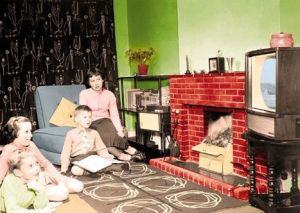
Our system was both simple and foolproof. The main TV in my grandparents’ house was in the basement by the fireplace. My sister would position herself at the bottom of the steps (with the door “accidentally” closed at the top), and I would hover my finger over the “previous channel” button on the remote, ready for her signal.

In that basement we saw the videos for Aerosmith’s “Sweet Emotion,” Guns ‘N’ Roses’ “November Rain,” U2’s “Even Better Than the Real Thing,” and Michael Jackson’s “Jam” for the first time. We witnessed the evolution of Kurt Cobain, performing with cheerleaders, hanging on a cross and eventually playing unplugged in a natty sweater. We also saw the hot dance moves I knew my hopelessly uncoordinated body would never let me conquer. Armed with this information, we would return to school and be in the know until Valentine’s Day. In that brief window, all of our touchstones would begin to stale until we were once again relegated to the sidelines and second-hand video knowledge.

Of course watching that much MTV could only lead to premarital sex and other inappropriate behavior, but if our parents cared they didn’t let on much. They were probably just happy my sister and I weren’t fighting for once. There may have been several occasions dad watched with us just to see what all the fuss was about. Allegedly. (He was as impressed with the 360-degree camerawork on “Even Better Than the Real Thing” as us. In a pre-“Matrix” world it was pretty remarkable. I also remember him liking the dolphins in Guns ‘N’ Roses’ “Estranged,” not that it made any more sense then than it does now.)

My grandparents downsized to a condo in the late ‘90s. By then I was in college and my sister could drive to Westport and experience a more authentic musical environment. They eventually moved closer to our parents and better healthcare in Independence.

Grandma died a week ago today, five days after suffering a stroke that rendered her right side paralyzed and took away her ability to speak. She could still smile, though, and the half of her face that could lit up any time one of her loved ones walked into her hospital room. She went quicker than expected – Grandpa didn’t even have the chance to say goodbye – but peacefully in her sleep.

Truth is, of all my grandparents, my grandma and I probably had the least obvious connection. She was all the things I wasn’t: patient, selfless and completely uninterested in sports, music and movies. Her life revolved around church and serving her friends and family. Anything else that collided with that universe was just gravy.

The TV in her basement, like a lot of the furniture in that room was sold or given away long ago. But in a lot of ways, it was never turned off. I go back there in my mind when I pull up a long-forgotten Black Star video up on Youtube, or watch any of my music DVDs. And now I think of Grandma, waiting for us upstairs with a freshly prepared hot meal and a smile on her face. Come join us. There’s always room for one more at her table.

“Stax Does the Beatles”

zzstaxdoesthebeatles~_101b

By Joel Francis

The ultimate Stax tribute to the Beatles was Booker T and the MGs 1970 album “McLemore Avenue.”  None of those tracks appear on the 2007 compilation “Stax Does the Beatles,” but strong contributions from Isaac Hayes, the Bar Kays, Carla Thomas and four other MG tracks make collection as strong as it appears on paper.

Otis Redding opens the album with arguably the greatest Beatles cover of all time. His version of “Day Tripper” (presented here in an unreleased alternate take) may even top the Beatles. Redding’s “Day Tripper” may be second only to Wilson Pickett and Duane Allman’s “Hey Jude” in the pantheon of Beatle covers. Pickett’s reading is sadly missing on this album, but David Porter’s “Help!” continues Redding’s frenetic horn lines and double-time delivery to add an urgency only hinted in John Lennon’s originals vocals.

“Stax Does the Beatles” contains two very different versions of “Yesterday,” a funky, sassy spin on “And I Love Her” and a slight cheat with John Gary Williams’ 1973 cover of George Harrison’s “My Sweet Lord.” Some readings work better than others, but all are stamped with the high quality that defined the Stax catalog.

The collection’s centerpiece is Isaac Hayes’ 12-minute cinematic, romantic rendition of “Something.” His arrangement features almost as many instruments as the Beatles “A Day in the Life,” including saxophone, wah guitar, full orchestra and a gorgeous piano line that holds the whole thing together. And that’s just the first 2 minutes.

Some might complain Hayes’ “Something” is overblown, over-produced and pretentious. They haven’t been paying attention to the deep longing in Hayes’ voice.

Although “Something” and “Day Tripper” come the closest, nothing on this collection will replace or make one forget the Beatles versions. The magic in their songs is that there are so many nooks and crannies it seems unlikely future generations will ever exhaust the possibilities of reinterpretation.

For Beatle fans that can play a song in their head by just thinking of the title or chorus, these R&B translations are for you. They are a fresh coat of paint on a favorite structure. For soul fans interested in the influence of soul in rock and vice versa, there is much to enjoy in “Stax Does the Beatles.” People who don’t like either Stax or the Beatles should find the nearest house of worship and repent. Then buy this on the way home.

Review: Earth, Wind and Fire with Chicago

(Above: Chicago and Earth, Wind and Fire team up to rock “25 or 4 to 6.” That song ended the duo’s three-hour performance at the Sprint Center on Sunday.)

By Joel Francis
The Kansas City Star

Chicago and Earth, Wind and Fire took the stage Sunday night at the Sprint Center armed with enough musicians for a intramural football team and sufficient horns to start a Glenn Miller Orchestra franchise.

The 18-strong band opened with a tag-team of each other’s hits, opening appropriately with “Beginning” followed by “Never” and an extended “We Can Make It Happen.” The bands played like there was a penalty for letting the energy lag, barely pausing to take a breath between numbers.

With the crowd warmed up, Chicago departed leaving Earth, Wind and Fire to entertain on their own. The soul veterans were more than up to the task. They kicked off their hour-long set with “Boogie Wonderland,” which activated the hidden springs in each seat that forced everyone to their feet.

Serpentine Fire” and the Latin-influenced “Evil” made sure everyone kept moving until the cascade of slow jams: “That’s the Way of the World,” “After the Love is Gone” and a cover of Chicago’s “Wishing You Were Here.” That number got a smooth jazz make-over that featured original member Philip Bailey’s pillow-soft falsetto.

The spotlights turned on the energetic crowd for a sing-along through “Got to Get You Into My Life,” which found the band working the lip of the stage shaking hands with the crowd. After “Fantasy,” the stage went dark and three huge neon drums were wheeled to center stage. Armed with neon drumsticks and shirts with lights the ad hoc drum corp. created an impressive groove that segued into the set-ending “Let’s Groove.”

Chicago did themselves a favor by scheduling a 20-minute intermission before their set, but they still had a hard time matching EWF’s energy. “Saturday in the Park” got things off to a good start and their cover of “I Can’t Let Go” returned the favor EWF paid with “Wishing You Were Here.”

Unfortunately, the band slipped into soft rock mode after an spirited “Alive Again.” “Look Away” melted into “Hard Habit To Break,” “You’re the Inspiration,” “Just You and Me” and “Hold Me Now.” True, all the songs were hits and drew enthusiastic vocal support from the crowd, but putting them all together killed the pacing and energy.

After coaxing the audience back to their feet, Chicago’s 50-minute set closed with “Stronger Every Day.”
Despite just seven original members across the two groups, strong arrangements meant key departed musicians like Maurice White and Peter Cetera weren’t missed. With so much talent onstage, special effects took a back seat – the musicians were more than enough spectacle.

The stage featured a two-tiered riser with a drum kit on each side at the top which made the structure resemble twin pyramids. There was plenty of space out front for the artists to run around. None of them made better use of this space than EWF founding bass player Verdine White, who strutted in fringed bell-bottoms and appeared to be having the time of his life.

The upper deck of the Sprint Center was curtained off, leaving a cozy lower bowl that didn’t have many empty seats. The sound was good. Not clear enough to pick out each specific instrument, but each section was distinct. Drums thumped, guitars sizzled and horns punched.

This was the groups’ third tour together and it’s easy to see why both musicians and audiences keep coming back. While similar outings could turn into a battle of the bands, Chicago and EWF complement each other well. Both are known for soaring vocals and intricate horn lines and really are two sides of the same coin.

The night ended the same way it began, with both bands onstage trading hits. EWF’s “September” led into Chicago’s “Free,” which featured the sax players from both bands sparring over a White bassline that recalled the finer moments of Maceo Parker and Bootsy Collins in James Brown’s band.

The bands nailed the night shut with a run on “Sing A Song,” “Does Anybody Know What Time It Is,” “Shining Star” and “25 or 4 to 6” that didn’t leave any other option but to dance. Three hours after taking the stage together, the musicians celebrated each other like a sports team winning the pennant. In a way, they had.