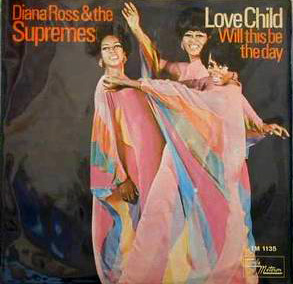
Diana Ross and the Supremes – “Love Child”

Lovechild-single-supremes
Diana Ross and the Supremes – “Love Child,” Pop # 1, R&B # 2

By Joel Francis

The departure of Holland-Dozier-Holland reverberated throughout Hitsville, but no one felt it as acutely as the Supremes. Between 1964’s “Where Did Our Love Go” and 1967’s “Reflections,” the powerhouse songwriting and production triumvirate landed 10 songs at No. 1 and a three more in the Top 10.

Berry Gordy spared little expense in turning the Supremes into the biggest group on his label, and he was loathe to see them slink back to their pre-HDH obscurity. Before the two trios met, the best the Supremes could muster was No. 23. Those numbers were no longer acceptable.

Desperate, Gordy sequestered a half dozen of his best writers in a Detroit hotel and demanded they come up with a new hit for Diana Ross and the Supremes. Credited anonymously to “The Clan,” the result was another No. 1 hit for Gordy’s favorite group. The Clan model worked so well, Gordy revived it the following year, this time as “The Corporation,” to write hits for the Jackson 5. Gordy gave both these teams generic names to prevent writers and producers from superseding the fame of the performer or the label.

It would have been fascinating to be a fly on the wall as the writers pitched this song to Gordy. Love songs were the Supremes bread and butter, but it’s doubtful Gordy envisioned his siren singing about abstinence. In “Love Child,” a woman, scarred by being born out of wedlock, the singer tries to convince her man to “hold on just a little bit longer” and understand that “no child of mine will be bearing/The name of shame I’ve been wearing.” “Love Child” wasn’t the first song to touch on unwanted pregnancy – Gordy himself and Smokey Robinson wrote the song  “Bad Girl” in the early days of the Miracles  – but it became the definitive song on the subject until “Billie Jean.”

Diana Ross is the only Supreme to appear on “Love Child,” and for once her voice does a song justice. This might be because the background of the woman in the song mirrors Ross’s childhood in the Brewster-Douglass housing project in Detroit. Unlike the song’s subject, Ross was born to married parents. The painfully shy Ross could no doubt to the lyrics like “So afraid that others knew I had no name” and “I started school/And a worn, torn dress that somebody threw out. Too poor to afford the stylish clothes she coveted, the aspiring fashion designer made her own clothes cobbled from scraps and hand-me-downs.

“Love Child” opens with a few bars of funk guitar before the sweep of strings relegate the guitar to the back of the mix. The arrangement – particularly the strings and backing vocals – foreshadows the disco trend that would serve Ross so well in the decade to come. For such a hard-driving song, the percussion is surprisingly soft. During Hitsville’s production-line heyday, the song would have been driven by snare and tambourine. Nearly a minute of “Love Child” passes before the snare a full drum kit completely engage. Instead, the propulsion rests with what sounds like ride cymbal, maracas and a glockenspiel.

Although they aren’t on the record, Mary Wilson and Cindy Birdsong performed the song with Ross on the Ed Sullivan Show in September, 1968. Despite the show’s conservative stance against the Rolling Stones “Let’s Spend the Night Together,” and the Doors “Light My Fire,” they lyrics to “Love Child” were performed as-is with no discussion. It was one of the group’s final performances on the popular Sunday night TV staple.

Despite its success, few performers have covered “Love Child.” It is unlikely the Supremes number will be confused with Deep Purple’s 1975 song of the same name.

Review: Kind of Blue turns 50

(Above: Jimmy Cobb’s So What Band delivers “The Theme” – and a drum solo.)

By Joel Francis

Jimmy Cobb had been onstage at the Gem Theater for over an hour Saturday night before he finally gave the capacity crowd what they came for: a drum solo.

As the last living musician from the landmark Miles Davis sessions for “Kind of Blue,” Cobb would have deserved an ovation regardless of what he played. The taught and thunderous riffs that snapped from his 80-year-old wrists would have been impressive from someone half Cobb’s age.

All year Cobb and his sextet, dubbed the So What Band, have toured the world celebrating the 50th anniversary of “Kind of Blue.” Since Cobb is the last living musician from those sessions, it’s a noble gesture and fantastic marketing, but the execution could have been deadly. Play it too close to the original and you end up with paint-by-numbers Davis and John Coltrane. Improvise too much and the music not only loses its spirit, but the evening seems like a gimmick.

Fortunately, the band played it down the middle, playing homage without slavish dedication. As the trumpet player, Wallace Roney had the greatest cross to bear. While not emulating Davis, Roney’s similar moody tone and posture made comparisons inevitable. Tenor saxophonist Javon Jackson seemed hesitant and overwhelmed at times in his role filling Coltrane’s shoes but overall added a strong voice to the night.

As the stand-in for the lesser-known Cannonball Adderly, alto sax player Vincent Herring had the most flexibility. Herring took advantage by chipping in adventurous solos that varied the textures laid by Roney and Jackson. Pianist Larry Willis was the ensemble’s hero, vamping on the chords behind the soloists with flourish and relishing every turn in the spotlight.

The band whipped through “Kind of Blue” in order, extending the original LP’s run time by about a half hour. “So What” started at an aggressive tempo accentuated by Roney’s angry solo that made “Freddie Freeloader” seem almost jovial in contrast.

Willis opened “Blue In Green” with a tremendous solo before Roney took over. The melancholy number was made even more poignant by the way Roney whipped away from the mic after his solo, leaving before the note was finished and before any resolution.

Since there was no drum solo on “Kind of Blue,” the band added “The Theme,” a piece from Davis’ period on the Prestige label, as a showcase for Cobb. He took another brief solo during “Four,” the joyous victory lap of an encore.

After striking the right tone, the ensemble had carte blanche with the rapturous crowd. The musicians were speaking through an established vocabulary with the emphasis on the right syllables. There would be no funk breakdowns, hip hop remixes or hard rock power chords. While the conservative approach often cuts against the genre’s best interests, Saturday night it sounded magnificent.

Setlist: So What, Freddie Freeloader, Blue In Green, All Blues, Flamenco Sketches, The Theme. Encore: Four.

Review: Mutemath

(Above: Mutemath drummer Darren King does the monkey at the Beaumont Club on Oct. 16, 2009.)

By Joel Francis
The Kansas City Star

The Beaumont Club has had many colorful adjectives hurled its way through the years, but “percussive” has probably never been one of them. It’s puzzling, then, that Mutemath drummer Darren King decided to rap his drumsticks on the rafters near the conclusion of Mutemath’s 100-minute show on Friday night.

Balanced on a bass drum held aloft by the crowd, King beat on the metal beams before swinging back onstage like a primate and joining half the band at his proper drum kit to conclude the night.

It took both the quartet and the crowd a while to reach that point, though. For the first half of its show, Mutemath was restrained to a fault, drawing warm applause but little dancing or movement. The audience seemed content to stand and take in the spectacle and see where the music would lead them.

And what a spectacle it was. With the drums set off at extreme stage left, a huge semicircle video screen and bank of lights dominated the setting, the stage looked like Pink Floyd and band sounded like an angular U2, heavy on the Eno.

Mutemath were at their atmospheric best on “Stare at the Sun,” a hypnotic number from their 2006 debut. Like many of their songs, it deals with the search for greater meaning and the uncertainty in those discoveries.

“You Are Mine” made great use of the screen by playing grainy black-and-white film loops behind the band. As singer and keyboard player Paul Meany sang about love, the images blurred the lines between devotion and obsession. On “No Response,” King stood in front of the screen a played a set of illuminated electronic drum pads that set off light cues.

King had the flashiest role, but bass player Roy Mitchell-Cardenas was the band’s secret weapon. Switching between electric and upright bass, his instrument was the only one that consistently carried the melody and existed beyond adding texture. Utility man Greg Hill was the jack of all trades, alternated between guitar – his primary instrument – keyboards and percussion.

After about 30 minutes of foreplay, the band slowly started gaining speed. It started during “Noticed,” when Meany abruptly quit singing and the crowd picked up the song on cue. That led into the bright pop of “Typical,” and a sea of smiles. The main set ended with an insistent reading of “Burden” that found the band stretching out. The powerful performance sounded like it somehow morphed from the single into the 12-inch remix before wrapping back up with the chorus.

After a break and the slight “Pins and Needles,” the band picked back up where it left off with “Spotlight,” which found Meany spontaneously jump up from behind his keyboard and dancing around the stage. “Reset” featured a long instrumental introduction and had been going for nearly 10 minutes when King started dancing on the ceiling. By then, no one wanted to come down.

Setlist: The Nerve, Backfire, Chaos, Clipping, No Response, (unknown song), Stare at the Sun, Electrifying, Armstice, You Are Mine, Peculiar People, Noticed, Typical, Burden. Encore: Pins and Needles, Spotlight, Reset.

Celebrating Buck O’Neil, Kansas City and Jazz

(Above: Thirty seconds with Buck O’Neil is guaranteed to brighten your day.)

By Joel Francis

Buck O’Neil, Negro Leagues baseball player and ambassador of all things good, died at age 90 three years ago this month. Today we pay tribute to Buck by reprinting his longest music-only interview.

I spoke to Buck as an undergrad back in the summer of 1998 while freelancing for the Kansas City Blues Society. For some reason the article never made it into “Blues News,” and it languished until Ken Burns premiered his “Jazz” documentary series in 2001. I was working for The Examiner in Independence, Mo. at the time. They were all too happy to run my interview.

The day photographer and I took the picture that accompanied the story (not the one that appears online), we met Buck at the Blue Room then hit Arthur Bryant’s around the corner. Now *that’s* Kansas City.

Keep reading:
Buck O’Neil: Sweet Times and Sweet Sounds at 18th and Vine.

New DVD Box Set Celebrates Rock Hall Performances

rock hall dvds

By Joel Francis

When the Rolling Stones were inducted into the Rock and Roll Hall of Fame in 1989, a tuxedo-clad Mick Jagger famously announced “Tonight we’re all on our best behavior — and we’re being rewarded for 25 years of bad behavior.”

That irony is on full display throughout eight of the DVDs in a new collection of induction ceremony performances released by Time Life and the Rock Hall this month. (A ninth disc features highlights from the 1995 Concert for the Rock and Roll Hall of Fame held in Cleveland.) Despite white tablecloth banquet tables and austere surroundings, great music frequently prevails.

The “Rock Hall Live” discs each run between 75 and 90 minutes and have a loose theme of soul, punk or ‘50s pioneers and the performances span the first ceremony in 1986 to this year’s Metallica induction. The performances tend to fall in two camps.

The early ceremonies were all-star celebrations of the inductees’ songbooks shot with on a couple video camera. Through fly-on-the-wall footage we see Jerry Lee Lewis and Chuck Berry swap verses on “Roll Over Beethoven” and Little Richard rejoice through “I Can’t Turn You Loose” as Jagger, Bob Dylan, members of the Beatles, Beach Boys and other rock royalty stand shoulder to shoulder, holding mics and strumming instruments. It’s fun to play spot the artist during these early presentations. Sometimes the results are shocking, as when Stevie Ray Vaughan appears – playing a Les Paul, no less – during “Beethoven.”

As the ceremonies grew in stature, the performances were better preserved and choreographed. The past 15 years of inductions play like one massive VH1 special, makes sense as these events have been a spring broadcast staple on that channel for better than a decade. Although the production is smoother, the spontaneity is retained when Jimmy Page casually strolls onstage to join Jeff Beck on “Beck’s Bolero” and Queen jam with the Foo Fighters on “Tie Your Mother Down.”

With are more than 100 performances across the nine discs, some unevenness is expected. Some this is because of the health of the performers. These discs capture some of the final appearances by The Band’s Rick Danko, Ruth Brown, Lynyrd Skynyrd’s Billy Powell and Johnny Cash. Brown and Powell are fine, but Danko and Cash labor through their sets. Sometimes the pairings misfire, as on Bruce Springsteen and Axl Rose’s duet through “Come Together.”

These missteps are minimized by the tight pacing of each disc, which moves from artist to artist like a well-paced soundtrack, with occasional snippets of introduction and induction speeches. (Complete version of selected speeches are available as bonus features.)  Despite the loose themes, each disc boasts a variety of guitar heroes, singer/songwriters, tributes and hits.

The best moments come when the performers reach beyond the formal atmosphere, like when Patti Smith spits onstage, or two kids bum rush the stage to help Green Day commemorate the Ramones. There is an impressive display of solos from guitar heroes Beck, Page, Eric Clapton, Buddy Guy, B.B. King, Joe Perry, Carlos Santana, Peter Green, and Kirk Hammett, but the greatest six-string moment is Prince’s searing tribute to George Harrison on “While My Guitar Gently Weeps.” Anchored by Tom Petty, Jeff Lynne and Harrison’s son Dhani, the immaculately tailored Prince soars on an jaw-dropping solo that is long on both melody and style.

Each disc contains about a several bonus features, which highlight backstage moments like watching Steven Tyler and Joe Perry induct Led Zeppelin from the wings of the stage with the band (and Willie Nelson!). It’s fun to watch Robbie Robertson, Bruce Springsteen and John Fogerty work out “Green River” and to eavesdrop on Hammett and Perry talk about guitars, but one viewing is probably enough.

One downside to this set is the packaging and sequencing. Each disc is housed in its own separate, full-sized case. This takes up a lot of shelf space. It would have been nice if they all came bundled in one compact, cardboard and plastic unit like seasons of TV shows.

The greater inconvenience is the sequencing. Cream’s three-song reunion from 1993 is spread across three discs. Ditto for the Doors’ 1993 set with Pearl Jam’s Eddie Vedder (three songs over three discs) and Bruce Springsteen’s E Street revival from 1999 (four songs on four discs). Culling the best moments is understandable, but it would have been great to get the multi-song sets in one place. It is also puzzling that less than two hours of the six-hour Concert for the Rock and Roll Hall of Fame are included.

Oversights aside, any of these discs stand alone as a fun romp through rock history and celebration of its greatest songs and players across most genres and eras. At $120, this set isn’t cheap, but it’s a heck of a lot more affordable – and easier to come by – than the ticket that gets you a plate at one of those sterile, banquet tables. You don’t have to dress up, either.

(Full disclosure: The Daily Record received a complimentary review copy of “Rock Hall Live.”)

Keep Reading:

Rock Hall Celebrates 50 Years of Motown

Rock Hall Celebrates the 40th Anniversary of Woodstock

George Kalinsky: Painting with Light (Rock Hall photo exhibit)

Bruce Springsteen Rocks the Hall (part one)

Bruce Springsteen Rocks the Hall (part two)

Marvin Gaye and Tammi Terrell – “Ain’t Nothing Like the Real Thing”

ain't nothing
Marvin Gaye and Tammi Terrell – “Ain’t Nothing Like the Real Thing,” Pop # 8, R&B # 1

By Joel Francis

Marvin Gaye and Tammi Terrell’s first album together, “United,” was a smash that spawned three Top 5 R&B hits and turned Gaye into a soul superstar. A follow-up was inevitable. In March, 1968, less than three months after the release of their previous single, “Ain’t Nothing Like the Real Thing” announced the fruits of the duo’s new collaborations.

“Ain’t Nothing Like the Real Thing” is more of a Brill Building pop song than a soul number. Each singer gets two brief verses, but the heavy emphasis is on the chorus, which is usually repeated. There is a touch of Carol King’s phrasing in Terrell’s verses and the piano line – particularly the bit that introduces the first verse owes to King’s style. Although the structure is deceptively simple, the song works because the hook allows the complementary voices to dance. The clever bridge also surprises up the verse-chorus structure.

The song is definitely outside of the Motown paradigm, but Gaye’s voice , especially the soulful moans that appear after the drums and bass introduce the song, let the listener know we’re still deep in Motown territory.

Sadly, “Real Thing” was the next-to-last “real thing” Gaye and Terrell worked on together. In October, 14, 1967, following the completion of the No. 1 R&B hit “You’re All I Need To Get By,” Terrell collapsed in Gaye’s arms while performing at college homecoming in Virginia. Doctors diagnosed Terrell with a brain tumor and her days as a singer and performer were over.

Gaye completed the pair’s second album, “You’re All I Need,” by overdubbing his voice to Terrell solo recordings, a trick reprised on the duo’s third and final album, “Easy.” Largely present in name only, “Easy,” found Valerie Simpson standing in for Terrell on all but two albums. “Easy” spawned three Top 20 R&B hits, but nothing as influential or wonderful as “Real Thing.”

When Terrell died at age 24 on March 16, 1970, Motown released her final “duet” with Gaye in tribute.

“Ain’t Nothing Like the Real Thing” has been a go-to duet for 40 years. Diana Ross and the Supremes were the first to capitalize, recording a version with the Temptations in 1969. The following year the Ross-relieved Supremes cut another version with the Four Tops. The Jackson 5 included their cover on their 1972 album “Lookin’ Out the Windows.” Aretha Franklin recorded a rare solo version of the song in 1974.

Other performers to record “Real Thing” include Donny and Marie Osmond, Gladys Knight and Vince Gill, Elton John and Marcella Detroit, and Beyonce and Justin Timberlake. Michael McDonald and Boyz II Men also included interpretations of the number on their Motown tribute albums.

Review: Wilco returns to the Crossroads (2009)

(Above: Wilco deliver a “Shot in the Arm.”)

By Joel Francis

Wilco had been onstage for nearly two hours Tuesday night when they headed back out for their second encore. Despite a long night and a chilly temperature somewhere in the 40s, they unloaded both barrels with the energetic one-two of “Monday” and “Outtasite (Outta Mind).”

For those few moments, the show touched the same stratosphere the band maintained throughout their for-the-ages performance almost two years ago to the day at Crossroads in 2007. The force and power bubbling under the surface for most of the night finally emerged and everyone – band and sold-out crowd alike – soaked it in.

The band announced its presence with “Wilco (The Song)” which found guitarist Nels Cline violently thrashing his guitar in front of his speaker to induce feedback. Although each song in the return engagement to Crossroads was solid, they all hit the same emotional plane without generating much drama. The main set was very, very good, but very reliable, without any peaks or valleys.

Wilco was at its best when it stretched out, as on “Bull Black Nova,” “Handshake Drugs” and “I’m the Man Who Loves You.” “At Least That’s What You Said,” opened gently on Pat Sansone’s piano before the harsh stomp of Jeff Tweedy’s guitar took over. The band inverted the loud-quiet-loud formula for “Misunderstood,” which thundered between verses before dropping back to Tweedy’s voice and guitar.

Because the band’s latest release, “Wilco (The Album),” is a summation record, the new material fit well alongside old favorites. Although it tipped toward the fresh, the setlist was democratic, ignoring the first album and drawing equally from the rest.

As the songwriter and frontman, Tweedy gets the spotlight, but the entire ensemble deserves credit. Bass player John Stirrat contributed gorgeous harmony vocals to several songs. Cline delivered several jaw-dropping solos, but the most amazing one came during “Impossible Germany,” where he made the guitar neck seem three times as long.

The evening’s secret weapon, though, was Sansone, who added an organ texture reminiscent of The Band’s Garth Hudson to “Kingpin” and seemed to chipping in a tasty guitar or keyboard line every time I looked his way.

There were a few pleasant surprises, like the “Summerteeth” nugget of joy “I’m Always in Love,” a loose and funky “Hoodoo Voodoo” that found Sansone and Cline trading guitar solos, and “Radio Cure,” which sounded like a voyage inside Tom Waits’ piano.

Always affable, Tweedy was in good spirits, suggesting the throng shouting requests elect a president and present their wishes in writing. After blowing his nose during “Hate It Here,” he pretended to toss the handkerchief into the audience.

Nearly two and a half hours after saying hello, Wilco closed out the night with a barnstorming version of “I’m A Wheel.” After teasing the embers they lit a sonic pyre on a cold night that will burn brightly until their next visit.

Setlist: Wilco (The Song); I Am Trying To Break Your Heart; Bull Black Nova; You Are My Face; One Wing; A Shot In The Arm; Radio Cure; Impossible Germany; At Least That’s What You Said; One By One; I’ll Fight; Handshake Drugs; Sonny Feeling; Hate It Here; Can’t Stand It; Jesus, Etc; Walken; I’m the Man Who Loves You. (Encore 1:) Misunderstood; I’m Always In Love; You Never Know (with Liam Finn); California Stars (with Liam Finn, Eliza Jane Barnes). (Encore 2:) Kingpin; The Late Great; Monday > Outtasite (Outta Mind) > Hoodoo Voodoo; I’m A Wheel.

Keep reading:

Wilco Wows at Crossroads (2007)

Review: Wilco at Wakarusa (2005)

Jay Bennett, Always In Love

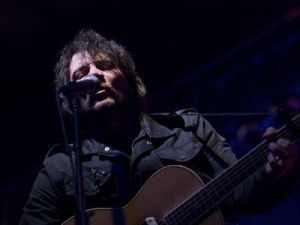
(below: Jeff Tweedy at Crossroads, Oct. 6, 2009.)

tweedy

Johnny Cash – “Flesh and Blood”

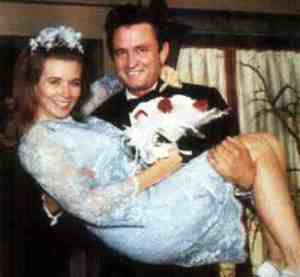
june_carter_johnny_cash-wedding
Johnny Cash – “Flesh and Blood,” Pop #54, Country #1

By Joel Francis

Johnny and June had only been married for three years when Cash penned this love song for his wife. In that time, Cash had rejuvenated his career with two hugely successful live albums recorded in prisons and earned his own weekly television show.

Although these endeavors burnished under the name “Johnny Cash,” June Carter was no less responsible for their success. With a smoldering strength, she challenged and sustained as her man finally kicked the drug addiction that had plagued him for the better part of a decade and proudly supported him through his rejuvenation – personally, artistically, commercially and otherwise.

The list of adjectives used to describe the Man in Black is a million miles long, but “devoted” has to rank near the top. In “Flesh and Blood,” Cash celebrates his love for his wife and slips in some sideways admiration for his savior.

Bolstered by his omnipresent boom-chicka rhythm section, Cash rhapsodizes about afternoons spent outdoors and nature’s beauty. The majesty of Mother Nature is a feast for the mind and spirit, Cash sings, but “flesh and blood needs flesh and blood, and you’re the one I need.”

Cash grows philosophical on the bridge, for as great as the day had been, he knew it was all temporary. “Love is all that will remain,” Cash intones. In the New Testament, Jesus talks of three types of love: agape, eros and philia. For most of the song, Cash has been singing about eros, or romantic love. But in the bridge, he shifts to singing about agape, or godly love, and philia, love between friends. Eros will fade, he implies, but agape and philia will sustain. This clever turn not only subtly sows a bit of gospel, but universalizes Cash’s eros love for his wife into the broader forms, expanding the palate to a love everyone can understand.

In the 1969 documentary “The Man, His World, His Music,” there is a scene of Cash rehearsing the song at home for his wife. The song was sweetened with strings in the studio, but its soul was intact there on the sofa as Cash found a way to say what every woman wants to hear: All this other stuff is nice, but as long as I’ve got you, I’ll forever be happy.

Bobby Taylor – “Does Your Mama Know About Me”

mama know
Bobby Taylor – “Does Your Mama Know About Me,” Pop # 29, R&B # 5

By Joel Francis

North Carolina native Bobby Taylor was working with a trio of Canadian musicians performing Motown numbers in Vancouver when the group caught the attention of Supremes Mary Wilson and Florence Ballard. The pair excitedly contacted Berry Gordy after hearing Bobby Taylor and the Shades in concert, and Gordy signed the group to his Gordy Records subsidiary.

Unfortunately, the excitement over Taylor’s stage shows failed to translate over records to a wider audience, and the group broke up in 1969 after one album and a handful of lukewarm singles. “Does Your Mama Know About Me” was the group’s biggest hit, peaking at No. 29 on the Pop chart.

Although Taylor’s Motown footprint is shallow, he had a hand in scouting and nurturing several well-known performers. While he was never a member of the Shades – later rechristened the Vancouvers by Gordy – Taylor recalled that Seattle guitarist Jimi Hendrix played with the group on several occasions. Shades drummer Floyd Sneed went on to join Three Dog Night. After booking a local band to open for them in Chicago, Taylor recommended Gordy sign the Jackson 5. He went on to produce the majority of the band’s debut album.

The Vancouver to go onto greatest acclaim, though, was the band’s guitarist. The half-Chinese, Scots-Irish born Thomas Chong co-wrote “Does Your Mama Know About Me” and performed on two more Vancouvers singles before being fired for missing a gig – he was applying for a green card – and becoming a superstar as half of the comedy duo Cheech and Chong.

With its sweeping strings and lush orchestration, “Does Your Mama Know About Me” feels more like a Philly soul number than a Motown production. This type of arrangement was used to great effect by Kenny Gamble and Leon Huff on early ‘70s soul hits like “Me and Mrs. Jones” and “If You Don’t Know Me By Now.” Although Gamble and Huff developed their sound independently – though they were no doubt keeping an ear trained on Motown – “Mama” illustrates how Motown continued to be at the vanguard of soul music beyond the departure of Holland-Dozier-Holland and its production-line sound.

A forgotten footnote, the only noteworthy cover of “Does Your Mama Know About Me” was performed by Diana Ross and the Supremes and included on their 1968 album “Love Child.”

Rita Wright – “I Can’t Give Back the Love I Feel For You”

syreeta
Rita Wright – “I Can’t Give Back the Love I Feel For You,” did not chart

By Joel Francis

Rita Wright is best known by her 1970s stage name, Syreeta. Before she collaborated with – and briefly married – Stevie Wonder, and scored a handful of Adult Contemporary hits with Billy Preston, Wright was a Pittsburgh transplant working as a secretary for Motown. Wright managed to catch the ear of Brian Holland, who signed her to the label. Holland collaborated with Ashford and Simpson – the songwriting team ironically brought in to replace the defected Holland, his brother Brian and their partner Lamont Dozier – on her 1968 debut, “I Can’t Give Back the Love I Feel For You.”

The song opens with a jarringly dissonant horn line before settling upon Wright’s soft voice. Although her performance is strong, the arrangement betrays the track’s origin as an abandoned Diana Ross and the Supremes cut. Although Ross eventually cut the song as a solo track for her 1971 album “Surrender,” Wright’s version could easily be confused for a lost Supremes track.

Although “I Can’t Give Back” didn’t chart, Wright had a successful recording career. She co-wrote “Signed, Sealed, Delivered” with Wonder and the Spinners’ hit “It’s A Shame.” Her first two LPs, 1972’s “Syreeta” and 1974’s “Stevie Wonder Presents: Syreeta” are hidden soul gems.

Ross’ version of “I Can’t Give Back” came in the middle of a sort of renaissance for the number. Dusty Springfield covered it in 1970 during the sessions to her follow up to “Dusty In Memphis,” the Philly soul masterpiece “A Brand New Me.” The final lineup of the Jeff Beck Group, featuring vocalist Bobby Tench, put their stamp on the song in 1972.