10 Must-see bands at Kanrocksas (part 1 – Friday)

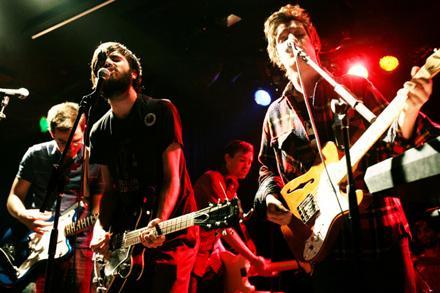
(Above: The Lawrence band Fourth of July make breakups sound like fun on “Friend of a Friend.”)

By Joel Francis
The Daily Record

The big names at the top of the bill will draw the most fans, but sometimes the best performances are from lesser-known acts early in the day. In the week leading up to the inaugural Kanrocksas music festival we’ll examine 10 overlooked acts. Below are five acts from Friday’s lineup. On Thursday we examine Saturday’s bands.

FRIDAY

The Joy Formidable (Ad Astra stage, 2:50 – 3:30 p.m.)

The Joy Formidable have toured with the Editors and Passion Pit and turned to Muse and Glasvegas’ producer to help behind the boards for their studio debut. Singer Ritzy Bryan has a touch of Bjork in her delivery and the arrangements hint at what could happen if Jesus and Mary Chain were a pop band.

Fitz and the Tantrums (Main Stage, 2:50 – 3:30 p.m.)

This Los Angeles-buzz band play opposite the Joy Formidable, which is fitting because their music is at the other end of the spectrum as well. Working without a guitar, the group splits the difference between the Dap-tone sound and Maroon 5.

Fourth of July (Ink Unplugged stage, 6:15 6:45 p.m.)

This Lawrence quintet, comprised of two sets of siblings, combined the heartache and pain of “Blood on the Tracks”-era Bob Dylan with the relentlessly upbeat jangle of Camper Van Beethoven. A longtime mainstay of the Lawrence/KC music scene, their work deserves a wider audience.

Kid Cudi (Main Stage, 6:10 – 7 p.m.)

After bringing only a DJ to his Kansas City debut at the Midland theater last year, Kid Cudi has decided to bring a live band on the road with him this time out. Cudi’s studio work places the minimalist introspection of Kanye West’s “808s and Heartbreaks” in more lush, accessible surroundings. It should be interesting to watch Cudi try to translate his headphone music to a festival setting.

Major Lazer (Critical Mass tent, 8:15 – 9:05 p.m.)

DJs Diplo and Switch are best know for helping create the pastiche behind M.I.A.’s three albums. On their own the pair – who met through working with M.I.A. – create some swampy, dubbed-out dancehall reggae. Put Shaggy in a blender with the Bomb Squad, add George Clinton’s showmanship and you’re close.

Keep reading:

10 Must-see bands at Kanrocksas (part 2 – Saturday)

Wakarusa Music Festival: A Look Back

Claypool hits the jackpot on casino debut

(Below: A bonus video from Major Lazer.)


Review: Snoop Dogg with Hearts of Darkness

 (Above: Hearts of Darkness are one of the biggest bands in Kansas City and a tough act to follow.)

By Joel Francis
The Daily Record

As a live entertainment, hip hop has a bad rap (sorry). The genre’s main criticism – no one’s actually playing instruments – becomes especially acute onstage. While great MCs can deliver a stirring performance backed only by a DJ, the two-turntables-and-a-microphone set-up is the hip hop equivalent of going unplugged. The safety nets are removed and the MC’s skills (or lack thereof) are on full display.

Although he has brought a live band the past several times he’s come to Kansas City, Snoop Dogg decided to forgo live instrumentation for his performance Tuesday night at Crossroads KC. Backed by a DJ, trio of dancers, two hype men and three gentlemen whose job it seemed was to hang out onstage, Snoop delivered lethargic readings of his most celebrated hits.

Ironically, Snoop undermined his set by making fans wait more than an hour by listening to a playlist from his catalog. The rap stars belated appearance seemed almost superfluous in context. After listening to pre-recorded versions of his music for so long, having authentic vocals over more pre-recorded tracks didn’t seem that special anymore.

Stage problems also hampered the evening. During the first song, “I Wanna Rock,” the lighting rig gradually started lowering in front of the stage. Unfazed, Snoop and his ensemble continued to perform, nearly obscured. When it happened a second time, however, Snoop stopped the show and addressed the stage manager.

“Why does this (stuff) always happen when Snoop Dogg come on?” he asked.

A spate of hits, including “P.I.M.P.” and “Gin and Juice” got the crowd dancing, but the performance seemed like high-spectacle karaoke or an infomercial with a great chorus. With his DJ doing nothing more than cuing backing tracks and shouting over the songs, Snoop would have been better served dumping the entourage and hiring a live rhythm section to breathe some life into the numbers. Although the crowd responded enthusiastically, the result was nothing that couldn’t be easily found at any of the city’s best hip hop dance clubs.

Opening act Hearts of Darkness didn’t do Snoop any favors. The 70-minute set by the local Afro-beat ensemble may have carried on too long for casual fans, but the interplay between the group’s large horn section and several percussionists kept the crowd dancing despite the withering heat. A cover of Outkast’s “Spottieottiedopaliscious” blended well with the 15-piece band’s original material.

A half hour into Snoop’s set – and more than three hours after Hearts of Darkness took the stage – I succumbed to the weather and the hour and headed for home. The decision may sniff of Old Man Syndrome, but it turned out to be the right call: Snoop himself called it a night less than 30 minutes later.

The high point of the Doggfather’s set was watching the teenagers outside the venue, dance and party on dumpsters across the street so they could see over the fence and watch the rap celebrity. The group was having so much fun they even got a shout-out from the stage. But it’s hard to feel shortchanged when you haven’t paid anything in the first place.

Keep reading:
Review: Snoop Dogg with Method Man and Redman
A Black Friday blowout
Review: Lupe Fiasco 

Review: Titus Andronicus

(Above: Titus Andronicus deliver “A More Perfect Union.”)

By Joel Francis
The Daily Record

It’s clear that Patrick Stickles is a smart guy. His band Titus Andronicus is named after one of Shakespeare’s more obscure plays and his lyrics are littered with sly allusions to American history and rock heroes like Bruce Springsteen and Bob Dylan.

Despite the pretentious song titles (check the setlist) and English-major critiques (“This next song is about the narrator’s quest for internal validation,“ Stickles announced at one point), many of the band’s songs deal with self-doubt, alienation, insecurity and other forms of social and emotional uncertainty that have served countless other bands so well for so long.TitusAndronicus

When Stickles led crowd in singing “you will always be a loser” or “the enemy is everywhere” it gave off similar vibe to when Weezer declared “In the garage/no one hears me sing this song or Morrissey and the Smiths wondered “In my life/why do I give time/to people who don’t care if I live or die?”

Bonded in isolation, a full but not crowded Riot Room crowd reveled in the indie punk band’s 90-minute set on Friday night. The quintet charged out of the gate with the driving “A More Perfect Union,” also opening track on their most recent, excellent album, “The Monitor.” Stickle doesn’t have a big singing range and his lyrics are so dense it’s often difficult to discern what he’s saying/screaming over the band, but he always keeps the sound churning.

The set stalled a couple times because of equipment problems, but those interruptions couldn’t stall the night. Top moments included the emotional tour de force “Battle of Hampton Roads,” which lead into the mostly instrumental “Titus Andronicus Forever.”

One of the few indie bands that can boast a trio of guitars, “Forever” found the middle ground between Boston and Sonic Youth. As guitarists Amy Klein and David Robbins wailed in harmony, Stickle and the rhythm section reveled in cacophony.

Klein was the night’s unsung hero. Her boundless energy infected the entire room. Most of the night it looked as if she was playing guitar on a trampoline. The only time she wasn’t bouncing around was when she switched to violin. Her lovely solo and arrangement on “Four Score” served as a nice counterpoint to Stickles’ grievances.

At times Stickle seemed to prattle on a bit much between numbers -– especially in the second half of the set –- but when the band kicked in the world was a perfect place, at least until the song ended.

Setlist: A More Perfect Union; Richard II; My Time Outside the Womb; New Song; Upon Viewing Brueghel’s ‘Landscape With the Fall of Icarus’; Fear and Loathing in Mahwah; No Future Part Three: Escape From No Future; Titus Andronicus; To Old Friends and New; Battle of Hampton Roads > Titus Andronicus Forever; Four Score and Seven.

Keep reading:

Review: Smashing Pumpkins, Cake

Review: T-Model Ford

Review: Modest Mouse (2010)

Review: Del tha Funkee Homosapien

(Above: Del tha Funkee Homosapien breaks down the basics of good hygiene.)

By Joel Francis
The Kansas City Star 

Many music fans causally attach the phrase “golden era” to a nostalgic entry point or a favorite genre style. But the music of Del the Funky Homosapien truly represents a lost period of hip hop, before rap was the CNN of the streets or a gangsta’s paradise.

A 20-year veteran, Del’s music eschews many of hip hop’s biggest clichés to focus on more light-hearted topics such as personal hygiene, the public transit system and friends who overstay their welcome.

As such, Del’s sold-out, one-hour set at the Riot Room on Saturday night was refreshingly devoid of social commentary or macho posturing. His humble mission to have fun and start a party was an energetic success.

Del threw his syncopated punch lines like a fighter, bouncing on his heels with each syllable as if sparring with his mic. His set included classics like “Mistadobalina” and “Dr. Bombay” from his 1991 debut album, but newer tracks like “Foot Down” and “Get It Right Now” show Del’s wit and delivery haven’t slowed down. The hilarious “If You Must” (sample lyric: “this fool’s breath, I mean so bad it’ll melt your ice cream”) was another memorable moment.

Backed by DJ Zac Hendrix and MC Bukue One – whose lengthy set together immediately preceded Del’s – the headliner at times seemed the smallest of the three personalities onstage. As Bukue handled the between-song banter, Del often briefly retreated to lean against a speaker at the back of the stage until it was time for the next song.

Despite allowing him to play the wallflower, Bukue and Hendrix were good foils for Del. Both performers kept the mood light and the crowd moving. At one point, both MCs exchanged freestyles as Hendrix changed up the beats after each turn. One of samples in Hendrix’ arsenal was a snippet of an Isley Brothers song employed by Del’s cousin Ice Cube on his hit “It Was a Good Day.”

After a short dance interlude and Bukue’s puzzling impersonation of Digital Underground’s Shock G during a cover of “Humpty Dance,” Del returned with two tracks that showed despite his comedic tendencies, he is a serious artist. A song from the acclaimed “Deltron 3030” project lead into “Clint Eastwood,” the Gorillaz’ single that featured Del and briefly elevated him out of the underground.

For Del, the golden age is now. It’s the title he bestowed on his new three-disc release and singing along to the familiar chorus about “sunshine in a bag” it’s not hard to agree.

Keep reading:

Review: “How to Rap”

Peter, Bjorn and John Heart Hip Hop

thePhantom – “Bohemian Seduction Grooves”

Review: R. Kelly

(Above: This sketch has aged better than R. Kelly’s music.)

By Joel Francis
The Kansas City Star 

Plenty of R&B singers are happy to work a couple into a hot lather, and then let them retreat to more intimate surroundings. R. Kelly would be first in line to stand in the doorway and watch.

For nearly 20 years, Kelly’s sexually outrageous songs have been a staple on urban radio. Although mainstream audiences know him best for the saccharine “I Believe I Can Fly,” Saturday’s Sprint Center crowd had no problem singing along to any of his dozens of Top 40 R&B hits.

Kelly’s most recent album is “Love Letter,” an album that found channels Burt Bacharach more than “Letters to Penthouse,” but he had no trouble mixing the upscale new material with the more explicit older tunes.

“They said I shouldn’t mix the classy songs with the sex songs,” Kelly told the crowd, “but sex is classy.”

The 90-minute concert was divided into three acts. While each act was distinct, they also felt unfinished. Kelly and his tight eight-piece band rapidly flitted from song to song, rarely lingering on one number long enough to see it all the way through.

The first part included slow jams such as “Number One Hit,” “Happy People” and a chopped and screwed version of “Thoia Thoing.” During “Strip for You” Kelly encouraged women to take off their clothes for him. A few stray T-shirts flew his way.

After a short video, Kelly re-emerged with some of his best club tracks, working the crowd into a frenzy with “Fiesta,” “I’m a Flirt” and “Ignition (remix).” Kelly let the crowd handle Kelly Price’s part on their duet “Friend of Mine,” which segued into the soul rant “Real Talk.” He returned to the sultry material with “When a Woman Loves” before inviting about three dozen women from the crowd onstage for “Step in the Name of Love.”

The upper level of the Sprint Center was curtained off, but the lower bowl was mostly full. More empty seats emerged the farther one got from the stage, but both the performer and the audience’s consistently high energy made the room seem packed.

Relentlessly shuffling through Kelly’s catalog in incomplete snippets was like spending time with a sex addict with attention deficit disorder. Instead of persistently tossing pebbles at the bedroom window, the jukebox approach was more like running around the house and ringing the doorbell, testing the patio door, rapping on the windows and pulling on the storm cellar door.

Keyshia Cole and Marsha Ambrosius performed 30-minute sets, but the experiences were night and day. Ambrosius, formerly part of the duo Floetry, has the better voice, but her set was poorly paced. A diversion into old school R&B hits masked her talents and wasted set time. Her performance was nearly salvaged by a reading of Floetry’s “Say Yes” and her own “Far Away.” Cole’s set was nonstop energy. The music paused long enough for Cole to call the ladies to their feet where many remained for the rest of her set, which included anthems like “I Should Have Cheated,” “Let It Go” and “Take Me Away.” Let’s hope Ambrosius was taking notes.

Keep reading:

Police On My Back: Five Musicians Convicted of Murder

Jamie Foxx Brings It on Saturday

Review: Raphael Saadiq

Review: Roger McGuinn

(Above: The voice of the Byrds, Roger McGuinn, transforms “Eight Miles High” and shows off his guitar chops with this stunning acoustic arrangement.)

By Joel Francis
The Kansas City Star

The stage was empty, but the sound was unmistakable. The shimmering jangle from the 12-string blonde Rickenbacker guitar rang clear throughout the Folly Theater as Roger McGuinn, voice and architect of the Byrds, strolled out casually from stage right. The chorus of the opening song, a cover of Bob Dylan’s “My Back Pages,” resonated throughout the night: “I was so much older then/I’m younger than that now.”

For the next 100 minutes, McGuinn treated the two-thirds full theater to a stroll through his back pages, or, more specifically the music that influenced the sound of the Byrds and his songwriting. It took McGuinn half a hour to work his way up to the rock and roll era. He explained a reworking of “Jesu, Joy of Man’s Desire” ended up as “She Don’t Care About Time,” a Byrds b-side, sang a sailor chanty, a spiritual and paid homage to Woody Guthrie and Lead Belly. He also used his own “Chestnut Mare” as an example of the cowboy songs from the old West.

These performances were interesting as a musical history lesson, but the show didn’t really take off until Elvis entered the building. Calling the transistor radio the iPod of its day, McGuinn explained how the portable radio freed him from having to listen to his parents’ music (and vice versa). The thrill of watching Presley inspired McGuinn to get his first guitar.

Now inspired, McGuinn told the audience about his lessons at the Old Town School of Folk Music in Chicago, where each week not only was a new song taught but several different styles of playing it. From there he took the crowd on a expedition through the Limeliters and Chad Mitchell Trio in Los Angeles into Bobby Darin’s band before landing at the Brill Building in New York City.

It was there McGuinn first heard the Beatles and recognized the folk-chord structures they used. Alone in his vision to marry folk with the British Invasion, McGuin fled the Greenwich Villagescene for the Troubador in Los Angeles where he met Missouri native Gene Clark and group that would become the Byrds were born.

Each adventure was illuminated by a musical representation of the time, from the Limeliter’s “There’s A Meeting Here Tonight” and Joan Baez’ “Silver Dagger” to “You Showed Me,” the first song McGuinn and Clark wrote together, which later became a Top 10 hit for the Turtles.

McGuinn performed most of the set seated on a piano bench at center stage. The only musician onstage, he was surrounded by four instruments, an acoustic and electric 12-string guitar, a 7-string guitar and a banjo. The open cases around him made McGuinn look like a posh busker.

The crowd relished every note and story. The room was often so quiet you could hear McGuinn’s pick hitting the strings. He frequently had to prod the audience to get involved, even singing the chorus on major songs like “You Ain’t Goin’ Nowhere,” another Dylan cover.

Although his tenor voice had lost some of its range, McGuinn’s singing was strong and his guitar playing was impressive. The best moment was a fascinating new arrangement of “Eight Miles High” that was more Ravi Shankar than Timothy Leary. Appropriately, the autobiographical journey ended with a relatively recent song, “May the Road Rise To Meet You.”

Set List: My Back Pages; She Don’t Care About Time; Leave Her Johnny, Leave Her (Time For Us To Leave Her); Old Blue; Chestnut Mare; Pretty Boy Floyd; Rock Island Line; Heartbreak Hotel (excerpt); Unknown Spiritual; There’s a Meetin’ Here Tonight; Silver Dagger; Gambler’s Blues (aka St. James Infirmary); The Water Is Wide; You Showed Me; Mr. Tambourine Man; You Ain’t Goin’ Nowhere; Mr. Spaceman; Dreamland; Up To Me; Eight Miles High; Turn, Turn, Turn. Encore: Feel A Whole Lot Better; Bells of Rhymney; May The Road Rise To Meet You.

Keep reading:

Review: Chris Hillman

CSNY – “Ohio”

Bob Dylan: All Along the Watchtower

Review: Big Head Todd and the Monsters

(Above: Big Head Todd and the Monsters burn down the house with the mellow, jangly “City on Fire.”)

By Joel Francis
The Kansas City Star 

Less than four months after swinging through town in their rootsy Big Head Blues Club guise, the Colorado quartet Big Head Todd and the Monsters delivered a full-on rock show Saturday night at Crossroads KC.

February’s show at the Midtown was a tribute to Robert Johnson, complete with guests like celebrated blues sidemen Hubert Sumlin and James Cotton. Although the most recent show didn’t have all of the former’s trappings and production, it still felt like an upbeat homage to the blues and the Monster’s influences.

The 100-minute set featured a couple Johnson numbers, both rearranged to the point that it’s doubtful that Johnson’s ghost would recognize them as his own. “Last Fair Deal Gone Down” rested on a loping bassline until the end. The band seemed to change its mind at the coda and switched to a more traditional arrangement that served them well.

The best numbers were the ones that traded the band’s effortlessly smooth sound for chutzpah. Frontman Todd Park Mohr showed surprising grit and gravitas tackling John Lee Hooker and Howlin’ Wolf. It is no coincidence that the show’s two highest moments pivoted on the readings of “Smokestack Lightnin’” and Hooker’s “Boogie Chillen” and “Boom Boom.”

Several numbers, such as “Sister Sweetly” and “Back to the Garden,” mined the electric organ and wah wah guitar sound of Parliament/Funkadelic. “Neckbreaker” combined the lyrical style of Jimi Hendrix with the chaotic bridge from “Whole Lotta Love.”

Other surprising facets of the band’s sound included John Mellencamp on “Dinner with Ivan” and Bob Dylan and the Band on the excellent “City on Fire” and “Rocksteady,” which used the same chord progression as “All Along the Watchtower.” Keyboard player Jeremy Lawton frequently channeled Steve Winwood or Ray Manzarek. His beefy parts helped the lofty choruses soar even higher.

The Monsters work hard, but their sound is so polished that even when Mohr is powering through a solo the overall performance still sounds laid-back. It’s hard to be offended by the band’s understated pop melodies, but it’s also hard to get too excited about them. Ergo, the lawn at Crossroads was barely a third full, at best. Everyone there was either a die-hard fan, or didn’t have anything better to do.

By the time the house lights briefly came on before the encore, it seemed everyone who wasn’t a big-time fan had long moseyed to the exit. Those who remained, however, were treated to two of the band’s biggest and best numbers, “Broken Hearted Savior” and “Circle.”

Setlist: All the Love You Need; Sister Sweetly; Come On In My Kitchen; Dinner With Ivan; Bittersweet; Last Fair Deal Gone Down; Neckbreaker; Smokestack Lightnin’; Cashbox; Helpless; City On Fire; Back to the Garden; Under A Silvery Moon; Dirty Juice; Conquistador; Boogie Chillen/Boom Boom; It’s Alright; Rocksteady. Encore: Broken-Hearted Savior;  Circle.

Keep reading:

Review: Big Head Blues Club

Review: Jack Johnson

Review: Pete Yorn, Ben Kweller

Cake: John McCrea sees a future without music

(Above: Cake’s newest video is called “Sick of You.” They definitely seem tired of the lifestyle.)

By Joel Francis
The Kansas City Star 

It won’t be hard to spot John McCrea on Friday night. The lead singer and chief songwriter for the alt-rock band Cake will hold center stage in a night of music in the City Market.

Seeing him in the future, however, may be more problematic.

Concerned with the direction of the music industry and unwilling to make a living by touring alone, McCrea is seriously considering a second career as a farmer.

“When I look five to 10 years in the future, I don’t see myself able to afford to make a living as a musician,” McCrea said. “We just spent 2½ years on an album, which is a significant investment. I’m not willing to do that again if people are just going to take it against our will, play it a few times then move on to the next thing to consume.”

Although celebrity musicians will always exist, McCrea said, midlevel, working-class bands like Cake may cease to be if there’s not reciprocity between fans and artists.

“Touring is a grueling thing to do, and if that’s a musician’s only source of income it means they can never come home,” he continued. “I have a family. I hate touring, and if there’s no other option I’ll get out.”

Fans can rest easy for now, however.

When Cake’s sixth album, “Showroom of Compassion,” debuted at No. 1 last January, much was made about the fact that it had sold fewer copies than any previous chart-topper.

What people missed, McCrea said, was that it sold roughly the same number of copies in its first week as Cake’s previous release, “Pressure Chief.”

This consistency is even more remarkable considering seven years had passed between those albums, years marked by turmoil in the record industry.

“We watched everyone stop paying for music during those years (between albums),” McCrea said. “The joke in the studio was that by the time we were finished nobody would be buying music anymore.”

Cake had a solid run of Top 40 hits in the 1990s, including “The Distance,” a cover of “I Will Survive,” “Sheep Go to Heaven” and “Short Skirt/Long Jacket.” Vince DiFiore’s trumpet and McCrea’s sardonic spoken/sung lyrics became the band’s calling card. Radio airplay combined with constant touring earned the band a cult following.

“So far I’m happy with what’s happened with this album,” McCrea said. “It tells me we have a relationship with our fans, and they trust us to go out on a limb and buy something without hearing it.

“I know when I was a kid I didn’t have that much money, and sometimes you’d buy an album and there’d only be one good song on it. I learned to be careful, but at the same time I learned that other artists always seemed to put out good records and knew I could trust them. We try very hard not to waste our fans’ time or money.”

The California-based quintet still toured during their recording hiatus — they stopped in Kansas City several times — but for the main part the group’s focus was on extricating themselves from their contract with Columbia Records and setting up their own shop.

“I don’t think a major label is a good place for a band like us,” McCrea said. “Since music is now free, the industry needs to economize and go out to dinner less. We didn’t want to have to pay for all the waste at a label.”

After testing the waters with a 2005 rarities and B-sides collection, Cake decided to self-release “Showroom of Compassion.” Liberation and success instilled a newfound sense of confidence, and for the first time in a while all of the band’s members were excited to contribute.

“Democracy is a slow process,” McCrea said. “There were a lot of disagreements, but we found our way through. Unlike past albums, everyone is completely happy with how this one turned out.”

A band at a crossroads, Cake is considering setting up an annual summer event similar to Wilco’s Solid Sound Festival or Cracker’s campouts. Cake tested the concept several years ago with its own multi-artist Unlimited Sunshine Tour, but the idea of staying in one place appeals to McCrea.

“I guess by definition fewer people would be able to see it,” McCrea said, “but I travel enough as it is.”

Keep reading:

Review: Cake

Cracker: The Grateful Dead of indie rock

Review: Smashing Pumpkins, Cake

Review: Jamey Johnson

(Above:  The song is called “Playing the Part,” but Jamey Johnson is definitely his own man.)

By Joel Francis
The Kansas City Star 

Jamey Johnson stood onstage at Crossroads in a black t-shirt and blue jeans. The wind that pushed temperatures to the mid-century mark on Saturday night frequently floated the long follicles of his hair and beard. Subtract the acoustic guitar and add some tattoos and Johnson could have easily been mistaken for one of the performers at Rockfest, occurring simultaneously just a few blocks away.

Call him the last Highwayman or forgotten outlaw, Johnson’s music is wedged in a narrow crevasse in today’s country landscape, too traditional for the alt. country/no alternative scene and rarely sweet and polished enough for the new/young country machine. (Johnson has tasted mainstream success in co-writing Trace Adkin’s “Honky Tonk Badonkadonk,” George Straight’s No. 1 hit “Give It Away” and his own “In Color.” He performed the latter two to great response, letting the audience take over on the chorus.)

Johnson basks in the music of his idols, both stylistically and aesthetically. Littered with signatures, his blonde acoustic guitar is clearly a tribute-in-progress to Willie Nelson’s famous six-string Trigger. Johnson’s 24-song was an immaculate honky tonk playlist, seamlessly crisscrossing between original material, Nelson, Merle Haggard, Waylon Jennings, Don Wilson, Hank Williams – both father and son – George Jones and Ray Price.

The one-third-capacity crowd oscillated in their responses throughout the 100-minute set. They were either completely invested, whooping and hollering and singing along with every word as on “Get Straight,” “In Color” and several of the better-known covers, or completely disinterested and conversing over the performance. Perhaps the consistently low-key, understated arrangements wore thin, but given their overwhelming responses at times it’s hard to believe this crowd didn’t know exactly what they were getting beforehand.

High points included a steamrolling “That Lonesome Song” that gained energy from the interplay between the pedal steel and electric guitarists. During a spirited reading of “Tulsa Time,” Johnson gave each of his six band members time in the spotlight as they passed solos across the stage. “By the Seat of Your Pants” opened with an a cappella verse capped with a rare Johnson solo on his acoustic guitar.

After slowing the set to a crawl with the romantic “Amanda” and remorseful “Walkin’,” the night ended with the crowd-pleasing “In Color” and jubilant “I Saw the Light,” the most energetic number of the night. A few more moments like this would have kept the crowd in hand more consistently.

When the houselights came up few could believe it was over. There was no encore and Johnson had barely acknowledged the crowd beyond working our town into his lyrics a couple of times. It was clear as he left, however, that Johnson was satisfied he’d made his mark.

Setlist: High Cost of Living; Lonely at the Top; Cover Your Eyes; Night Life (Willie Nelson cover); Country State of Mind (Hank Williams Jr. cover); Can’t Cash My Checks; The Door Is Open (Waylon Jennings cover); Playin’ the Part; Mary Go Round; Tulsa Time (Don Williams cover); I Remember You; That’s the Way Love Goes (Merle Haggard cover); That Lonesome Song; For the Good Times (Kris Kristofferson/Ray Price cover); unknown slow blues cover; Still Doing Time (George Jones cover); Misery and Gin (Merle Haggard cover); By the Seat of Your Pants; Give it Away; Set ‘Em Up, Joe; Amanda (Don Williams cover); Walkin’ (Willie Nelson cover); In Color; I Saw the Light (Hank Williams cover).

Keep reading

Meet the New Boss: Pat Green

“Willie Nelson: An Epic Life” by Joe Nick Patoski

Rock Hall commemorates 35 years of Austin City Limits

Review: Social Distortion

(Above: Social Distortion frontman Mike Ness says he’s performed “Story of My Life” so many times it belongs to the fans more than him – but it never gets old to hear.)

By Joel Francis
The Kansas City Star 

Bathed in a white spotlight, Social Distortion front man Mike Ness generated a wall of distorted chords with his Les Paul guitar before belting out the lonesome words to “Making Believe,” a song first recorded more than 50 years ago. Ness was joined by the rest of the band on the second verse, adding a punch Kitty Wells and Emmylou Harris probably never imagined when they recorded their hit versions of the song. Before the chorus came around again the classic country number had been converted to a punk anthem.

For many of the songs in Social D’s 90-minute set Tuesday night the Beaumont Club the reverse was also true. It isn’t hard to imagine songs like “Bad Luck,” “Bakersfield,” and especially “Prison Bound” as traditional country fare cast in only a slightly different light.

Social Distortion’s presentation recalls Black Flag – full of furious energy and tattoos – but its content – songs of the downtrodden and desolate searching for redemption – could have come from the Acuff-Rose catalog.

The Orange County quartet have been smearing the line between country and punk for more than 30 years now, long before the alt-country era of Uncle Tupelo or even cowpunk contemporaries Jason and the Scorchers.

The sidemen sometimes change, but Ness and company roll into town regularly enough that the singer/ lead guitarist knew where State Line divides the town and that he was firmly planted on the Missouri side. The current lineup includes drummer David Hidalgo Jr., son of the Los Lobos singer and guitarist.

Although the band released its first album in seven years in January, most of the night was dedicated to fan favorites and fevered sing-alongs. “Bad Luck,” “Sick Boys” and “Ball and Chain” drew especially hearty responses. On the rare occasion when the fans didn’t know the words, as on the new song “Gimme the Sweet and Lowdown,” they participated by crowd surfing and jumping around.

Hard-driving instrumental “Road Zombie” took off like a brick dropped on the accelerator. The band barreled through half of their main setlist in about 30 minutes, before Ness paused to talk and slow things down.

Near the end of the first set, Ness introduced the fiddle player from  Chuck Regan’s band, who opened, and invited him to sit in with the band. Second guitarist Jonny Wickersham strapped on an acoustic guitar and an accordion player joined the ensemble for a pair of stripped-down songs. The resulting performances of “Down Here (With the Rest of Us)” and “Reach for the Sky” proved even unamplified Social D was still electric.

Ness is clearly proud of his band’s legacy. Before one number he stopped to chat with a young girl who named Social Distortion her favorite band. She wasn’t the only pre-adolescent fan in the crowd. As Ness said before “Story of My Life,” these songs have been around so long they’re not really about him anymore. They belong to everyone who grew up with the band or is just discovering his music. Shows like this will ensure that circle remains unbroken.

Setlist: Road Zombie > So Far Away; King of Fools; Bad Luck; Mommy’s Little Monster; Sick Boys; Machine Gun Blues; Ball and Chain; Down on the World Again; Bakersfield; Gimme the Sweet and Lowdown; Down Here (With the Rest of Us); Reach for the Sky; Making Believe (Jimmy Work cover). Encore: Prison Bound; Story of My Life; Ring of Fire (Johnny Cash cover).

Keep reading:

Review: Old 97s, Lucero

Review: Son Volt with the North Mississippi All-Stars and Split Lip Rayfield

Happy Clash-mas Eve