Review: Carbon/Silicon at the Record Bar

Above: Carbon/Silicon deliver “The News.”

By Joel Francis

Like a lot of bands who play The Record Bar, Carbon/Silicon is trying to promote their first album and make a name. But as the latecomers who were turned away at the door learned, few of those bands have a greater legacy than Mick Jones and Terry James.
The former Clash and Gen-X axemen dashed onstage through a side door, ripped through ten songs from their debut album in about an hour, then hurriedly left, leaving the sold-out throng to revel in what they’d witnessed.

Jones may be a more than a few years removed from his commercial heyday, but he still has plenty of magic left to deliver. He is a bit leaner and more articulate these days, but can still craft a great melody and rip a sizzling solo.

While few in the crowd seemed familiar with the new material, it’s unlikely that anyone left without the catchy chorus of “The News” – “Good morning it’s the news/and all of it is good” – stuck in their head. The chords in “WTF” slashed in a similar progression to “Clash City Rockers” and tore with just as much fury.

James trotted out a left-field cover of “Reason to Believe” for his turn at the mic. A punk cover of a Rod Stewart hit shouldn’t have worked, and nearly didn’t, but the band’s enthusiasm for the tune kept the wheels from falling off.

After cracking several jokes about the empty Conestoga wagon in the southeast corner of the parking lot, Jones prefaced “Really the Blues” with an apology: “When we found out we were playing Kansas City, we knew we had to play the blues. This is our attempt.”

Jones and James have been leading Carbon/Silicon – named for the combination of organic (guitars) and synthetic (computers) used in their songwriting process – for six years now, nearly as long as Jones and Joe Strummer were partners in the Clash. Saturday night’s only nod to their former bands, though, was a tease of “Police On My Back” during the band introductions in the final number.

That was more than enough for the dedicated, though, who christened every guitar solo with a hearty yell and kept the Record Bar illuminated with constant camera flashes and cell phone captures.

The duo were backed by Big Audio Dynamite alum Leo Williams on bass and drummer Domonic Greensmith.

Setlist: The Magic Suitcase/I Loved You/War on Culture/Reason to Believe/Soylent Green/Acton Zulus/The News/Really the Blues/WTF/Why Do Men Fight?
Eddie Holland – “Jamie”

index-hdh1.jpg

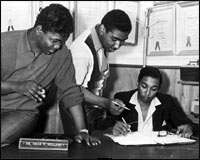
Eddie Holland – “Jamie,” Pop #30, R&B #6

Like Barrett Strong, who co-wrote this song, Eddie Holland was more comfortable composing than performing. He only had two hits in front of the mic, but teamed with Lamont Dozier and brother Brian Holland to pen a staggering 25 No. 1 pop hits in six years. You could call Holland-Dozier-Holland the Neptunes of their time, but the reverse is probably more accurate.

“Jamie” was a big enough hit that Motown built an self-titled album around it and dropped it in stores in late 1962. The album didn’t sell well, but Holland continued to turn out singles for the next couple years. None of them replicated enough of “Jamie”‘s chart success to warrant release of a second album. Today, all of Holland’s Motown solo material has been rounded up on the “Complete Eddie Holland” import collection. — by Joel Francis

The Marvelettes – “Please Mr. Postman”

marvelettes-please-mr-postman1.jpg

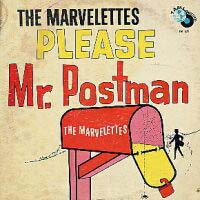
The Marvelettes – “Please Mr. Postman” Pop #1, R&B #1

It took six songwriters, but Motown finally, swept the top of the charts with this song. The Marvelettes were a group of high school who entered a 1961 school talent contest for the chance to audition for Motown. While this original performance is certainly memorable, the group definitely isn’t, which is probably why both the Beatles and the Carpenters were successful with their covers.

For the Beatles, the song was a tribute to American Motown music free of specific artistic association (it wasn’t “The Beatles doing Smokey,” like their cover of “You Really Got A Hold On Me”). For the Carpenters, it was a chance to revisit the schoolgirl longing and nostalgia the song represented. (By the way, this entry contains way more than I ever thought I’d write on the Carpenters. Let us promise never to speak of them again.) — by Joel Francis

Bruce is Bigger than Big 12 Tourney

314pkboss7.jpg

By Joel Francis

The Kansas City Star

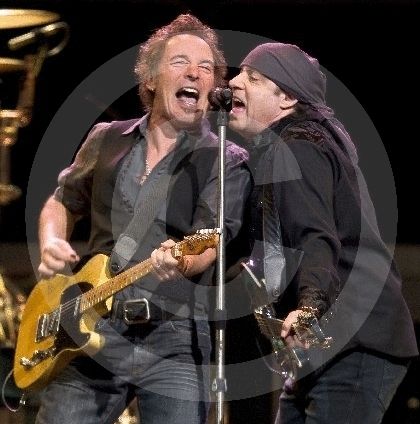
With the Big 12 tourney reigning in Kansas City, Bruce Springsteen and the E Street Band commandeered Omaha’s empty arena for nearly three hours of musical magic on Friday night.

Springsteen opened with “No Surrender” and kept his foot on the gas for the rest of the night. Although the band played three-quarters of last year’s album, “Magic,” they didn’t shy from their late-‘70s glory days. The new material meshed with the old well. In short, it all worked and it all kicked ass.

The ballads were just as affecting as the barnburners. Violinist Soozie Tyrell duetted with Springsteen for a beautiful reading of “Magic” accented by guitarist Nils Lofgren’s flamenco-like fills. Bass player Garry Tallent added a captivating countermelody to “The River,” which was haunted by Springsteen’s falsetto vocals. “Waitin’ On A Sunny Day” found the band armed with acoustic guitars and leading the audience in a campfire sing-along.

After a short sermon updated from his pro-John Kerry, “Vote For Change” tour, Springsteen dedicated “Living in a Future World” to his “Vote For Change” tourmate, local boy Conor Oberst. Oberst himself popped up nearly an hour later during the encore to lend his voice to “Thunder Road,” but was woefully unprepared to keep up with The Boss. Oberst nervously paced in circles around guitarist Little Steven Van Zandt, and flubbed most of his lines. Fortunately, everyone else in the arena had the lyrics down and picked up the slack.

There were several surprises tucked into the 25-song set, but none was bigger than “Jungleland.” Saxophonist Clarence Clemons looked shaky throughout the night – he frequently took breaks in a large easy chair positioned near the back of the stage – but he and pianist Roy Bittan delivered a riveting performance of arguably Springsteen’s greatest song. That was followed by a throwback romp through the “Detroit Medley” led by drummer Max Weinberg. Springsteen said they hadn’t performed this one in a while, and he proved his point by fumbling with some of the lyrics. Earlier in the night, the band reclaimed “Because the Night” from Patti Smith.

Two E-Street mainstays were M.I.A. Springsteen’s wife Patti Scialfa was at home tending to the family, and Danny Federici is receiving treatments for melanoma. His organ bench was ably filled by Seeger Sessions tour alum Charles Giordano.
For a man who named his sixth album after Omaha’s home state, Springsteen and the E Street Band haven’t been frequent visitors. Springsteen said this was their first visit in 30 years, and his only musical nod to “Nebraska” was a boogie version of “Reason to Believe” that sounded like it was arranged by John Lee Hooker and Canned Heat.

The house lights came up for “Thunder Road” and “Dancing in the Dark” before the night ended with “American Land,” a Irish-flavored original that brought St. Patrick’s Day a few days early.

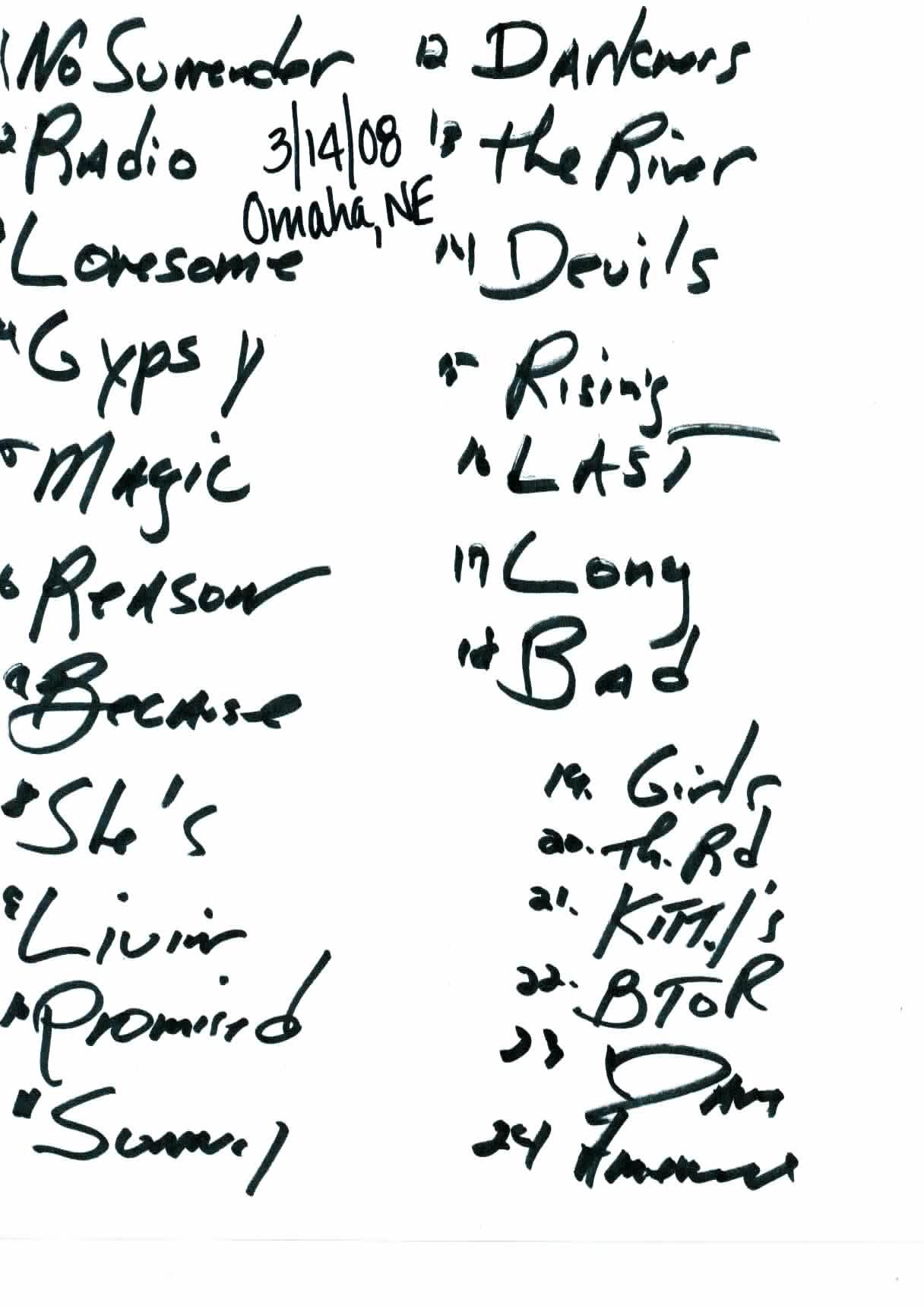
Setlist:
No Surrender/Radio Nowhere/Lonesome Day/Adam Raised A Cain/Gypsy Biker/Magic/Reason to Believe/Because the Night/She’s the One/Living in a Future World/Promised Land/Waitin’ On A Sunny Day/The River/Devil’s Arcade/The Rising/Last To Die/Long Walk Home/Badlands//ENCORE: Girls In Their Summer Clothes/Thunder Road (with Conor Oberst)/Jungleland/Detroit Medley/Born to Run/Dancing in the Dark/American Land

omaha-setlist.jpg

Keep Reading:

Review: “Big Man” by Clarence Clemons

Bruce Springsteen and Tom Morello – “The Ghost of Tom Joad”

Review: Springsteen’s “Dream” Needs More Work

Springsteen in the Waiting Room: Drop the Needle and Pray

Springsteen Rocks the Hall (part 1)

Springsteen Rocks the Hall (part 2)

More Bruce Springsteen on The Daily Record

Claypool hits the jackpot on casino debut

les-claypool.jpg

By Joel Francis
The Kansas City Star

A sold-out and animated crowd renewed Les Claypool’s faith Monday night at Harrah’s Voodoo Lounge.

“I’ve never played a casino before,” Claypool confessed to the crowd toward the end of his set. “I was thinking ‘What’s next, is Claypool going to be playing Branson?’”

Judging from their response, most of the crowd would have been more than happy to travel the three hours to see the bass-playing legend. Claypool’s done quite well following his eclectic muse for the past 20 years, and it saw him through this betting-hall debut.

For a shade over two hours Claypool led his quartet – drummer Paulo Baldi, Skerik on saxophone and sometime Malachy Papers collaborator Mike Dillon on percussion – through a bizarre but upbeat mélange of prog funk free jazz.

That looks like a head-scratcher on paper, but it works surprisingly well in concert. Each player has a well-defined role and knows how to walk the line between the experimental and excruciating. The result may not be for the uninitiated, but it is more accessible than imagined.

The quartet hit their stride with the third song, “David Makalaster.” The band stretched the song to nearly 10 minutes, with each instrument adding new textures and layers.

In a way, this was the template of the night. Claypool would narrate a couple verses of a song and then the group would explore every nook and cranny of what it had to offer. While this is the province of many a jam band – and no doubt there were many jam fans present – Claypool has enough variance in his catalog that the songs never felt  the same.

The credit for this goes to the drummers. Their propulsive interplay kept the group moving forward and made the explorations hypnotic, not repetitive. The light-speed synergy between the two percussionists, who were briefly joined by a third, unnamed guest, created the illusion of an invading drum corp. Drum solos are usually the time for a beer or bathroom run, but when Claypool ceded the stage to the percussion, it drew the biggest cheers of the night.

Claypool keep the songbook focused on his most recent efforts with the Frog Brigade and his 2006 solo album, “Of Whales and Woe.” Set closer “D’s Diner” flirted with hip-hop, and Claypool returned for an unaccompanied stroll through Primus’ “American Life.” When the full band returned for a Black Sabbath cover Claypool bypassed “N.I.B.,” which Primus covered several years ago, in favor of “Electric Funeral.”

Claypool has made a career of blending the disparate. He’s wise and faithful enough to know better than to pander to new fans, but he does know how to make the existing ones very happy. Even if it means playing a casino.

The Miracles – “Shop Around”

Shop Around

The Miracles – “Shop Around” Pop #2, R&B #1

Barry Gordy borrowed $800 from his family to launch the Tamla label. The first group Gordy signed to Tamla was The Matadors, who changed their name to The Miracles.

It’s impossible to underestimate how important main Miracle Smokey Robinson was to Barry Gordy’s success. He not only brought dozens of hit records to the charts with The Miracles, but wrote most of Mary Well’s early hits and “My Girl” for the Temptations. It is impossible to get to Hitsville U.S.A. without going through Robinson.

This song was Motown’s first No. 1 hit (on the R&B charts, at least), over 45 years ago. If you updated the production and handed this song to Mariah Carey under the altered title to “Sleep Around” it would probably be a hit again today. Not that this is necessarily a good thing. — by Joel Francis

Barrett Strong – “Money (That’s What I Want)”

Note: This post is the beginning of a new running feature on The Daily Record. In anticipation of the 50th anniversary of Motown, we’ll be walking through the “Motown: Hitsville U.S.A. (1959-1971)” box set track by track.


Money 45

Barrett Strong – “Money (That’s What I Want)”Pop #23, R&B #2


Barrett Strong may not have wanted to be a lead singer, but Motown founder Barry Gordy definitely wanted money. Strong’s sister went to school with Jackie Wilson, whom Gordy had written some songs for in the early ‘50s. Gordy’s song “Lonesome Teardrops” was a big hit for Wilson, but when Gordy realized the real money in the music game was producing and publishing, he started his own label.

Strong said he was never comfortable on the mic, but he was definitely in the zone with songwriting partner Norman Whitfield. The two would go on to pen several hits for The Temptations including “I Wish It Would Rain,” “Cloud Nine,” and “Just My Imagination” and Edwin Starr’s No. 1 anti-war hit “War.” All of these songs made Gordy some serious money. — by Joel Francis